Should You Keep Your Cat Indoors?
The New Risks Every Cat Owner Should Know
For generations, cats have wandered through gardens, climbed fences and disappeared on neighbourhood adventures before casually returning home as though nothing happened.
But attitudes towards outdoor cats are changing.
Veterinarians, animal welfare organisations and conservation groups increasingly encourage owners to consider keeping cats indoors or providing controlled outdoor access. Alongside familiar dangers such as cars, fights and disease, emerging concerns including avian influenza (bird flu) have given cat owners another reason to reconsider unrestricted roaming.
But is keeping a cat indoors actually better for them? And can a cat that loves exploring outside really be happy living indoors?
The answer isn’t simply about shutting the door. It’s about creating a lifestyle that gives your cat safety, stimulation, exercise and opportunities to express natural behaviour.
Should Cats Be Kept Indoors?
Keeping a cat indoors can protect them from many hazards they would otherwise encounter while roaming freely.
Outdoor cats may face:
- Road traffic.
- Fights with other cats.
- Dog attacks.
- Parasites.
- Infectious diseases.
- Poisoning or toxic substances.
- Becoming lost or trapped.
- Injuries that owners don’t immediately notice.
There is also the impact roaming cats can have on wildlife, particularly birds and small mammals.
What about cats and bird flu?
Highly Pathogenic Avian Influenza, particularly H5N1, has created another concern.
Cats can become infected with some strains of avian influenza, and contact with infected birds or contaminated raw animal products may present a risk.
This doesn’t mean every outdoor cat is in immediate danger, and the level of risk varies considerably by location and current outbreaks. However, it provides another reason for owners to monitor veterinary and government advice when bird flu is circulating.
Preventing cats from hunting or interacting with sick or dead birds can reduce potential exposure.
Indoor doesn’t have to mean imprisoned
One of the biggest objections owners have is understandable:
“My cat loves going outside.”
Keeping a cat safe doesn’t necessarily mean they can never experience fresh air again.
Controlled outdoor options include:
- Secure cat enclosures.
- Cat-proof fencing.
- Enclosed balconies.
- Supervised garden time.
- Harness and lead walking.
A well-designed catio can be particularly effective, allowing cats to experience sunshine, smells, breezes and outdoor activity without unrestricted roaming.
Are Indoor Cats Happier and Healthier?
An indoor lifestyle can remove many external dangers, but simply keeping a cat inside doesn’t automatically make them happy.
Cats still need to behave like cats.
That means climbing, scratching, hiding, exploring, observing, hunting and playing.
Create an interesting indoor world
A stimulating home might include:
- Tall cat trees.
- Window perches.
- Scratching posts.
- Interactive toys.
- Puzzle feeders.
- Cardboard boxes and hiding spaces.
- Elevated resting areas.
- Regular play sessions.
You don’t necessarily need a huge house.
Cats make excellent use of vertical space, so shelves, towers and elevated platforms can dramatically increase their usable territory.
Don’t forget their hunting instincts
Your beautifully fed house cat is still carrying the behavioural instincts of a predator.
Play can provide an outlet for those instincts.
Wand toys, moving toys and games that imitate stalking and chasing can allow your cat to practise the natural sequence of watching, stalking, chasing and catching.
Several short play sessions can be more engaging than simply leaving toys scattered around the house all day.
Let them watch the world
Sometimes entertainment can be remarkably simple.
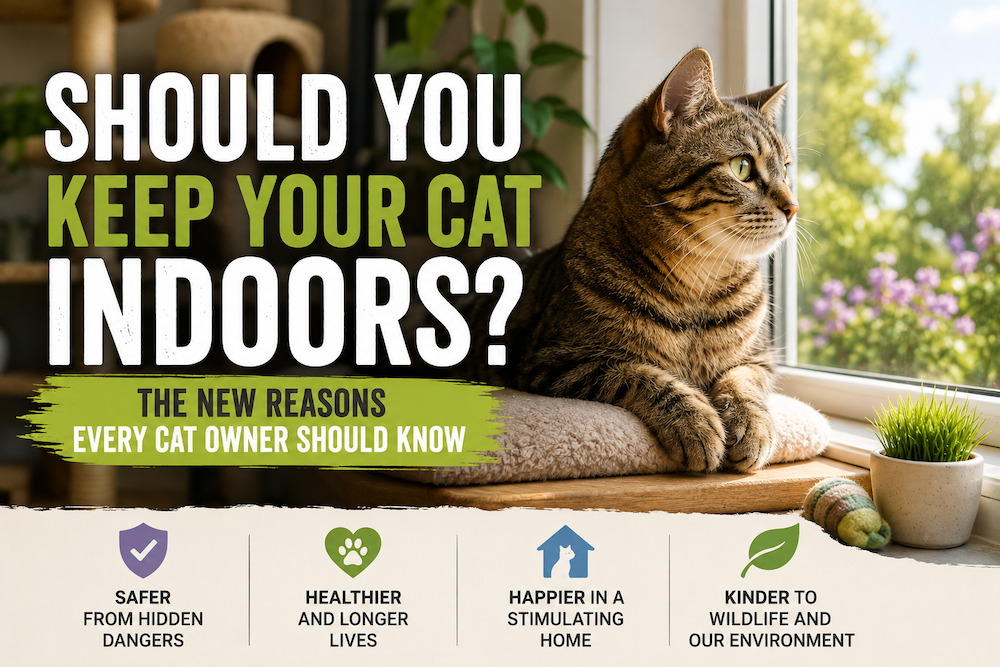
A secure window overlooking a garden can provide hours of stimulation.
Birds, insects, people, leaves and neighbourhood activity effectively become cat television.
A comfortable window perch can therefore be one of the easiest enrichment additions you make.
Watch their weight
Indoor cats may have fewer opportunities for spontaneous exercise than roaming cats.
That makes appropriate portion sizes, play and physical activity particularly important.
Obesity can contribute to serious health problems, so keeping an indoor cat safe should also mean keeping them active.
How Do You Turn an Outdoor Cat Into an Indoor Cat?
This is often the hardest part.
A cat accustomed to exploring outdoors may initially object strongly to suddenly finding the door closed.
You might experience:
- Meowing at doors.
- Scratching.
- Pacing.
- Attempts to escape.
- Increased attention-seeking.
- Frustration or restlessness.
That doesn’t necessarily mean the transition has failed.
Make indoors better before removing outdoors
Rather than simply taking something away, replace it with something worthwhile.
Before restricting outdoor access, introduce additional:
- Climbing areas.
- Interactive play.
- Puzzle feeding.
- Window access.
- Scratching surfaces.
- Comfortable hiding places.
Your objective is to make the indoor environment interesting enough that your cat has plenty to do.
Establish a routine
Cats often thrive on predictable routines.
Try scheduling meals and play sessions at roughly consistent times.
An energetic play session followed by food can be particularly satisfying because it loosely mirrors the natural pattern of hunt, catch, eat and rest.
Consider controlled outdoor access
For cats that genuinely enjoy being outside, the answer doesn’t have to be entirely indoors versus completely unrestricted freedom.
A secure catio or enclosed garden can provide a valuable middle ground.
Some cats can even learn to walk comfortably on a harness when introduced gradually and positively.
Be patient
A cat that has roamed freely for years may not transform into a contented house cat overnight.
Allow time for adjustment and pay attention to behaviour.
Persistent stress, inappropriate toileting, aggression, excessive grooming or major behavioural changes shouldn’t simply be dismissed as stubbornness. A veterinarian or qualified feline behaviour professional can help identify the underlying problem.
What Is the Best Choice for Your Cat?
There isn’t one living arrangement that perfectly suits every cat or every household.
But unrestricted outdoor roaming carries genuine risks—to the cat themselves and, in many environments, to wildlife.
For many families, the best compromise may be an enriched indoor lifestyle combined with safe, controlled outdoor experiences.
That might mean a sunny catio.
A secure garden.
A window overlooking the world.
Or simply an indoor environment filled with opportunities to climb, stalk, explore, play and relax.
Keeping a cat indoors shouldn’t be about taking their world away.
Done properly, it’s about building them a safer world that’s still worth exploring.