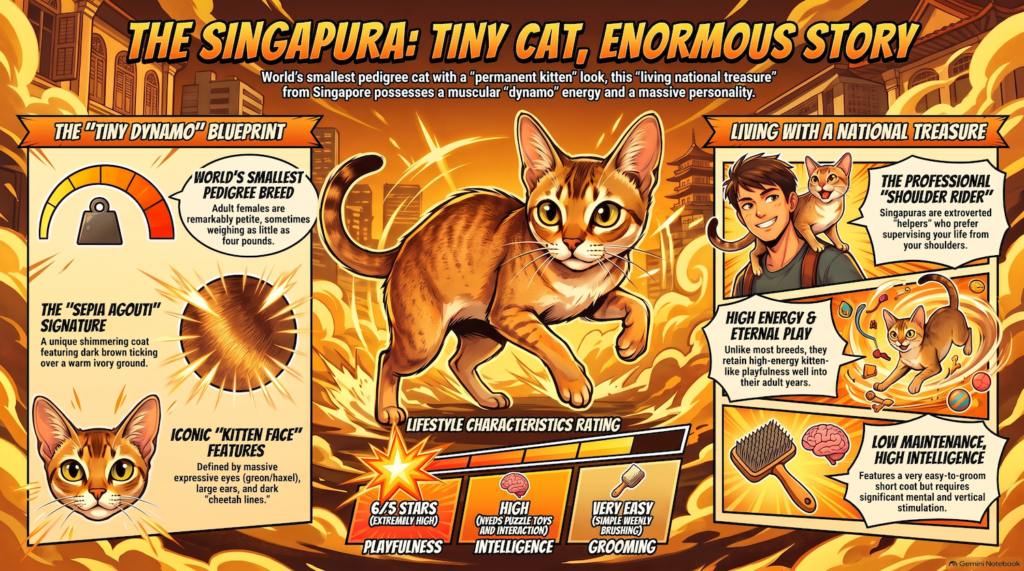
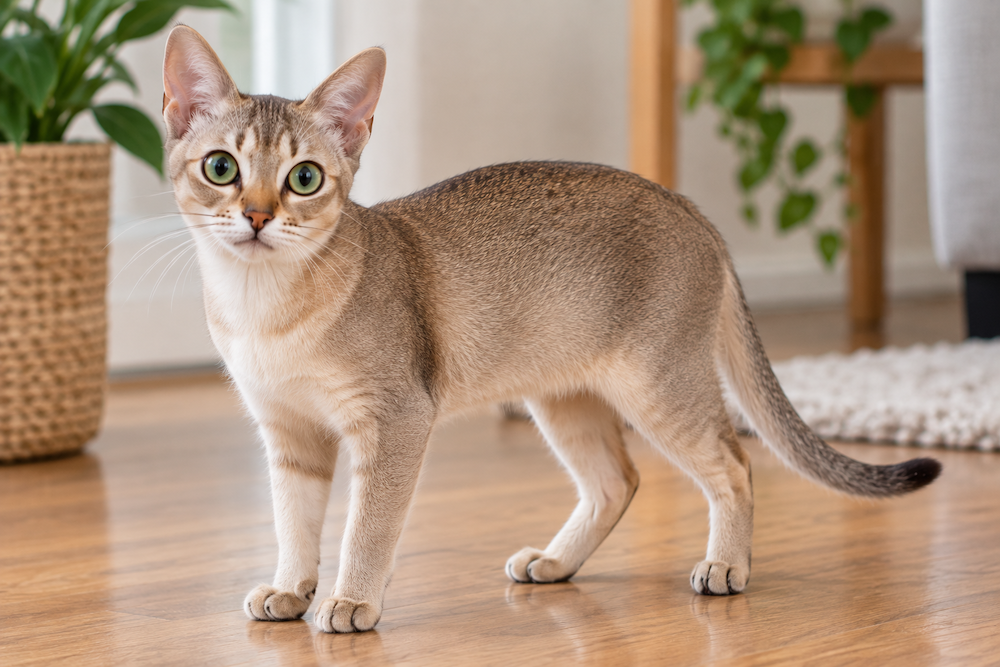






Tiny, enormous-eyed, and packed with personality — the Singapura is one of the smallest recognised cat breeds, famous for its warm sepia-ticked coat, oversized ears, mischievous curiosity, and a fascinating origin story linking Singapore with American breeders.
🧠 QUICK SNAPSHOT
- Temperament: Affectionate, curious, playful
- Energy Level: High
- Size: Very Small
- Good With Families: Excellent
- Indoor Living: Excellent
- Trainability: High
- Grooming: Low
- Best For: Families, apartment living, interactive households, owners wanting a small but highly involved companion
- Typical Lifespan: Around 11–15 years
📚 OVERVIEW
The Singapura may be tiny, but very little about its personality is small.
It is famous for being one of the smallest recognised pedigree cat breeds, with adult females often weighing around 1.8–2.7 kg (4–6 lb) and males commonly around 2.7–3.6 kg (6–8 lb), although individuals vary.
Its appearance is distinctive: enormous eyes, oversized ears, a compact but muscular body and a short coat with warm sepia agouti ticking.
The breed’s history is considerably more complicated.
The traditional story says American breeders Hal and Tommy Meadow brought small ticked cats from Singapore to the United States during the 1970s and established the breed from these Singaporean cats.
Later investigations raised questions about parts of that origin story, including whether some foundation cats had actually travelled from the United States to Singapore before returning.
This created a long-running debate about exactly how the modern breed originated.
Whatever the pedigree controversy, the Singapura became strongly associated with Singapore and was embraced there as a feline symbol.
Personality-wise, these cats are usually curious, affectionate and energetic.
The Singapura is a good demonstration of an important feline principle:
the size of the cat has absolutely no obligation to match the size of its personality.
✅ PROS & CONS
Pros
- One of the smallest recognised cat breeds
- Extremely affectionate and people-oriented
- Playful and entertaining
- Intelligent and trainable
- Excellent apartment cat
- Easy-care short coat
- Usually enjoys being involved in family life
- Distinctive large eyes and ears
Cons
- Can demand considerable attention
- High play and enrichment requirements
- May dislike very noisy or chaotic environments
- Small size means careful handling is important
- Pyruvate kinase deficiency occurs in the breed
- Some females can experience uterine inertia during birth
- Rare in many countries
- Not hypoallergenic
Is a Singapura a Good Family Cat?
Yes, the Singapura is generally an excellent family cat, particularly for households wanting an affectionate and interactive companion.
These cats tend to enjoy being close to their humans and frequently involve themselves in whatever is happening around the home.
Many live happily with respectful children and compatible pets.
Their tiny size does require consideration.
Young children should understand that a Singapura is a small living animal rather than a toy. Rough handling or accidental falls can cause injury.
Despite their size, Singapuras aren’t generally timid little ornaments. Many are playful, curious and surprisingly confident once comfortable in their environment.
They can form strong relationships with their families and may seek laps, shoulders or any other available position offering a good view of household activity.
A Singapura might be one of the smallest cats in the neighbourhood.
It is unlikely to consider that a reason for receiving any less attention.
Can a Singapura Live Indoors or in an Apartment?
Yes, the Singapura is extremely well suited to indoor and apartment living.
Its small physical size makes it easy to accommodate, but owners shouldn’t confuse small size with low activity.
These cats need vertical territory, scratching areas, interactive toys and opportunities to explore.
Tall cat trees and wall-mounted platforms are particularly useful because Singapuras often enjoy observing their surroundings from elevated positions.
A secure window perch can provide hours of visual stimulation.
They also tend to enjoy human companionship, so an apartment where someone regularly interacts with the cat can be far more satisfying than a huge but empty home.
Secure indoor living protects the Singapura from traffic, predators, infectious disease and other outdoor dangers.
A secure cat enclosure can provide additional stimulation where practical.
For this breed, you don’t necessarily need a large home.
You simply need to make every level of the home interesting.
How Much Exercise and Play Does a Singapura Need?
The Singapura has high play and enrichment requirements despite its tiny stature.
Daily interactive play should be part of its routine.
Fishing-wand toys, small balls, tunnels, climbing structures and chasing games can all encourage healthy movement.
Several shorter play sessions throughout the day generally work particularly well.
Singapuras are agile cats and often enjoy climbing to elevated positions.
Mental exercise is equally valuable.
Puzzle feeders, treat hunts and simple training games give an intelligent cat something constructive to investigate.
Maintaining a healthy body condition is important because even a relatively small amount of excess weight represents a significant proportion of such a tiny cat’s ideal body weight.
Don’t expect the Singapura to look at its diminutive proportions and decide to conserve energy.
Nobody appears to have told the breed that small cats are supposed to take up less space.
Is a Singapura Easy to Train?
Yes, Singapuras are generally intelligent, curious and highly capable of learning through positive reinforcement.
Treats, toys, praise and clicker training can be used to teach practical behaviours and entertaining tricks.
Many cats can learn to come when called, enter a carrier voluntarily, retrieve toys, use designated scratching areas and accept routine handling.
Harness training may also be possible for suitable individuals when introduced gradually.
The Singapura’s curiosity can make training particularly rewarding.
Unfortunately, curiosity also means the cat may conduct independent training sessions involving cupboards, shelves and objects you hadn’t intended to include in the curriculum.
Early positive exposure to nail trimming, dental checks, carrier travel and veterinary handling is particularly valuable.
A clever Singapura doesn’t need to be forced to learn.
The greater challenge may be convincing it that your lesson plan is more interesting than its own.
Does a Singapura Shed?
Yes, but the Singapura is generally a low-maintenance breed when it comes to coat care.
Its short, fine coat doesn’t normally require intensive grooming.
Weekly gentle brushing is usually sufficient to remove loose hairs and maintain the coat’s condition.
Some seasonal variation in shedding can occur.
Routine grooming also provides an opportunity to check the cat’s skin, body condition, ears and nails.
Dental care is important, as it is for all cats.
The Singapura is not hypoallergenic.
A short coat and relatively low level of visible shedding don’t eliminate feline allergens, which are largely associated with proteins produced in saliva and skin secretions.
The breed may leave considerably less fur around the house than some long-haired cats.
That doesn’t mean it has found a biological loophole around cat allergies.
What Health Problems Are Common in a Singapura?
The Singapura is generally a healthy breed, but there are several important inherited and reproductive health concerns prospective owners should understand.
One of the best documented is pyruvate kinase deficiency (PK deficiency).
Pyruvate kinase is an enzyme involved in red blood cell energy metabolism. Deficiency can cause red blood cells to break down prematurely, potentially resulting in haemolytic anaemia.
Fortunately, a DNA test is available, allowing responsible breeders to identify carriers and manage breeding accordingly.
Another reported concern is uterine inertia, in which a female cat’s uterus doesn’t contract effectively enough during labour. This can result in difficult births and may require veterinary intervention or caesarean delivery.
Like all cats, Singapuras can also develop dental disease, kidney problems, heart disease and other common feline conditions.
The breed’s historically small foundation population makes careful pedigree management and genetic diversity particularly important.
Prospective owners should ask breeders specifically about PK deficiency testing and the health history of their breeding lines.
⭐ Is the Singapura Really the World’s Smallest Cat Breed?
The Singapura is widely described as one of the world’s smallest recognised domestic cat breeds, and adult cats can indeed be remarkably petite.
Females can weigh only around 1.8–2.7 kg, while males are generally somewhat larger.
But “smallest cat breed in the world” should be treated as a general breed description rather than an absolute record applying to every individual.
Cats vary.
A particularly small individual from another breed could weigh less than a large Singapura.
What makes the Singapura remarkable is that small adult size is a consistent characteristic of the breed.
They aren’t simply tiny because they’re delicate, either.
A healthy Singapura should have a surprisingly muscular, substantial body beneath its fine coat.
Pick one up and you may discover there’s more cat packed into that little frame than expected.
⭐ Does the Singapura Really Come From Singapore?
This seemingly simple question has a surprisingly complicated answer.
The breed is certainly named after Singapore and historically associated with cats said to have originated there.
The traditional story says Hal and Tommy Meadow encountered small brown-ticked cats in Singapore and brought foundation animals to the United States during the 1970s.
Later scrutiny of import records and breeding history created questions about whether some cats had actually been taken from America to Singapore before being brought back.
This led to speculation that the breed may have involved cats related to established Burmese and Abyssinian lines rather than representing an untouched Singaporean street-cat population.
The precise history has consequently generated considerable debate.
So while Singapore is inseparable from the breed’s identity, the origins of the modern pedigree Singapura are more complicated than the original romantic story suggested.
⭐ What Does “Singapura” Mean?
Singapura is the Malay name for Singapore.
The name ultimately derives from Sanskrit words commonly interpreted as meaning “Lion City”.
That gives this tiny breed a rather magnificent identity.
A cat that may weigh less than some newborn human babies carries a name connected with lions.
The association became particularly appropriate when Singapore embraced the breed as part of its national identity.
The Singapura has sometimes been promoted locally under the name Kucinta, a wordplay involving Malay words associated with “cat” and “love”.
Between “Lion City” and “love cat”, the breed has accumulated considerably more grandiose branding than its tiny body might initially suggest.
⭐ Did the Singapura Really Start as a Singapore Drain Cat?
The Singapura has often been romantically described as descending from small cats living around Singapore’s streets and drains.
The nickname “drain cat” became part of the breed’s popular story.
Singapore certainly had free-roaming cats living in urban environments, including around drainage systems.
However, because questions later emerged about the precise ancestry of the foundation Singapuras, it’s safer not to present the pedigree breed as simply a preserved population of Singaporean drain cats.
The reality appears more complicated.
That doesn’t make the story uninteresting.
Quite the opposite.
The Singapura demonstrates how breed histories can evolve as documentation, genetics and historical investigation challenge the stories originally told about them.
Sometimes the fascinating fact isn’t that an old legend is true.
It’s discovering why everyone believed it in the first place.
⭐ Why Does the Singapura Have Such Huge Eyes?
The Singapura’s enormous eyes are a defining feature of its breed type.
They should appear large, open and expressive, giving the cat its famously alert expression.
Accepted eye colours typically include shades of green, hazel and yellow depending on the registry.
The effect is amplified by the cat’s small head and relatively enormous ears.
Dark outlines around the eyes can make them appear even larger.
Unlike some physical extremes in pedigree animals, large eyes alone aren’t the result of trying to create an extremely shortened skull.
A responsible Singapura should still possess balanced facial structure.
Those eyes also perfectly match the breed’s personality.
The Singapura is an intensely curious cat.
It often looks as though it has just discovered something astonishing.
Quite frequently, that something is whatever you’re attempting to do without its involvement.
⭐ What Is Special About the Singapura’s Coat?
The Singapura has a distinctive sepia agouti ticked coat.
Rather than displaying conventional stripes or spots across most of the body, individual hairs contain alternating bands of colour.
This creates a warm, finely textured appearance similar to the ticking seen in Abyssinians.
The overall colour is often described as an old-fashioned sepia tone, combining a warm ivory background with darker brown ticking.
Subtle markings can occur on parts of the face and legs.
The coat is short, fine and lies close to the body.
Most importantly, the limited colour palette helps make a Singapura immediately recognisable.
This isn’t a breed available in dozens of radically different colours.
The warm sepia appearance is part of its identity.
⭐ Is the Singapura Related to the Abyssinian and Burmese?
The Singapura shares obvious characteristics with both the Abyssinian and Burmese, and its historical and genetic background has generated considerable discussion.
The ticked coat resembles the Abyssinian.
The warm brown colouring and some genetic characteristics have also drawn comparisons with Burmese cats.
Questions surrounding the foundation cats led to speculation that Abyssinian and Burmese ancestry may have played a greater role in creating the breed than originally claimed.
Modern genetic studies have also shown that pedigree breed histories can be more interconnected than traditional origin stories suggest.
The safest conclusion is that the modern Singapura is an established pedigree population with a distinctive standard, while its precise foundation history is less straightforward than early accounts implied.
Looking like two breeds doesn’t automatically make a cat a simple cross between them.
But in the Singapura’s case, the resemblance helped trigger questions that reshaped how people understood its history.
⭐ Did Singapore Really Make the Singapura a National Cat?
The Singapura became strongly promoted as a national feline symbol of Singapore.
During the 1990s, the Singapore Tourist Promotion Board became involved in promoting the breed and developed the name Kucinta for a tourism campaign.
The breed’s connection with the country consequently became much larger than the relatively small pedigree population itself.
Images and sculptures celebrating Singapore’s street cats have also become part of the city’s cultural landscape.
There is an amusing irony here.
By the time the Singapura was being embraced as a national symbol, questions were already being raised about exactly how straightforward its Singaporean origin story really was.
Few cats manage to become involved simultaneously in genetics, tourism, national identity and an international pedigree controversy.
The Singapura achieved all of that while weighing about as much as a small bag of groceries.
⭐ Why Can Giving Birth Be Difficult for Singapura Cats?
Some Singapura females have experienced uterine inertia, a condition in which contractions during labour are too weak or ineffective to deliver kittens normally.
When this occurs, veterinary intervention may be necessary.
In some cases, a caesarean section is required.
This doesn’t mean every Singapura pregnancy will result in complications.
But it is a recognised enough concern that responsible breeders need to monitor pregnant queens carefully and have appropriate veterinary support available.
It also illustrates why breeding cats responsibly involves far more than simply putting two attractive pedigree animals together.
Pregnancy and birth carry genuine medical risks.
For a breed with a relatively limited population, reproductive health is also important to maintaining sustainable, healthy bloodlines.
⭐ Why Is Pyruvate Kinase Deficiency Important in the Singapura?
Pyruvate kinase deficiency is an inherited condition that can cause haemolytic anaemia, and it has been identified in the Singapura.
Red blood cells depend on the enzyme pyruvate kinase to help generate energy.
When the enzyme doesn’t function properly, affected red blood cells can have shortened lifespans.
Symptoms can vary and may include lethargy, weakness, pale gums or episodes of anaemia.
The good news is that genetic testing is available.
Breeders can identify clear cats, carriers and affected animals and make informed breeding decisions without unnecessarily eliminating healthy carriers from a small gene pool.
This is precisely what modern genetic testing should accomplish.
It allows breeders to preserve genetic diversity while gradually preventing affected kittens from being produced.
⭐ How Rare Is the Singapura?
Despite its international recognition, the Singapura remains a relatively uncommon breed.
Its breeding population is much smaller than those of popular cats such as the Ragdoll, Maine Coon, British Shorthair or Siamese.
The breed also began with a relatively small foundation population, making responsible management of genetic diversity particularly important.
Prospective owners may need to wait for a kitten or travel to find an established breeder.
Its rarity also means buyers should be cautious.
A tiny brown-ticked kitten isn’t automatically a pedigree Singapura.
Documentation, health testing and breeder reputation matter.
And with a cat whose origin story has already produced decades of debate, asking to see the paperwork seems particularly appropriate.