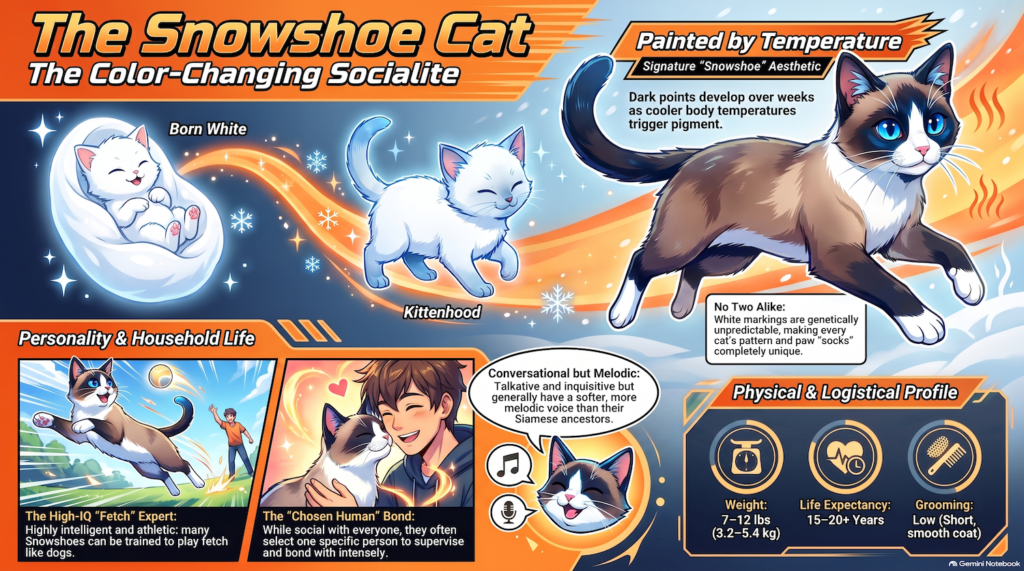
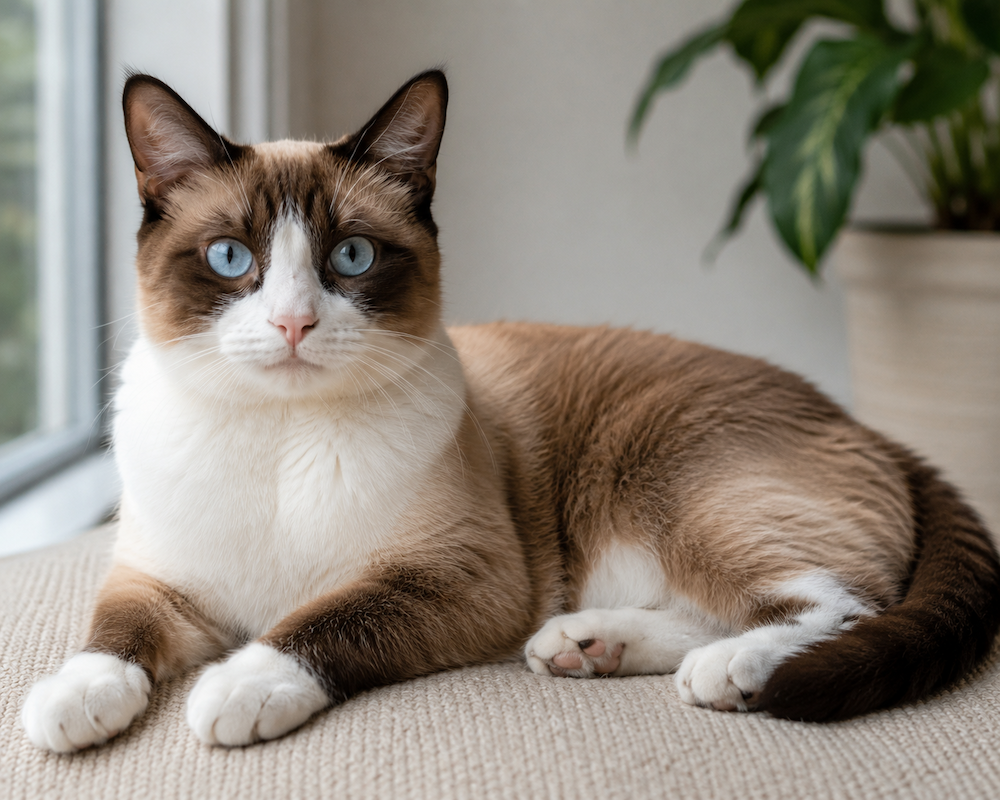






Affectionate, intelligent, and instantly recognisable by its brilliant blue eyes and white paws — the Snowshoe combines its Siamese heritage with a distinctive personality that is playful, social, and often wonderfully devoted to its favourite humans.
🧠 QUICK SNAPSHOT
- Temperament: Affectionate, intelligent, sociable
- Energy Level: Moderate to High
- Size: Medium
- Good With Families: Excellent
- Indoor Living: Excellent
- Trainability: High
- Grooming: Low
- Best For: Families, apartment dwellers, interactive owners, multi-pet homes
- Typical Lifespan: Around 12–15 years
📚 OVERVIEW
The Snowshoe is a relatively modern American breed famous for combining Siamese-style colourpoints with contrasting white paws, vivid blue eyes, and distinctive facial markings.
The breed’s story began during the 1960s when Philadelphia Siamese breeder Dorothy Hinds-Daugherty discovered several kittens with unexpected white feet in a Siamese litter. Rather than treating the markings simply as a fault, she recognised their potential and began developing a new type of cat.
Siamese cats were crossed with American Shorthair-type cats to establish the combination of colourpoint patterning, white markings, and a somewhat more substantial body.
Producing perfectly marked Snowshoes remains challenging. The interaction between colourpoint and white-spotting genetics means markings can vary considerably, which helps explain why beautifully symmetrical show-quality cats aren’t easy to produce.
Personality is equally appealing. Snowshoes tend to be affectionate, intelligent, playful, and deeply interested in people. Many inherit the conversational nature of their Siamese ancestors, although their voices are often described as somewhat softer.
They are cats that generally want to participate in family life rather than simply watch it.
✅ PROS & CONS
Pros
- Extremely affectionate and people-oriented
- Usually excellent with families
- Intelligent and trainable
- Low-maintenance short coat
- Often good with other social pets
- Playful without usually being excessively hyperactive
Cons
- Doesn’t enjoy prolonged isolation
- Can be vocal and demanding of attention
- Needs regular mental stimulation
- May become mischievous when bored
- Not hypoallergenic
- Pedigree Snowshoes can be difficult to find
Is a Snowshoe a Good Family Cat?
Yes, the Snowshoe is generally an excellent family cat, particularly for households wanting an affectionate and interactive companion. These cats tend to form strong relationships with their people and often want to participate in whatever the family is doing.
Snowshoes usually interact well with respectful children. Their playful nature makes games an excellent way for children to build a relationship with them, while children should still learn to recognise when the cat wants space.
The breed can also thrive in multi-pet households. Many Snowshoes enjoy living with another friendly cat and can adapt successfully to cat-friendly dogs when introductions are gradual.
Some individuals develop an especially strong relationship with one favourite person, following them between rooms and regularly seeking their attention.
This social nature means a Snowshoe isn’t ideal for someone wanting a highly independent cat that can routinely spend long days alone. In an interactive household, however, its combination of affection, intelligence, and playfulness can make it an outstanding family companion.
Can a Snowshoe Live Indoors or in an Apartment?
Yes, the Snowshoe is very well suited to indoor and apartment living, provided its environment offers enough play, climbing opportunities, companionship, and mental stimulation.
A large property isn’t essential. Tall cat trees, window perches, scratching posts, climbing shelves, tunnels, and interactive toys can turn a relatively compact apartment into an interesting feline environment.
Snowshoes are intelligent cats, so puzzle feeders, treat hunts, and rotating toys can be particularly useful for preventing boredom.
Owners should also provide daily interactive play rather than expecting the cat to exercise itself.
One consideration in apartments is vocalisation. Snowshoes have Siamese ancestry and many enjoy communicating with their humans, although individual cats vary considerably in how talkative they are.
Secure indoor living protects cats from traffic, fights, disease, poisoning, predators, and other hazards. A secure cat enclosure or appropriately introduced harness walks can provide additional enrichment.
For a Snowshoe, companionship and stimulation matter considerably more than the size of the home.
How Much Exercise and Play Does a Snowshoe Need?
The Snowshoe has moderate-to-high exercise requirements and benefits from several interactive play sessions throughout the day.
Fishing-wand toys, balls, tunnels, toy mice, climbing structures, and chasing games provide excellent physical activity while allowing the cat to express natural stalking and pouncing behaviours.
Many Snowshoes also enjoy retrieving toys and can become enthusiastic participants in games of fetch.
Mental exercise is equally important. Puzzle feeders, clicker training, treat hunts, rotating toys, and learning new tricks provide challenges for an intelligent cat that may quickly become bored with repetitive activities.
Climbing opportunities should be readily available. Snowshoes are athletic enough to enjoy vertical territory without generally having the relentless activity level associated with some of the most energetic breeds.
Once its physical and mental needs have been met, a Snowshoe is often very happy settling down beside — or directly on — its favourite person.
Is a Snowshoe Easy to Train?
Yes, the Snowshoe is generally easy to train for a cat because it combines intelligence, curiosity, and a strong desire to interact with people.
Positive reinforcement using treats, praise, toys, and clicker training can teach behaviours such as coming when called, sitting, giving a paw, retrieving toys, entering a carrier voluntarily, and walking on a harness.
Training can also make everyday care easier. Gradually teaching acceptance of nail trimming, dental checks, carrier travel, and gentle body handling can significantly reduce stress later.
Some Snowshoes are fascinated by water and may investigate taps, showers, or sinks, which can also be incorporated into safe enrichment activities.
Training sessions should remain short, positive, and interesting. Punishment should be avoided.
Their intelligence does mean Snowshoes can learn behaviours their owners didn’t intentionally teach. They may quickly discover where food is kept, which cupboard contains their toys, or exactly which vocalisation gets a human to respond.
Does a Snowshoe Shed?
Yes, the Snowshoe sheds, but its short, close-lying coat is very easy to maintain. Shedding is usually light to moderate, although it can increase during seasonal coat changes.
A gentle brushing approximately once a week is generally sufficient to remove loose hair and maintain the coat’s smooth appearance. More frequent grooming may help during periods of heavier shedding.
Bathing is rarely required unless there is a specific reason. Routine nail trimming, dental care, and checks of the ears, eyes, skin, and body condition should form part of normal maintenance.
The Snowshoe is not considered hypoallergenic. Despite its short coat and straightforward grooming requirements, it still produces feline allergens through saliva and skin secretions.
Owners primarily interested in a low-maintenance coat, however, should find the Snowshoe considerably easier to manage than most long-haired breeds.
Its distinctive appearance requires remarkably little work to maintain.
What Health Problems Are Common in a Snowshoe?
The Snowshoe is generally considered a relatively healthy breed, but responsible breeding and preventative veterinary care remain important.
Because of its Siamese ancestry, some health conditions found within Siamese-related populations may also be relevant to Snowshoes. These can include inherited eye problems and certain heart conditions. Hypertrophic cardiomyopathy (HCM) is an important cardiac disease affecting cats generally and should be discussed with breeders and veterinarians where appropriate.
Some Siamese-related cats can develop crossed eyes or tail abnormalities. These features are less medically significant than many inherited diseases but demonstrate the importance of understanding breeding-line history.
Dental disease, obesity, kidney disease, and urinary problems can also affect cats regardless of pedigree.
Prospective owners should choose breeders who are transparent about health within their lines and undertake appropriate testing.
Regular veterinary examinations, dental care, balanced nutrition, weight management, and prompt investigation of unexplained health or behavioural changes can help a Snowshoe enjoy a typical lifespan of approximately 12–15 years or longer.
⭐ Why Does the Snowshoe Have White Feet?
Those beautiful white paws are the characteristic that gave the Snowshoe its name.
The breed combines two different types of coat genetics.
Its Siamese ancestry contributes the familiar colourpoint pattern, where the cooler areas of the body — particularly the face, ears, legs, and tail — develop darker pigmentation.
Separate white-spotting genetics interrupt that pigmentation, creating the distinctive white paws and other white markings.
The challenge for breeders is that white spotting isn’t something that can be positioned with perfect precision.
A show-quality Snowshoe ideally has balanced markings, but nature doesn’t always cooperate. One kitten may have beautifully symmetrical white feet while another inherits considerably more or less white.
That unpredictability makes breeding consistently marked Snowshoes surprisingly difficult.
The breed’s name sounds simple.
Producing the four little white “snowshoes” in exactly the right places is anything but.
⭐ Are Snowshoe Kittens Born White?
Yes. Snowshoe kittens are generally born very pale or almost completely white, and their darker colourpoints develop after birth.
This happens because the colourpoint gene inherited through Siamese ancestry is temperature-sensitive.
Inside the mother’s womb, the kitten’s body is uniformly warm, restricting the production of darker pigment.
After birth, cooler areas such as the ears, face, legs, and tail begin producing more pigment and gradually become darker.
The process continues as the kitten grows, meaning a young Snowshoe can look considerably different several months later.
Body colour may also darken progressively with age.
The white spotting that creates the Snowshoe’s characteristic paws remains unaffected in those areas, producing the dramatic contrast between white feet and darker points.
So choosing a Snowshoe kitten can involve an interesting element of anticipation.
Its adult appearance hasn’t completely revealed itself yet.
⭐ Is the Snowshoe Just a Siamese With White Feet?
No, although the Siamese is fundamental to the Snowshoe’s history.
The breed began when white-footed kittens unexpectedly appeared in a Siamese litter owned by American breeder Dorothy Hinds-Daugherty during the 1960s.
Rather than simply continuing to breed unusual Siamese cats, a deliberate breeding program was developed. American Shorthair-type cats were incorporated to help establish the desired white markings and a somewhat more substantial body type.
The resulting Snowshoe retained several obvious Siamese characteristics, including blue eyes, colourpoints, intelligence, sociability, and a tendency towards conversation.
But its body structure, markings, and overall appearance developed into something recognisably different.
Temperament can also feel like a fascinating middle ground: highly social and interactive, but often somewhat less intense than the stereotypical Siamese.
So the white paws started the story.
They didn’t end it.
⭐ Do Snowshoe Cats Really Like Water?
Some certainly appear to.
Snowshoes have developed a reputation for being unusually interested in running and moving water. Individual cats may investigate dripping taps, watch showers, play with water in a sink, or become fascinated by pet drinking fountains.
Some may even voluntarily paddle in shallow water.
That doesn’t mean every Snowshoe is a miniature swimming champion. Water preference varies enormously between individual cats, and no cat should ever be forced into water because of a breed stereotype.
For an interested Snowshoe, however, water can provide useful enrichment. A pet fountain or supervised water-based play may offer another source of mental stimulation.
Owners should just remember that feline curiosity doesn’t necessarily include any concern for keeping the surrounding floor dry.
If your Snowshoe develops a fascination with its water bowl, you may eventually discover that the cat is having considerably more fun with it than you are.