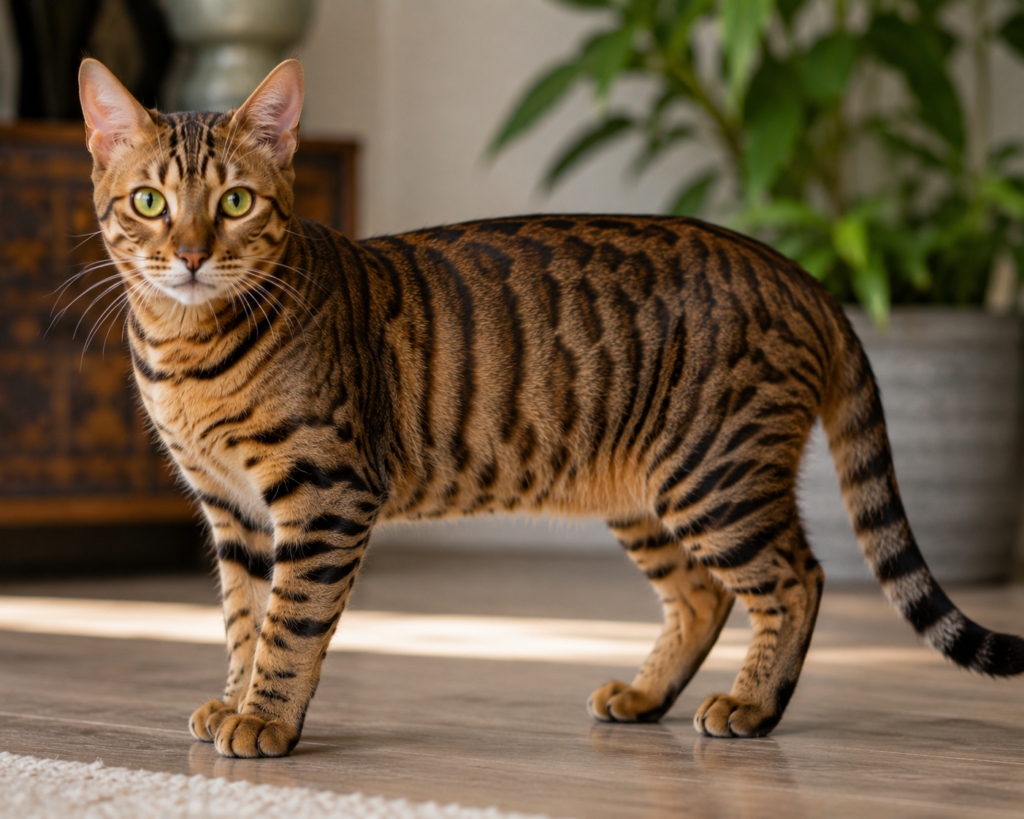






Striped like a tiny tiger but bred entirely for life at home — the Toyger is a striking modern cat combining bold markings, an athletic body, and an affectionate, intelligent personality designed to make the wild look wonderfully domestic.
🧠 QUICK SNAPSHOT
- Temperament: Affectionate, intelligent, outgoing
- Energy Level: Moderate to High
- Size: Medium
- Good With Families: Excellent
- Indoor Living: Excellent
- Trainability: High
- Grooming: Low
- Best For: Families, interactive owners, multi-pet households, apartment living
- Typical Lifespan: Around 12–15 years
📚 OVERVIEW
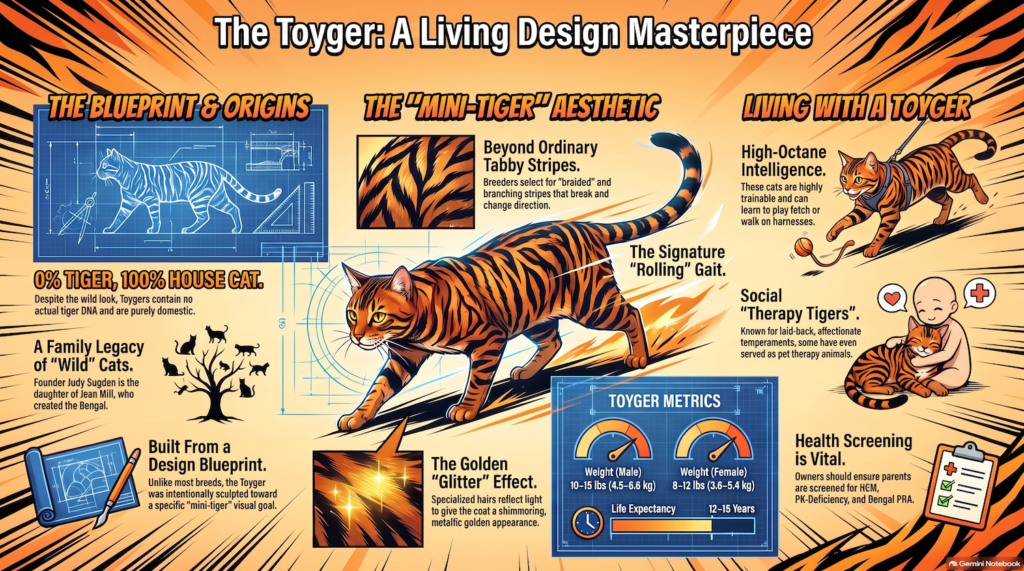
The Toyger is one of the most visually dramatic modern cat breeds. Its name combines “toy” and “tiger,” which perfectly describes the original objective: creating a domestic companion that resembles a miniature tiger.
The breed was developed in the United States beginning in the 1980s by breeder Judy Sugden, daughter of Bengal breed pioneer Jean Mill. Sugden noticed unusual markings on one of her tabby cats and began selectively breeding cats to exaggerate tiger-like characteristics.
Bengal cats contributed to the breed’s development, alongside carefully selected domestic cats. Despite its appearance, however, no actual tiger was used to create the Toyger.
The ideal Toyger has bold, branching vertical stripes rather than the more conventional vertical tabby pattern, with a muscular body, long torso, substantial bone, and distinctive facial markings. Some coats have an extraordinary glitter-like sheen.
Temperament was also an important consideration. Toygers are intended to be companion animals and tend to be affectionate, intelligent, confident, and playful.
The result is essentially a cat designed to bring the visual drama of a tiger into the home — minus several hundred kilograms of tiger.
✅ PROS & CONS
Pros
- Affectionate and people-oriented
- Highly intelligent and trainable
- Usually excellent with families
- Spectacular tiger-like appearance
- Easy-care short coat
- Often adapts well to other pets
Cons
- Needs regular play and mental stimulation
- Can become bored without enrichment
- Doesn’t enjoy prolonged isolation
- Genuine Toygers remain relatively rare
- Well-bred kittens can be expensive
- Not hypoallergenic
Is a Toyger a Good Family Cat?
Yes, the Toyger is generally an excellent family cat, particularly for households wanting an affectionate, playful, and interactive companion. Although its striped coat creates an exotic appearance, the modern Toyger is bred specifically as a domestic companion.
Toygers tend to enjoy spending time with their people and can form strong relationships with several members of the household. Many are confident and outgoing rather than particularly shy.
They can be excellent companions for respectful children who understand appropriate feline handling. Interactive games provide a particularly good way for children and Toygers to build relationships.
Many Toygers also live successfully with other cats and cat-friendly dogs after gradual introductions.
The breed’s intelligence and sociability mean companionship is important. A Toyger routinely left alone for long periods without sufficient enrichment may become bored or frustrated.
For families wanting an involved cat that combines spectacular looks with a friendly domestic temperament, the Toyger can be an excellent choice.
Can a Toyger Live Indoors or in an Apartment?
Yes, a Toyger can live very successfully indoors or in an apartment, provided the home offers sufficient opportunities for climbing, playing, exploring, and interacting with people.
Toygers are athletic cats, so vertical territory can dramatically improve an indoor environment. Tall cat trees, shelves, scratching towers, window perches, tunnels, and secure elevated resting areas are all valuable.
Puzzle feeders, interactive toys, treat hunts, and rotating enrichment activities help keep their intelligent minds occupied.
Secure indoor living is particularly sensible for an unusual pedigree cat, protecting it from traffic, fights, infectious diseases, poisoning, theft, and other outdoor hazards.
A secure cat enclosure can provide additional stimulation, while some Toygers can be trained to walk comfortably on a harness.
The Toyger doesn’t need a jungle.
It needs an interesting environment where it can climb, investigate, play, and spend plenty of time with its humans.
How Much Exercise and Play Does a Toyger Need?
The Toyger has moderate-to-high exercise requirements and should receive several opportunities for interactive play every day.
Fishing-wand toys, balls, tunnels, climbing structures, toy mice, and games involving stalking, chasing, and pouncing provide excellent physical exercise.
Toygers are also intelligent, making mental enrichment particularly important. Puzzle feeders, treat hunts, clicker training, rotating toys, and learning new tricks can challenge their problem-solving abilities.
Many enjoy games of fetch, and some can become enthusiastic participants in harness walks and other structured activities.
Climbing should also be encouraged. Providing appropriate elevated territory gives an athletic cat somewhere legitimate to exercise rather than leaving it to discover that the bookshelf provides an excellent substitute.
Exercise requirements vary between individuals and with age, but a Toyger shouldn’t be chosen purely because of its beautiful coat.
Behind those tiger stripes is an active cat that needs something worthwhile to do.
Is a Toyger Easy to Train?
Yes, the Toyger is generally highly trainable for a cat. Intelligence, curiosity, confidence, and a willingness to interact with humans make positive-reinforcement training particularly effective.
Using treats, praise, toys, or clicker training, Toygers can learn behaviours such as coming when called, sitting, giving a paw, retrieving toys, entering a carrier voluntarily, and walking on a harness.
Training can also make routine care easier. Gradually teaching acceptance of nail trimming, dental checks, carrier travel, and gentle body examination can reduce stress during future veterinary visits.
Sessions should remain short, positive, and interesting. Punishment should never be used as a training strategy.
The Toyger’s intelligence also means it may independently learn things its owner didn’t intend to teach.
Cupboards, doors, food containers, and household routines can all become puzzles.
Fortunately, giving the cat structured challenges makes it less likely to decide that dismantling your house is today’s most interesting intellectual exercise.
Does a Toyger Shed?
Yes, the Toyger does shed, but its short coat is relatively easy to maintain. Shedding is generally light to moderate, although individual cats may shed more during seasonal changes.
A gentle brushing approximately once a week is normally sufficient to remove loose hairs and maintain the coat’s beautiful appearance.
Some Toygers display an attractive glitter effect, where individual hairs reflect light and give the coat a shimmering appearance. This trait is associated with domestic cat genetics rather than anything inherited from an actual tiger.
Bathing is rarely required unless there is a particular reason.
Routine grooming should also include nail trimming, dental care, and regular checks of the ears, skin, and overall body condition.
The Toyger is not hypoallergenic. Major feline allergens are produced in saliva and skin secretions, so a short coat and relatively manageable shedding don’t guarantee suitability for someone with cat allergies.
What Health Problems Are Common in a Toyger?
The Toyger is a relatively young breed, so responsible breeding and ongoing health monitoring are particularly important. Many Toygers live approximately 12–15 years, with well-cared-for individuals potentially living longer.
One important consideration is hypertrophic cardiomyopathy (HCM), a heart condition involving abnormal thickening of the heart muscle. HCM occurs across the wider feline population and has also been a concern in breeds contributing to Toyger ancestry.
Some Toyger lines have historically been reported with other inherited abnormalities, making careful pedigree management and genetic diversity important.
Owners should also remember that Toygers can develop common feline problems including dental disease, obesity, kidney disease, and urinary conditions.
Prospective owners should seek responsible breeders who are transparent about health within their lines, undertake appropriate screening, and avoid selecting cats purely for increasingly dramatic physical characteristics.
Regular veterinary examinations, dental care, balanced nutrition, weight management, and prompt investigation of unexplained health changes provide the best foundation for a long and healthy life.
⭐ Is a Toyger Actually Part Tiger?
No. Despite appearances, the Toyger has absolutely no tiger ancestry.
The breed was deliberately created to resemble a miniature tiger through selective breeding of domestic cats.
Developer Judy Sugden began the project during the 1980s after noticing unusual markings on one of her cats. She envisioned a domestic breed with more dramatic tiger-like striping, particularly around the face.
Bengals were incorporated into the breed’s development, which sometimes creates additional confusion because the Bengal itself has more distant Asian leopard cat ancestry.
But there is an enormous genetic gulf between selectively breeding domestic cats for tiger-like markings and breeding cats with actual tigers.
Tigers belong to the genus Panthera. Domestic cats belong to Felis.
So the Toyger’s tiger resemblance is essentially a remarkable piece of selective breeding.
It has the stripes, not the tiger.
Which makes sharing the sofa considerably easier.
⭐ Why Are Toyger Stripes Different From Ordinary Tabby Stripes?
The Toyger’s stripes were deliberately selected to create a much more tiger-like appearance than the conventional pattern seen on a domestic mackerel tabby.
Ordinary tabby cats often have relatively regular vertical stripes running down their sides.
Toyger breeders instead favour bold, irregular, branching, and sometimes broken vertical markings that create a more dramatic pattern.
Facial markings are particularly important. Domestic tabby patterns don’t naturally reproduce a tiger’s face perfectly, so generations of selective breeding have focused on creating more circular and expressive markings around the head.
Strong contrast between the dark pattern and background colour further enhances the effect.
The ideal isn’t simply “an orange tabby with better stripes.”
Breeders have attempted to alter the entire visual impression — coat pattern, body proportions, head shape, movement, and colouring — to suggest a tiger while retaining the temperament and practicality of a domestic cat.
⭐ Why Was the Toyger Created?
The Toyger wasn’t developed solely because miniature tigers look spectacular.
Judy Sugden also connected the project with awareness of tiger conservation.
Her idea was that creating a domestic cat visually reminiscent of a tiger could encourage people to appreciate the beauty of wild tigers while reinforcing the importance of protecting them in their natural habitats.
There’s an interesting contrast behind the concept.
Humans have historically been fascinated by keeping exotic animals, sometimes with disastrous consequences for both wildlife and owners.
The Toyger offers something very different: create the appearance through domestic-cat breeding while leaving actual wild cats where they belong.
Whatever impact the breed ultimately has on conservation awareness, the underlying principle remains sensible.
If you love the extraordinary beauty of a tiger, you don’t need a tiger in your backyard.
You can admire the real thing in the wild — and let your tiny striped impersonator occupy the sofa.
⭐ Why Are Toyger Kittens So Difficult to Breed Consistently?
Because creating a convincing miniature tiger involves far more than producing a striped kitten.
Tabby markings are common throughout the domestic cat population. The Toyger breeding objective is much more specific: bold vertical markings, strong contrast, desirable facial patterning, appropriate body structure, suitable colouring, and a friendly companion temperament.
Genetics doesn’t deliver all of those characteristics according to a simple template.
Even carefully selected parents can produce kittens with significant differences in markings and overall type.
This means breeders may need generations of selective breeding to strengthen particular characteristics while simultaneously protecting health, genetic diversity, and temperament.
And that last part is crucial.
A Toyger with spectacular stripes but poor health or an unsuitable temperament isn’t a successful companion breed.
The real challenge isn’t creating a cat that looks wild.
It’s creating one that looks wild while remaining healthy, friendly, and thoroughly domestic.