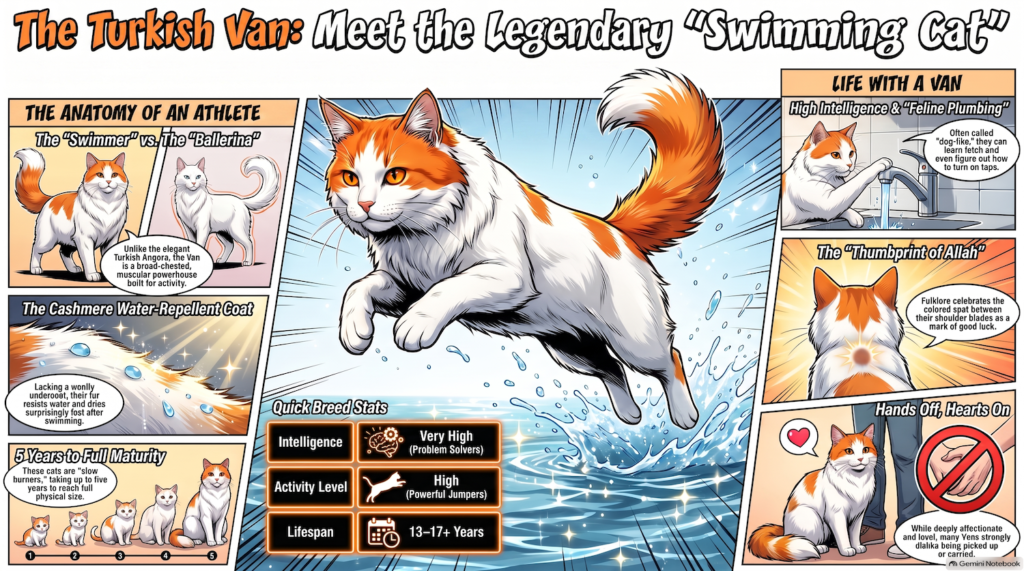






Athletic, intelligent, and famous for an unusual fascination with water — the Turkish Van is a powerful semi-longhaired cat with a distinctive coloured head and tail, an independent streak, and enough personality to keep an entire household entertained.
🧠 QUICK SNAPSHOT
- Temperament: Intelligent, energetic, confident
- Energy Level: High
- Size: Medium to Large
- Good With Families: Yes, especially with older children
- Indoor Living: Very Good with sufficient enrichment
- Trainability: High
- Grooming: Moderate
- Best For: Active households, experienced cat owners, families wanting an interactive cat
- Typical Lifespan: Around 12–17 years
📚 OVERVIEW
The Turkish Van is a distinctive semi-longhaired cat associated with the region around Lake Van in eastern Turkey. Large, muscular, and remarkably athletic, it is very different in both appearance and temperament from the similarly named Turkish Angora.
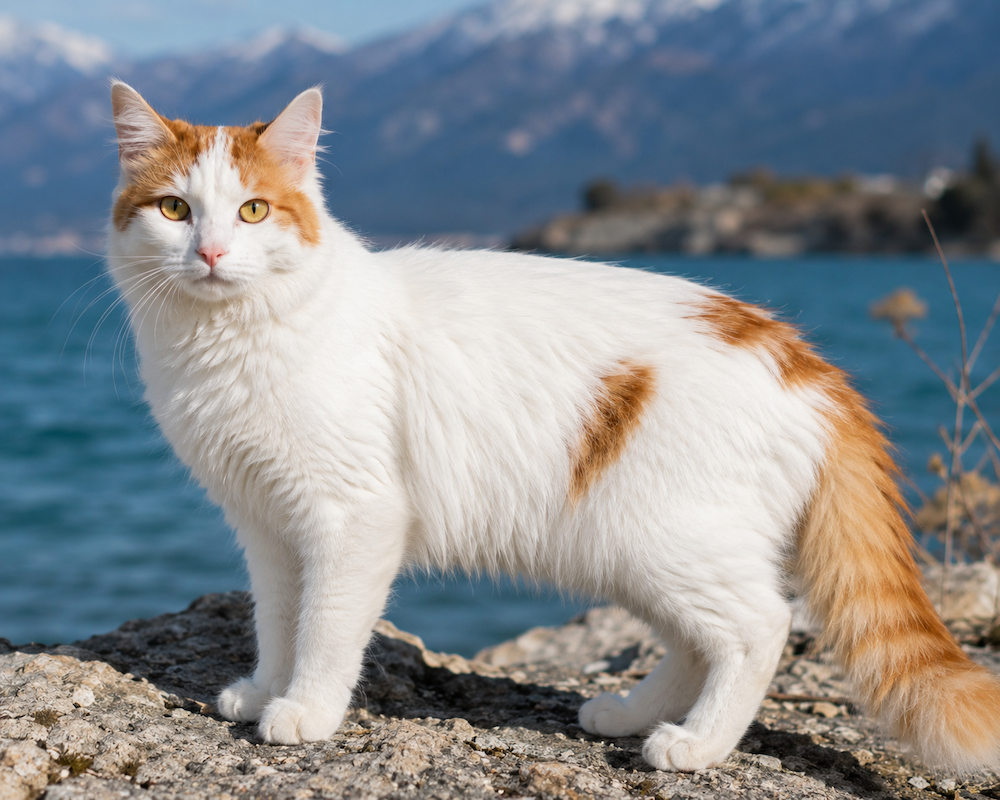
The classic Turkish Van is predominantly white, with colour concentrated around the head and a fully coloured tail. This distinctive arrangement became so closely associated with the breed that similar markings in other cats are commonly described as a “van pattern.”
The breed became established in Britain during the 1950s after Laura Lushington and Sonia Halliday brought cats from Turkey back to the UK. Rather than being developed through deliberate crossing of existing pedigree breeds, the Turkish Van was established from cats originating in its native region.
Turkish Vans are intelligent, curious, athletic, and frequently independent. Many enjoy affection but prefer choosing when and how interactions happen rather than being constantly carried.
Then there’s the water.
The breed’s reputation for swimming and playing with water has earned it the famous nickname “the swimming cat.”
✅ PROS & CONS
Pros
- Highly intelligent and entertaining
- Athletic and playful
- Strongly attached to its family
- Beautiful and distinctive coat
- Generally manageable grooming requirements
- Often retains a playful personality throughout adulthood
Cons
- High exercise and enrichment requirements
- May dislike being picked up or restrained
- Can be independent and strong-willed
- Powerful jumper that seeks high places
- Not always ideal for very young children
- Water bowls and taps may become toys
Is a Turkish Van a Good Family Cat?
Yes, the Turkish Van can be a very good family cat, particularly for households that appreciate an intelligent, active cat with an independent personality. These cats often develop strong bonds with their people but may express affection differently from breeds that constantly demand laps and cuddles.
Many Turkish Vans prefer sitting beside their owners, following them around, or initiating play rather than being carried for long periods. Respecting these preferences helps create a strong relationship.
They can live successfully with considerate children, particularly older children who understand feline body language and don’t force physical contact. Their large, powerful build also makes them less fragile than many smaller breeds.
Turkish Vans may coexist with other cats and cat-friendly dogs after careful introductions, although their confident personalities can occasionally make relationships more complicated.
Families wanting a passive lap cat may prefer another breed. Those looking for a clever, athletic companion with plenty of individuality may find the Turkish Van fascinating.
Can a Turkish Van Live Indoors or in an Apartment?
Yes, a Turkish Van can live indoors or in an apartment, but the home needs to provide enough space and enrichment for a large, athletic cat.
Vertical territory is particularly important. Tall, sturdy cat trees, climbing shelves, window perches, scratching towers, and safe elevated resting areas allow the Turkish Van to climb and survey its surroundings.
These cats can be powerful jumpers, so owners should expect them to reach places they assumed were inaccessible.
Puzzle feeders, tunnels, interactive toys, and daily play are essential for preventing boredom. Secure balconies and windows are particularly important in apartments.
Indoor living protects cats from traffic, disease, fights, predators, poisoning, and other outdoor hazards. A secure cat enclosure can provide additional stimulation.
The Turkish Van’s size and energy mean a very small, poorly enriched apartment may be restrictive. However, a thoughtfully designed indoor environment offering plenty of vertical space can work extremely well.
How Much Exercise and Play Does a Turkish Van Need?
The Turkish Van is a high-energy, athletic breed that needs substantial daily exercise and interactive play. Several energetic play sessions spread throughout the day help satisfy its desire to chase, climb, leap, investigate, and problem-solve.
Fishing-wand toys, balls, tunnels, climbing structures, puzzle feeders, and games that encourage jumping are excellent choices. Some Turkish Vans also enjoy retrieving toys.
Their powerful hind legs make them particularly impressive jumpers, and vertical exercise should form an important part of their environment.
Mental stimulation matters just as much. Food puzzles, clicker training, treat hunts, rotating toys, and opportunities to investigate new objects can keep an intelligent Van occupied.
Water can also become enrichment for individuals fascinated by it. A dripping tap or pet fountain may provide considerable entertainment, although water play should always be safe and supervised where necessary.
Without adequate stimulation, a Turkish Van is perfectly capable of creating entertainment that its owner never requested.
Is a Turkish Van Easy to Train?
Yes, the Turkish Van is highly intelligent and capable of learning quickly, although its independent personality means cooperation shouldn’t be confused with automatic obedience.
Positive reinforcement using treats, toys, praise, and play produces the best results. Clicker training can be particularly effective because it turns learning into an interesting problem-solving exercise.
Turkish Vans can potentially learn to come when called, retrieve toys, enter their carrier voluntarily, walk on a harness, and perform simple tricks.
Training is also useful for handling. Because some Turkish Vans dislike being restrained, gradually teaching acceptance of nail trimming, grooming, dental checks, and veterinary-style examination can make future care considerably easier.
Punishment should be avoided. It can damage trust and rarely teaches a cat what behaviour is actually expected.
The Turkish Van’s intelligence can sometimes work against its humans. Doors, cupboards, containers, and household routines may all become puzzles to solve.
Does a Turkish Van Shed?
Yes, the Turkish Van does shed, despite its coat lacking the extremely dense woolly undercoat found in some other longhaired breeds.
Its distinctive semi-long coat has a soft, cashmere-like texture and changes noticeably with the seasons. The winter coat becomes considerably fuller, while the summer coat is shorter and lighter.
Brushing around once or twice each week is generally sufficient during normal periods, with more frequent grooming helpful during seasonal shedding.
Because the coat isn’t excessively woolly, it tends to resist severe matting better than many heavily coated breeds. Nevertheless, tangles should be removed before they become uncomfortable.
Routine nail trimming, dental care, and ear checks should accompany coat maintenance.
The Turkish Van is not considered hypoallergenic. Allergic reactions to cats are primarily caused by proteins produced in saliva and skin glands, so neither coat length nor relatively manageable shedding guarantees compatibility for allergy sufferers.
What Health Problems Are Common in a Turkish Van?
The Turkish Van is generally regarded as a robust breed, but responsible breeding and preventative veterinary care remain important.
Hypertrophic cardiomyopathy (HCM), a condition involving abnormal thickening of the heart muscle, can occur in cats and has been reported in Turkish Vans. Prospective owners should discuss heart health and breeding-line history with responsible breeders.
Like other cats, Turkish Vans can also develop dental disease, kidney problems, urinary conditions, obesity, and age-related disorders. Their naturally substantial, muscular build should not be mistaken for excess weight.
White cats are sometimes associated with congenital deafness, particularly when blue eyes are involved. However, the genetics of the Turkish Van’s predominantly white appearance differ from those of a completely dominant-white cat, so simplistic claims that Turkish Vans are inherently prone to deafness should be avoided.
Regular veterinary examinations, good dental care, appropriate nutrition, weight management, and prompt investigation of health changes help support a lifespan commonly around 12–17 years.
⭐ Do Turkish Van Cats Really Like Swimming?
The Turkish Van’s reputation as the “swimming cat” is one of the most famous stories associated with the breed.
Early accounts from people involved in establishing Turkish Vans in Europe described cats showing an unusual willingness to enter water. Their homeland around Lake Van provided an irresistible explanation, and the swimming-cat reputation became part of breed folklore.
Many modern Turkish Vans do appear fascinated by water. Some play with dripping taps, investigate showers, paddle in shallow water, or repeatedly splash their drinking bowls.
However, this doesn’t mean every Turkish Van loves swimming.
Cats remain individuals, and putting an unwilling Van into a bath simply because its breed is famous for water is likely to produce one extremely unimpressed cat.
The better description is that Turkish Vans appear to have an unusually strong reputation for water curiosity.
Owners may discover this when their cat encounters a running tap.
Or when they wonder why half the water that was in the bowl is now on the kitchen floor.
⭐ Why Is It Called the “Van Pattern”?
The Turkish Van’s appearance became so distinctive that it contributed terminology now used far beyond the breed itself.
A classic Turkish Van is predominantly white, with coloured markings concentrated on the head and a coloured tail. Small additional body spots may sometimes occur.
This arrangement is now commonly called a van pattern, even when it appears in completely unrelated domestic cats.
The traditional Turkish Van coat isn’t simply white because of a dominant-white gene masking all other colour. Instead, extensive white spotting produces the characteristic distribution of white and coloured areas.
The tail is particularly beautiful and may show visible rings depending on colour and pattern.
Recognised colours vary between cat registries, but red and cream markings are particularly strongly associated with the breed, alongside other accepted variations.
So when someone describes an ordinary mixed-breed cat as having “van markings,” they’re indirectly referencing the distinctive appearance made famous by the Turkish Van.
⭐ Is a Turkish Van the Same as a Turkish Angora?
No. The Turkish Van and Turkish Angora are separate breeds, despite both having strong associations with Turkey and often being predominantly white.
The Turkish Angora is generally more finely built, with an elegant, slender appearance and a flowing silky coat. It is historically associated particularly with Ankara.
The Turkish Van is typically larger and more muscular, with a distinctive semi-long coat and the classic coloured head and tail markings. Its name connects it with the Lake Van region of eastern Turkey.
Their personalities can also differ. Turkish Angoras are famously active and people-oriented, while Turkish Vans often combine affection with a noticeably independent streak and may be less enthusiastic about being carried.
Confusion is understandable — two spectacular Turkish cats with flowing coats and fascinating histories.
But put representative examples beside each other and the differences become much clearer.
One is the elegant Angora.
The other is the muscular, water-curious Van.