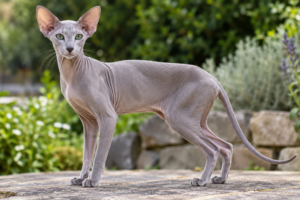
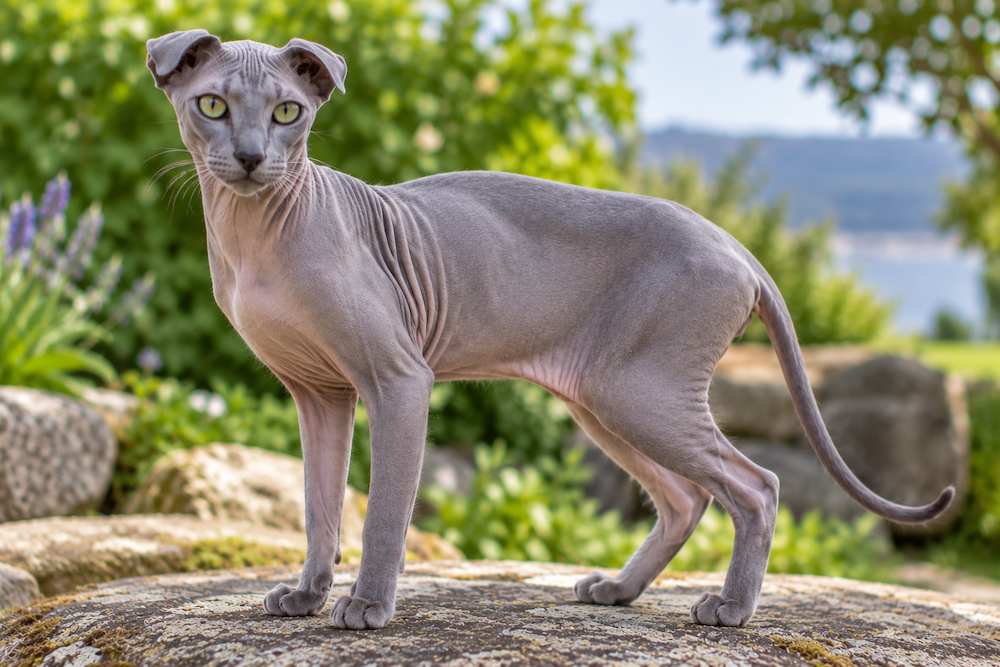






Hairless, inward-folding ears, and an appearance unlike almost any other cat — the Ukrainian Levkoy is a modern Ukrainian breed combining Donskoy hairlessness with folded ears, an elegant angular body, remarkable intelligence, and a surprisingly affectionate, people-focused personality.
🧠 QUICK SNAPSHOT
- Temperament: Affectionate, intelligent, sociable
- Energy Level: Moderate to High
- Size: Medium
- Good With Families: Very Good
- Indoor Living: Excellent
- Trainability: High
- Grooming: Moderate despite little or no hair
- Best For: Experienced owners, interactive households, apartment living, people wanting an unusual and highly social companion
- Typical Lifespan: Around 12–15 years, although robust long-term breed data is limited
📚 OVERVIEW
There are unusual-looking cats, and then there is the Ukrainian Levkoy.
With its largely hairless body, long angular head and ears that fold forward and downward, the breed has an appearance sometimes described as almost alien.
Yet beneath that extraordinary exterior is a domestic cat developed specifically to be sociable, intelligent and affectionate.
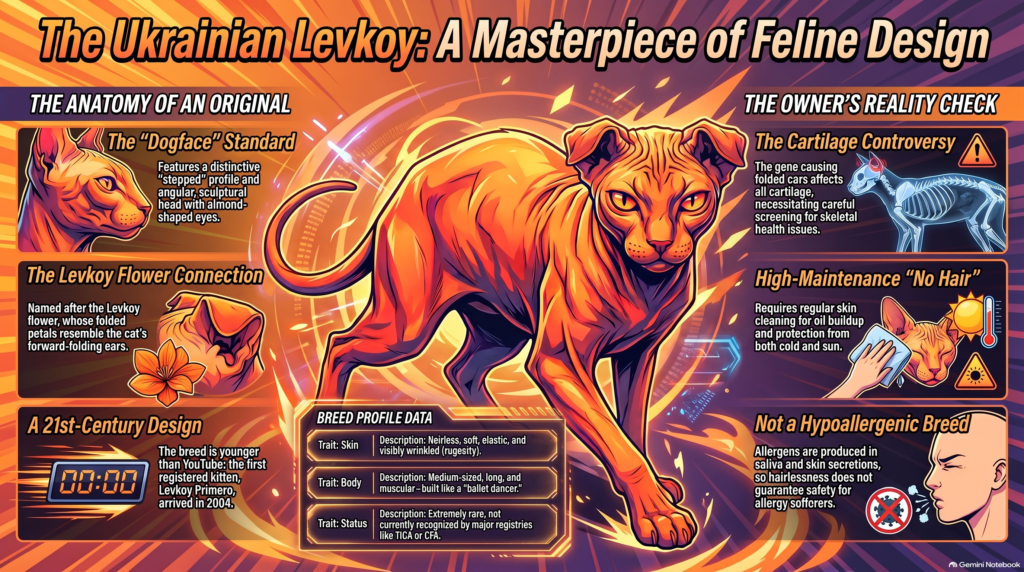
The Ukrainian Levkoy was created in Ukraine during the early 2000s by breeder Elena Biriukova.
Its development involved the hairless Donskoy and folded-ear cats related to the Scottish Fold, alongside other cats used to establish the desired body type.
The aim was to combine hairlessness with an entirely different head and ear shape from other naked breeds.
The first cat recognised as representing the new breed type, Levkoy Primero, was born in 2004.
The breed’s name comes from the Levkoy flower, whose folded petals reminded its creator of the cat’s distinctive ears.
Ukrainian Levkoys tend to be friendly, inquisitive and strongly people-oriented. Many enjoy interactive play and close contact with their families.
However, the breed also raises significant welfare questions.
The folded ears are associated with the same type of cartilage mutation that makes Scottish Fold breeding controversial. This deserves serious consideration by anyone interested in the breed.
✅ PROS & CONS
Pros
- Extremely distinctive appearance
- Affectionate and people-oriented
- Intelligent and interactive
- Well suited to indoor living
- Usually playful and curious
- Often sociable with compatible pets
- Minimal conventional shedding in hairless individuals
Cons
- Folded-ear genetics raise significant welfare concerns
- Hairless skin requires specialised care
- Vulnerable to cold and excessive sun
- Can become distressed without enough companionship
- Not truly hypoallergenic
- Very rare outside Eastern Europe
- Long-term breed-specific health data is limited
- Not recognised by many major international cat registries
Is a Ukrainian Levkoy a Good Family Cat?
Yes, the Ukrainian Levkoy is generally described as an affectionate, sociable and family-oriented cat, although prospective owners should also consider the breed’s health and welfare issues.
These cats tend to enjoy human interaction and often form strong bonds with their families.
Many are playful without being relentlessly energetic and can live successfully with respectful children.
They may also get along with compatible cats and cat-friendly dogs when introduced properly.
Ukrainian Levkoys aren’t generally known for being highly independent. Many actively seek company and may follow their owners around the home.
Because hairless skin offers less physical protection, children need to handle these cats gently. Scratches and minor injuries that would disappear beneath another cat’s coat are much more exposed.
For the right household, the Levkoy can be an extremely engaging companion.
But appearance shouldn’t be the deciding factor.
With a breed carrying intentionally selected structural mutations, health and welfare deserve at least as much attention as personality.
Can a Ukrainian Levkoy Live Indoors or in an Apartment?
Yes. The Ukrainian Levkoy is particularly well suited to indoor and apartment living.
For hairless individuals, indoor living also provides important protection from temperature extremes and excessive ultraviolet exposure.
A comfortable home should provide warm sleeping areas, climbing structures, scratching posts, window perches and interactive toys.
Despite its unusual appearance, the Levkoy remains an active domestic cat and needs opportunities to climb, explore and play.
Warmth is particularly important during cold weather.
Blankets and appropriately designed heated pet beds can be useful. Some owners also use cat clothing, although garments need to fit comfortably and should never interfere with normal movement.
Sun exposure needs management as well because sparsely coated skin can burn.
A secure outdoor enclosure may provide enrichment under appropriate weather conditions.
The Levkoy doesn’t need acres of territory.
It needs warmth, enrichment and plenty of social contact.
How Much Exercise and Play Does a Ukrainian Levkoy Need?
The Ukrainian Levkoy generally has moderate to high exercise requirements and should receive interactive play every day.
These cats are typically curious and intelligent, making mental stimulation just as important as physical activity.
Fishing-wand toys, balls, tunnels and chasing games can provide useful exercise.
Cat trees and climbing systems create additional opportunities for movement.
Puzzle feeders, hidden treats and clicker training can challenge the cat mentally.
Several shorter sessions spread throughout the day generally suit normal feline activity patterns better than one marathon workout.
Owners should also monitor body condition carefully.
With no thick coat hiding the body, weight changes can be easier to spot, but maintaining good muscle condition remains important.
Hairless does not mean inactive.
The Ukrainian Levkoy may look as though it belongs in a science-fiction film, but it still considers a toy mouse racing across the floor an entirely serious matter.
Is a Ukrainian Levkoy Easy to Train?
Yes, the Ukrainian Levkoy is generally considered intelligent and responsive to positive-reinforcement training.
Treats, toys, praise and clicker training can be used to teach useful behaviours and tricks.
Cats can learn to come when called, enter carriers voluntarily, use designated scratching areas and accept routine handling.
Early cooperative-care training is especially useful for this breed.
Skin cleaning, bathing when necessary, ear inspection, nail trimming and dental care can all become easier when introduced positively during kittenhood.
Punishment should be avoided.
Short, enjoyable training sessions help maintain attention and build trust.
The breed’s sociable personality can make training particularly rewarding because interaction with its human can itself become part of the reward.
Does a Ukrainian Levkoy Shed?
A hairless Ukrainian Levkoy has very little conventional shedding, but that doesn’t make it maintenance-free.
In fact, caring for exposed skin can require more work than many prospective owners expect.
Normal feline skin produces oils. In coated cats, hair helps absorb and distribute those oils.
Without a conventional coat, oil can accumulate directly on the skin.
Some Levkoys therefore require gentle wiping or occasional bathing, depending on the individual.
Nail beds and ears can also collect oily debris and should be checked regularly.
Bathing too frequently can dry or irritate the skin, so care needs to be tailored to the cat rather than following an excessive fixed schedule.
The Ukrainian Levkoy is also not reliably hypoallergenic.
Major feline allergens are produced through saliva and skin secretions, not simply the hair itself.
No fur doesn’t mean no allergens.
What Health Problems Are Common in a Ukrainian Levkoy?
The Ukrainian Levkoy requires particularly careful consideration from a health and welfare perspective because its appearance combines inherited hairlessness with folded ears.
The ear fold is associated with a mutation affecting cartilage development. In Scottish Fold cats, the relevant mutation can cause osteochondrodysplasia, a disorder affecting cartilage and bone throughout the body rather than only the ears.
This can lead to painful joint abnormalities, stiffness, abnormal bone development and mobility problems.
The fact that the ears look different is therefore only the visible expression of a mutation that can have effects elsewhere.
Hairlessness brings additional practical concerns including vulnerability to cold, sunburn and skin irritation.
Because the Ukrainian Levkoy remains rare, comprehensive long-term population health data is limited.
Responsible breeders should prioritise skeletal health, genetic diversity, cardiac health and overall quality of life rather than increasingly extreme physical characteristics.
Prospective owners should specifically ask how breeders manage the folded-ear mutation and what health monitoring is performed.
⭐ Who Created the Ukrainian Levkoy?
The Ukrainian Levkoy was developed by Ukrainian breeder Elena Biriukova during the early 2000s.
Her objective was ambitious.
Rather than producing another hairless cat resembling the Sphynx or Donskoy, she wanted to establish a completely different visual type.
The breeding program combined Donskoy hairlessness with the folded-ear characteristic associated with Scottish Fold-type cats.
Other cats were used to help establish the desired elongated, angular body and head.
In 2004, a male kitten called Levkoy Primero was born and became an important early representative of the breed.
That makes the Ukrainian Levkoy extraordinarily young compared with ancient natural breeds such as the Korat or Japanese Bobtail.
It wasn’t discovered in an isolated population.
It was deliberately created according to a breeder’s visual concept.
⭐ Why Is It Called the Ukrainian Levkoy?
The breed’s name has a surprisingly elegant origin.
The Levkoy is a flowering plant, known for petals that can appear folded or bent.
According to the breed’s history, Elena Biriukova thought the cat’s distinctive folded ears resembled the petals of a Levkoy flower.
That inspired the name.
“Ukrainian” naturally identifies the breed’s country of origin.
So unlike breed names derived from cities, famous people or supposed ancient legends, Ukrainian Levkoy essentially means:
the Ukrainian cat with ears resembling a Levkoy flower.
Considering the animal itself looks remarkably futuristic, its floral name is unexpectedly gentle.
⭐ Is the Ukrainian Levkoy Related to the Sphynx?
Not directly in the way many people assume.
The Ukrainian Levkoy’s hairlessness primarily comes from the Donskoy, another hairless breed developed in Russia.
The Canadian Sphynx has a separate history and a different hairlessness mutation.
This is an important reminder that “hairless cat” isn’t a single genetic category.
Hairlessness has appeared independently in different cat populations.
The breeds also have noticeably different appearances.
The Sphynx generally has a more rounded, substantial look with enormous ears.
The Ukrainian Levkoy was developed with a longer, flatter and more angular head plus the characteristic forward-folding ears.
From a distance, both may appear bald.
Up close, they are very different cats.
⭐ Is the Ukrainian Levkoy Related to the Donskoy?
Yes. The Donskoy is one of the Ukrainian Levkoy’s foundation breeds and provided the hairlessness characteristic used in its development.
The Donskoy itself originated after an unusual cat named Varvara was discovered in Rostov-on-Don, Russia, during the 1980s.
Varvara’s hair loss eventually proved hereditary, leading to the establishment of a new hairless breed.
The Ukrainian Levkoy breeding program later used Donskoy genetics while adding the folded-ear characteristic and developing a different overall body type.
This means the Levkoy and Donskoy are historically related but shouldn’t be confused.
The Donskoy contributed the lack of hair.
The Ukrainian breeding program added the ears and redesigned much of the silhouette.
⭐ Are All Ukrainian Levkoys Completely Hairless?
No. Coat expression can vary.
Because the breed’s hairlessness comes through Donskoy ancestry, individuals can display different degrees and textures of hair.
Some may be virtually naked.
Others can have a fine covering that feels like suede, peach fuzz or velour.
Coat terminology can vary between breeders and organisations.
Some kittens can also change as they mature, losing hair they possessed earlier in life.
This means “hairless” doesn’t necessarily mean perfectly smooth skin from birth until old age.
Even completely naked-looking cats usually possess extremely fine hairs somewhere on the body.
The breed’s defining appearance is therefore better described as hairless or sparsely coated rather than assuming every Levkoy is identical.
⭐ Why Do the Ukrainian Levkoy’s Ears Fold?
The ears fold because of an inherited mutation affecting cartilage.
This is where the breed’s appearance becomes medically significant.
Ear cartilage normally provides enough rigidity to keep a cat’s ears upright.
The mutation interferes with normal cartilage development, allowing the ears to fold forward.
Unfortunately, cartilage isn’t found only in ears.
It also plays a critical role in joints throughout the body.
That’s why folded-ear genetics can raise serious welfare concerns.
In Scottish Fold cats, the same underlying type of skeletal disorder can produce painful abnormalities affecting the legs, paws and tail.
The folded ears may look cute or unusual.
Biologically, however, they can be a visible sign of a mutation affecting the cat’s entire skeletal system.
⭐ Is the Ukrainian Levkoy’s Folded Ear Controversial?
Yes — very much so.
The ethics of deliberately breeding folded-ear cats has become increasingly controversial because the characteristic is linked with abnormal cartilage development.
Several veterinary and animal-welfare organisations have criticised breeding cats specifically for this trait.
Some jurisdictions have introduced restrictions affecting the breeding or sale of cats carrying harmful inherited characteristics.
The Ukrainian Levkoy adds another layer because breeders are combining folded ears with a second highly unusual physical trait: hairlessness.
Supporters of the breed argue that careful selection and responsible breeding can reduce health problems.
Critics question whether deliberately perpetuating a mutation associated with skeletal disease is justified at all.
Prospective owners should understand this debate before choosing the breed.
A distinctive appearance shouldn’t prevent difficult questions about how that appearance was created and what it means for the animal.
⭐ Does a Ukrainian Levkoy Need Sunscreen?
Hairless and sparsely coated cats can be vulnerable to sunburn and ultraviolet skin damage, but applying human sunscreen isn’t automatically safe.
Some ingredients used in human skincare products can be unsuitable if cats lick them from their skin.
The safest approach is primarily environmental.
Limit prolonged exposure to strong direct sunlight, provide shade and keep the cat indoors during periods of intense UV.
Even indoor cats can spend hours lying in sunny windows, so owners should monitor exposure.
If additional sun protection is medically necessary, owners should ask their veterinarian about an appropriate cat-safe product rather than improvising with human sunscreen.
The Levkoy may enthusiastically seek out the warmest patch of sunlight in the house.
Unfortunately, enthusiasm isn’t the same thing as UV protection.
⭐ Does the Ukrainian Levkoy Feel Hotter Than a Normal Cat?
It can certainly feel warmer when you touch it, but that doesn’t necessarily mean its normal internal body temperature is dramatically higher.
The difference is insulation.
When you touch a furry cat, your hand is separated from the skin by a layer of hair.
When you touch a nearly naked Ukrainian Levkoy, you’re effectively touching warm skin directly.
That creates a surprisingly warm sensation.
The lack of insulating fur also means these cats can lose heat more quickly in cold environments.
Many compensate behaviourally by seeking blankets, warm beds, sunny windows and human laps.
This can make the breed particularly cuddly during winter.
Whether this represents affection or strategic use of the nearest available human radiator is something owners may choose not to investigate too closely.
⭐ Is the Ukrainian Levkoy Hypoallergenic?
No. The Ukrainian Levkoy is not reliably hypoallergenic simply because it has little or no hair.
The main feline allergen, Fel d 1, is produced largely by salivary and sebaceous glands.
Cats spread the allergen over their skin and coat while grooming.
A hairless cat therefore still produces potential allergens.
The lack of fur may change how hair and allergenic material accumulate around a home, but it doesn’t guarantee an allergy-free environment.
Individual cats also produce different amounts of allergens, while individual people vary greatly in sensitivity.
Anyone with significant cat allergies should spend time with the specific cat before making a commitment.
Choosing a bald cat because you’re allergic to cat hair misunderstands the problem.
The hair usually isn’t what you’re actually allergic to.
⭐ How Rare Is the Ukrainian Levkoy?
The Ukrainian Levkoy is extremely rare internationally.
The breed was only developed during the early 2000s and never achieved the widespread international establishment of breeds such as the Sphynx.
Recognition is also limited.
While it has been accepted by some organisations in Ukraine and Russia, it isn’t universally recognised by the world’s largest international cat registries.
The war in Ukraine has inevitably added further difficulty to maintaining and developing Ukrainian animal breeding populations, although precise current numbers for the Levkoy are difficult to establish.
Anyone encountering a Ukrainian Levkoy advertised for sale should request detailed pedigree and health documentation.
A hairless cat with folded ears isn’t automatically a responsibly bred pedigree Ukrainian Levkoy.
With a breed this unusual, the most important paperwork isn’t proof that the cat looks rare.
It’s evidence that someone has taken its health seriously.