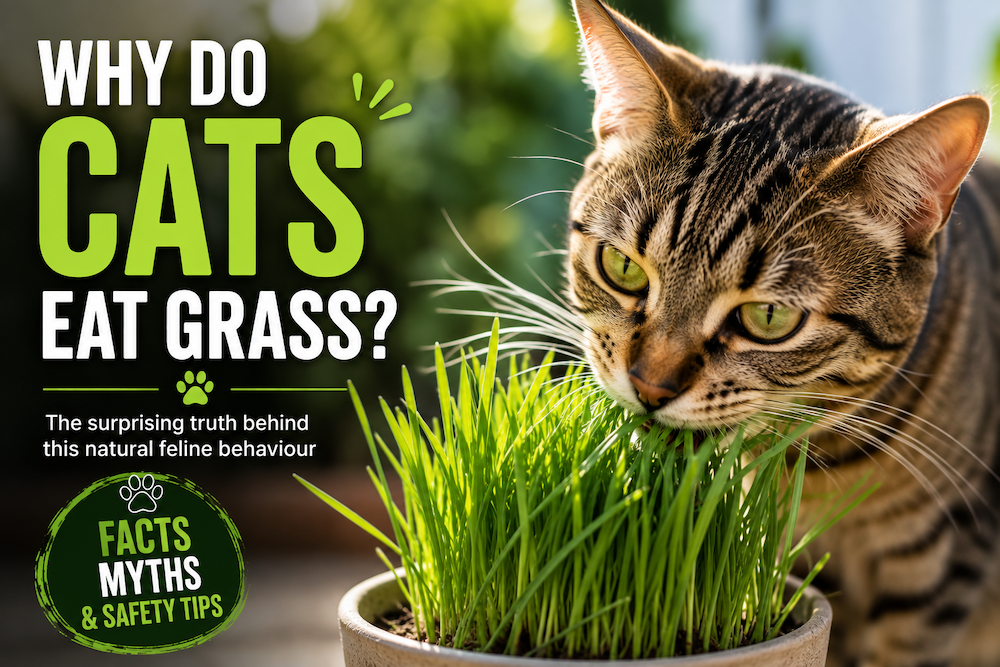
Why Do Cats Eat Grass?
The Surprising Truth Behind Your Little Carnivore
Your cat is a highly specialised predator.
They have razor-sharp claws, canine teeth, extraordinary hearing and a body designed around eating meat. In fact, cats are obligate carnivores, meaning animal-based nutrition is essential to their survival.
So why does this finely tuned little predator wander outside and start eating the lawn?
Why do cats eat grass?
The usual explanation is that cats eat grass because they’re feeling sick, want to make themselves vomit or need to get rid of a hairball.
It sounds perfectly reasonable.
There’s just one problem.
Research suggests the real answer is far more interesting.
Plant eating appears to be surprisingly common among cats, most don’t seem sick before they do it, and scientists have even found clues suggesting this strange habit could have roots stretching back to their wild ancestors.
Why Does My Cat Eat Grass?
The first surprise is just how common plant eating appears to be.
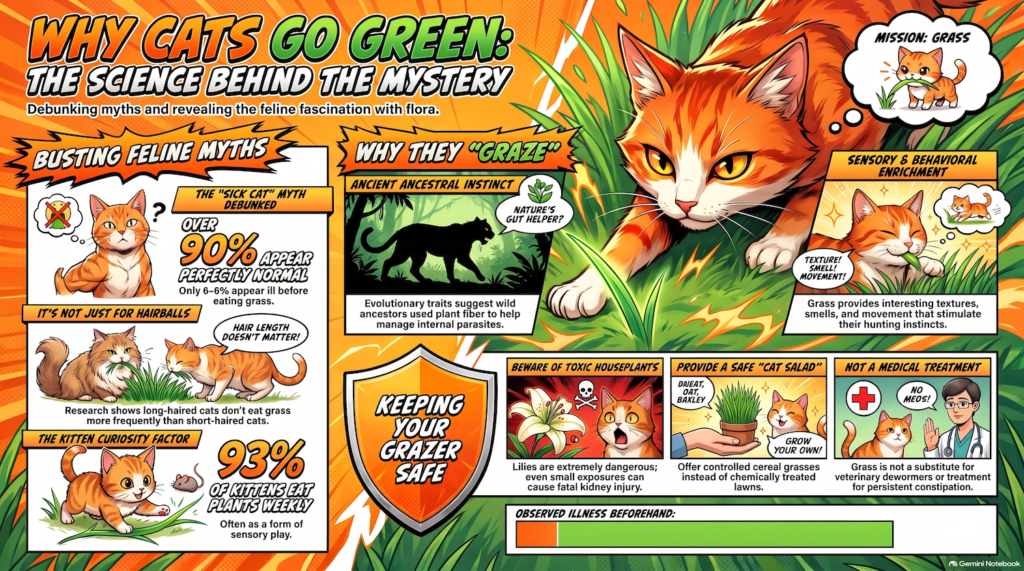
Research based on large surveys of cat owners found that 65% of cats in one survey ate plants weekly, while another found that 71% had been observed eating plants at least six times.
So if your cat occasionally turns into a miniature lawnmower, you aren’t alone.
But aren’t cats supposed to eat meat?
Absolutely.
Cats are obligate carnivores, but that doesn’t mean they’re physically incapable of eating vegetation.
It means cats have particular nutritional requirements that depend heavily on nutrients obtained from animal tissues. These include nutrients such as taurine, arginine and preformed vitamin A.
A cat can therefore require a meat-based diet while still occasionally choosing to eat a plant.
The intriguing question is why they choose to do it.
It could be an ancient feline behaviour
One of the most fascinating possibilities is that plant eating is an instinctive behaviour inherited from feline ancestors.
Plant material has been found in wild felids, leading researchers to investigate whether vegetation consumption may have provided an evolutionary advantage.
One hypothesis involves intestinal parasites.
Fibrous plant material moving through the digestive tract might historically have helped ancestral animals manage intestinal parasites or parasite material.
Importantly, this doesn’t mean grass is a natural dewormer and you should never use it instead of proper parasite prevention or veterinary treatment.
But it raises an extraordinary possibility.
Your cat may live in a house, sleep on your bed and eat carefully formulated food from a bowl…
yet their desire to nibble grass could have origins far older than domestication itself.
Maybe cats simply enjoy grass
Not every feline behaviour requires an elaborate medical explanation.
Cats may also eat grass because they enjoy it.
Think about a patch of grass from your cat’s perspective.
It moves.
It smells interesting.
It bends when touched.
It brushes against their whiskers.
It provides an unusual texture when bitten.
For an indoor cat especially, a pot of living grass can provide something interesting to investigate, chew and interact with.
Sometimes the answer to “Why is my cat eating grass?” may simply be:
Because your cat likes eating grass.
Do Cats Eat Grass Because They Are Sick?
This is where the most popular explanation begins to fall apart.
The familiar story goes like this:
Cat feels sick → cat eats grass → cat vomits → cat feels better.
If that’s what’s happening, we’d expect cats to commonly appear unwell before eating plants.
Researchers found something very different.
In major owner surveys, only around 6–9% of cats were frequently reported as appearing ill before eating plants.
In other words, more than 90% didn’t appear sick beforehand.
That’s a pretty significant clue.
Why do cats eat grass and then throw up?
Here’s where things get interesting.
Although relatively few cats appeared ill before eating plants, a larger proportion were reported vomiting afterwards.
Around 27–37% were frequently reported to vomit after eating plants in the surveys.
But that doesn’t necessarily mean the cat ate the grass in order to vomit.
Consider another possibility:
Your cat feels perfectly fine.
They eat several fibrous blades of grass.
The relatively indigestible plant material irritates or stimulates their gastrointestinal tract.
They vomit.
To us, it looks as though:
“The cat knew they were sick and ate grass to make themselves throw up.”
But the actual sequence may sometimes be:
Healthy cat → eats grass → vomits because they ate grass.
Scientists cannot simply ask cats which explanation they prefer, so the precise motivation remains difficult to prove.
What the research does tell us is that sickness before plant eating appears relatively uncommon.
Do kittens eat grass?
Here’s another fascinating clue.
Younger cats appear to be particularly enthusiastic plant eaters.
In one survey, around 93% of cats under one year old were reported eating plants weekly.
Young cats were also less likely to appear sick beforehand and less likely to vomit afterwards.
That’s difficult to reconcile with the idea that plant eating is mainly a response to illness.
It makes much more sense if chewing vegetation is part of normal feline exploratory or inherited behaviour.
And anyone who has lived with a kitten knows that investigating something often involves three stages:
Look at it.
Attack it.
Put it in your mouth.
Does Eating Grass Help Cats With Hairballs?
This is the other explanation almost every cat owner has heard.
Cats groom themselves constantly.
They swallow loose hair.
That hair can accumulate in the digestive system.
So perhaps cats eat grass to help bring up hairballs?
It’s a plausible theory.
But researchers found a very interesting way to examine it.
The long-haired cat test
Think about this logically.
If cats mainly eat grass to help deal with swallowed hair, which cats should have the greatest reason to eat plants?
Long-haired cats.
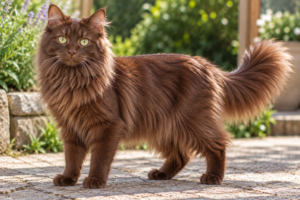
They generally have more hair available to swallow while grooming than short-haired cats.
Researchers compared them.
And the expected difference wasn’t there.
Long-haired and short-haired cats did not show meaningful differences in how frequently they ate plants.
They also weren’t significantly different in how often they appeared ill beforehand or vomited afterwards.
That doesn’t mean grass and hairballs can never interact.
A cat may swallow hair.
The same cat may eat grass.
Both can end up in the stomach.
And both may subsequently appear in the same pile on your carpet.
But seeing grass beside a hairball doesn’t prove your cat deliberately ate the grass to remove the hairball.
Sometimes two things simply end up travelling together.
Does grass give cats fibre?
Grass contains fibrous plant material, and fibre can affect gastrointestinal movement and stool formation.
So it’s possible that consuming small amounts of vegetation provides digestive effects for some cats.
But we shouldn’t leap from that possibility to:
“My cat is eating grass because their diet doesn’t contain enough fibre.”
Cats eating nutritionally complete diets may still consume vegetation.
Grass eating alone isn’t evidence that your cat’s food is deficient.
If you’re concerned about your cat’s diet, digestion or constipation, speak with your veterinarian before making significant dietary changes.
Is cat grass safe?
For cats that actively seek vegetation, providing a known safe source of cat grass can be a useful option.
And here’s a fun fact:
Cat grass isn’t the same thing as catnip.
Cat grass commonly consists of young cereal grasses such as:
- Wheat.
- Oat.
- Barley.
- Rye.
Catnip is a completely different plant—Nepeta cataria, a member of the mint family—which can produce its famous behavioural response in susceptible cats.
So one is essentially feline recreational chemistry.
The other is salad.
The real danger may not be the grass
Occasionally nibbling safe grass may not be particularly concerning for a healthy cat.
But random vegetation is another matter.
Outdoor grass can potentially be contaminated with:
- Herbicides.
- Pesticides.
- Fertilisers.
- Other garden chemicals.
- Animal faeces.
- Parasites.
Indoor cats face another risk:
houseplants.
A cat doesn’t necessarily know the difference between a safe pot of cat grass and a toxic decorative plant.
Some common plants can make cats seriously ill.
Certain true lilies and daylilies are particularly dangerous, because even small exposures can potentially cause severe kidney injury.
If you suspect your cat has eaten or been exposed to a toxic plant, contact your veterinarian or the appropriate animal poison service where you live promptly rather than waiting for symptoms to appear.
When should grass eating worry you?
The important thing isn’t simply whether your cat eats grass.
It’s whether the behaviour is normal for your cat and what else is happening.
An otherwise healthy cat occasionally nibbling safe grass is very different from a cat that suddenly starts frantically consuming vegetation.
Speak with your veterinarian if grass or plant eating becomes excessive or occurs alongside:
- Repeated vomiting.
- Diarrhoea.
- Loss of appetite.
- Weight loss.
- Lethargy.
- Abdominal discomfort.
- Constipation or straining.
- A significant change in normal behaviour.
Also pay attention if your cat begins persistently eating other non-food materials such as plastic, fabric, paper, wool or litter.
That may require investigation for medical or behavioural causes.
So, Why Does Your Cat Eat Grass?
The most accurate answer may be:
There probably isn’t one single reason.
For some cats, grass may provide interesting taste and texture.
For others, fibre and gastrointestinal effects could play a role.
Plant eating may provide enrichment.
And some cats may simply possess an inherited behavioural tendency to eat vegetation that reaches all the way back to their wild ancestors.
What the research challenges is the simplistic idea that a grass-eating cat must be sick.
Most cats studied didn’t appear ill beforehand.
And the equally popular hairball explanation isn’t as convincing as it first appears either—particularly because long-haired cats don’t seem to eat plants more frequently than short-haired cats.
Perhaps the strangest part of all is that grass eating isn’t really that strange.
Your cat may be an obligate carnivore.
They may possess the instincts and anatomy of an extraordinary little predator.
They may stalk imaginary prey through your living room, ambush your ankles and stare through the window as though they’re planning the downfall of every bird in the neighbourhood.
And then they’ll wander over to a pot of grass…
and have a salad.
Because sometimes the most mysterious thing about cats is simply being a cat.