Why Do Dogs Eat Grass?
The Surprising Truth Behind Your Dog’s Grass Grazing
You buy your dog carefully formulated food packed with protein, vitamins and minerals.
Perhaps you even buy the expensive stuff.
Then you take them outside and watch them enthusiastically start eating the lawn.
So why do dogs eat grass?
One of the most common explanations is that dogs eat grass because they feel sick and deliberately want to make themselves vomit. It sounds convincing—especially if you’ve actually watched your dog eat grass and throw up shortly afterwards.
But the real story is much more interesting.
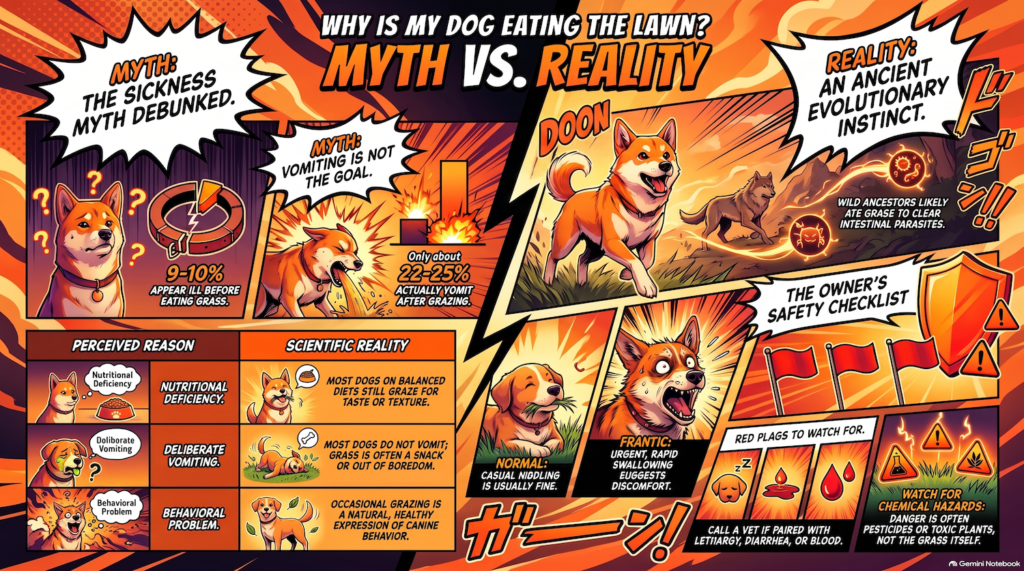
Research suggests that most dogs don’t appear ill before eating grass, and most don’t vomit afterwards. Grass eating may instead be a normal canine behaviour influenced by taste, texture, digestion, instinct, boredom or simply the fact that your dog enjoys doing it.
Usually it’s harmless.
Sometimes, however, the way your dog eats grass can tell you that something isn’t quite right.
Why Does My Dog Eat Grass?
The first thing to understand is that eating grass is extremely common among dogs.
For many healthy dogs, occasionally stopping for a nibble during a walk isn’t necessarily a sign that anything is wrong.
There may also be more than one explanation.
They might simply like it
Sometimes we overlook the most obvious possibility.
Your dog may enjoy eating grass.
Some dogs appear surprisingly selective. Rather than chomping indiscriminately through the lawn, they’ll sniff several patches before choosing particular blades.
Fresh shoots, soft grass and moist new growth may be especially appealing.
And remember that your dog doesn’t experience a lawn the way you do.
To us, it’s grass.
To a dog’s extraordinary nose, that same patch could contain scents from other dogs, wildlife, insects, soil, plants, food and countless other things we can’t detect.
What looks like an unremarkable lawn to you may be an enormous sensory noticeboard to your dog.
Your dog’s ancestors ate plants too
Plant eating isn’t something domestic dogs invented after humans created suburban lawns.
Plant material has also been observed in the diets of wild canids.
Researchers have even proposed that plant eating may have ancient evolutionary origins, potentially including a role in helping wild ancestors deal with intestinal parasites.
That doesn’t mean your dog is consciously eating grass to treat worms—and grass certainly isn’t a substitute for modern parasite prevention.
But it does suggest that occasionally eating vegetation may be a very old canine behaviour.
Your Labrador grazing in the park might be doing something dogs have inherited from ancestors stretching back thousands of years.
Could your dog need more fibre?
Grass contains fibrous plant material, so another possibility is that some dogs seek it because of its effect on digestion.
There is an intriguing published veterinary case involving a Miniature Poodle that had reportedly eaten plants and vomited regularly for years. After being switched to a higher-fibre diet, the behaviour stopped.
That’s fascinating—but it involved one dog.
It doesn’t prove that every grass-eating dog has a fibre deficiency.
If your dog eats a complete and balanced diet and occasionally grazes, there’s no reason to immediately assume their food is nutritionally inadequate.
Boredom may contribute
Sometimes grass is simply something to do.
A dog spending long periods alone in a garden without much exercise, play or mental stimulation may begin chewing vegetation as an activity.
If that’s happening, the solution may not be changing the dog’s food.
It could be more:
- Walks and sniffing opportunities.
- Interactive play.
- Training
- Food puzzles.
- Safe chews.
- Time interacting with you.
Stress and anxiety may also contribute to repetitive behaviours in some dogs, although grass eating alone isn’t enough to diagnose either.
Do Dogs Eat Grass When They Are Sick?
This is where the biggest grass-eating myth begins to unravel.
We’ve probably all heard some version of:
“Dogs eat grass when they’re sick because they know it will make them vomit.”
There is a problem with that explanation.
Most dogs that eat grass don’t appear to be sick beforehand, and most don’t vomit afterwards.
Veterinary summaries of research into plant-eating dogs have reported that only around 10% showed signs of illness before eating plants, while fewer than a quarter regularly vomited afterwards.
That doesn’t fit particularly well with the idea that dogs generally eat grass as a deliberate vomiting treatment.
But sick dogs can eat grass
This doesn’t mean the connection between nausea and grass is completely imaginary.
Some dogs experiencing gastrointestinal discomfort may urgently seek vegetation.
The important clue can be how they’re eating it.
There’s a big difference between:
“I’ll nibble these interesting blades while we’re walking.”
and:
“I MUST EAT THIS ENTIRE LAWN IMMEDIATELY.”
A dog frantically swallowing long pieces of grass before vomiting may indeed be experiencing digestive discomfort.
The chicken-and-egg problem
Here’s another fascinating question.
Suppose your dog:
- Eats grass.
- Vomits
What actually happened?
Did your dog feel nauseous and therefore eat grass?
Or did swallowing coarse grass irritate the digestive system enough to contribute to vomiting?
Seeing one event happen before another doesn’t automatically prove why it happened.
That’s why we should be cautious about claiming dogs deliberately use grass as a form of medicine.
Why does my dog eat grass and vomit yellow foam?
Owners sometimes notice their dog urgently eating grass and later vomiting yellow liquid or foam.
The yellow material is often bile, particularly when the stomach is relatively empty.
An occasional episode isn’t the same as a recurring problem.
If your dog repeatedly eats grass and vomits—especially first thing in the morning—it’s worth discussing the pattern with your veterinarian rather than simply assuming your dog “needs grass”.
There could be an underlying gastrointestinal issue that deserves investigation.
Should I Stop My Dog Eating Grass?
For an otherwise healthy dog occasionally nibbling clean, untreated grass, there’s usually no reason to panic.
But that doesn’t mean all grass is automatically safe.
Ironically, the biggest danger may sometimes be what’s on the grass, rather than the grass itself.
Watch out for lawn chemicals
Grass may have been treated with:
- Herbicides
- Pesticides
- Fertilisers
- Weed killers.
- Slug or snail products.
- Other garden chemicals.
Don’t allow your dog to graze in recently treated areas, and always follow the safety instructions for products used on your own lawn.
Be particularly cautious in unfamiliar public or landscaped areas where treatment signs are displayed.
Grass can contain more than grass
Areas used by dogs and wildlife can potentially be contaminated with faecal material and parasites.
Your dog may also accidentally consume plants growing amongst the grass.
Some ornamental plants are toxic to dogs and can cause anything from gastrointestinal upset to serious poisoning.
Knowing what’s growing in your own garden is therefore important.
When is grass eating a concern?
Instead of asking only whether your dog eats grass, look at the bigger picture.
Occasional relaxed grazing by a happy, healthy dog is very different from a sudden behavioural change.
Speak to your veterinarian if grass eating becomes excessive or occurs alongside:
- Frequent vomiting.
- Persistent diarrhoea.
- Loss of appetite.
- Weight loss.
- Lethargy
- Abdominal discomfort.
- Blood in vomit or stool.
- Repeated gagging or retching.
- Difficulty passing stool.
- A sudden dramatic increase in grass eating.
Also pay attention if your dog starts eating large amounts of other non-food items such as soil, stones, fabric or plastic.
Don’t punish your dog for grazing
If you don’t want your dog eating grass, punishment isn’t necessary.
Instead, teach a positive “leave it” cue, redirect them and reward them for moving away.
If boredom appears to be contributing, give them something better to do.
And if your dog seems compelled to eat grass or repeatedly becomes sick afterwards, investigate the reason rather than simply trying to suppress the behaviour.
So, Why Does Your Dog Eat Grass?
The slightly frustrating—but scientifically more accurate—answer is:
There probably isn’t one reason.
Some dogs may enjoy the taste or texture.
Some may be exploring.
Some may be bored.
Dietary fibre could influence the behaviour in certain individuals.
Grass eating may also have roots in behaviours inherited from wild ancestors.
And yes, some dogs experiencing digestive discomfort may seek grass.
But the familiar idea that dogs generally eat grass because they’re sick and deliberately want to make themselves vomit doesn’t explain what researchers have observed in most grass-eating dogs.
For many healthy dogs, occasional grazing appears to be exactly that:
normal dog behaviour.
So the next time your dog ignores the premium food you’ve carefully selected and starts eating your lawn, don’t immediately assume something is wrong.
Watch how they’re eating.
Watch how often they’re doing it.
And most importantly, watch the dog attached to the mouth.
If they’re happy, energetic, eating normally and merely sampling a few blades during a walk, your little lawnmower probably isn’t giving you cause for alarm.
But if the behaviour suddenly changes, becomes frantic or comes with signs of illness, that’s when the grass may be telling you something worth investigating.
Because sometimes your dog eats grass because their stomach isn’t feeling right.
And sometimes…
your dog is simply being a dog.