Why Does My Cat Bite Me?
You’re sitting peacefully with your cat.
They’re purring. You’re giving them a gentle stroke. Everything seems perfectly fine.
Then suddenly…
BITE.
It can feel as though your cat changed their mind about you in a split second.
But why does your cat bite you?
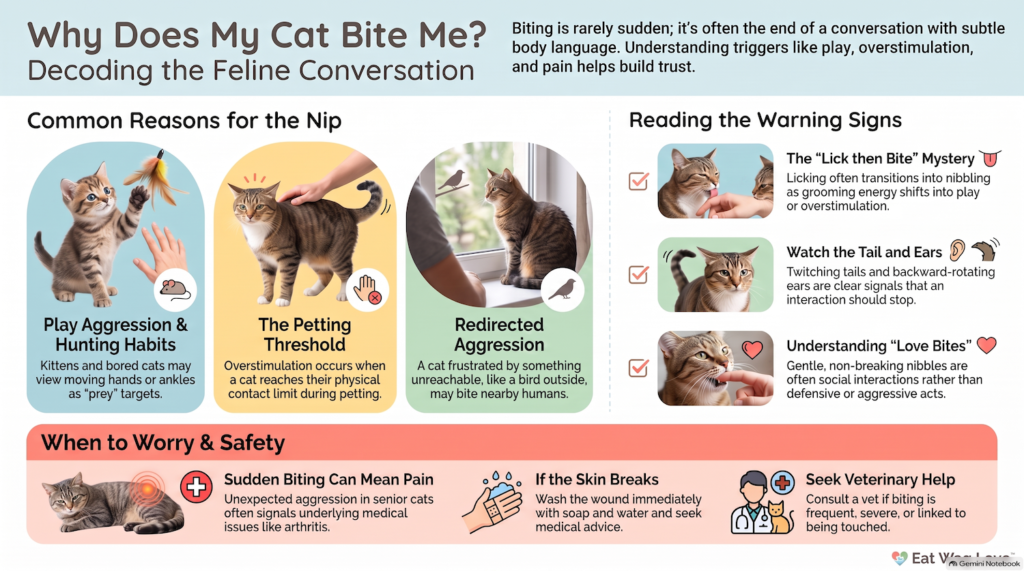
The answer is rarely as simple as your cat being “aggressive”. Cats bite for many reasons, including play, overstimulation, fear, frustration, redirected aggression and sometimes pain.
And here’s one of the most important things to understand:
The bite may be the final part of the message—not the beginning.
Your cat may have already been communicating through their eyes, ears, tail and body before their teeth ever became involved.
Learning to recognise those signals can help prevent bites—and help you understand your cat considerably better.
Why Do Cats Bite Their Owners?
Biting is a completely natural part of feline behaviour.
Cats are predators. Their teeth aren’t only designed for eating—they’re also used during hunting, play, defence and social interactions.
The important question isn’t simply:
“Did my cat bite me?”
It’s:
“What was happening when my cat bit me?”
Your cat may simply be playing
This is especially common with kittens and younger cats.
Kittens learn about their world through play. They stalk, chase, pounce, grab and bite.
Unfortunately, sometimes the prey they’re stalking is…
your ankle.
If your cat hides behind the sofa before launching an elaborate surprise attack on your feet, they’re probably not plotting your downfall.
You may have simply become the most interesting moving target in the room.
Play biting can include:
- Stalking
- Crouching
- Pouncing
- Grabbing
- Biting
- Kicking with the back legs.
This is why it’s important not to teach kittens that hands and feet are toys.
A tiny kitten attacking your fingers might seem adorable.
A fully grown cat doing exactly the same thing can be considerably less enjoyable.
Use wand toys, balls, toy mice and kicker toys instead.
Toys are for biting. Humans aren’t.
Your cat might need more opportunities to play
Cats retain powerful predatory instincts even when their dinner conveniently arrives in a bowl every evening.
They still benefit from opportunities to:
Stalk → Chase → Pounce → Catch.
Without enough appropriate play and mental stimulation, some cats may redirect their energy towards moving hands, ankles or other pets.
Several short interactive play sessions can provide a much better outlet.
And occasionally let your cat catch the toy.
Even tiny household predators deserve to win sometimes.
Your cat may be frightened
A frightened cat generally wants distance from whatever is making them uncomfortable.
If they can escape, many cats will simply leave.
But what happens if they can’t?
A cat that feels cornered, trapped or restrained may eventually bite to create distance.
You may see warning signals first:
- Flattened or backward-facing ears.
- Dilated pupils.
- A tense body.
- Hissing
- Growling
- Swatting
- Attempts to retreat.
The message isn’t necessarily:
“I want to attack you.”
It may simply be:
“Please move away.”
Your cat may be experiencing pain
This is particularly important when biting is new behaviour.
Imagine your cat has always enjoyed having their back stroked but suddenly begins biting whenever you touch one particular area.
Don’t automatically assume they’ve developed an attitude problem.
Something might hurt.
Pain-related behaviour can potentially occur with conditions involving joints, teeth, ears, skin, injuries or other health problems.
Cats can be remarkably good at concealing discomfort.
Sometimes a behavioural change is one of the first signs an owner notices.
If your normally friendly cat suddenly becomes defensive when touched, veterinary advice is sensible.
What Does It Mean When A Cat Bites You?
There isn’t one universal translation for a cat bite.
A playful kitten bite means something very different from a defensive bite from a frightened adult cat.
To understand what happened, look at the whole situation.
Your cat’s body language can reveal the answer
Cats communicate constantly.
We just don’t always notice.
Pay attention to:
Eyes: Have the pupils suddenly become much larger?
Ears: Are they relaxed and forward, or beginning to rotate backwards?
Tail: Is it resting comfortably or flicking increasingly quickly?
Body: Is your cat loose and relaxed or becoming rigid?
Head: Have they suddenly started looking towards your hand?
Movement: Are they trying to leave?
These small signals can transform an apparently unpredictable bite into something much easier to understand.
Why does my cat give me little “love bites”?
Some cats gently nibble their owners during relaxed social interactions.
People commonly call these love bites.
It’s a cute name, but it isn’t a precise scientific category.
A gentle nibble could occur during:
- Social interaction.
- Grooming
- Play
- Attention-seeking.
- Mild overstimulation.
Look at intensity and body language.
A relaxed cat gently nibbling without breaking the skin is very different from a frightened or highly aroused cat delivering a forceful defensive bite.
So don’t automatically translate every little bite as:
“My cat loves me.”
But don’t automatically assume it’s aggression either.
Why does my cat lick me and then bite me?
This is another classic cat-owner mystery.
Your cat might happily lick your hand several times…
then suddenly nibble or bite it.
The interaction could be transitioning from grooming into play.
Your cat may be becoming overstimulated.
Or the bite may simply communicate that they’ve had enough.
Again, the tail, ears, eyes and body position can provide important clues.
Your cat might be upset about something completely different
One of the most fascinating explanations is redirected aggression.
Imagine your indoor cat spots an unfamiliar cat outside the window.
They become intensely aroused.
Their body becomes tense.
Their pupils enlarge.
Their tail begins moving.
But they can’t reach the other cat.
Then you innocently walk over and touch them.
BITE.
You weren’t the original cause of the reaction.
You were simply the nearest available target.
Redirected aggression is one reason a bite can appear to come completely “out of nowhere”.
If your cat is intensely focused on another animal or something frightening, don’t immediately pick them up.
Give them time and space to calm down.
Why Does My Cat Bite Me When I Pet Them?
This is perhaps the most confusing situation of all.
Your cat voluntarily comes over.
They climb onto your lap.
They’re purring.
You stroke them.
They appear to be enjoying themselves.
And then they bite you.
One possible explanation is petting-induced overstimulation.
Cats have different petting limits
Not every cat wants twenty minutes of continuous stroking.
One cat might happily enjoy a long cuddle.
Another may decide:
Five strokes. That was excellent. We’re done now.
The problem occurs when the human keeps going.
The cat may initially communicate more subtly.
Watch for:
- Tail twitching.
- Skin rippling.
- Ears moving backwards.
- Enlarged pupils.
- Turning towards your hand.
- Increasing body tension.
- Trying to reposition or leave.
Stop the interaction while it’s still positive rather than waiting for your cat to make their feelings unmistakably clear.
Where you pet your cat matters too
Many cats enjoy being stroked around areas such as the:
- Cheeks
- Chin
- Forehead
- Base of the ears.
Some cats may be considerably less enthusiastic about having their:
- Belly
- Feet
- Tail
- Lower back.
touched.
Every cat is different.
Learning your own cat’s preferences is much more useful than assuming all cats enjoy the same type of affection.
Purring doesn’t always mean “keep going”
This catches many owners by surprise.
A cat can be purring and enjoying an interaction but still eventually reach their tolerance limit.
Think of feline affection as something your cat participates in rather than something being done to them.
Give them opportunities to choose when interaction begins and when it ends.
Never punish your cat for biting
Shouting, hitting, spraying water or frightening your cat doesn’t explain what you’d prefer them to do.
Worse, punishment can add fear to the interaction.
If your cat bites:
- Stop what you’re doing.
- Stay calm.
- Give them space.
- Think about what happened immediately beforehand.
The useful question isn’t:
“How do I punish my cat for biting?”
It’s:
“Why did my cat feel they needed to bite?”
When should biting concern you?
Occasional playful or overstimulation-related biting is very different from a major unexplained behavioural change.
Talk to your veterinarian if biting:
- Starts suddenly.
- Becomes dramatically more frequent.
- Happens whenever one particular area is touched.
- Is accompanied by hiding.
- Occurs alongside appetite changes.
- Appears with mobility problems.
- Is associated with toileting changes.
- Becomes unusually severe.
Medical causes should be considered before simply labelling a cat as aggressive.
What should you do if a cat bite breaks the skin?
Cat teeth can create small but relatively deep puncture wounds.
If a bite penetrates your skin, wash the wound promptly and thoroughly with soap and running water.
Don’t assume a tiny-looking puncture is automatically insignificant.
Seek appropriate medical advice, particularly for deep wounds or if you develop increasing:
- Redness
- Swelling
- Warmth
- Pain
- Discharge
- Fever
Because Eat Wag Love has a global audience, it’s also important to remember that recommendations concerning rabies and tetanus vary depending on the country, animal and circumstances.
Follow the medical and public-health advice applicable where you live.
Your Cat May Have Been Talking Before They Bit
So, why does your cat bite you?
Sometimes they’re playing.
Sometimes they’ve had enough petting.
Sometimes they’re frightened.
Sometimes they’re frustrated.
Sometimes something completely different has triggered their reaction.
And occasionally, a sudden change in biting behaviour can indicate discomfort or pain.
The fascinating part is that cats often communicate before they bite.
The tail starts twitching.
The ears change position.
The pupils widen.
The muscles become tense.
They look towards your hand.
What seemed like a bite that came from nowhere may actually have been the final sentence in a conversation that started several seconds earlier.
The better we become at recognising those signals, the less mysterious our cats become.
And perhaps that’s the biggest lesson.
Instead of simply asking:
“Why did my cat bite me?”
try asking:
“What was my cat trying to tell me before they did?”
Learning that language can mean fewer bites, better interactions and a much stronger understanding of the wonderfully complicated cat sharing your home.