Why Does My Dog Stare at Me?
What Your Dog Is Really Trying to Tell You
You’re sitting on the sofa when you get that strange feeling.
You’re being watched.
You look across the room and there they are.
Your dog.
Staring directly at you.
You go to the kitchen. They stare.
You put your shoes on. They stare.
You pick up your keys and suddenly the surveillance operation reaches maximum intensity.
And if you’re eating?
Those eyes become almost impossible to ignore.
So why does my dog stare at me?
Sometimes it’s affection. Sometimes your dog wants something. Sometimes they’re waiting for information, anticipating what you’re about to do or even asking you for help.
And occasionally, a stare can mean something completely different.
The fascinating truth is that your dog isn’t necessarily just looking at you.
They may be reading you.
Why Do Dogs Stare?
Dogs pay extraordinary attention to humans.
Think about how important you are to your dog’s world.
You control food, walks, doors, toys, car rides, access to the garden and many of the best things that happen during their day.
Watching you makes sense.
But dogs can become remarkably good at noticing the tiny signals that predict what happens next.
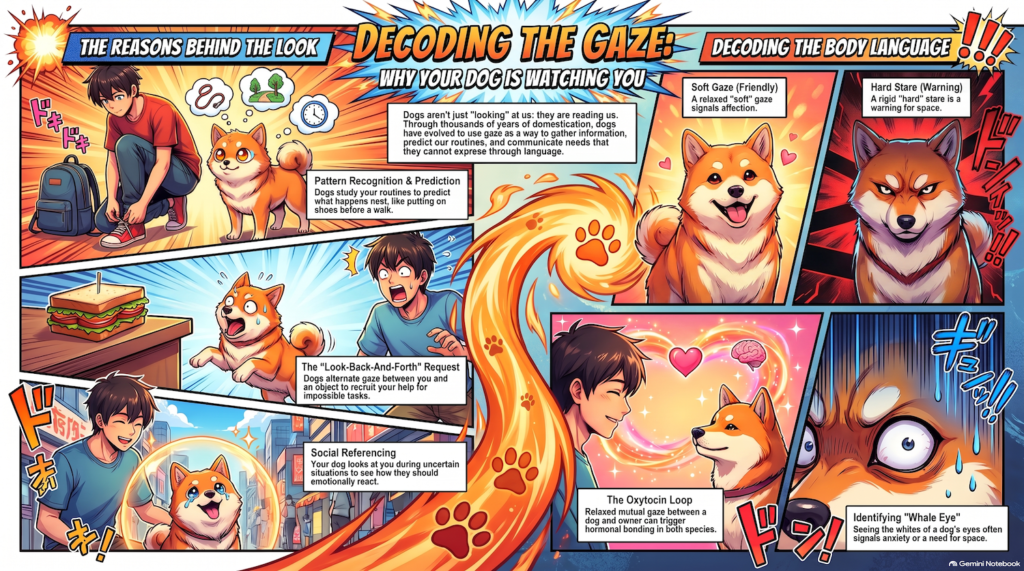
Your dog has been studying you
You may think you’ve spent years training your dog.
There’s a good chance your dog has spent those same years training themselves to understand you.
Perhaps you:
- Finish your coffee.
- Close your laptop.
- Put on particular shoes.
- Pick up your phone.
- Walk towards the door.
Your dog is already jumping around excitedly.
You haven’t touched the leash.
You haven’t said “walk”.
How did they know?
Probably because they’ve seen this sequence dozens—or hundreds—of times before.
Dogs learn patterns.
Your movements, routines and habits provide clues about what is going to happen next.
What looks almost psychic may actually be something just as impressive:
Your dog knows you incredibly well.
Sometimes they’re asking for something
Your dog’s stare may also be a request.
Watch what happens next.
Your dog looks at you.
Then the door.
Then back at you.
That message isn’t particularly difficult to translate.
“Open it.”
Or perhaps:
Dog looks at you.
Looks at ball.
Looks at you.
“Human. Ball. You know what to do.”
Dogs can alternate their gaze between a person and an object as part of communication.
Researchers have also studied what happens when dogs encounter problems they can’t solve themselves.
Imagine a favourite toy or treat becomes inaccessible.
The dog tries to retrieve it.
They try again.
Eventually they stop…
and look at the human.
That look may not mean:
“I give up.”
It may effectively mean:
“Your turn.”
For an animal living with humans, that’s a clever strategy.
After all, you have hands.
Does My Dog Stare at Me Because They Love Me?
Sometimes, yes.
And this is one of the most fascinating parts of the relationship between humans and dogs.
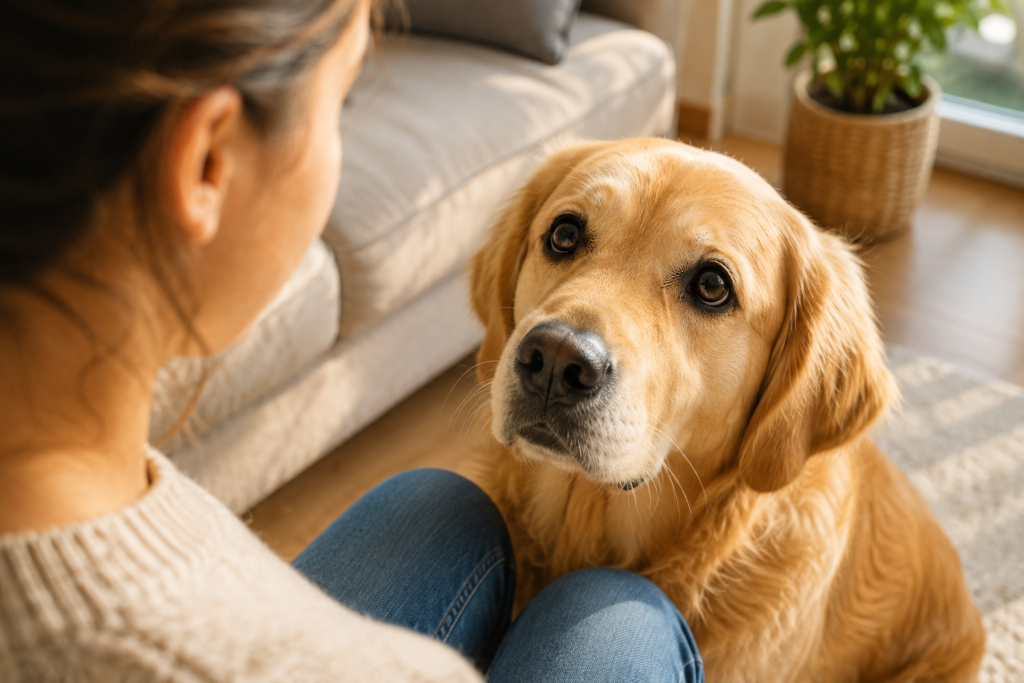
Positive, relaxed mutual gaze between dogs and their familiar humans has been associated with oxytocin-related bonding processes.
Oxytocin is frequently nicknamed the “love hormone”, although its biological role is more complicated than that simple label suggests.
Research into dog-human relationships has found that mutual gaze can participate in a positive feedback process associated with social bonding.
In other words, that quiet moment when your relaxed dog looks into your eyes may genuinely be part of the extraordinary bond between your two species.
But there’s an important distinction:
Not every stare means “I love you.”
Your dog may be reading your emotions
Dogs don’t need to understand human emotions exactly as we do to recognise that something about us has changed.
They can notice differences in:
- Facial expression.
- Voice.
- Body posture.
- Movement.
- Behaviour.
- Daily routine.
Your dog may therefore watch you more closely when you’re upset, excited, angry or behaving unusually.
Researchers have also investigated social referencing in dogs.
This is essentially the idea that an animal can use another individual’s reaction to help decide how to respond to something uncertain.
Imagine your dog encounters a strange object.
They look at it.
Then they look at you.
They may be gathering information.
“You’re relaxed about this. Maybe I don’t need to worry.”
That’s far more sophisticated than simply staring.
Why does my dog follow me and stare at me?
Because you’re interesting.
Or, more accurately, interesting things tend to happen around you.
Food appears.
Doors open.
Walks begin.
Games happen.
Cars go places.
Your dog may also simply enjoy being close to you.
Dogs are social animals, and following a familiar person can be part of normal companionship.
So when your dog follows you into the bathroom and stares at you as though you’re conducting an important meeting together…
they may simply not want to miss whatever fascinating event happens next.
Even though absolutely nothing does.
Why Does My Dog Stare at Me While I’m Eating?
This one is usually considerably less mysterious.
They want your food.
But there’s an interesting behavioural lesson hiding behind those enormous pleading eyes.
Imagine this:
Your dog stares at your sandwich.
You ignore them.
They continue staring.
You resist.
The eyes become even more tragic.
Eventually you think:
“Oh alright. Just a tiny piece.”
You give them some.
What has your dog learned?
Staring works.
If a behaviour produces something rewarding, that behaviour can become more likely in the future.
So your dog tries again tomorrow.
And again.
Eventually you have a dog capable of staring at a piece of chicken with the concentration of an Olympic athlete.
You may think you’ve trained your dog.
At this particular moment…
your dog may have trained you.
Why does my dog stare at me before a walk?
Again, prediction.
Dogs learn chains of events.
Perhaps every afternoon you finish work, stand up, change shoes and grab your phone before walking the dog.
Eventually the first part of that sequence becomes enough.
Laptop closes.
Dog looks up.
You stand.
Dog stares.
Shoes appear.
Tail starts wagging.
The leash hasn’t even appeared yet.
Your dog has simply learnt what comes next.
Perhaps dogs aren’t the creatures of habit after all.
Maybe we are.
Why does my dog stare at me when they poop?
Yes, we’re going there.
It’s one of those questions dog owners quietly wonder about.
A popular explanation is that dogs feel vulnerable while toileting and stare at their owners for protection.
It’s possible that monitoring a trusted person provides useful social information, but we shouldn’t pretend science has given us one definitive translation for the famous poop stare.
Your dog could be:
- Checking where you are.
- Maintaining social contact.
- Watching whether you’re moving away.
- Anticipating what happens next.
- Simply behaving out of habit.
So despite what you may have read online, we can’t confidently translate the look as:
“Guard me while I do this.”
Sometimes science has to admit that dogs aren’t providing subtitles.
Not every stare is friendly
This is the most important part of understanding canine staring.
Compare two dogs.
The first has:
- Soft eyes.
- Relaxed eyelids.
- Loose facial muscles.
- A comfortable mouth.
- Relaxed posture.
- Natural blinking.
That’s very different from a dog showing:
- A rigid body.
- Fixed, unblinking eyes.
- A tense or closed mouth.
- Freezing.
- Forward weight.
- Tension around food, a toy or another valued object.
That second dog may be giving a hard stare.
The message could be:
“Give me space.”
Don’t stare back in an attempt to “show who’s boss”.
Create space and avoid escalating the situation.
If hard staring occurs around food, toys or other valued items, resource guarding may be involved and professional behavioural guidance may be appropriate.
What is whale eye?
Another useful signal is sometimes called whale eye.
This happens when a dog turns their head while keeping their eyes directed towards something, making the white of the eye unusually visible.
Whale eye can occur when a dog feels uncomfortable or concerned, particularly when combined with body tension.
You might see it when a dog is:
- Guarding something.
- Being hugged when they don’t enjoy it.
- Crowded by a person or child.
- Nervous about handling.
- Trying to avoid confrontation.
So while social media may call it hilarious “side-eye”, the rest of the dog’s body may be telling a more important story.
Why does my dog stare at nothing?
Sometimes your dog suddenly becomes fascinated by a wall or empty corner.
Before assuming your house is haunted, remember that dogs experience the environment differently from us.
They may detect:
- Tiny movements.
- Insects.
- Reflections.
- Faint sounds.
- Smells you haven’t noticed.
However, a new pattern of persistent unexplained staring can occasionally deserve veterinary attention, particularly if it occurs alongside:
- Confusion.
- Circling.
- Abnormal movements.
- Reduced responsiveness.
- Disorientation.
- Seizure-like activity.
- Significant behavioural changes.
This can be particularly important in older dogs.
Staring alone doesn’t diagnose a medical problem, but a sudden change in normal behaviour is worth investigating.
So, What Is Your Dog Really Saying?
The answer depends entirely on the situation.
A stare might mean:
“I love you.”
Or:
“Feed me.”
“Open the door.”
“Throw the ball.”
“Is it walk time?”
“Help me get that.”
“What are you doing?”
Or occasionally:
“I’m uncomfortable. Please give me space.”
That’s why the most important rule is:
Never read the eyes without reading the dog.
Look at the ears.
The mouth.
The tail.
The posture.
The movement.
And what is happening around them.
A stare isn’t a complete sentence by itself.
It’s one word in a much bigger conversation.
And perhaps that’s what makes your dog’s staring so fascinating.
Humans and dogs are two very different species, yet thousands of years of living together have produced an extraordinary relationship.
Dogs watch us.
They learn our routines.
They notice our movements.
They seek information from us.
They ask us for help.
And sometimes they simply sit quietly and look into the eyes of the person they trust.
So the next time you look across the room and discover those familiar eyes fixed firmly on you, don’t just ask:
“Why does my dog stare at me?”
Ask something more interesting:
“What is my dog trying to tell me?”
Because they may not be able to speak our language.
But that doesn’t mean they’re not talking.