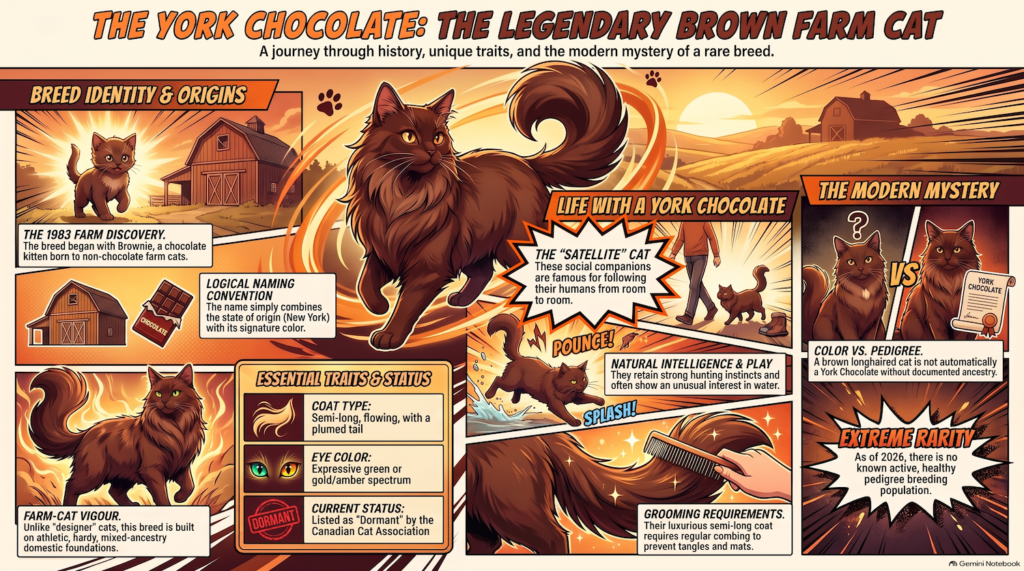
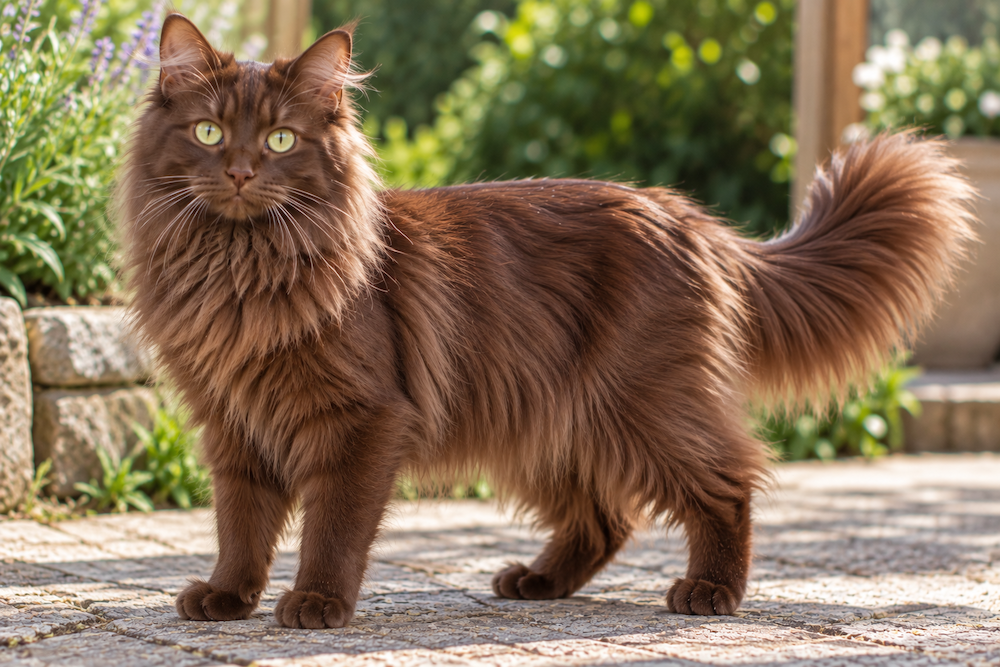






Rich chocolate-brown, silky-haired, and born almost by accident on an American dairy farm — the York Chocolate was a rare breed developed from ordinary farm cats, becoming famous for its unusual chocolate coat, affectionate personality, and a breed history that may now have ended almost completely.
🧠 QUICK SNAPSHOT
- Temperament: Affectionate, friendly, intelligent
- Energy Level: Moderate
- Size: Medium to Large
- Good With Families: Excellent
- Indoor Living: Excellent with enrichment
- Trainability: High
- Grooming: Moderate
- Best For: Families, interactive households, owners wanting an affectionate semi-longhaired companion
- Typical Lifespan: Often estimated at around 13–15 years, although reliable breed-specific data is extremely limited
📚 OVERVIEW
The York Chocolate has one of those breed histories that sounds almost too perfect.
It didn’t begin in a prestigious breeding establishment or through a carefully planned cross between famous pedigree cats.
Instead, its story began on a dairy farm in New York State during the 1980s.
Farm owner Janet Chiefari noticed an unusually beautiful long-haired brown kitten named Brownie among her cats.
Brownie later produced more kittens displaying rich chocolate colouring, convincing Chiefari that something unusual was being inherited.
From these humble beginnings, she began selectively breeding the cats and eventually developed what became known as the York Chocolate.
The breed was characterised by its medium-to-large muscular body, semi-long silky coat and rich chocolate or lilac colouring, sometimes combined with white.
York Chocolates were described as affectionate, playful and strongly people-oriented while retaining the hunting abilities you’d expect from their farm-cat ancestry.
Unfortunately, the story may not have a happy ending.
The breed never developed a large international population, and established York Chocolate breeding programs appear to have largely disappeared.
Today, the York Chocolate may be functionally extinct as an organised pedigree breed.
That makes its story particularly fascinating: an ordinary farm kitten helped create a recognised breed — and within only a few decades, that breed may have almost vanished again.
✅ PROS & CONS
Pros
- Affectionate and people-oriented
- Beautiful chocolate or lilac coat
- Historically considered an excellent family cat
- Intelligent and playful
- Strong natural hunting instincts
- Semi-long coat reportedly resisted matting reasonably well
- Fascinating natural farm-cat origins
Cons
- Extremely rare and possibly functionally extinct
- Virtually impossible to find from established modern breeding programs
- Limited breed-specific health research
- Semi-long coat still requires regular grooming
- Strong hunting instincts may make small pets unsuitable companions
- Not hypoallergenic
- Brown domestic cats can easily be incorrectly advertised as York Chocolates
Is a York Chocolate a Good Family Cat?
Yes. Historical descriptions portray the York Chocolate as an affectionate, friendly and family-oriented cat.
These cats were reported to form strong relationships with their humans and often enjoyed following family members around the home.
Their farm-cat ancestry also contributed a playful, curious side.
They weren’t simply decorative long-haired cats. York Chocolates were capable hunters with plenty of interest in toys, movement and exploration.
They could potentially live successfully with respectful children and compatible pets when properly introduced.
However, there is an important limitation when discussing temperament.
The York Chocolate population was always small, and there are very few — if any — established modern breeding populations from which to draw reliable behavioural information.
Historical breed descriptions are therefore more useful than claims about how today’s York Chocolates behave.
If someone currently offers you a York Chocolate kitten, verifying that it genuinely belongs to documented York Chocolate lines should come before assuming it will possess the traditional breed personality.
Can a York Chocolate Live Indoors or in an Apartment?
Yes. The York Chocolate was considered adaptable enough for indoor and apartment living, provided it received sufficient exercise and enrichment.
Its medium-to-large body meant it benefited from sturdy cat trees, scratching posts and adequate climbing territory.
Interactive toys and puzzle feeders could help satisfy the intelligence and hunting instincts inherited from its working farm-cat ancestors.
Secure indoor living would also be particularly sensible for a genuinely rare pedigree animal.
The breed’s historical hunting ability means homes containing pet birds, rodents or other small animals would require careful management.
York Chocolates were reportedly highly social with their humans, so a home providing regular companionship would generally be preferable to one where the cat was left alone for long periods every day.
The original York Chocolates may have started life around a dairy farm.
That doesn’t mean a modern one would need its own herd of cows to remain entertained.
How Much Exercise and Play Does a York Chocolate Need?
The York Chocolate had moderate exercise requirements but retained a playful and athletic personality.
Daily interactive play would be important.
Fishing-wand toys, balls, tunnels and games that simulate stalking and catching prey would be particularly appropriate.
Its farm-cat ancestry means the breed was historically associated with genuine hunting ability rather than being developed solely as a companion or show animal.
Climbing structures and elevated resting areas would provide additional physical activity.
Mental enrichment matters as well.
Puzzle feeders, hidden treats and simple training games can challenge an intelligent cat.
Several shorter play sessions throughout the day generally fit natural feline behaviour better than one extended workout.
The York Chocolate’s luxurious coat may have made it look sophisticated.
Underneath was still a cat whose ancestors had very practical opinions about what should happen when a mouse appeared.
Is a York Chocolate Easy to Train?
Yes. York Chocolates were historically described as intelligent and responsive cats, suggesting they should respond well to positive-reinforcement training.
Food rewards, toys, praise and clicker training can all be effective with motivated cats.
Practical behaviours such as coming when called, entering a carrier voluntarily, using designated scratching areas and accepting grooming can be taught gradually.
Training would also provide useful mental stimulation.
Because York Chocolates had semi-long coats, positive grooming training during kittenhood would have been particularly valuable.
Regular handling of the paws, ears, mouth and coat helps make routine care easier throughout adulthood.
As with any cat, punishment is unnecessary and can damage trust.
An intelligent farm-derived cat generally doesn’t need much help learning.
The more interesting question is whether it learns what you wanted it to learn or something considerably more useful to itself.
Does a York Chocolate Shed?
Yes. The York Chocolate had a semi-long, silky coat and would naturally shed.
Historical breed descriptions often emphasised that the coat was relatively easy to manage despite its length.
Regular brushing, perhaps two or three times a week depending on the individual, would help remove loose hair and prevent tangles.
More frequent grooming could be useful during seasonal shedding periods.
The coat was generally longer around areas such as the neck, chest and tail, creating an attractive flowing appearance.
Routine care should also include nail trimming, dental hygiene and examination of the ears, eyes and skin.
The York Chocolate was not hypoallergenic.
Its unusual brown colouring had nothing to do with production of feline allergens, which primarily originate in saliva and skin secretions.
Chocolate may sound delicious.
Unfortunately, it doesn’t make the cat allergy-friendly.
What Health Problems Are Common in a York Chocolate?
There isn’t enough reliable population data to identify a strong list of York Chocolate-specific inherited diseases.
This is an important distinction.
The breed developed from domestic farm cats and was never maintained in the large numbers required to generate comprehensive long-term health studies.
Historical descriptions generally portrayed York Chocolates as robust cats.
However, that shouldn’t be interpreted as evidence that the breed was genetically free of disease.
Like other domestic cats, they could potentially develop dental disease, kidney disease, urinary disorders, heart disease, arthritis, obesity and other common feline health problems.
A tiny breeding population also creates potential concerns about genetic diversity if breeding isn’t carefully managed.
If genuine York Chocolate lines still exist, maintaining detailed pedigrees and avoiding excessive inbreeding would be particularly important.
With an extremely rare breed, “we don’t know of a problem” is not the same thing as “the problem doesn’t exist.”
⭐ Did the York Chocolate Really Begin With One Brown Farm Kitten?
Yes — the breed’s story centres on a striking brown kitten named Brownie.
Brownie was born on Janet Chiefari’s dairy farm in New York State in 1983.
Her parents weren’t famous pedigree show cats.
They were farm cats.
Brownie stood out because of her beautiful long-haired chocolate-brown coat.
The story became even more interesting when Brownie later produced kittens that included more unusually coloured brown cats.
Chiefari realised the chocolate colouring wasn’t simply a one-off accident.
She began selectively breeding cats displaying the characteristics she wanted to preserve.
From this small group of farm cats, the York Chocolate gradually emerged.
It is an extraordinary example of how a completely new pedigree breed can begin.
No exotic wild cat.
No ancient royal palace.
No elaborate international breeding program.
Just one unusually beautiful kitten born in a barn in New York.
⭐ Who Was Minky — and Why Was He Important?
Brownie wasn’t the only important cat in the York Chocolate story.
One of her early descendants was a chocolate male called Minky.
Brownie and Minky reportedly produced kittens that helped establish both solid chocolate and chocolate-and-white cats within the developing breeding program.
These early generations allowed Janet Chiefari to demonstrate that the distinctive appearance could be reproduced rather than appearing as a single random mutation.
That was crucial.
Finding one unusual cat doesn’t create a breed.
A breeder needs to establish a population in which desired characteristics can be reliably inherited while maintaining health and consistent type.
Brownie may have started the story.
Minky and the following generations helped demonstrate that there was enough genetic consistency to turn an unusual farm cat into something resembling an organised breed.
⭐ Why Is the York Chocolate Called “York Chocolate”?
The name is wonderfully straightforward.
“York” refers to New York State, where the breed originated.
“Chocolate” refers to its characteristic rich brown coat.
Put them together and you get York Chocolate.
It is one of those rare breed names that tells you almost everything important before you’ve even seen the cat.
The breed was also produced in lilac, essentially a diluted version of chocolate, and both colours could occur with white depending on the breed standard.
But chocolate remained the colour most closely associated with its identity.
Considering some cat breeds require paragraphs of ancient-language translation to explain their names, the York Chocolate makes things refreshingly simple:
Where is it from?
New York.
What colour is it?
Chocolate.
Breed named.
⭐ Are Chocolate-Brown Cats Naturally Rare?
Solid chocolate is much less common in the general domestic-cat population than black, tabby, white or many other familiar colours.
The chocolate colour occurs when a cat inherits particular variants affecting the production of eumelanin, the pigment responsible for black and brown colouring.
Essentially, genetically black pigment is modified into a warmer brown shade.
For a cat to display chocolate colouring, it generally needs to inherit the appropriate recessive variants from both parents.
This helps explain why chocolate can appear unexpectedly in a population and then become more common when breeders deliberately select for it.
The York Chocolate breeding program took an unusual colour appearing among ordinary farm cats and made that colour central to an entire breed.
Brownie wasn’t simply given a food-inspired name because somebody liked chocolate.
Her colour was the genetic feature that ultimately gave the breed its identity.
⭐ Did the York Chocolate Have Siamese Ancestry?
The original farm cats behind the York Chocolate were reportedly believed to have some Siamese ancestry somewhere in their background, although their precise ancestry wasn’t documented like that of established pedigree cats.
This possibility has often been mentioned when discussing where the chocolate colour may have come from.
Chocolate-related colouring is well established in Siamese and related breeds.
However, it would be misleading to describe the York Chocolate simply as a long-haired chocolate Siamese.
The breed developed from an American farm-cat population and acquired a very different body type, coat and overall appearance.
Its uncertain foundation ancestry is actually part of what makes the York Chocolate interesting.
Breeders didn’t begin with a detailed pedigree chart.
They began with cats whose genetics had already been mixed naturally for generations.
⭐ Was the York Chocolate a Working Farm Cat?
Its foundation cats certainly were.
The original York Chocolates emerged from ordinary cats living around a dairy farm, where hunting ability had practical value.
Historical descriptions of the breed frequently mentioned strong hunting instincts.
That makes the York Chocolate quite different from breeds created primarily to achieve a particular show-ring appearance.
Its early ancestors weren’t selected because judges admired them.
They survived and reproduced within a working rural environment before Janet Chiefari noticed something unusual about their coats.
The later pedigree breed retained a more polished appearance, but its farm origins remained visible in its muscular build, intelligence and hunting behaviour.
Underneath all that silky chocolate fur was a cat whose family résumé once included:
rodent control.
⭐ Was the York Chocolate Recognised as an Official Breed?
The York Chocolate gained recognition from some smaller feline organisations, but it never achieved universal recognition across all of the world’s major registries.
This distinction matters.
The term “recognised breed” can sound absolute, but cat registries operate independently.
One organisation may accept a breed while another doesn’t.
During the York Chocolate’s development, enthusiasts worked to establish breed standards and expand recognition.
The breed gained enough attention to develop followers outside the United States, including in parts of Europe.
However, it never achieved the large breeder network needed to become a major international pedigree breed.
Limited recognition probably contributed to the difficulty of maintaining a sustainable population.
A breed can have an official name, standard and enthusiasts and still remain dangerously close to disappearing if there simply aren’t enough breeders maintaining it.
⭐ Is the York Chocolate Extinct?
Possibly — or at least functionally extinct as an organised pedigree breed.
This is one of the most fascinating and frustrating parts of the York Chocolate story.
Modern, verifiable breeding programs are extremely difficult to locate, and the breed has effectively disappeared from much of the organised cat-breeding world.
There may be individual cats descended from historic York Chocolate lines, but that isn’t the same thing as having a viable, documented breeding population.
This is why declaring the breed absolutely extinct requires caution.
Cats don’t come with a global census.
But from a practical pedigree perspective, the York Chocolate appears to have become extraordinarily scarce and may no longer exist as a sustainable organised breed.
That means its entire rise and decline may have occurred within roughly a few human generations.
⭐ Is Every Long-Haired Brown Cat a York Chocolate?
Definitely not.
A long-haired chocolate-brown domestic cat can look remarkably similar to a York Chocolate without having any documented connection to the breed.
Brown colouring can appear naturally in domestic cats through the appropriate genetic combination.
Long hair is also widespread.
Put the two traits together and you can produce a cat that visually resembles a York Chocolate.
Breed identity requires ancestry, not merely appearance.
This distinction is particularly important now that genuine York Chocolate breeding lines are so difficult to find.
An online seller advertising an ordinary brown kitten as an “extremely rare York Chocolate” should be able to provide convincing pedigree evidence.
Without documentation, the most accurate description may simply be:
an exceptionally beautiful chocolate domestic longhair.
And there’s absolutely nothing wrong with that.
⭐ Could the York Chocolate Breed Ever Be Recreated?
A cat that looks like a York Chocolate could certainly be produced again.
Breeders could select chocolate and lilac semi-longhaired domestic cats for similar size, structure and temperament.
But genetically and historically, that wouldn’t necessarily restore the original York Chocolate.
A pedigree breed represents more than a collection of visible characteristics.
It also represents documented descent from a particular foundation population.
If surviving descendants from the original York Chocolate lines could be identified and verified, a preservation program might theoretically rebuild the population.
Without those cats, creating similar-looking animals would essentially mean establishing a new breed inspired by the old one.
This raises a fascinating question about what “extinction” means for domestic breeds.
You can recreate the appearance.
You can recreate the colour.
You might even recreate the temperament.
But without the original genetic lineage, have you really brought the breed back?