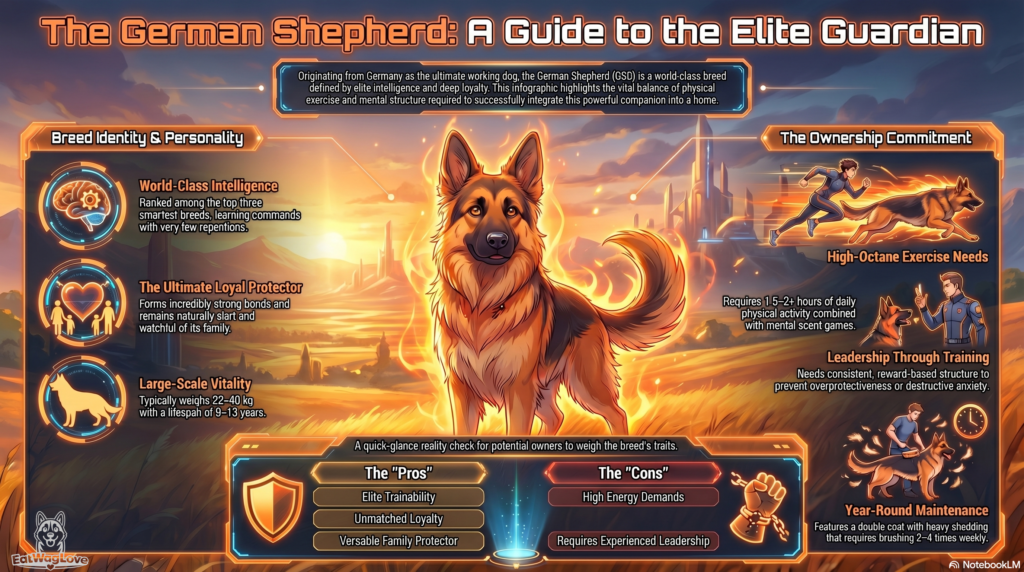
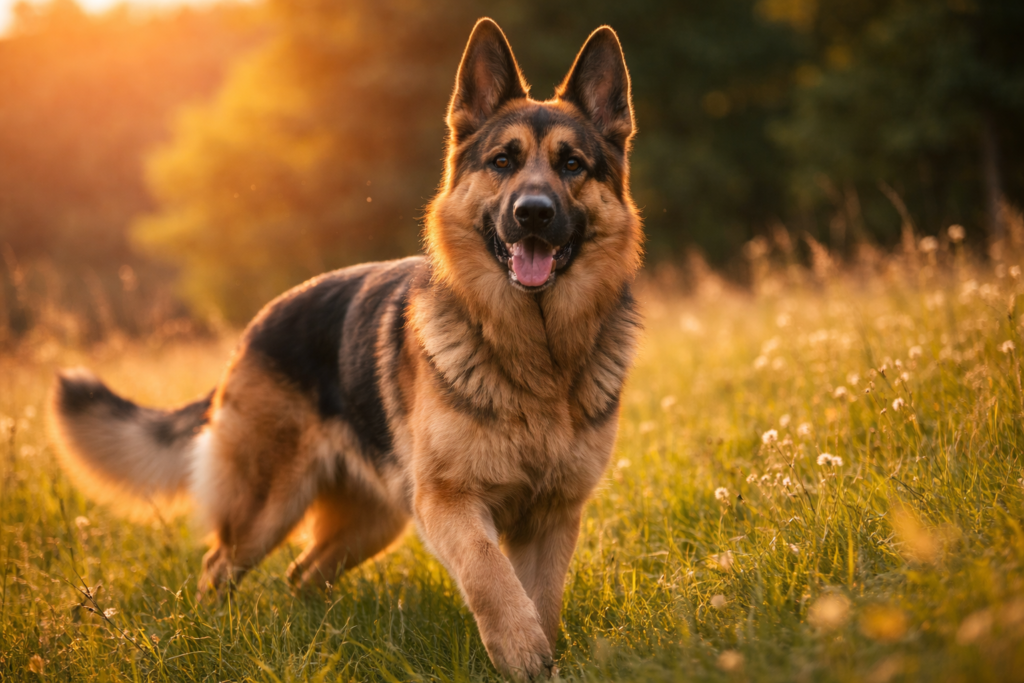







Loyal, intelligent, and protective — the ultimate companion for active and committed owners.
🧠 QUICK SNAPSHOT
- Temperament: Loyal, Intelligent, Protective
- Energy Level: High
- Size: Large
- Good with Families: Yes (with training)
- Training Difficulty: Moderate
📚 OVERVIEW
German Shepherds are one of the most popular and versatile dog breeds in the world. Originally bred for herding and working roles, they are known for their intelligence, loyalty, and protective instincts. They excel as family companions, guard dogs, and working dogs when properly trained and socialised.
✅ PROS & CONS
Pros
- Extremely loyal and protective
- Highly intelligent and trainable
- Great for active families or individuals
Cons
- Needs regular exercise and stimulation
- Can become destructive if bored
- Requires consistent training and leadership
Is a German Shepherd a Good Family Dog?
Yes. A well-bred and properly socialised German Shepherd can be an excellent family dog.
They’re typically loyal, intelligent and strongly attached to their household. Many are naturally watchful without needing to be encouraged to guard.
Their size, strength and working instincts mean early training and socialisation are particularly important. They generally suit owners who want an involved, active dog rather than an easygoing companion requiring little training.
How Much Exercise Does a German Shepherd Need?
Most healthy adult German Shepherds need around 90 minutes to two hours of daily physical activity, combined with mental stimulation.
Walking, hiking, obedience, tracking, scent work, retrieving and structured games can all be excellent outlets.
Simply running a German Shepherd until it’s exhausted isn’t ideal. Mental work is equally important for a breed developed to think and work alongside people.
Is a German Shepherd Easy to Train?
Yes. German Shepherds are among the most trainable dog breeds.
They generally learn quickly, respond well to structured training and can master complex sequences of behaviour.
Positive reinforcement combined with consistency works extremely well.
Their intelligence also means they quickly learn unwanted behaviours if owners accidentally reward them.
Does a German Shepherd Shed?
Yes — heavily.
German Shepherds have a dense double coat and shed throughout the year, with particularly intense seasonal coat changes.
Regular brushing helps control loose hair, but anyone considering the breed should expect dog hair around the house.
There’s a reason owners sometimes jokingly call them “German Shedders.”
Is a German Shepherd Hypoallergenic?
No. German Shepherds aren’t considered hypoallergenic.
Their substantial shedding distributes hair and dander throughout the environment.
People with significant dog allergies should spend time around adult German Shepherds before considering ownership.
How Often Should You Brush a German Shepherd?
German Shepherds generally benefit from brushing several times each week, increasing to daily grooming during heavy seasonal shedding.
Brushing removes dead undercoat and helps maintain skin and coat condition.
Routine bathing is usually only necessary when the dog becomes dirty or develops a veterinary reason for more frequent washing.
Should You Shave a German Shepherd?
Generally, no.
The German Shepherd’s double coat provides insulation and environmental protection.
Routine shaving can interfere with normal coat function and regrowth.
Removing loose undercoat through regular brushing is generally preferable unless clipping is medically necessary.
What Health Problems Are Common in German Shepherds?
Potential health concerns include hip dysplasia, elbow dysplasia, degenerative myelopathy, gastric dilatation-volvulus, exocrine pancreatic insufficiency and certain spinal, skin and autoimmune disorders.
Responsible breeders should screen breeding dogs appropriately.
Structure matters too. Selection for exaggerated body shape shouldn’t take priority over sound movement and working function.
Are German Shepherds Prone to Hip Dysplasia?
Yes. Hip dysplasia is a recognised concern in German Shepherds.
It occurs when the hip joint develops abnormally, potentially resulting in instability, pain and arthritis.
Genetics play an important role, although growth rate, body weight and environmental factors can influence severity.
Responsible breeders should use formal hip assessment before breeding.
Are German Shepherds Prone to Elbow Dysplasia?
Yes. Elbow dysplasia can also affect German Shepherds.
The term describes several developmental abnormalities involving the elbow joint, potentially leading to pain and arthritis.
Breeding dogs should ideally undergo recognised elbow assessment as well as hip screening.
What Is Degenerative Myelopathy in German Shepherds?
Degenerative myelopathy (DM) is a progressive neurological disease affecting the spinal cord.
Affected dogs typically develop weakness and poor coordination in the hind limbs, with the condition gradually progressing.
A genetic risk variant associated with DM can be tested for, although carrying the variant doesn’t guarantee that a dog will develop clinical disease.
What Is Exocrine Pancreatic Insufficiency in German Shepherds?
Exocrine pancreatic insufficiency (EPI) occurs when the pancreas doesn’t produce enough digestive enzymes.
Dogs may lose weight despite having a huge appetite and can develop chronic diarrhoea or unusually bulky stools.
German Shepherds have a recognised predisposition.
Treatment typically involves adding pancreatic enzymes to food under veterinary supervision.
Are German Shepherds Prone to Bloat?
Yes. Their deep chest means German Shepherds can be at risk of gastric dilatation-volvulus (GDV).
The stomach fills with gas and can rotate, cutting off its own blood supply.
Repeated unsuccessful attempts to vomit, abdominal swelling, severe restlessness or collapse require immediate emergency veterinary treatment.
How Long Do German Shepherds Live?
German Shepherds commonly live around 9–13 years, although individual longevity varies.
Genetics, body condition, joint health, exercise and veterinary care all influence lifespan.
Maintaining a lean body condition is particularly important for reducing unnecessary stress on joints.
How Big Does a German Shepherd Get?
German Shepherds are medium-to-large dogs.
Males are typically around 60–65 cm at the shoulder, while females are approximately 55–60 cm.
Healthy adults commonly weigh around 22–40 kg, with males generally heavier.
Functional athleticism should be valued over excessive size.
Are There Giant German Shepherds?
Some breeders advertise “Giant,” “King” or oversized German Shepherds, but these aren’t officially recognised size varieties.
Deliberately selecting for extreme size can increase stress on joints and potentially introduce other health problems.
A German Shepherd should be strong and substantial without sacrificing athletic movement.
Can a German Shepherd Live in an Apartment?
Yes, although it requires considerable commitment.
A German Shepherd receiving enough exercise, training and mental stimulation can settle surprisingly well indoors.
The bigger challenges are energy, barking and stimulation rather than square metres.
Access to a garden doesn’t replace meaningful exercise.
Can a German Shepherd Be Left Alone?
Adult German Shepherds can learn to spend reasonable periods alone, but they’re generally strongly people-oriented working dogs.
Long periods of isolation can contribute to boredom, barking, destructive behaviour or separation problems.
Gradual independence training from puppyhood is useful.
Are German Shepherds Velcro Dogs?
Many are.
German Shepherds were bred to work in close partnership with people, and many develop extremely strong attachments to their handlers.
Following owners from room to room is common.
Some will apparently supervise showering, cooking, gardening and trips to the letterbox with equal professional seriousness.
Are German Shepherds Good With Children?
Well-socialised German Shepherds can be excellent with children.
They’re often affectionate, playful and naturally watchful around their families.
Their size and strength require supervision around small children.
Children should also learn to respect the dog’s food, sleeping areas and personal space.
Are German Shepherds Good With Other Dogs?
They can be.
Early socialisation is particularly important because German Shepherds can become selective or defensive around unfamiliar dogs.
Well-socialised individuals often live successfully with other dogs.
Temperament, genetics and previous experiences all matter.
Are German Shepherds Good With Cats?
Many can live successfully with cats, especially when raised alongside them.
Prey drive varies substantially between individuals and working lines.
Slow introductions and management are important.
A German Shepherd accepting its household cat doesn’t automatically mean it will ignore unfamiliar cats outdoors.
Do German Shepherds Have a Strong Prey Drive?
Many do.
Prey drive varies by breeding line but can be very strong in working German Shepherds.
Chasing, gripping and intense interest in moving objects can all reflect working drives deliberately maintained in some populations.
These instincts can be channelled into training, toys and dog sports.
Are German Shepherds Protective?
Yes. German Shepherds commonly possess natural watchfulness and protective instincts.
They often monitor unfamiliar people and situations carefully.
A stable German Shepherd shouldn’t need to view everyone as a threat.
Confidence, judgement and control are far more desirable than uncontrolled aggression.
Are German Shepherds Naturally Aggressive?
No. Indiscriminate aggression isn’t a desirable German Shepherd characteristic.
The breed should ideally be confident, stable and controllable.
Poor genetics, inadequate socialisation, fear, pain or inappropriate training can contribute to aggressive behaviour.
A protection breed doesn’t need to be suspicious of everything to be effective.
Are German Shepherds Good Guard Dogs?
Yes. German Shepherds are among the world’s best-known guarding and protection breeds.
Their intelligence, physical ability, trainability and natural alertness make them highly capable.
However, serious protection training should be undertaken only with knowledgeable professionals and suitable dogs.
Most family German Shepherds don’t need specialised attack training.
Are German Shepherds Good Watchdogs?
Excellent.
They’re naturally attentive and usually quick to notice unusual people, sounds and activity.
Their size and bark alone can provide substantial deterrence.
A well-trained dog should also learn that not every delivery driver represents an international security incident.
Do German Shepherds Bark a Lot?
They can be fairly vocal.
German Shepherds may bark when alerting, excited, frustrated or under-stimulated.
Training can establish clear boundaries.
Excessive barking may indicate boredom, anxiety or insufficient mental stimulation rather than simply being unavoidable breed behaviour.
Why Do German Shepherds Whine So Much?
Many German Shepherds are surprisingly communicative dogs.
They may whine when excited, anticipating something, frustrated or seeking interaction.
Some appear to maintain an entire vocabulary of whines, grumbles and dramatic sighs.
Persistent vocalisation can also indicate anxiety or discomfort.
Why Does My German Shepherd Follow Me Everywhere?
Close handler orientation was deliberately selected for generations.
A working German Shepherd needed to monitor and respond to its human partner, whether herding sheep, patrolling or performing service work.
That instinct can translate into following family members everywhere at home.
Why Does My German Shepherd Lean Against Me?
Leaning can be a simple form of affection and physical contact.
Some German Shepherds appear to enjoy maintaining body contact with trusted people.
It isn’t automatically an attempt at “dominance,” an outdated explanation frequently applied to normal canine behaviour.
Why Does My German Shepherd Put Its Paw on Me?
Pawing can mean attention-seeking, affection, excitement or learned communication.
If putting a paw on someone reliably produces stroking or conversation, the behaviour can quickly become reinforced.
German Shepherds are intelligent enough to learn which buttons work — including the human ones.
Are German Shepherds Good Running Dogs?
Yes. Healthy adult German Shepherds can make excellent running companions.
They’re athletic dogs with considerable stamina.
Structured distance running should wait until skeletal maturity, particularly because joint development is important in this breed.
Are German Shepherds Good Hiking Dogs?
Excellent.
Their combination of stamina, intelligence and handler focus makes German Shepherds strong hiking companions.
Joint health, conditioning and weather conditions should be considered.
Reliable recall is also important around wildlife and livestock.
Do German Shepherds Like Water?
Many do, although swimming enthusiasm varies.
German Shepherds weren’t primarily developed as water retrievers, but they’re athletic and often competent swimmers.
Positive early experiences can increase confidence around water.
Can German Shepherds Swim?
Most physically healthy German Shepherds can swim.
Their athletic build generally allows effective swimming, although individual confidence varies.
Dogs should still be supervised around deep water, strong currents and pools without easy exits.
How Fast Can a German Shepherd Run?
A fit German Shepherd can reach approximately 45–50 km/h in short bursts, although exact speed varies between dogs.
More important than maximum speed is the breed’s combination of acceleration, endurance and manoeuvrability.
Those characteristics contributed to its success in demanding working roles.
Can German Shepherds Jump High?
Yes. German Shepherds are powerful and athletic jumpers.
Some can clear surprisingly high obstacles, particularly when highly motivated.
Secure fencing therefore matters.
Their jumping ability also contributes to success in working-dog sports and obstacle-based training.
When Do German Shepherds Calm Down?
Many begin noticeably settling between two and three years of age, although working lines can remain highly energetic for much longer.
Mental maturity develops gradually.
Training calm behaviour is usually more effective than simply waiting for an adolescent German Shepherd to become less enthusiastic.
What Is the Difference Between a Working-Line and Show-Line German Shepherd?
Working lines are generally bred with greater emphasis on working ability, drive, endurance and functional structure.
Show lines place greater emphasis on conformation to particular breed standards.
There are also significant differences between German/European and American show populations.
These aren’t separate breeds, but selective breeding has created noticeably different types.
What Is a West German Working-Line German Shepherd?
West German working lines are German Shepherd populations bred primarily for working performance, including sport, police-style work and service roles.
They often have substantial working drive and require experienced handling.
The term describes a breeding tradition rather than a separate breed.
What Is a DDR German Shepherd?
“DDR German Shepherd” refers historically to dogs developed in the former East Germany — the German Democratic Republic.
East German breeding programmes placed considerable emphasis on working ability, physical robustness and service use.
Modern dogs marketed as DDR generally descend partly from those historical bloodlines rather than coming from a currently operating East German breeding system.
What Is a Czech German Shepherd?
Czech German Shepherd lines developed from working populations associated with the former Czechoslovakia, including dogs bred for military and border-service roles.
They became particularly valued within working-dog communities.
Modern Czech-line dogs vary considerably depending on subsequent breeding.
Are American and German German Shepherds Different?
They’re the same breed, but decades of selection under different kennel systems have created noticeable differences in some bloodlines.
American show lines often emphasise a particular side-gait and outline.
German breeding systems traditionally place substantial emphasis on working qualifications and health testing alongside conformation.
Individual dogs matter more than stereotypes about entire countries.
Why Do Some German Shepherds Have Sloped Backs?
The apparently sloping topline seen in some show dogs results partly from structure and show stance, particularly rear angulation.
Selective breeding in certain populations has exaggerated hindquarter angulation.
A German Shepherd should still move efficiently and remain physically functional.
Extreme structure that compromises movement shouldn’t be confused with desirable breed type.
Were Original German Shepherds Straighter-Backed?
Historical photographs show early German Shepherds with functional working structures, although considerable variation existed.
Modern terminology such as “straight-back German Shepherd” is often used commercially and isn’t itself an official breed variety.
The more useful question is whether the individual dog has sound, efficient structure and movement.
What Is a Long-Haired German Shepherd?
Long-haired German Shepherds carry genetic variants producing a longer coat, often with substantial feathering around the ears, legs and tail.
They’re still German Shepherds, not a separate breed.
Recognition of long coats within show standards has varied historically between kennel organisations.
Can German Shepherds Have Long Hair?
Yes.
Long coats occur naturally through recessive coat-length genetics.
Two normal-looking short-coated parents carrying the relevant variants can potentially produce long-coated puppies.
Long-coated dogs still shed considerably.
What Colours Can German Shepherds Be?
German Shepherds occur in several colours, including black and tan, black and red, sable, bi-colour and solid black.
Some kennel standards also address other colours differently.
Colour should always be secondary to health, temperament and working structure.
What Is a Sable German Shepherd?
Sable German Shepherds have individual hairs with bands of different pigmentation, producing an overall wolf-grey, brown, red or dark appearance.
Sable is strongly associated with early and working German Shepherd populations.
The colour can change substantially as puppies mature.
Can German Shepherds Be Completely Black?
Yes. Solid black German Shepherds occur naturally within the breed.
Black is produced by inherited coat-colour genetics and doesn’t indicate that the dog is a different breed.
Black puppies can occur from non-black parents if the appropriate genes are carried.
What Is a Bi-Colour German Shepherd?
A bi-colour German Shepherd is predominantly black with relatively limited tan markings, commonly appearing on the legs, feet, face or underside.
Some very dark bi-colour dogs can initially appear almost solid black.
It’s a recognised colour pattern within the breed.
What Is a Black and Red German Shepherd?
Black-and-red dogs have the familiar dark saddle or blanket pattern combined with rich reddish pigmentation rather than lighter tan.
The colouring became particularly prominent in some German show lines.
The intensity of red pigment doesn’t indicate better health or working ability.
Can German Shepherds Be White?
Yes, genetically white German Shepherds occur.
However, white is disqualified or treated differently under some German Shepherd breed standards.
White dogs played a historical role within early German Shepherd populations.
They shouldn’t be confused with albinism.
Is a White German Shepherd an Albino?
No.
White German Shepherds generally have normal dark pigmentation of the nose, eyes and skin.
Their white coat results from coat-colour genetics rather than albinism.
They don’t inherently have the pigment-related health problems associated with true albinism.
Is the White Swiss Shepherd Related to the German Shepherd?
Yes. The White Swiss Shepherd Dog, or Berger Blanc Suisse, developed from white German Shepherd populations.
White German Shepherds exported to North America contributed importantly to the population later established in Switzerland and Europe.
The White Swiss Shepherd is now recognised internationally as a separate breed.
Can German Shepherds Be Blue?
Dilute pigmentation can produce dogs described as blue German Shepherds.
Blue isn’t accepted as a standard colour by some major breed organisations.
Colour dilution shouldn’t be prioritised over health, temperament and structure.
“Rare” colour is primarily a marketing description, not evidence of superior quality.
Can German Shepherds Have Blue Eyes?
Adult German Shepherds normally have brown eyes.
Blue eyes aren’t characteristic of the breed standard and may sometimes indicate unusual pigmentation or ancestry.
Puppies can initially have lighter eyes that darken during development.
Is a Panda German Shepherd a Real German Shepherd?
Yes. The term “Panda German Shepherd” describes an unusual piebald-style white spotting pattern that appeared through a spontaneous genetic mutation in a documented German Shepherd line.
The best-known foundation dog was Frank von Phenom, born in 2000.
The colouring doesn’t constitute a separate breed.
Is a King Shepherd a German Shepherd?
No. The King Shepherd is a separate developing/composite dog type created using German Shepherds and other large breeds.
It’s often considerably larger than a standard German Shepherd.
It shouldn’t be marketed simply as an unusually large purebred GSD.
Is a Shiloh Shepherd a German Shepherd?
No. The Shiloh Shepherd was developed from German Shepherd ancestry with additional breeding influences and its own breeding programmes.
It was created partly in response to preferences for larger size, temperament and structure.
It’s distinct from a standard pedigree German Shepherd.
Is a Belgian Malinois a Type of German Shepherd?
No. The Belgian Malinois and German Shepherd are completely separate breeds developed in neighbouring European countries.
Both became famous as police and military dogs, which causes frequent confusion.
Their physical structure, historical development and working styles differ.
What Is the Difference Between a German Shepherd and a Belgian Malinois?
German Shepherds are generally larger, heavier and more substantial, while Belgian Malinois tend to be lighter and exceptionally fast and intense.
Both can possess enormous working drive.
At high working levels, individual bloodlines and training matter more than simplistic claims that one breed is always tougher or smarter.
Is a Dutch Shepherd a German Shepherd?
No. Dutch Shepherds are a separate Dutch breed, historically developed for farm and livestock work.
They’re particularly associated with brindle colouring.
German, Dutch and Belgian Shepherd populations developed from the broader European tradition of working sheepdogs but became distinct breeds.
Why Do German Shepherds Have Such Large Ears?
Large erect ears provide excellent sound localisation and awareness, useful characteristics in a working dog.
They also became a defining element of breed type.
German Shepherd puppies often go through entertaining stages where one ear stands, both fall, and then everything changes again.
When Do German Shepherd Puppies’ Ears Stand Up?
Ear development varies considerably.
Many puppies develop fully erect ears between approximately three and six months, although some take longer.
Teething can coincide with temporary changes in ear carriage.
Manipulating ears unnecessarily isn’t advisable without professional guidance.
Are German Shepherd Puppies Born With Floppy Ears?
Yes. German Shepherd puppies are born with soft, folded ears.
The cartilage strengthens as they grow.
The progression towards upright ears can be uneven, with one ear occasionally standing weeks before the other.
Why Do German Shepherds Tilt Their Heads?
Head tilting can help dogs localise sounds, interpret unfamiliar noises or improve visual access to a person’s face.
German Shepherds’ enormous expressive ears make the behaviour particularly noticeable.
Frequent unexplained head tilting accompanied by balance problems can also indicate an ear or neurological problem.
Why Do German Shepherds Have Black Masks?
Dark facial pigmentation occurs commonly within German Shepherd coat patterns.
A black mask can emphasise the muzzle and face, particularly in sable and tan/red dogs.
The extent of masking varies genetically.
It has no special connection to guarding ability or temperament.
What Were German Shepherds Originally Bred For?
German Shepherds were originally developed primarily to herd and protect sheep.
Their creator wanted a highly intelligent, athletic and versatile working dog capable of controlling livestock while responding closely to its handler.
Police and military work came later.
The word “Shepherd” in the name is completely literal.
Were German Shepherds Originally Police Dogs?
No. Their original purpose was sheep herding and flock protection.
However, traditional shepherding was changing rapidly as Germany industrialised.
The breed’s intelligence and versatility allowed it to transition successfully into police, military and service work.
That adaptability ultimately helped secure its future.
Who Created the German Shepherd?
The person most closely associated with creating the modern breed is Captain Max von Stephanitz, a German cavalry officer and dog enthusiast.
He wanted to preserve and standardise the best characteristics of Germany’s regional sheep-herding dogs.
His emphasis was overwhelmingly on working usefulness.
Who Was Max von Stephanitz?
Max Emil Friedrich von Stephanitz was the driving force behind the development of the modern German Shepherd Dog.
He believed working ability should determine breeding decisions.
In 1899, he encountered a dog whose appearance and working characteristics closely matched his ideal.
That dog became the foundation of his new breed.
Who Was Horand von Grafrath?
Horand von Grafrath is regarded as the first registered German Shepherd Dog and one of the breed’s most important foundation animals.
Max von Stephanitz purchased him in 1899 after seeing him at a dog show.
Horand became registration number one in the new German Shepherd breed registry.
Was Horand von Grafrath Originally Called Hektor Linksrhein?
Yes. Before Max von Stephanitz purchased him, Horand was known as Hektor Linksrhein.
Von Stephanitz renamed him Horand von Grafrath.
His combination of intelligence, strength and working-dog appearance embodied many of the characteristics von Stephanitz wanted to establish.
When Was the German Shepherd Breed Created?
The key date is 1899.
That year Max von Stephanitz purchased Horand and helped establish the Verein für Deutsche Schäferhunde, commonly abbreviated SV.
This organisation became the German parent club responsible for the breed’s systematic development.
What Does “Deutscher Schäferhund” Mean?
Deutscher Schäferhund literally means German Shepherd Dog.
“Deutscher” means German, while “Schäferhund” means shepherd dog.
The name directly describes the breed’s original livestock-working purpose.
What Is the SV in German Shepherds?
SV stands for Verein für Deutsche Schäferhunde, the German Shepherd breed organisation founded in 1899.
The SV became enormously influential in establishing breeding standards, working tests and registration.
Its philosophy helped maintain a strong connection between physical structure and working ability.
Did German Shepherds Come From Wolves?
No. German Shepherds aren’t wolf hybrids.
They were developed from German domestic herding dogs.
Their erect ears, long muzzle and sometimes wolf-grey colouring can create a wolf-like appearance, but the modern breed wasn’t created by crossing shepherd dogs with wolves.
Was Wolf Blood Deliberately Added to German Shepherds?
Historical speculation about wolf ancestry has surrounded German Shepherds for decades, partly because of their appearance and early descriptions.
However, the breed’s documented foundation lies in domestic German sheepdogs, and claims of deliberate recent wolf-crossing aren’t supported as a defining part of breed creation.
They’re domestic dogs, not wolfdogs.
What German Dogs Were Used to Create the German Shepherd?
The breed was developed from regional German sheep-herding dogs, particularly populations valued for intelligence, endurance and livestock-working ability.
These weren’t necessarily modern recognised breeds.
Von Stephanitz and his colleagues consolidated useful regional types into one increasingly standardised population.
Why Was the German Shepherd Created?
Von Stephanitz feared that traditional German herding dogs could disappear as industrialisation reduced the need for shepherding.
His goal was to preserve their working qualities in a unified breed.
He deliberately promoted German Shepherds for new roles including police and military service.
That decision transformed the breed’s future.
When Did German Shepherds Become Police Dogs?
German Shepherds entered police work during the early 20th century, particularly in Germany.
Their intelligence, scenting ability, courage and trainability made them exceptionally suitable.
Von Stephanitz actively promoted these alternative working roles as traditional sheep-herding opportunities declined.
Why Are German Shepherds Used by Police?
They combine several valuable characteristics: trainability, physical strength, scenting ability, confidence, endurance and strong handler relationships.
Individual police dogs may specialise in patrol work, tracking or detection.
Not every German Shepherd has the temperament required for professional police work.
Why Are German Shepherds Used by the Military?
German Shepherds can perform patrol, detection, tracking, messenger and search roles, depending on training and historical period.
Their versatility made them particularly valuable during both World Wars.
Military working dogs require exceptional environmental stability as well as physical ability.
Did German Shepherds Serve in World War I?
Yes. German Shepherds served during World War I in roles including messenger work, guarding, carrying supplies and locating wounded soldiers.
Soldiers from other countries encountered the breed during the war and were impressed by its working ability.
This exposure contributed to its international expansion.
Did German Shepherds Serve in World War II?
Yes. German Shepherds were extensively used during World War II by multiple countries.
They performed military functions including guarding, messaging and detection.
Their association with Germany didn’t prevent Allied forces from recognising their usefulness.
Why Were German Shepherds Called Alsatians?
Anti-German sentiment surrounding World War I made the breed’s German name politically unpopular in Britain.
The Kennel Club therefore used the name Alsatian Wolf Dog, later shortened to Alsatian.
The name referred to the Alsace region rather than representing a different breed.
Is an Alsatian the Same as a German Shepherd?
Yes. Alsatian and German Shepherd refer to the same breed.
“Alsatian” became particularly common in Britain and some Commonwealth countries.
The original German Shepherd Dog name was eventually restored officially, although some people still use Alsatian today.
When Did Britain Stop Calling Them Alsatians?
The Kennel Club eventually restored the German Shepherd Dog name during the late 20th century after decades of using Alsatian terminology.
The transition happened gradually, with combined wording used for a period.
“Alsatian” remains culturally familiar even though German Shepherd Dog is now standard.
Who Was Rin Tin Tin?
Rin Tin Tin was one of the most famous dogs in entertainment history.
American soldier Lee Duncan rescued him as a puppy from a war-damaged kennel in France during World War I and brought him to the United States.
Rin Tin Tin became an enormously successful silent-film star during the 1920s.
Did Rin Tin Tin Save Warner Bros?
A popular legend claims Rin Tin Tin saved Warner Bros from bankruptcy, but that version is exaggerated.
His films were certainly highly successful and financially valuable to the studio.
Rin Tin Tin nevertheless played a major role in popularising German Shepherds in the United States.
Was Rin Tin Tin a Real German Shepherd?
Yes. Rin Tin Tin was a German Shepherd rescued from France in 1918.
He became famous for his athletic performances and apparent ability to express emotion on camera.
His descendants and successors continued using the Rin Tin Tin name in later media.
Who Was Strongheart?
Strongheart, originally named Etzel von Oeringen, was another pioneering German Shepherd movie star.
He became famous before Rin Tin Tin and appeared in silent films during the early 1920s.
Strongheart helped establish the German Shepherd as a glamorous and heroic breed in popular culture.
Was Strongheart Famous Before Rin Tin Tin?
Yes. Strongheart became a film star before Rin Tin Tin’s major Hollywood career.
Both dogs were enormously influential in popularising German Shepherds internationally.
Their success helped transform the breed from specialised working dog into one of the world’s most recognisable dogs.
Did German Shepherds Become Popular Because of Hollywood?
Hollywood contributed enormously.
Strongheart and Rin Tin Tin presented German Shepherds as intelligent, courageous and almost supernaturally capable heroes.
Their films introduced millions of people to the breed.
Few dog breeds have had their international popularity shaped so dramatically by individual canine movie stars.
Are German Shepherds Used as Guide Dogs?
Yes. German Shepherds played an important historical role in guide-dog development, particularly during the early 20th century.
They were among the first breeds widely trained to guide people who were blind.
Labrador and Golden Retrievers later became more dominant in many guide-dog programmes.
Was the First Guide Dog a German Shepherd?
German Shepherds were central to the early organised guide-dog movement, particularly following World War I.
Schools in Germany trained dogs to assist veterans who had lost their sight.
The history is more complex than identifying one universally agreed “first guide dog,” but German Shepherds were foundational to modern guide-dog programmes.
Are German Shepherds Used for Search and Rescue?
Yes. Their scenting ability, trainability, athleticism and strong handler focus make them highly suitable for search-and-rescue work.
German Shepherds have been trained for wilderness searches, disaster work and tracking missing people.
Different search disciplines require specialised training.
Can German Shepherds Detect Drugs and Explosives?
Yes. German Shepherds have long been used as detection dogs for explosives, narcotics and other target odours.
The work uses their exceptional olfactory ability combined with trainability and search motivation.
Detection dogs don’t inherently know what substances they’re finding — they’re trained to recognise particular odours and indicate them.
How Good Is a German Shepherd’s Sense of Smell?
German Shepherds possess an extraordinary canine sense of smell, allowing trained individuals to detect extremely faint odour signatures.
Exact claims about particular numbers of scent receptors vary between sources and individuals.
Their practical detection record is more meaningful: they’ve successfully worked in tracking, search-and-rescue, police and military scent roles worldwide.
Are German Shepherds One of the Smartest Dog Breeds?
German Shepherds are widely regarded as exceptionally intelligent and trainable.
However, simplistic breed intelligence rankings measure only limited aspects of canine cognition.
Their real strength lies in the combination of learning ability, working motivation, environmental awareness and cooperation with humans.
Can German Shepherds Learn Hundreds of Commands?
Individual German Shepherds can develop very large trained vocabularies and complex behaviour chains.
Working dogs may learn numerous verbal commands, hand signals and situational cues.
The exact number isn’t as important as their capacity to discriminate between cues and apply learned behaviours under distracting conditions.
Is a German Shepherd a Herding Dog?
Yes. Despite becoming famous for police work, the German Shepherd remains fundamentally a herding breed.
Its original job involved controlling and protecting flocks.
Traditional German tending work differed from the dramatic eye-based gathering style associated with breeds such as the Border Collie.
What Is HGH Herding in German Shepherds?
HGH refers to the German Herdengebrauchshund working tradition and associated herding test.
German Shepherds can work as “living fences,” patrolling boundaries and preventing large flocks from entering crops or roads.
This requires stamina, obedience and independent judgement.
It’s much closer to the breed’s original purpose than police work.
Did German Shepherds Herd Sheep Differently From Border Collies?
Yes.
Border Collies commonly gather and move sheep using controlled pressure and intense eye, while traditional German Shepherd tending often involves patrolling boundaries around large flocks.
The German Shepherd may effectively create a moving living fence.
Different herding jobs produced different working styles.
Is the German Shepherd a Natural Breed?
No. The German Shepherd is a deliberately standardised modern breed, created from older German regional sheepdogs.
Its foundation populations were genuine working dogs rather than recently invented companion crosses.
But the unified breed itself resulted from organised selection beginning around the end of the 19th century.
Is the German Shepherd Still a Working Dog Today?
Absolutely.
German Shepherds continue working in herding, police service, military roles, tracking, detection, search and rescue, assistance work, protection sports and numerous other disciplines.
Few breeds have successfully transitioned into such a broad range of jobs.
That versatility was precisely what Max von Stephanitz wanted to preserve.
Is a German Shepherd a Good First Dog?
It can be, but it’s a demanding first dog.
A committed owner willing to provide training, exercise, socialisation and mental stimulation can succeed.
However, their strength, intelligence and protective instincts leave less room for inconsistent handling than many easier companion breeds.
Choosing a stable, appropriately bred puppy is particularly important.
Where Does the German Shepherd Come From?
The German Shepherd was developed in Germany at the end of the 19th century from regional working sheepdogs.
In 1899, Captain Max von Stephanitz saw a dog called Hektor Linksrhein whose intelligence, strength and working ability closely matched his ideal. He purchased and renamed him Horand von Grafrath, registered him as the first German Shepherd and helped establish the organisation that would systematically develop the breed.
Industrialisation was already reducing traditional shepherding work, so von Stephanitz pushed his dogs into police, military and service roles instead.
It proved an extraordinary decision. In barely a century, a dog created to patrol sheep became a herder, soldier, police officer, guide dog, tracker, rescuer, detection specialist, movie star and family companion — making the German Shepherd one of the most versatile working breeds ever developed.