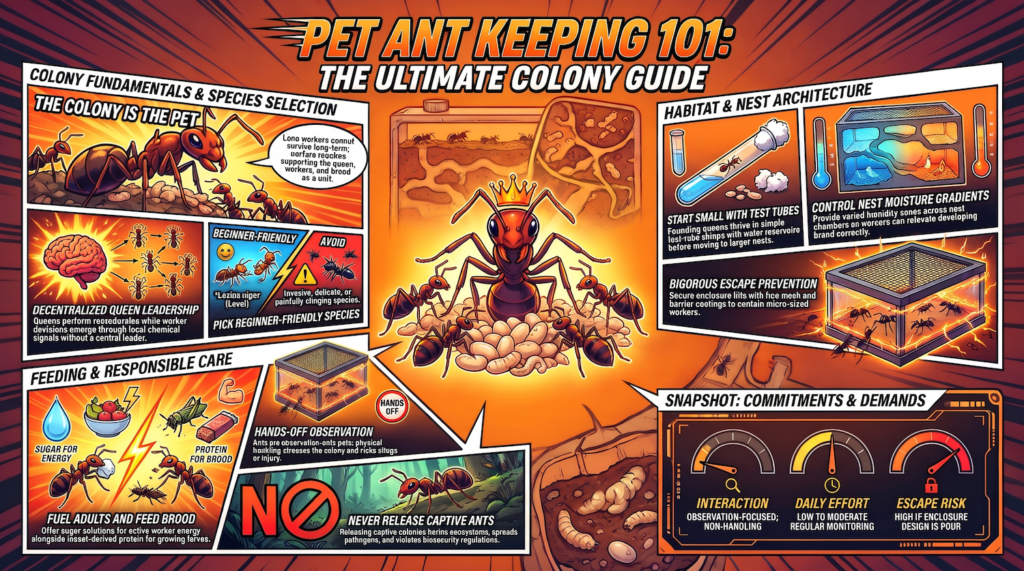








Tiny, industrious and extraordinarily intelligent as a colony, pet ants are fascinating miniature creatures famous for their intricate underground tunnels, remarkable teamwork, complex social behaviour and incredible ability to build thriving communities inside an ant farm.
🧠 QUICK SNAPSHOT
Trait | Pet Ants |
|---|---|
Scientific Classification | Family Formicidae |
Other Names | Ant Farm Ants, Formicarium Ants, Pet Ant Colonies |
Pet Type | Invertebrate / Social Insect |
Natural Distribution | Almost worldwide, except Antarctica and some remote islands |
Popular Pet Species | Lasius niger, Messor barbarus, Camponotus species, Pheidole species and suitable native Australian ants |
Typical Worker Lifespan | Several months to a few years, depending on species |
Queen Lifespan | Several years; queens of some species can exceed 15–20 years |
Worker Size | Approximately 2–20 mm, depending on species |
Queen Size | Commonly 5–25 mm, depending on species |
Colours | Black, brown, red, yellow, orange and combinations |
Body Type | Hard exoskeleton with six legs and jointed antennae |
Diet | Species-dependent; commonly sugars, insects, seeds or other foods |
Activity | Varies by species, temperature and colony conditions |
Temperament | Social within colonies; defensive behaviour varies by species |
Noise Level | Effectively silent to humans |
Social Needs | Highly social; workers function within organised colonies |
Housing | Secure formicarium connected to a foraging area |
Temperature | Species-specific; many temperate species thrive around 20–28°C during active periods |
Humidity | Species-specific, with suitable nest moisture gradients |
Grooming | No direct grooming required |
Maintenance | Low to moderate, depending on colony size |
Handling | Observation only; direct handling is discouraged |
Beginner Friendly? | Yes, with a suitable species and appropriate equipment |
Famous Feature | Extraordinary colony organisation, chemical communication and tunnel construction |
📚 OVERVIEW
Pet ants are among the most unusual and educational animals that can be kept in captivity. Rather than caring for a single animal, ant keepers maintain an entire miniature society, often consisting of a queen, workers and developing young. Their fascinating behaviour can be observed through a specially designed enclosure called a formicarium, commonly known as an ant farm.
Ants belong to the family Formicidae, which includes more than 14,000 scientifically described living species. They inhabit almost every terrestrial environment on Earth, from tropical rainforests and deserts to grasslands, gardens and woodlands. Different species have developed extraordinary adaptations for collecting food, building nests, defending colonies and surviving challenging conditions.
One of the greatest attractions of keeping ants is watching their colony develop. A small founding colony may begin with a single queen and a handful of workers. Over time, workers collect food, care for developing larvae, maintain the nest and expand their living space. Some colonies eventually contain hundreds or thousands of individuals, depending on the species.
Their care requires a suitable species, a secure escape-proof formicarium, appropriate moisture and temperature, species-specific nutrition and responsible colony management. In Australia, native species are generally the appropriate starting point, but collection, possession and movement rules vary by jurisdiction.
✅ PROS & CONS
👍 Pros
Fascinating natural teamwork and social behaviour
Excellent educational pets for children and adults
Require relatively little physical space initially
No walking or conventional grooming required
Entertaining tunnel construction and food collection
Can observe colony growth over many years
Wide variety of species and behaviours
Suitable for patient beginners with proper preparation
👎 Cons
Colonies can escape through tiny openings
Some species bite, sting or spray defensive chemicals
Require species-specific food and humidity
Queens may live for many years
Colony growth may require larger enclosures
Some species have seasonal dormancy requirements
Poor hygiene can encourage mould or mites
Exotic and invasive species may be prohibited
Are Ants Good Pets?
Yes. Ants can make fascinating pets for people who enjoy observing natural behaviour.
Their complex social organisation, food collection and nest construction provide almost endless opportunities for learning.
However, ants are observation pets rather than animals that enjoy being handled.
Are Pet Ants Good for Beginners?
Yes, provided a suitable species is chosen.
Hardy, locally permitted species with straightforward environmental and feeding requirements are generally the best starting point.
Beginners should avoid highly defensive, difficult-to-contain or specialist species.
What Is an Ant Farm?
An ant farm is an enclosure designed for observing ants and their nesting behaviour.
More advanced ant farms are called formicariums.
They often include a nesting chamber and a separate foraging area where workers collect food and dispose of waste.
What Is the Difference Between an Ant Farm and a Formicarium?
An ant farm is the familiar general name for an enclosure used to keep ants.
A formicarium is the more technical term for an artificial ant nest.
Modern formicariums may use acrylic, plaster, aerated concrete or other suitable materials and often connect to a separate foraging area.
How Long Do Pet Ants Live?
Lifespan varies enormously according to species and caste.
Workers may live from several months to several years.
Queens of certain species can live for more than 15–20 years, meaning a healthy colony can become a substantial long-term commitment.
How Long Does an Ant Queen Live?
Some ant queens survive for many years.
In certain species, queens have been documented living for more than two decades.
However, lifespan varies significantly, and many queens live considerably shorter lives.
Can an Ant Colony Survive Without a Queen?
It depends on the species and colony structure.
In many commonly kept species, a colony without a reproductive queen cannot produce replacement workers indefinitely.
Existing workers may survive for some time, but the colony will eventually decline.
Some ant species have unusual reproductive systems that allow colonies to function differently.
Do You Need a Queen Ant for an Ant Farm?
A queen is usually necessary for a self-sustaining colony.
The queen produces eggs that develop into new workers.
A worker-only ant farm can provide short-term observation, but it generally cannot maintain its population indefinitely.
Can You Keep Just One Ant as a Pet?
An individual worker ant generally isn’t suitable as a long-term pet.
Most ants are highly social and depend on their colony for normal behaviour and survival.
A properly established colony is usually the most appropriate arrangement.
How Many Ants Should You Start With?
Beginners often start with a founding queen and a small number of workers.
A colony of approximately 5–20 workers, depending on species, can be easier to establish than a large colony.
The appropriate starting size depends on the species and housing system.
What Are the Best Ant Species for Beginners?
Popular beginner species internationally include:
Black Garden Ant (Lasius niger) — hardy and active, where legally available
Harvester Ants (Messor species) — fascinating seed-collecting behaviour
Carpenter Ants (Camponotus species) — often relatively large and easy to observe
Big-Headed Ants (Pheidole species) — interesting worker size differences
Suitable native Australian species — often the appropriate choice for Australian keepers
Availability and legality vary by location. Species should never be imported, collected or transported without checking applicable regulations.
What Are the Best Pet Ants in Australia?
Australia has an extraordinary diversity of native ants.
Some locally permitted Camponotus species and other relatively manageable native ants may be suitable for prepared beginners.
The best choice depends on local regulations, availability, colony size, defensive behaviour and environmental requirements.
Can You Keep Bull Ants as Pets?
Some experienced Australian ant enthusiasts keep native bull ants belonging to the genus Myrmecia, where permitted.
However, bull ants can deliver painful stings, and some species present a significant allergy or anaphylaxis risk.
They are not recommended for beginners or households where accidental contact is likely.
Do Pet Ants Bite?
Some ants bite, while others sting or use defensive chemicals.
The severity varies considerably between species.
Owners should avoid direct handling and choose species appropriate to their experience and household circumstances.
Are Pet Ants Dangerous?
Most appropriately selected ant species present relatively low risk when securely contained.
However, certain species can deliver painful stings or bites, and allergic reactions are possible.
Escapes can also create ecological risks, particularly with invasive or non-native species.
Do Pet Ants Recognise Their Owners?
Ants can learn and respond to environmental cues, including odours and feeding locations.
However, there is little evidence that pet ants recognise individual human caregivers in the way dogs or other social vertebrates might.
Their communication relies heavily on chemical signals.
Are Ants Intelligent?
Ants demonstrate remarkable learning, navigation and problem-solving abilities.
Individual ants can learn routes and associate cues with food.
At the colony level, simple interactions between individuals produce highly organised collective behaviour.
Can Ants Communicate With Each Other?
Yes.
Ants communicate primarily through chemical signals called pheromones.
They also use touch, antenna movements and, in some species, vibrations or sounds.
These signals help coordinate food collection, defence and colony activities.
Do Ants Have Different Jobs?
Yes.
Ant colonies commonly contain workers that perform tasks such as foraging, nest maintenance, brood care and defence.
The division of labour depends on species, worker age, body size and colony needs.
In some species, specialised larger workers perform particular tasks.
Do Ants Sleep?
Ants experience periods of rest and reduced activity.
However, their rest patterns differ from human sleep.
Workers may take numerous short rest periods, while queens and other colony members can display different activity patterns.
Are Ants Active at Night?
Some ant species are primarily nocturnal.
Others forage during daylight or remain active at different times depending on temperature and food availability.
Their activity patterns reflect adaptations to local environmental conditions.
What Size Ant Farm Do You Need?
The appropriate enclosure depends on the species and colony size.
A founding colony may initially thrive in a properly maintained test-tube setup.
As the population grows, a larger formicarium and foraging area may become necessary.
Oversized nesting chambers can sometimes create moisture and waste-management problems for very small colonies.
What Is the Best Type of Ant Farm?
A well-designed formicarium with reliable moisture control and a secure foraging area is generally preferable for long-term keeping.
Acrylic, plaster and aerated-concrete systems are popular.
The best material depends on the species’ nesting and humidity requirements.
Are Gel Ant Farms Good for Ants?
Gel ant farms are often marketed as colourful educational displays.
However, many are unsuitable for long-term colony health because they may provide inadequate nutrition, moisture control or nesting conditions.
A properly designed formicarium with species-appropriate food is generally a better option.
Can Ants Escape From an Ant Farm?
Yes.
Ants are extremely skilled at finding tiny openings.
Even small gaps around lids, tubing or feeding ports may allow workers to escape.
Secure construction and suitable escape-prevention barriers are essential.
What Temperature Do Pet Ants Need?
Temperature requirements vary significantly by species.
Many temperate and subtropical species remain active at approximately 20–28°C, although some require warmer or cooler conditions.
Excessive heat can quickly kill an enclosed colony, so heating must be carefully controlled.
Do Pet Ants Need Humidity?
Yes, most species require access to suitable nest moisture.
However, humidity requirements vary considerably.
Some prefer relatively dry nesting conditions with access to a moist chamber, while others require consistently humid environments.
A moisture gradient allows ants to select appropriate nesting locations.
Do Pet Ants Need Sunlight?
Ants don’t generally require direct sunlight.
In fact, direct sun can rapidly overheat an ant farm.
Normal room lighting is usually sufficient for observation, while the nesting area should provide darkness or suitable cover.
What Do Pet Ants Eat?
Ant diets vary according to species.
Many consume sugary liquids for energy and insects or other protein sources for growth.
Some species specialise in collecting seeds, while others have more unusual dietary requirements.
Food should always be selected for the particular species.
Can Pet Ants Eat Honey?
Some ant species readily consume appropriately diluted honey or other suitable sugar solutions.
However, sticky or concentrated liquids can trap small workers.
Food should be offered safely in tiny quantities or suitable feeders and removed before spoilage.
Do Pet Ants Need Protein?
Many species require protein, particularly when raising larvae.
Suitable protein sources may include appropriately sized feeder insects.
The amount needed varies with colony size, species and brood production.
Do Pet Ants Need Water?
Yes.
Ant colonies require reliable access to water or suitable moisture sources.
Many formicariums include integrated hydration systems.
Water should be provided in a way that prevents drowning, particularly for very small workers.
How Often Should You Feed Pet Ants?
Feeding frequency depends on species, colony size and activity.
Small colonies may require only modest food portions every few days, while larger colonies may need more frequent feeding.
Uneaten perishable food should be removed promptly to prevent mould and contamination.
Do Pet Ants Need Cleaning?
Yes, but cleaning should focus primarily on the foraging area.
Food scraps, dead insects and excessive waste should be removed regularly.
The nesting chambers should be disturbed as little as possible because unnecessary interference can stress the colony.
Do Ant Colonies Grow Quickly?
Growth rates vary considerably.
Some species produce new workers relatively quickly, while others develop slowly.
Temperature, nutrition, queen productivity and seasonal cycles all influence colony growth.
How Many Ants Can Live in One Colony?
Some ant colonies contain only dozens or hundreds of workers.
Others contain thousands or even millions of individuals.
Colony size depends on species, environmental conditions and reproductive structure.
Do Ants Lay Eggs?
Yes.
Queen ants generally lay the eggs that develop into new colony members.
The eggs hatch into larvae, which eventually become pupae and then adult ants.
This complete metamorphosis is one of the most fascinating processes to observe in an ant farm.
Can You See Baby Ants in an Ant Farm?
Yes.
A well-designed observation nest may allow keepers to see eggs, larvae and pupae.
Workers often move developing young between chambers to maintain suitable environmental conditions.
Observing brood care is one of the most rewarding aspects of ant keeping.
Do Pet Ants Hibernate?
Some temperate ant species undergo seasonal dormancy, often called diapause.
During this period, colony activity and food requirements decrease.
However, not all species require dormancy, and temperature management should reflect their natural biology.
Can You Release Pet Ants Into the Wild?
Captive ant colonies should not be released into the wild.
Even apparently native ants may originate from different geographic populations or carry pathogens and parasites.
Releasing non-native species can create serious ecological problems and may be illegal.
Owners should arrange responsible rehoming or seek expert advice if they can no longer maintain a colony.
What Health Problems Can Affect Pet Ant Colonies?
Common problems include dehydration, overheating, unsuitable humidity, starvation, mould contamination, mites and colony stress.
Poor environmental conditions can cause workers or queens to die.
Careful observation, appropriate nutrition and stable housing conditions are essential.
Are Pet Ants Legal to Keep?
Pet ants are legal in many countries, but some countries or regions restrict or prohibit the possession, collection, sale, importation or transport of particular species.
Australia has strict biosecurity regulations designed to prevent the introduction and spread of invasive ants.
Keepers should verify applicable state and territory rules, avoid prohibited species and obtain colonies only from lawful sources.
What Makes Pet Ants Unique?
Imagine watching an entire miniature civilisation develop before your eyes.
Workers dig tunnels, carry food, care for young, defend their colony and communicate through invisible chemical messages.
At the centre of many colonies is a queen whose reproductive activity can sustain the colony for years.
That’s the extraordinary world of pet ants.
Ants are among the most successful social insects on Earth.
Scientists have described more than 14,000 living ant species, and researchers estimate that approximately 20 quadrillion individual ants may inhabit the planet at any given time.
That’s an almost unimaginable number of tiny animals.
But their success isn’t simply the result of large populations.
It’s their remarkable cooperation.
An individual ant has a relatively small nervous system, yet an entire colony can display sophisticated collective behaviour.
Workers coordinate food collection, construct complex nests and respond rapidly to threats.
Scientists sometimes describe ant colonies as superorganisms because the individuals function together in ways that resemble the coordinated systems of a larger organism.
One of their most fascinating abilities is chemical communication.
Ants produce pheromones that convey information to other colony members.
Some pheromones help guide workers towards food.
Others signal danger or influence social behaviour.
A worker discovering a valuable food source may return to the nest while depositing chemical signals that help other ants locate it.
This creates the familiar sight of ants marching along organised trails.
Their construction abilities are equally extraordinary.
Some species excavate elaborate underground nests containing chambers for brood care, food storage and other activities.
The workers respond to moisture, temperature and chemical cues when selecting suitable nesting locations.
Inside a transparent formicarium, keepers can sometimes observe this remarkable engineering process.
Another fascinating feature is the division of labour.
In many species, younger workers spend considerable time caring for eggs and larvae.
Older workers may undertake riskier activities such as foraging.
Some species possess specialised soldier-like workers with enlarged heads and powerful jaws.
However, ant societies vary enormously, and not every species follows the same organisational pattern.
Their strength is another extraordinary characteristic.
Some ants can carry objects many times heavier than their own body weight.
Their small size and body structure allow them to achieve impressive strength relative to their mass.
Ant navigation is equally remarkable.
Certain desert ants use visual landmarks, the position of the sun and internal distance estimation to navigate across challenging terrain.
Other species rely heavily on chemical trails.
Some ants even demonstrate surprisingly sophisticated learning abilities.
Researchers have shown that ants can learn associations, navigate mazes and adjust their behaviour based on previous experiences.
Their reproductive biology is also fascinating.
In many species, a young queen leaves her original colony during a reproductive flight.
After mating, she may establish a new nest and begin producing workers.
Some founding queens survive for extended periods using stored energy while raising their first generation of offspring.
Watching a colony develop from a founding queen into a thriving community is one of the most rewarding experiences in ant keeping.
Perhaps the most surprising fact is that an ant farm isn’t simply a container of insects.
It’s a living society.
Every worker contributes to the colony’s survival through countless small actions.
Food is collected, young are protected, tunnels are maintained and environmental conditions are constantly assessed.
The colony responds to challenges without requiring a single worker to understand the entire system.
For children and adults alike, observing ants provides a remarkable introduction to biology, ecology, engineering and animal behaviour.
And unlike many conventional pets, ants offer the opportunity to observe an entire social community developing over time.
Pet ants aren’t simply tiny insects in a glass enclosure — they’re extraordinary engineers, sophisticated communicators and members of one of nature’s most successful societies, offering a fascinating window into the hidden world beneath our feet.