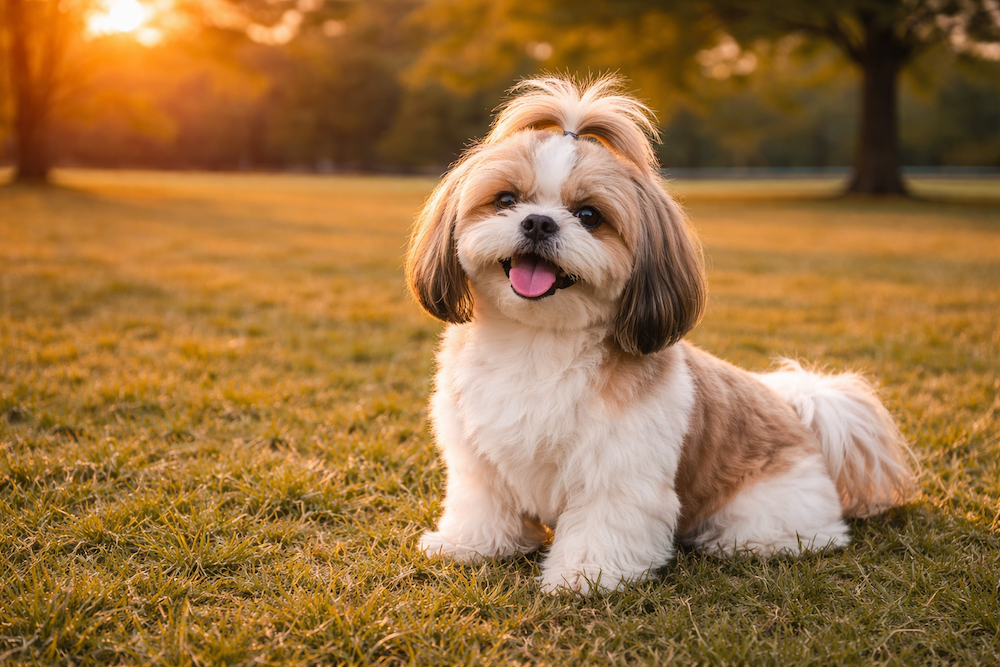







Affectionate, charming, and made for companionship — the ultimate lap dog.
🧠 QUICK SNAPSHOT
- Temperament: Affectionate, Friendly, Gentle
- Energy Level: Low to Moderate
- Size: Small
- Good with Families: Yes
- Training Difficulty: Easy to Moderate
📚 OVERVIEW
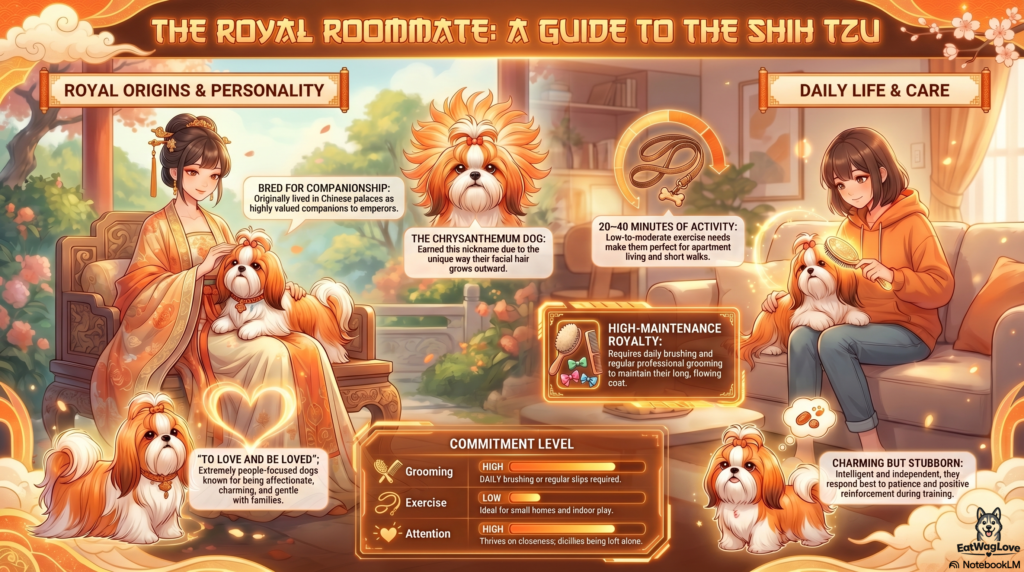
Shih Tzus are small companion dogs known for their long, flowing coats and sweet personalities. Originally bred to be lap dogs for royalty, they are affectionate, adaptable, and happiest when spending time with their owners. Their calm nature makes them ideal for indoor living.
✅ PROS & CONS
Pros
- Great for apartments and smaller homes
- Very affectionate and people-focused
- Low exercise requirements
Cons
- Requires regular grooming and coat care
- Can be prone to certain health issues
- Doesn’t like being left alone for long periods
Is a Shih Tzu a Good Family Dog?
Yes. Shih Tzus are generally affectionate, friendly and adaptable family dogs.
They were bred primarily as companion dogs and usually enjoy being closely involved in family life.
Their small size makes them relatively easy to manage, although young children should be taught to handle them gently.
Are Shih Tzus Good With Children?
Yes. Shih Tzus can be excellent with respectful children.
They’re usually playful, affectionate and sociable, but their small size means they can be injured by rough handling.
Supervision is particularly important around toddlers and very young children.
How Much Exercise Does a Shih Tzu Need?
Most adult Shih Tzus need around 30–60 minutes of gentle exercise each day.
Short walks and indoor play sessions are usually sufficient.
Because they’re brachycephalic, strenuous exercise should be avoided during hot or humid weather.
Are Shih Tzus Easy to Train?
Shih Tzus are intelligent but can have an independent and stubborn streak.
They respond best to short, positive training sessions using praise and rewards.
Consistency is important, particularly with toilet training.
Are Shih Tzus Hard to Toilet Train?
Some Shih Tzus can take longer to toilet train than owners expect.
Their small bladder, independent personality and dislike of unpleasant weather can make consistency especially important.
Frequent toilet opportunities, supervision and reward-based training usually produce the best results.
Do Shih Tzus Shed a Lot?
Shih Tzus are generally low-shedding dogs.
Their long hair tends to remain trapped within the coat rather than falling freely around the home.
However, low shedding doesn’t mean low maintenance — their coat requires considerable grooming.
Are Shih Tzus Hypoallergenic?
Shih Tzus are often described as hypoallergenic because they shed relatively little, but no dog is completely hypoallergenic.
Dog allergens are found in saliva and skin secretions as well as hair and dander.
Some allergy sufferers may tolerate a Shih Tzu better than a heavy-shedding breed, but this isn’t guaranteed.
How Often Should You Groom a Shih Tzu?
A long-coated Shih Tzu generally needs daily brushing to prevent tangles and mats.
Many pet owners choose a shorter “puppy cut”, which is easier to maintain but still requires regular brushing and professional grooming.
Their face, eyes, ears, nails and teeth also need routine attention.
Why Do Shih Tzus Have Tear Stains?
Tear staining can occur when tears repeatedly wet the hair beneath the eyes, leaving reddish-brown discolouration.
Shih Tzus can be particularly prone because of their facial structure, prominent eyes and surrounding hair.
Persistent or excessive tearing should be checked by a veterinarian because eye irritation, blocked tear drainage or other problems may be involved.
What Health Problems Are Common in Shih Tzus?
Common concerns include brachycephalic airway problems, eye disorders, dental disease, patellar luxation, ear problems and certain spinal or joint conditions.
Their prominent eyes are particularly vulnerable to irritation and injury.
Responsible breeding that avoids extremely exaggerated facial features can help reduce some health risks.
Do Shih Tzus Have Breathing Problems?
Some do.
The Shih Tzu is a brachycephalic, or short-muzzled, breed, and some individuals can experience brachycephalic obstructive airway syndrome.
Signs can include noisy breathing, snoring, poor exercise tolerance, overheating and difficulty breathing.
Severe breathing problems aren’t something that should simply be accepted as normal for the breed.
How Long Do Shih Tzus Live?
Shih Tzus commonly live around 10–16 years, with many reaching their teenage years.
Their relatively long potential lifespan is one of the breed’s attractions.
Healthy weight, dental care, appropriate exercise and regular veterinary checks can help support longevity.
How Big Does a Shih Tzu Get?
Shih Tzus are small dogs.
Adults generally stand around 20–28 cm tall and commonly weigh approximately 4–7.5 kg.
Despite their small size, they’re usually quite sturdy and substantial beneath that enormous coat.
Can a Shih Tzu Live in an Apartment?
Yes. Shih Tzus are particularly well suited to apartment living.
They’re small, don’t require enormous amounts of exercise and were developed primarily as indoor companion dogs.
Daily walks, play and mental stimulation are still important.
Can Shih Tzus Be Left Alone?
Shih Tzus generally prefer plenty of human companionship and may struggle when routinely left alone for long periods.
Adult dogs can learn to tolerate reasonable periods alone when introduced gradually.
Their strong companion-dog background means they’re usually happiest when they’re included in everyday family life.
Do Shih Tzus Bark a Lot?
Shih Tzus can be alert barkers, particularly when someone approaches the home.
They’re not necessarily constant barkers, but some individuals become vocal through excitement, boredom or attention-seeking.
Early training can help prevent excessive barking.
Are Shih Tzus Affectionate?
Very.
Shih Tzus were specifically developed as companion dogs, and many thrive on close contact with their owners.
They often enjoy sitting beside people, following family members around the home and receiving plenty of attention.
Do Shih Tzus Like to Cuddle?
Many do.
Shih Tzus are often enthusiastic lap dogs and can be extremely cuddly with their favourite people.
Individual personalities differ, but companionship is one of the defining characteristics of the breed.
Are Shih Tzus Good With Other Dogs?
Generally, yes.
Well-socialised Shih Tzus are often friendly with other dogs and can live successfully in multi-dog households.
Their small size means interactions with much larger, energetic dogs should be supervised carefully.
Are Shih Tzus Good With Cats?
Yes. Many Shih Tzus live very successfully with cats.
They were bred primarily for companionship rather than hunting, so they generally have less intense prey drive than many terrier or hunting breeds.
Gradual introductions are still important.
Do Shih Tzus Have a High Prey Drive?
Usually not.
Shih Tzus weren’t developed primarily to chase or hunt animals, so their prey drive is generally lower than that of many working breeds.
Individual dogs can still chase birds or small animals, however.
Can Shih Tzus Handle Hot Weather?
Shih Tzus can struggle in hot weather because of their short muzzle and heavy coat.
Exercise should be restricted during hot or humid conditions, particularly during the middle of the day.
They need constant access to fresh water, shade and a cool indoor environment.
Can Shih Tzus Swim?
Some Shih Tzus can swim, but they’re generally not naturally strong swimmers.
Their short legs, heavy coat and brachycephalic facial structure can make swimming more difficult.
They should always be closely supervised around pools and other bodies of water.
Why Does a Shih Tzu Have an Underbite?
A slightly undershot jaw, where the lower jaw extends beyond the upper jaw, is characteristic of the Shih Tzu.
This contributes to the breed’s distinctive facial appearance.
However, severe dental crowding or difficulty eating should be assessed by a veterinarian.
What Colours Do Shih Tzus Come In?
Shih Tzus occur in a remarkably wide variety of colours and combinations.
These can include black, white, gold, red, brindle, liver and various combinations and markings.
A puppy’s colour can also change considerably as it matures.
What Is a Teacup Shih Tzu?
“Teacup Shih Tzu” isn’t an officially recognised Shih Tzu variety.
The term is generally used to market dogs bred or expected to be unusually small.
Extremely small dogs can face increased health risks, so prospective owners should be cautious of breeders promoting tiny size as a special or rare type.
What Is the Difference Between a Shih Tzu and a Lhasa Apso?
The breeds look similar but are distinct.
Shih Tzus were primarily developed as companion dogs, while Lhasa Apsos historically served as alert watchdogs in Tibetan monasteries and households.
Lhasa Apsos tend to have longer muzzles and can be somewhat more independent and reserved.
Where Does the Shih Tzu Come From?
The Shih Tzu has strong historical connections with Tibet and imperial China.
Its ancestors were likely small Tibetan dogs that were developed further in Chinese imperial courts, potentially with influence from breeds such as the Pekingese.
The modern breed was later established from a relatively small surviving population.
What Does Shih Tzu Mean?
“Shih Tzu” is commonly translated as “lion dog.”
Small lion-like companion dogs had important cultural associations in China and Tibet, where lions featured prominently in Buddhist symbolism despite actual lions not being native to the region.
The breed’s long flowing coat contributed to this lion-like image.
Were Shih Tzus Royal Dogs?
Yes. Shih Tzus have a strong association with Chinese imperial courts, where small companion dogs were highly prized.
The breed became particularly associated with palace life during the late imperial period.
These dogs weren’t developed for herding livestock, retrieving birds or chasing vermin — companionship itself was their job.
Is a Shih Tzu a Good First Dog?
Yes. A Shih Tzu can be an excellent first dog.
They’re affectionate, adaptable, relatively small and don’t require extreme amounts of exercise.
Prospective owners should nevertheless be prepared for substantial grooming, dental care and potential brachycephalic health issues.
What Makes the Shih Tzu Unique?
The Shih Tzu has one of the more unusual résumés in the dog world.
While other breeds were developed to herd sheep, retrieve ducks, guard property or hunt animals, the Shih Tzu’s principal occupation was considerably more luxurious:
being excellent company.
These little “lion dogs” became associated with Chinese imperial palace life, where companionship rather than physical labour was their speciality.
Centuries later, remarkably little has changed.
A modern Shih Tzu generally doesn’t need a flock to herd or a field to patrol.
Give it a comfortable home, a daily walk and a favourite human to follow from room to room and it has essentially resumed its traditional profession.
The impressive coat and regal expression may suggest otherwise, but underneath all that hair is a sturdy little companion with a simple philosophy:
Why work for a living when humans invented laps?