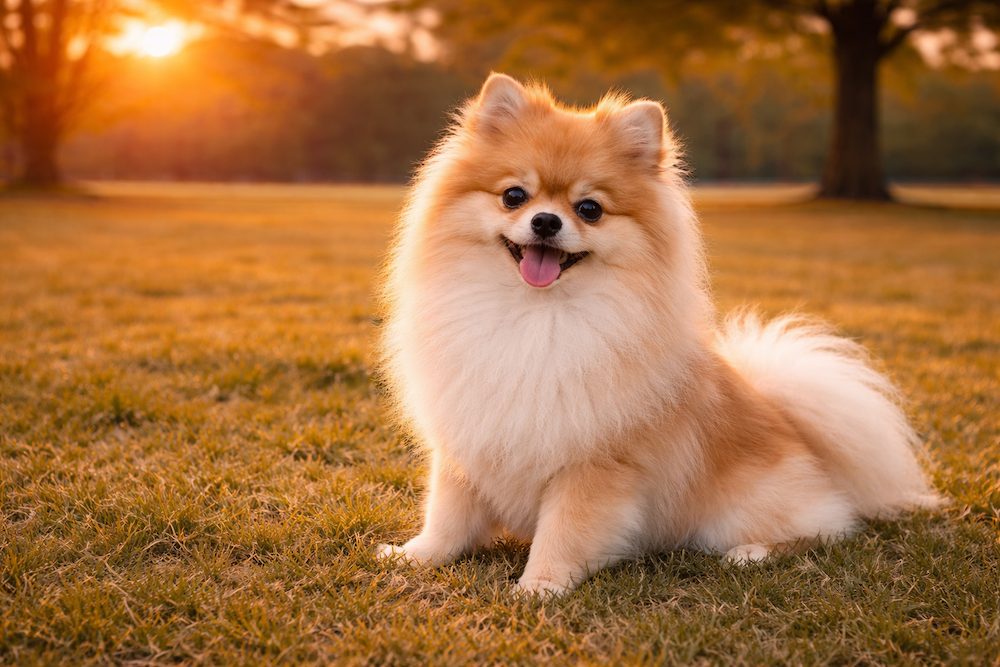





Fluffy, lively, and full of personality — a tiny dog that loves to be the centre of attention.
🧠 QUICK SNAPSHOT
- Temperament: Lively, Bold, Affectionate
- Energy Level: Moderate
- Size: Small
- Good with Families: Yes (with care)
- Training Difficulty: Moderate
📚 OVERVIEW
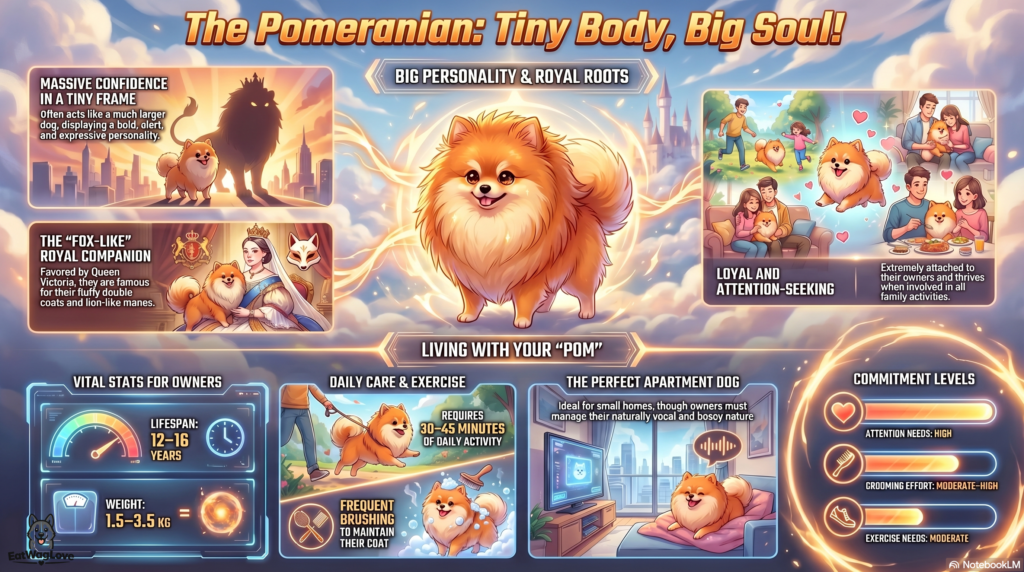
Pomeranians are small dogs with big personalities. Known for their fluffy coats and fox-like faces, they are confident, curious, and love being the centre of attention. Despite their size, they are alert and often act like much larger dogs, making them both entertaining and loyal companions.
✅ PROS & CONS
Pros
- Small size, great for apartments
- Full of personality and charm
- Loyal and affectionate
Cons
- Requires regular grooming
- Can be vocal and alert
- May be fragile and require careful handling
Is a Pomeranian a Good Family Dog?
Yes. Pomeranians can be affectionate, intelligent, lively and entertaining family companions.
They’re tiny dogs with remarkably confident personalities and often form very close bonds with their owners. Despite their size, they’re active, curious and usually want to be involved in everything happening around the home.
Their small, relatively fragile bodies make them better suited to families who understand how to handle toy breeds carefully.
Are Pomeranians Good With Children?
Pomeranians can be good with gentle, respectful children, particularly older children.
Their tiny size means rough handling, dropping or accidentally stepping on them can cause serious injury.
Close supervision is important around toddlers and young children.
How Much Exercise Does a Pomeranian Need?
Most Pomeranians need around 30–60 minutes of activity each day, usually divided between walks and play.
They’re considerably more energetic than their fluffy appearance suggests.
Training, puzzle toys and games are also valuable because Pomeranians are intelligent dogs that need mental stimulation.
Are Pomeranians Easy to Train?
Generally, yes.
Pomeranians are intelligent, alert and capable of learning commands and tricks quickly.
They can also be independent and surprisingly strong-minded, so positive reinforcement and consistent boundaries work particularly well.
Are Pomeranians Difficult to Toilet Train?
Some can be.
Their very small bladders mean puppies need frequent toilet opportunities, and bad weather can make some reluctant to go outside.
A consistent schedule, supervision and immediate rewards for toileting in the correct place are important.
Do Pomeranians Shed a Lot?
Yes. Pomeranians can be moderate to heavy shedders.
They have a dense double coat consisting of a soft undercoat beneath longer guard hairs.
Seasonal coat changes can produce particularly noticeable shedding.
Are Pomeranians Hypoallergenic?
No.
Pomeranians aren’t considered hypoallergenic.
Their dense double coat sheds, and allergens are also produced through saliva and skin secretions.
How Often Should You Groom a Pomeranian?
Pomeranians generally need thorough brushing several times a week, and more frequently during periods of heavy shedding.
The dense undercoat can tangle and mat, particularly behind the ears, under the legs and around the hindquarters.
Regular nail trimming, dental care and occasional professional grooming are also useful.
Should You Shave a Pomeranian?
Routine shaving isn’t recommended.
The Pomeranian has a double coat that provides insulation and protection. Shaving it extremely short can alter how the coat grows back, and some dogs experience delayed or uneven regrowth.
Mats or medical problems may occasionally require clipping under professional guidance.
What Health Problems Are Common in Pomeranians?
Potential health concerns include patellar luxation, collapsing trachea, dental disease, heart problems, eye disorders and Legg-Calvé-Perthes disease.
Pomeranians can also develop coat-loss conditions including alopecia X.
Extremely tiny dogs may face additional risks such as hypoglycaemia and physical injury.
What Is a Collapsing Trachea in Pomeranians?
Tracheal collapse occurs when the structures supporting the windpipe weaken, allowing the airway to partially flatten.
A characteristic honking cough can occur, particularly with excitement or pressure around the neck.
Maintaining healthy weight and using an appropriately fitted harness rather than placing unnecessary pressure on the throat can be helpful.
What Is Alopecia X in Pomeranians?
Alopecia X is a coat disorder particularly associated with Pomeranians and some other Spitz breeds.
Affected dogs can develop progressive hair loss, often beginning around the body and hindquarters while the head and lower legs remain relatively unaffected.
The condition is complex and should be assessed by a veterinarian because many other diseases can also cause hair loss.
How Long Do Pomeranians Live?
Pomeranians commonly live around 12–16 years, with some living longer.
They’re generally a long-lived breed.
Healthy weight, dental care, appropriate exercise and responsible breeding can all contribute to longevity.
How Big Does a Pomeranian Get?
Pomeranians are genuine toy dogs, commonly weighing around 1.8–3.5 kg, depending on the breed standard and individual dog.
Their enormous coat makes them appear considerably larger than the body underneath.
A healthy Pomeranian should still be sturdy and functional rather than excessively tiny or fragile.
When Is a Pomeranian Fully Grown?
Most Pomeranians reach close to their adult height by around 9–12 months.
Their body and particularly their adult coat may continue developing beyond this.
The spectacular mature Pomeranian coat can take considerably longer to reach its full appearance.
Is There a Teacup Pomeranian?
No. Teacup Pomeranian isn’t an officially recognised breed or size variety.
Pomeranians are already toy-sized dogs.
“Teacup”, “micro” and similar terms are usually marketing descriptions for exceptionally small individuals, and deliberately breeding for extreme miniaturisation can increase health and injury risks.
What Is a Throwback Pomeranian?
“Throwback Pomeranian” is an informal term used for a Pomeranian that grows considerably larger than the modern breed standard.
The name refers to the Pomeranian’s ancestry from larger Spitz-type dogs.
It isn’t a separate breed or officially recognised Pomeranian variety.
Can a Pomeranian Live in an Apartment?
Yes. Pomeranians can make excellent apartment dogs.
Their tiny size and manageable exercise requirements make them well suited to smaller homes.
Barking is usually a bigger potential issue than lack of space.
Can a Pomeranian Be Left Alone?
Adult Pomeranians can learn to tolerate reasonable periods alone, but many become strongly attached to their owners.
They generally enjoy being involved in household life.
Gradual independence training from puppyhood can help prevent excessive dependence and separation-related behaviour.
Are Pomeranians Cuddly?
Many are extremely affectionate and enjoy sitting on laps or sleeping beside their owners.
Others are slightly more independent and prefer staying nearby rather than constantly being held.
Individual personality varies considerably.
Do Pomeranians Bark a Lot?
They can.
Pomeranians are naturally alert and vocal, and many quickly announce visitors, unfamiliar noises or activity outside.
Early training can reduce excessive barking, but expecting a completely silent Pomeranian may be unrealistic.
Are Pomeranians Aggressive?
Aggression isn’t a desirable characteristic, but Pomeranians can be extraordinarily confident and assertive.
Poor socialisation or allowing unwanted behaviour because the dog is tiny can create problems.
A Pomeranian should receive the same thoughtful training and socialisation as a much larger dog.
Are Pomeranians Good With Other Dogs?
Generally, yes, when properly socialised.
The bigger concern is often physical safety around large dogs.
Some Pomeranians appear completely unaware of their own size and may confidently approach or challenge dogs many times heavier than themselves.
Are Pomeranians Good With Cats?
Many Pomeranians live successfully with cats, particularly when raised together.
Their Spitz ancestry can produce some chasing behaviour, but prey drive varies considerably.
Gradual introductions are important.
Can Pomeranians Handle Hot Weather?
Care is required.
Their dense double coat and small body can make strenuous activity during hot weather uncomfortable or dangerous.
During hot Australian conditions, walks should be scheduled for cooler periods, with constant access to water and a cool indoor environment.
What Does a Pomeranian Look Like?
The Pomeranian is a tiny Spitz-type dog with a dense double coat, small erect ears, pointed face and heavily plumed tail carried over the back.
A thick ruff around the neck and shoulders creates the breed’s famous fluffy appearance.
Underneath all that coat is a surprisingly compact little dog.
What Colours Can Pomeranians Be?
Pomeranians occur in an extraordinary range of colours and patterns, including orange, red, cream, black, brown, blue, sable, white, parti-colour and black and tan.
Orange and orange sable are among the colours most strongly associated with the modern breed.
Accepted colours vary somewhat between kennel organisations.
What Is a Merle Pomeranian?
A merle Pomeranian has a mottled coat pattern produced by the merle genetic variant.
Merle occurs in some modern Pomeranian populations, although its history and acceptance vary between registries.
Breeding two merle dogs together should be avoided because puppies inheriting two copies can have substantially increased risks of serious hearing and eye abnormalities.
Why Is My Pomeranian’s Coat Changing Colour?
Colour changes during growth are common in Pomeranians.
Puppies can lighten, darken or develop different sable shading as their adult coat replaces the puppy coat.
This means the final adult colour isn’t always obvious when a puppy is very young.
Why Is My Pomeranian Losing Its Puppy Fur?
Pomeranian puppies often pass through an awkward coat transition sometimes nicknamed the “puppy uglies.”
The fluffy puppy coat begins falling out before the full adult coat develops, temporarily making the youngster look thinner-coated or uneven.
This commonly occurs during the first year and shouldn’t be confused automatically with a medical hair-loss condition.
What Is the Difference Between a Pomeranian and a German Spitz?
They’re extremely closely related historically.
The Pomeranian developed from the German Spitz tradition, with breeders eventually selecting the smallest dogs and establishing the tiny companion breed familiar today.
In some international classification systems, the Pomeranian is still closely associated with or classified as the Zwergspitz — “Dwarf Spitz.”
What Is the Difference Between a Pomeranian and a Japanese Spitz?
The Japanese Spitz is considerably larger and traditionally white, while the Pomeranian is a much smaller toy Spitz available in many colours.
Both share classic Spitz characteristics such as erect ears, dense double coats and tails carried over the back.
They’re nevertheless distinct modern breeds.
Is a Pomeranian a Miniature Spitz?
In historical terms, essentially yes.
The Pomeranian belongs to the Spitz family of dogs and was developed by selecting increasingly small dogs from larger Spitz populations.
This explains why such a tiny companion still looks remarkably like a miniature northern working dog.
Where Do Pomeranians Come From?
The Pomeranian developed from larger German Spitz-type dogs associated with Pomerania, a historical region along the Baltic coast that today lies within parts of Germany and Poland.
These ancestral dogs were considerably larger than modern Pomeranians.
Selective breeding, particularly during the breed’s development in Britain, progressively reduced their size and established the modern toy dog.
Why Are Pomeranians Called Pomeranians?
The breed takes its name from Pomerania, the Baltic region historically associated with Spitz-type dogs important to its development.
The name survived even as breeders transformed the dog from a substantially larger Spitz into today’s tiny companion.
Were Pomeranians Originally Bigger Dogs?
Yes — substantially bigger.
The ancestors of modern Pomeranians were larger Spitz dogs rather than tiny lap dogs.
Historical Pomeranians could weigh several times as much as today’s dogs.
Selective breeding for smaller size eventually transformed the breed into one of the world’s best-known toy dogs.
Did Queen Victoria Own Pomeranians?
Yes. Queen Victoria became one of the most influential figures in Pomeranian history.
She developed a strong interest in the breed and kept several Pomeranians.
Her preference for smaller dogs helped increase the popularity of smaller Pomeranians in Britain during the late 19th century and contributed to the breed’s movement toward today’s toy size.
Did Pomeranians Survive the Titanic?
Yes.
Two Pomeranians are generally recorded among the small number of dogs that survived the sinking of the Titanic in 1912.
Their tiny size made it possible for their owners to take them into lifeboats, while most animals aboard weren’t so fortunate.
Why Do Pomeranians Act Like Big Dogs?
Their confidence makes more sense when you remember their ancestry.
The Pomeranian wasn’t created from generations of increasingly tiny companion breeds. It descended from larger, confident Spitz dogs and was subsequently miniaturised through selective breeding.
Modern Pomeranians often retain remarkable alertness and self-confidence despite weighing only a few kilograms.
Is a Pomeranian a Good Dog for Older People?
Often, yes.
Their small size, affectionate personality and moderate exercise requirements can make them excellent companions for older owners.
Potential challenges include grooming, barking, dental care and the risk of falls if a tiny dog frequently moves around its owner’s feet.
Is a Pomeranian a Good First Dog?
Yes, provided the owner is prepared for grooming and training.
Pomeranians are intelligent, affectionate and physically manageable, but they shouldn’t be treated like toys.
Consistent training, socialisation, dental care and regular coat maintenance are important throughout their lives.
What Makes the Pomeranian Unique?
The Pomeranian’s history explains one of the funniest things about the breed:
its personality seems to belong to a much bigger dog.
That’s partly because its ancestors actually were much bigger.
The breed developed from larger Spitz-type dogs associated with Pomerania, along the Baltic coast. These were sturdy dogs with thick double coats, erect ears and the classic curled Spitz tail.
Then humans started making them smaller.
The transformation accelerated during the 19th century, and Queen Victoria’s enthusiasm for smaller Pomeranians helped popularise the tiny version that eventually became today’s breed.
Yet much of the Spitz attitude survived the downsizing.
Modern Pomeranians remain alert, energetic, intelligent and often extraordinarily confident. They can excel at training, enthusiastically patrol their homes and challenge dogs whose heads weigh more than they do.
Even their enormous coat creates an illusion.
Underneath that spectacular cloud of fur may be only a couple of kilograms of actual dog.
So the Pomeranian is essentially the result of taking a much larger Spitz, shrinking the body dramatically and apparently forgetting to shrink the opinion of itself.