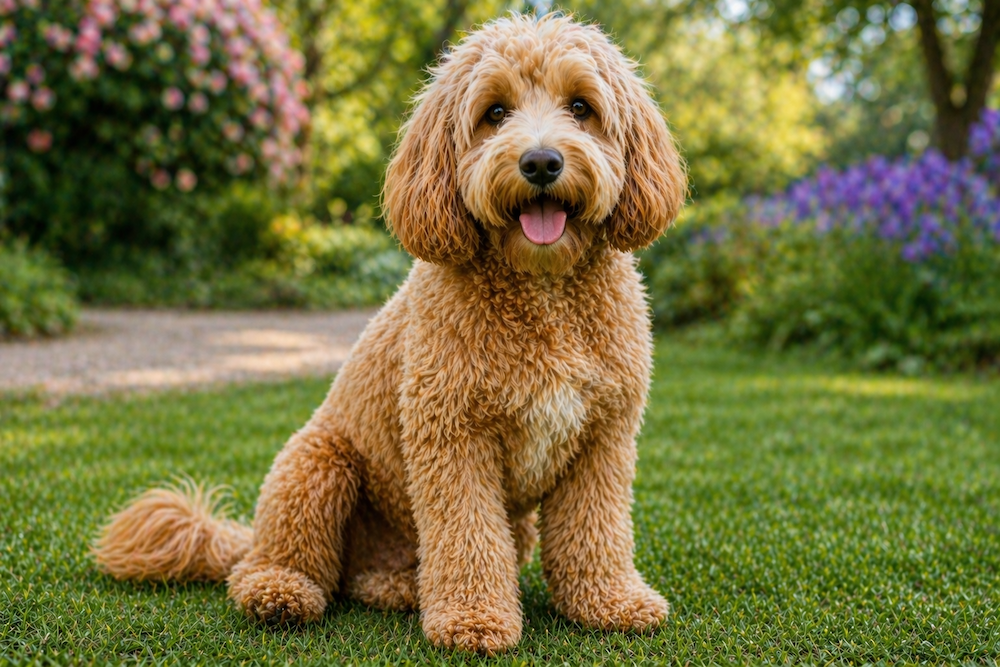







Playful, loving, and full of personality — a cheerful companion that fits perfectly into family life.
🧠 QUICK SNAPSHOT
- Temperament: Friendly, playful, affectionate
- Energy Level: Moderate
- Size: Small to medium
- Good With Families: Yes
- Trainability: High
- Grooming: Moderate
- Best For: Families, first-time owners, companionship
📚 OVERVIEW
The Cockapoo is a cross between a Cocker Spaniel and a Poodle, combining intelligence with a loving, social nature. They are known for their happy personality and strong bond with their owners.
They adapt well to different living environments and are one of the most popular companion breeds.
✅ PROS & CONS
Pros
- Very friendly and affectionate
- Great with children and families
- Intelligent and easy to train
- Adaptable to most homes
Cons
- Needs regular grooming
- Can develop separation anxiety
- Requires attention and interaction
- Energy levels vary between individuals
Is a Cockapoo a Good Family Dog?
Yes. Cockapoos are often excellent family dogs, combining the affectionate nature of the Cocker Spaniel with the intelligence and trainability of the Poodle.
They are typically social, playful and strongly attached to their families.
Many are good with children, although temperament varies because the Cockapoo is a cross rather than a standardised breed.
Early socialisation and responsible breeding are particularly important.
How Much Exercise Does a Cockapoo Need?
Most adult Cockapoos need around 60 minutes of exercise each day, although particularly energetic individuals may need more.
Walks, retrieving, swimming, scent games and training are excellent activities.
Both parent breeds have working ancestry, so Cockapoos often require more than simply being allowed into the backyard.
Mental stimulation is equally important for these intelligent dogs.
Is a Cockapoo Easy to Train?
Cockapoos are generally highly trainable.
Poodles are exceptionally intelligent, while Cocker Spaniels were developed to work cooperatively with people.
Positive reinforcement usually works extremely well.
Some Cockapoos can be excitable or easily distracted, particularly during adolescence, but consistent training can produce an excellent companion.
Their intelligence also means they can become very good at training their owners if the rules keep changing.
Does a Cockapoo Shed?
Cockapoos can be low, moderate or occasionally fairly noticeable shedders.
A curly Poodle-like coat may shed relatively little, while a straighter Cocker-like coat can shed considerably more.
Even puppies within the same litter can develop different adult coats.
Anyone buying a Cockapoo specifically because they’ve been promised a completely non-shedding dog should understand that crossbreed coat genetics aren’t completely predictable.
Is a Cockapoo Hypoallergenic?
No Cockapoo can be guaranteed to be hypoallergenic.
Some individuals with Poodle-like coats shed very little and may be easier for certain allergy sufferers to tolerate.
However, dog allergens come primarily from proteins in saliva, dander and skin secretions rather than the hair itself.
People with significant allergies should spend time with adult Cockapoos rather than assuming a puppy will be allergy-friendly.
How Often Does a Cockapoo Need Grooming?
Most Cockapoos require considerable regular grooming.
Curly or wavy coats should usually be brushed several times each week, with some requiring daily attention.
Professional grooming is commonly needed approximately every 6–8 weeks, depending on coat length and style.
Matting frequently develops behind the ears, under the legs, around the collar and other friction areas.
Low shedding doesn’t mean low maintenance — often it means exactly the opposite.
What Health Problems Are Common in Cockapoos?
Cockapoos can inherit health conditions from both Cocker Spaniels and Poodles.
Potential concerns include hip dysplasia, patellar luxation, progressive retinal atrophy and other eye disorders, ear disease, allergies and some inherited neurological conditions.
The exact risks vary depending on whether the Cocker parent is an American or English Cocker and whether a Toy, Miniature or Standard Poodle is involved.
Responsible breeders should health-test both parent lines rather than assuming crossbreeding automatically prevents inherited disease.
Why Do Cockapoos Get Ear Infections?
Cockapoos can be prone to ear problems because of their long, hanging ears and hair growth around the ear canal.
These features can restrict airflow and create a warm, moist environment where yeast and bacteria thrive.
Swimming can add additional moisture.
Regular ear checks are important, but excessive cleaning can also cause irritation.
Persistent odour, redness, discharge, scratching or head shaking should be investigated by a veterinarian.
How Long Do Cockapoos Live?
Cockapoos commonly live around 12–16 years, although size and genetics influence longevity.
Cockapoos produced from smaller Poodles may tend to live longer than much larger individuals.
Healthy body weight, dental care, regular exercise and preventive veterinary treatment can all contribute to longevity.
Because many live well into their teens, bringing home a Cockapoo can represent a very long commitment.
How Big Does a Cockapoo Get?
Cockapoo size can vary considerably.
Many weigh around 6–12 kg, but individuals can fall outside this range depending particularly on the size of the Poodle parent.
Crosses involving Toy Poodles may remain very small, while Miniature or Standard Poodle ancestry can produce substantially larger dogs.
There is no single universally accepted Cockapoo size standard.
What Is a Toy Cockapoo?
A Toy Cockapoo generally refers to a Cockapoo with Toy Poodle ancestry or an especially small adult size.
However, terminology isn’t standardised.
Labels such as Toy, Miniature and Maxi Cockapoo may mean different things to different breeders.
Prospective owners should ask for the actual sizes and weights of the parents rather than relying solely on a marketing category.
Is There Such a Thing as a Teacup Cockapoo?
“Teacup Cockapoo” isn’t an officially recognised size or breed variety.
The term is generally used to market exceptionally small dogs.
Deliberately breeding for extreme miniaturisation can increase the risk of fragile bones, hypoglycaemia, dental crowding and other health problems.
A healthy, structurally sound dog should always be prioritised over producing the smallest possible puppy.
Can a Cockapoo Live in an Apartment?
Yes. Cockapoos can be excellent apartment dogs when their exercise and mental-stimulation needs are met.
They’re generally adaptable and strongly people-oriented.
Barking and separation distress can become problems if training is neglected.
An apartment owner willing to provide daily walks, play and enrichment can often meet a Cockapoo’s needs perfectly well.
Can a Cockapoo Be Left Alone?
Cockapoos can learn to spend reasonable periods alone, but many dislike prolonged isolation.
Both Cocker Spaniels and Poodles tend to form strong relationships with people.
Some Cockapoos develop separation-related distress.
Teaching puppies to relax independently from an early age is valuable rather than allowing them to follow someone around the house constantly.
Do Cockapoos Bark a Lot?
Cockapoos can be moderately vocal, although individual variation is substantial.
Some bark when excited, when visitors arrive or when they hear unfamiliar noises.
Others are relatively quiet.
Boredom and separation anxiety can increase barking.
Early training that rewards calm behaviour can prevent alert barking from becoming a permanent soundtrack to household life.
Are Cockapoos Good With Children?
Cockapoos are generally very good with children, particularly when well socialised.
They’re often playful, affectionate and eager to participate in family activities.
Very small Cockapoos require additional care around young children because they can be injured through accidental rough handling.
Children should also learn to respect the dog’s food, toys and resting areas.
Are Cockapoos Good With Other Dogs?
Yes. Cockapoos are generally sociable with other dogs.
Both parent breeds have histories involving cooperation with people and other dogs.
Early socialisation remains important.
Some Cockapoos can become overexcited during greetings, so teaching calm interactions is useful even when the dog’s intentions are entirely friendly.
Are Cockapoos Good With Cats?
Cockapoos can live successfully with cats, particularly when introduced appropriately from a young age.
However, Cocker Spaniels are sporting dogs and Poodles also have hunting ancestry, so some Cockapoos retain noticeable prey or chasing instincts.
A household cat may be accepted as family while unfamiliar animals outdoors trigger greater excitement.
Do Cockapoos Like Water?
Many Cockapoos love water and swimming.
Both sides of their ancestry have strong connections with water.
Poodles were developed as water retrievers, while Cocker Spaniels are sporting dogs that can enthusiastically retrieve and work around wetlands.
Individual preferences still vary.
Dogs should be introduced to swimming safely rather than simply assuming genetics will teach them everything automatically.
Are Cockapoos Good at Fetch?
Many Cockapoos have a natural enthusiasm for retrieving.
Both parent breeds descend from working gundogs.
Poodles were historically water retrievers, while Cocker Spaniels flushed and retrieved game birds.
Balls and retrieving toys can therefore provide excellent physical and mental exercise.
Some Cockapoos seem prepared to play fetch indefinitely — usually several hours after their owner has reconsidered the arrangement.
Do Cockapoos Have a Strong Prey Drive?
Some Cockapoos can have a moderate prey drive, despite their teddy-bear appearance.
Both Poodles and Cocker Spaniels have genuine hunting ancestry.
Birds, squirrels and other fast-moving animals can therefore attract considerable interest.
Recall training is important, particularly for dogs allowed off lead.
A fluffy haircut doesn’t erase several centuries of sporting-dog genetics.
Why Is My Cockapoo So Energetic?
Cockapoos combine two intelligent, active sporting breeds.
A young Cockapoo may therefore have considerably more energy than its cuddly appearance suggests.
Insufficient exercise is only part of the problem when a Cockapoo seems constantly restless.
These dogs also need mental work.
Training, scent games, retrieving and puzzle activities can sometimes tire an energetic Cockapoo more effectively than simply adding another walk.
Why Does My Cockapoo Follow Me Everywhere?
Cockapoos tend to be highly people-oriented dogs.
Both Cocker Spaniels and Poodles were bred to work closely with humans, and modern Cockapoos are primarily companions.
Following family members around the house can therefore be perfectly normal.
However, owners should also encourage independence so that attachment doesn’t develop into separation distress.
A dog should enjoy your company without believing that a closed bathroom door constitutes an emergency.
Do Cockapoos Like to Cuddle?
Many Cockapoos are extremely affectionate and enjoy cuddling.
Their companion-dog popularity is partly due to their tendency to combine playfulness with close attachment to people.
Individual dogs vary, and some prefer lying beside their owners rather than directly on them.
Either way, Cockapoos usually enjoy being actively included in family life.
Why Do Cockapoos Have Tear Stains?
Some Cockapoos develop reddish-brown staining beneath their eyes, particularly dogs with pale coats.
The colour is associated with pigments called porphyrins present in tears.
Excessive tearing can also result from irritation, hair rubbing the eyes, allergies, tear-duct problems or eye disease.
Persistent or suddenly increased tearing deserves veterinary investigation rather than simply being treated cosmetically.
Why Does a Cockapoo’s Coat Mat So Easily?
Cockapoo coats can combine continuous hair growth, curls or waves with a soft texture that traps loose hair.
Instead of falling away, shed hairs can remain tangled within the surrounding coat.
Friction around harnesses, collars, ears, armpits and legs accelerates matting.
This explains the apparent contradiction of many Cockapoos: they may leave relatively little hair on the sofa because much of the loose hair is still trapped on the dog.
What Does a Cockapoo Look Like?
There is no single Cockapoo appearance.
Some have tightly curled Poodle-like coats, while others develop loose waves or relatively straight Cocker-style hair.
Muzzles, ear length, body proportions and size can also vary.
Even littermates can look surprisingly different.
The familiar teddy-bear appearance is partly genetics and partly grooming style rather than a fixed breed characteristic.
What Colours Can Cockapoos Be?
Cockapoos can occur in a very wide range of colours and patterns.
These can include black, chocolate, cream, apricot, red, buff and various parti-colour combinations.
Cocker Spaniel genetics can contribute additional markings and patterns.
Poodle colour genetics can also cause some coats to lighten significantly with age.
Two puppies that look similar at eight weeks may therefore become quite different-looking adults.
Why Do Some Cockapoos Fade in Colour?
Some Cockapoos inherit colour-fading genes from their Poodle ancestry.
A puppy born deep red, chocolate or black may gradually become lighter as the adult coat develops.
The extent varies enormously.
This is generally a normal genetic colour change rather than evidence that something is wrong with the coat.
Anyone choosing a puppy purely because of its exact shade should remember that the colour may not stay that way.
What Is an F1 Cockapoo?
An F1 Cockapoo is generally a first-generation cross between a Cocker Spaniel and a Poodle.
Because the parents are different breeds, F1 puppies can inherit widely varying combinations of characteristics.
Coat type, shedding, size and temperament aren’t guaranteed.
The F1 label tells you about the dog’s ancestry, not precisely what the adult dog will become.
What Is an F1B Cockapoo?
An F1B Cockapoo is usually produced by breeding an F1 Cockapoo back to a Poodle, although theoretically the backcross could be to a Cocker Spaniel.
Poodle backcrosses are often promoted as producing curlier, lower-shedding coats.
That outcome may become more likely, but it still isn’t guaranteed.
An F1B Cockapoo can still shed and still requires substantial grooming.
What Is an F2 Cockapoo?
An F2 Cockapoo is generally produced by breeding two F1 Cockapoos together.
This can create considerable genetic variation because puppies may inherit different combinations of Cocker and Poodle traits.
Generation terminology is useful for describing ancestry but shouldn’t be used as a promise about coat, personality or health.
Actual parent characteristics and health testing matter far more.
Is a Cockapoo a Recognised Dog Breed?
The Cockapoo is generally considered a crossbreed rather than a formally recognised pedigree breed by major kennel clubs.
Cocker Spaniels and Poodles have established breed standards, but Cockapoos don’t have one universally accepted international standard.
Dedicated Cockapoo organisations and breeding programmes do exist, and some breeders are working towards greater consistency across generations.
For now, however, variation remains a fundamental characteristic of the Cockapoo.
Is a Cockapoo Healthier Than a Cocker Spaniel or Poodle?
A Cockapoo may benefit from greater genetic diversity, but it isn’t automatically healthier than either parent breed.
Inherited diseases don’t disappear simply because two breeds are crossed.
A puppy can inherit health-risk variants from either side.
The best chance of producing healthy Cockapoos comes from health-tested Cocker Spaniels and Poodles selected for sound temperament and structure.
“Hybrid vigour” is a population-genetics concept, not a guarantee attached to every crossbred puppy.
What Is the Difference Between a Cockapoo and a Cavapoo?
A Cockapoo is a Cocker Spaniel–Poodle cross, while a Cavapoo is a Cavalier King Charles Spaniel–Poodle cross.
Cockapoos are often somewhat more energetic and may show stronger sporting or hunting instincts because of their Cocker Spaniel ancestry.
Cavapoos are generally more heavily influenced by the Cavalier’s companion-dog temperament.
However, both crosses vary considerably depending on the individual parents.
What Is the Difference Between a Cockapoo and a Cavoodle?
There is a very important distinction: Cavoodle and Cavapoo are generally two names for the same Cavalier King Charles Spaniel–Poodle cross.
A Cockapoo instead uses a Cocker Spaniel.
The names can easily cause confusion, particularly in Australia where “Cavoodle” is much more commonly used than “Cavapoo”.
So:
Cockapoo = Cocker Spaniel + Poodle
Cavoodle/Cavapoo = Cavalier King Charles Spaniel + Poodle
What Is the Difference Between an English Cockapoo and an American Cockapoo?
The distinction usually refers to the type of Cocker Spaniel used.
An English Cockapoo generally has an English Cocker Spaniel parent or ancestry, while an American Cockapoo uses an American Cocker Spaniel.
English Cockers tend to have a somewhat more athletic head and body, while American Cockers have been developed with a more domed skull and profuse coat.
Temperament and appearance can therefore differ depending on which Cocker population is involved.
Is the Cockapoo One of the Oldest Designer Dogs?
Yes. The Cockapoo is generally considered one of the earliest modern “designer” dog crosses.
Intentional Cocker Spaniel–Poodle crosses became established in the United States during the 1950s and 1960s, decades before the explosion of Poodle crosses such as Labradoodles, Goldendoodles and Bernedoodles.
This makes the Cockapoo unusual among today’s designer dogs.
It wasn’t created during the recent “doodle” boom — it was already around long before that boom began.
Was the Cockapoo Originally Created by Accident?
The exact story of the first Cockapoo isn’t well documented.
Cocker Spaniel–Poodle crosses were reportedly appearing in the United States by the 1950s, and breeders discovered that the resulting dogs could make appealing companions.
There isn’t a universally accepted individual who can be identified as the inventor of the Cockapoo.
The cross subsequently became deliberately bred and increasingly popular.
Claims naming a precise first breeder should therefore be treated cautiously unless supported by documentation.
Why Is It Called a Cockapoo?
The name Cockapoo combines Cocker Spaniel and Poodle.
Interestingly, the name predates the enormous modern trend for attaching “-poo” or “-doodle” to Poodle crosses.
Because Cockapoos have been deliberately bred for many decades, the name has become firmly established internationally.
Other names occasionally appear, but Cockapoo remains by far the most recognisable.
Where Does the Cockapoo Come From?
The modern Cockapoo is most strongly associated with the United States, where deliberate Cocker Spaniel–Poodle crosses became popular during the mid-20th century.
There is no securely documented single inventor or exact first litter, and accidental crosses undoubtedly occurred earlier.
What makes the Cockapoo historically interesting is its age relative to the modern designer-dog phenomenon. Long before Labradoodles and Goldendoodles became household names, people were already discovering what happened when you combined the Cocker Spaniel’s affectionate sporting personality with the Poodle’s intelligence and distinctive coat.