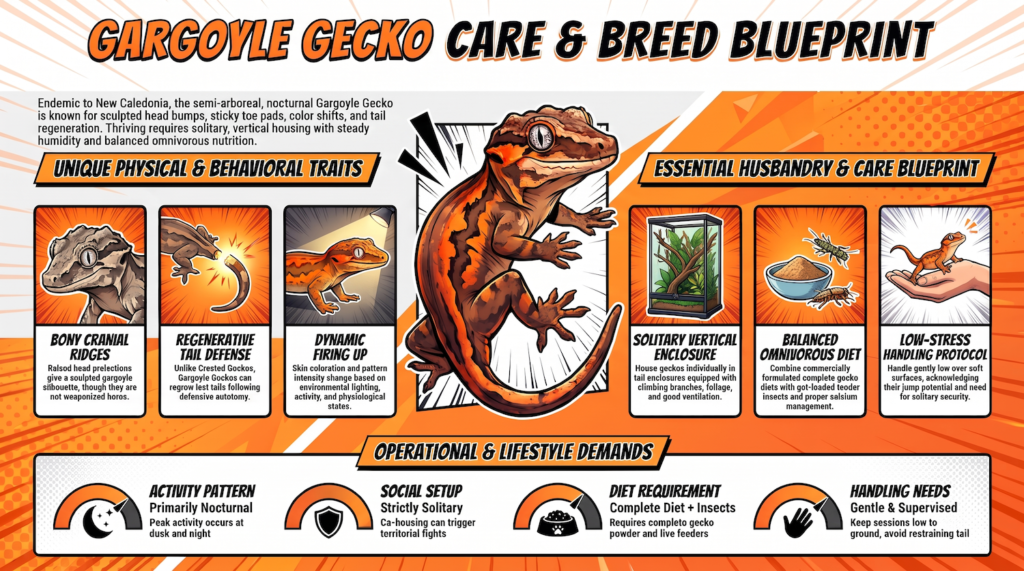
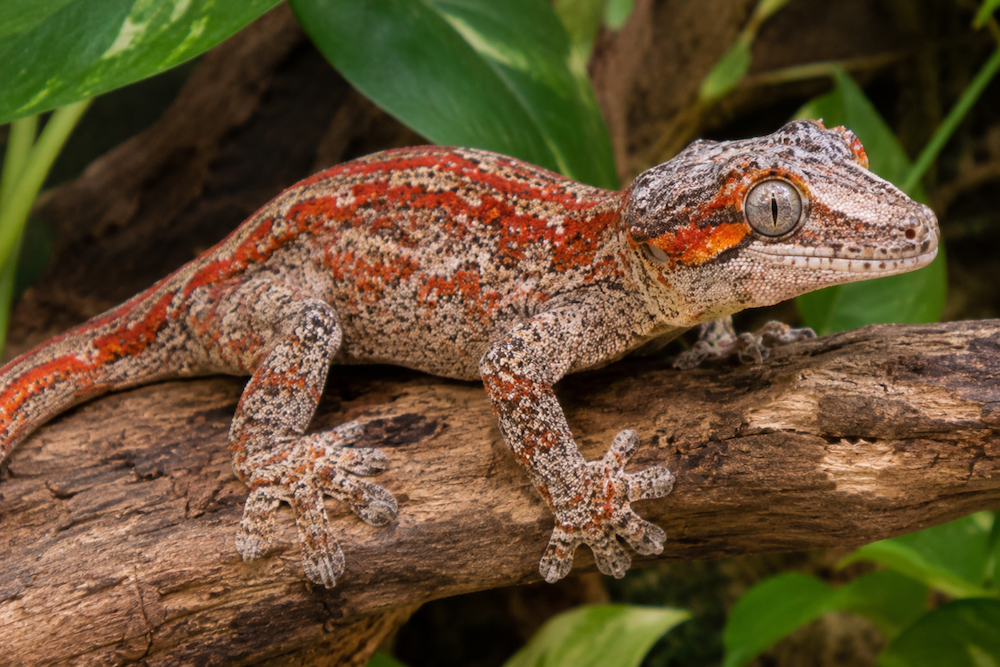







Strikingly patterned, wonderfully unusual and equipped with remarkable climbing abilities, the Gargoyle Gecko is a fascinating New Caledonian lizard famous for its horn-like head bumps, expressive appearance, spectacular colours and extraordinary ability to regenerate its tail.
🧠 QUICK SNAPSHOT
Trait | Gargoyle Gecko |
|---|---|
Scientific Name | Rhacodactylus auriculatus |
Other Names | New Caledonian Gargoyle Gecko, Gargoyle |
Pet Type | Reptile / Arboreal Gecko |
Natural Origin | Southern New Caledonia, a French territory in the South Pacific |
Typical Lifespan | Approximately 15–20 years in captivity; potentially longer |
Adult Size | Approximately 18–23 cm, including tail |
Adult Weight | Commonly 40–70 g; some individuals are heavier |
Skin Type | Soft, finely textured skin with small scales |
Colours | Brown, grey, cream, orange, red, yellow and various combinations |
Popular Patterns | Striped, reticulated, blotched and banded |
Distinctive Feature | Horn-like cranial bumps and a regenerating tail |
Diet | Omnivore |
Activity | Primarily nocturnal and crepuscular |
Temperament | Generally calm, curious and sometimes shy or jumpy |
Noise Level | Very quiet; occasional squeaks or other sounds |
Social Needs | Solitary |
Housing | Tall, well-ventilated tropical terrarium |
Temperature | Generally 22–26°C, with a modest temperature gradient |
Humidity | Approximately 60–80% during humid periods, with regular drying cycles |
Lighting | Consistent day-night cycle; low-level UVB beneficial |
Substrate | Reptile-safe, moisture-retaining substrate |
Grooming | No grooming required |
Exercise Needs | Moderate; requires climbing and exploration |
Handling | Usually manageable with gentle, careful handling |
Beginner Friendly? | Yes, for prepared keepers with appropriate equipment |
Famous Feature | Distinctive horn-like head projections and the ability to regrow a lost tail |
📚 OVERVIEW
The Gargoyle Gecko is a fascinating arboreal reptile native to New Caledonia, a group of islands in the South Pacific. It belongs to the genus Rhacodactylus and is closely related to several other remarkable New Caledonian geckos, including the enormous Leachianus Gecko.
Its unusual name comes from the small, horn-like bony projections on its head, which give it an appearance reminiscent of the carved gargoyles found on historic buildings. Combined with its large eyes, textured skin and extraordinary colour patterns, these features make the Gargoyle Gecko one of the most distinctive reptiles kept in captivity.
Gargoyle Geckos are primarily nocturnal and spend much of their active time climbing through branches, investigating foliage and searching for food. Many captive-bred individuals become accustomed to gentle handling, although they can be surprisingly quick and may leap unexpectedly.
Their care requires a tall, secure enclosure, suitable temperatures, controlled humidity, climbing structures, a balanced gecko diet, appropriate lighting and careful handling. Unlike some tropical reptiles, Gargoyle Geckos can be sensitive to excessive heat, making temperature management especially important.
✅ PROS & CONS
👍 Pros
Spectacular colours and distinctive patterns
Unique horn-like head projections
Generally manageable adult size
Can thrive on a suitable prepared gecko diet
Fascinating nocturnal climbing behaviour
Able to regenerate a lost tail
Often suitable for prepared beginner reptile keepers
Long-lived and interesting companion
👎 Cons
Sensitive to excessive temperatures
Requires carefully managed humidity
Can jump suddenly during handling
Needs a tall, well-furnished enclosure
May hide for much of the day
Some individuals are defensive or reluctant to be handled
Long lifespan creates a substantial commitment
Ownership is restricted or prohibited in some countries or regions
Are Gargoyle Geckos Good Pets?
Yes. Gargoyle Geckos can make excellent reptile companions for people interested in observing and caring for unusual lizards.
Their attractive appearance, manageable size and fascinating behaviour make them popular among reptile enthusiasts.
However, they require appropriate housing, environmental management and a long-term commitment.
Are Gargoyle Geckos Good for Beginners?
Yes.
Gargoyle Geckos are often considered suitable for prepared beginners.
Their dietary requirements can be relatively straightforward when a suitable commercial gecko diet is available.
However, correct temperatures, humidity, enclosure design and handling remain essential.
How Long Do Gargoyle Geckos Live?
Gargoyle Geckos commonly live approximately 15–20 years in captivity.
Some may live longer with excellent care.
Their lifespan depends on genetics, nutrition, housing conditions and veterinary attention.
How Big Do Gargoyle Geckos Get?
Adult Gargoyle Geckos generally reach approximately 18–23 cm in total length, including the tail.
Their bodies are relatively robust compared with some other similarly sized geckos.
Adult size varies according to genetics, sex and individual development.
How Much Do Gargoyle Geckos Weigh?
Adult Gargoyle Geckos commonly weigh approximately 40–70 grams.
Some healthy individuals may be heavier.
Regular weighing helps monitor growth and identify potential health concerns.
Why Are They Called Gargoyle Geckos?
Their name comes from the unusual bony projections on their heads.
These raised structures resemble small horns or the decorative features of carved stone gargoyles.
The projections are a natural part of their skull anatomy rather than true horns.
What Colours Do Gargoyle Geckos Come In?
Gargoyle Geckos display a remarkable variety of colours.
These include grey, brown, cream, orange, yellow and red.
Captive-bred individuals may possess particularly striking combinations of colours and patterns.
What Are the Different Gargoyle Gecko Morphs?
Popular appearance categories include:
Red Stripe — prominent reddish stripes along the back
Orange Stripe — orange markings running along the body
Reticulated — intricate, interconnected markings
Blotched — irregular patches of contrasting colour
Banded — more distinct cross-body markings
High-Colour — particularly vivid red, orange or yellow pigmentation
These are primarily descriptive breeding and appearance terms rather than formally defined genetic morphs.
Do Gargoyle Geckos Change Colour?
Yes, to a limited extent.
Gargoyle Geckos can become darker or brighter depending on environmental and physiological conditions.
Keepers often describe these changes as firing up and firing down.
Temperature, lighting, activity and other factors may influence their appearance.
Are Gargoyle Geckos Friendly?
Many captive-bred Gargoyle Geckos become relatively calm around familiar caregivers.
However, they don’t form affectionate relationships in the same way as social mammals.
Individual temperament varies, and some geckos remain nervous or defensive.
Do Gargoyle Geckos Recognise Their Owners?
Gargoyle Geckos can become familiar with feeding routines and environmental cues.
Some appear less nervous around familiar handling situations.
However, scientific evidence for individual human recognition in this species is limited.
Do Gargoyle Geckos Like Being Held?
Some Gargoyle Geckos tolerate gentle handling well.
Others prefer remaining within their enclosure.
Handling should be brief, calm and performed close to a safe surface because these geckos can jump unexpectedly.
Do Gargoyle Geckos Bite?
Yes.
Gargoyle Geckos may bite when frightened, restrained or responding defensively.
Adults possess relatively strong jaws for their size.
Although bites are usually minor, unnecessary handling should be avoided.
Are Gargoyle Geckos Aggressive?
Gargoyle Geckos aren’t generally aggressive towards humans.
However, some individuals may display territorial or defensive behaviour.
This can include vocalising, opening the mouth, lunging or biting.
Providing secure hiding places and avoiding excessive handling can reduce stress.
Are Gargoyle Geckos Active?
Yes, particularly during the evening and night.
They may climb branches, investigate foliage and search for food.
During daylight hours, they often remain concealed among vegetation or within sheltered areas.
Are Gargoyle Geckos Nocturnal?
Yes.
Gargoyle Geckos are primarily nocturnal and crepuscular.
They generally become more active after sunset.
A consistent day-night lighting cycle helps support their natural behaviour.
Can Gargoyle Geckos Live Together?
Gargoyle Geckos are generally best housed individually.
They can be territorial, and cohabitation may result in stress, injuries or competition for resources.
Even breeding pairs should not automatically be housed together permanently.
Can Two Male Gargoyle Geckos Live Together?
No.
Male Gargoyle Geckos can be highly territorial towards one another.
Housing males together creates a significant risk of fighting and injury.
Separate enclosures are strongly recommended.
Can Male and Female Gargoyle Geckos Live Together?
A male and female may tolerate temporary cohabitation under experienced supervision.
However, persistent courtship, mating pressure and territorial behaviour can create stress.
Separate housing is generally preferable outside carefully managed breeding arrangements.
What Size Enclosure Does a Gargoyle Gecko Need?
Gargoyle Geckos require vertically oriented accommodation with substantial climbing space.
For one adult, an enclosure measuring approximately 45 × 45 × 60 cm is a practical minimum starting point, although larger enclosures are preferable.
A terrarium around 60 × 45 × 90 cm provides additional room for exploration and enrichment.
Do Gargoyle Geckos Need a Tall Terrarium?
Yes.
Gargoyle Geckos are primarily arboreal and spend considerable time climbing.
A tall enclosure provides opportunities for exploring branches, foliage and elevated hiding places.
Adequate horizontal space is also important.
What Temperature Do Gargoyle Geckos Need?
Gargoyle Geckos generally thrive at temperatures around 22–26°C.
A modest warm area may be provided, but excessive heat must be avoided.
Prolonged temperatures above approximately 29–30°C can be dangerous.
Heating equipment should always be thermostatically controlled and carefully monitored.
What Humidity Do Gargoyle Geckos Need?
Gargoyle Geckos benefit from periodic humidity increases, commonly around 60–80% following misting.
However, the enclosure should also be allowed to dry moderately between misting sessions.
Constantly saturated, poorly ventilated conditions can contribute to respiratory and skin problems.
Do Gargoyle Geckos Need UVB Lighting?
Low-level UVB lighting is beneficial for Gargoyle Geckos.
Although primarily nocturnal, they may receive some natural ultraviolet exposure while resting near vegetation or sheltered surfaces.
Appropriate UVB lighting can support vitamin D synthesis and calcium metabolism.
Shaded retreats must remain available.
Do Gargoyle Geckos Need Heat Lamps?
Not always.
In a suitably warm room, additional heating may be unnecessary.
If heating is required, a low-output heat source controlled by a thermostat can provide an appropriate temperature gradient.
Strong heat lamps can quickly overheat small enclosures.
Do Gargoyle Geckos Need Hiding Places?
Yes.
Gargoyle Geckos require secure hiding places to feel safe.
Cork bark, dense foliage, hollow branches and suitable elevated shelters provide valuable cover.
Multiple hiding locations allow the gecko to select appropriate temperatures and humidity levels.
Are Gargoyle Geckos Good Climbers?
Yes.
Gargoyle Geckos are excellent climbers.
They possess specialised toe pads that help them grip many surfaces, along with claws that assist on rough materials.
However, their climbing ability differs from that of some other gecko species, and they may rely heavily on branches and textured surfaces.
Can Gargoyle Geckos Climb Glass?
Yes, many Gargoyle Geckos can climb glass and other relatively smooth surfaces.
Their specialised toe pads provide adhesion.
However, their grip may be less reliable than that of some other arboreal geckos, particularly on dirty or wet surfaces.
Can Gargoyle Geckos Jump?
Yes.
Gargoyle Geckos are capable of surprisingly powerful jumps.
They may leap between branches or suddenly jump from a person’s hand.
Handling should therefore take place close to a safe surface to prevent injuries from falls.
What Do Gargoyle Geckos Eat?
Gargoyle Geckos are omnivores.
Their diet may include fruit-derived foods, nectar-like resources and insects in the wild.
In captivity, a complete commercial diet formulated for fruit-eating geckos can provide the nutritional foundation.
Appropriately sized feeder insects may also be offered as part of a balanced feeding plan.
Can Gargoyle Geckos Eat Fruit?
Yes.
Gargoyle Geckos can consume suitable fruit-based foods.
However, plain fruit alone doesn’t provide complete nutrition.
A balanced commercial gecko diet is generally preferable because it contains appropriate protein, vitamins and minerals.
Do Gargoyle Geckos Need Live Insects?
Live insects can provide valuable nutrition and behavioural enrichment.
Suitable options may include appropriately sized crickets, roaches and other safe feeder insects.
However, many captive Gargoyle Geckos can obtain their primary nutrition from a complete commercial gecko diet.
How Often Should You Feed a Gargoyle Gecko?
Feeding frequency depends on age, size and body condition.
Young geckos generally require more frequent feeding than adults.
Many healthy adults are offered prepared gecko diet approximately three times weekly, with suitable insects offered periodically.
Food intake and body condition should be monitored.
Do Gargoyle Geckos Need Water Bowls?
Yes.
Fresh drinking water should always be available.
Gargoyle Geckos may also drink droplets from leaves and enclosure surfaces after misting.
A shallow, clean water dish and appropriate misting support hydration.
Can Gargoyle Geckos Regrow Their Tails?
Yes.
Gargoyle Geckos can shed their tails through a defensive process called autotomy.
Unlike Crested Geckos, Gargoyle Geckos can regenerate a replacement tail.
However, the regenerated tail may differ in shape, colour and texture from the original.
Why Do Gargoyle Geckos Drop Their Tails?
Tail loss is a defensive response.
A Gargoyle Gecko may release its tail when frightened, grabbed or attacked.
The detached tail can continue moving, potentially distracting a predator while the gecko escapes.
Tail loss should never be deliberately encouraged.
How Often Do Gargoyle Geckos Shed Their Skin?
Gargoyle Geckos shed periodically throughout their lives.
Young, rapidly growing individuals generally shed more frequently than adults.
Appropriate humidity and hydration help support healthy shedding.
Like many geckos, they may consume their shed skin.
How Do Gargoyle Geckos Breed?
Gargoyle Geckos reproduce by laying eggs.
Females commonly lay two eggs per clutch and may produce multiple clutches during a breeding season.
Females can also retain sperm after mating, allowing subsequent fertile clutches without repeated mating.
Captive breeding requires careful planning and appropriate management of the female’s nutritional and calcium requirements.
What Health Problems Are Common in Gargoyle Geckos?
Potential concerns include metabolic bone disease, dehydration, retained shed, obesity, parasites and respiratory infections.
Incorrect temperatures, poor humidity management and nutritional deficiencies can contribute to illness.
A reptile-experienced veterinarian should assess persistent refusal to eat, weakness, abnormal swelling or unusual behaviour.
Are Gargoyle Geckos Hypoallergenic?
Gargoyle Geckos don’t produce fur or mammalian dander.
However, no pet is completely allergen-free.
People may still react to enclosure materials, feeder insects or other environmental substances.
Are Gargoyle Geckos Legal to Keep as Pets?
Gargoyle Geckos are legal pets in some countries, but some countries or regions restrict or prohibit their ownership, breeding, sale or importation.
In Australia, Gargoyle Geckos are exotic reptiles and are generally prohibited as private pets under strict biosecurity and wildlife regulations.
Prospective owners should verify current national, state and local laws before attempting to obtain one.
What Makes the Gargoyle Gecko Unique?
Imagine a small tropical lizard with the face of a miniature dragon, beautiful red and orange markings, remarkable climbing abilities and the extraordinary power to regrow its tail.
That’s the fascinating Gargoyle Gecko.
These unusual reptiles are native to New Caledonia, a remarkable island territory in the South Pacific.
New Caledonia is famous for its extraordinary biodiversity, including numerous reptiles found nowhere else on Earth.
The Gargoyle Gecko is one of these endemic species.
Its scientific name, Rhacodactylus auriculatus, reflects its unusual anatomy.
The species name auriculatus refers to ear-like structures, an appropriate description of the raised projections near the back of its head.
These horn-like bumps give the gecko its distinctive gargoyle appearance.
Unlike true horns, they are bony projections associated with the skull.
Their unusual shape makes the Gargoyle Gecko look almost prehistoric.
Another extraordinary feature is its spectacular colour variation.
Some individuals display intricate grey and brown markings that provide excellent camouflage among bark and vegetation.
Others possess vivid orange, red or yellow stripes.
Captive breeding has produced particularly striking colour combinations, although these appearance categories aren’t necessarily controlled by simple single-gene inheritance.
Gargoyle Geckos also possess the fascinating ability to alter their colour intensity.
Keepers often describe individuals as fired up when their colours become darker or more vivid.
When fired down, their appearance may become paler or less contrasting.
These changes can be influenced by lighting, temperature, activity and other physiological conditions.
Their climbing abilities are equally impressive.
Gargoyle Geckos possess specialised toe pads containing microscopic adhesive structures.
These help them grip many surfaces while moving through branches and vegetation.
Their claws provide additional traction on rough materials.
However, unlike some other arboreal geckos, Gargoyle Geckos may rely more heavily on textured surfaces and climbing structures.
Their tails are another remarkable adaptation.
Many gecko species can shed their tails to escape predators.
But Gargoyle Geckos possess an additional ability that distinguishes them from their famous relative, the Crested Gecko.
Gargoyle Geckos can regrow their tails.
If a Gargoyle Gecko loses its tail, a replacement can gradually develop.
The regenerated tail may look different from the original because it doesn’t recreate every original anatomical structure.
Nevertheless, this regenerative ability is an extraordinary survival adaptation.
Their nocturnal lifestyle is another fascinating characteristic.
During daylight hours, Gargoyle Geckos often remain hidden among branches, bark and foliage.
After sunset, they become more active, exploring their surroundings and searching for food.
Their large eyes help them function in low-light conditions.
Like many geckos, they possess specialised visual adaptations that support nocturnal activity.
Their feeding behaviour is equally interesting.
Gargoyle Geckos are omnivores that consume a mixture of animal and plant-derived foods.
Their natural diet may include insects and fruit-associated resources.
This dietary flexibility helps distinguish them from strictly insectivorous lizards.
Another fascinating feature is their relationship with other New Caledonian geckos.
Gargoyle Geckos belong to the same genus as the enormous Leachianus Gecko, one of the world’s largest living geckos.
Despite their differences in size and appearance, these reptiles share an evolutionary history shaped by the unusual environments of New Caledonia.
Their reproductive biology is also remarkable.
Female Gargoyle Geckos typically lay pairs of eggs.
Under suitable conditions, they may produce several clutches during a breeding season.
Females can retain sperm, allowing fertile eggs to be produced after mating has occurred.
Perhaps most surprising is the contrast between their intimidating appearance and their relatively modest size.
A Gargoyle Gecko may look like a miniature dragon, complete with horn-like projections and striking markings, yet it usually weighs only a few dozen grams.
Its extraordinary appearance conceals a highly specialised tropical reptile adapted for climbing, nocturnal hunting and survival among the vegetation of New Caledonia.
The Gargoyle Gecko isn’t simply an unusual pet lizard — it’s a miniature dragon of the South Pacific, equipped with remarkable climbing abilities, spectacular colour patterns, extraordinary regenerative powers and one of the most distinctive faces in the reptile world.