






Compact, friendly, and full of charm — a lively little companion with a big personality.
🧠 QUICK SNAPSHOT
- Temperament: Friendly, lively, affectionate
- Energy Level: Moderate
- Size: Small
- Good With Families: Yes
- Trainability: High
- Grooming: Low
- Best For: Families, apartment living, companionship
📚 OVERVIEW
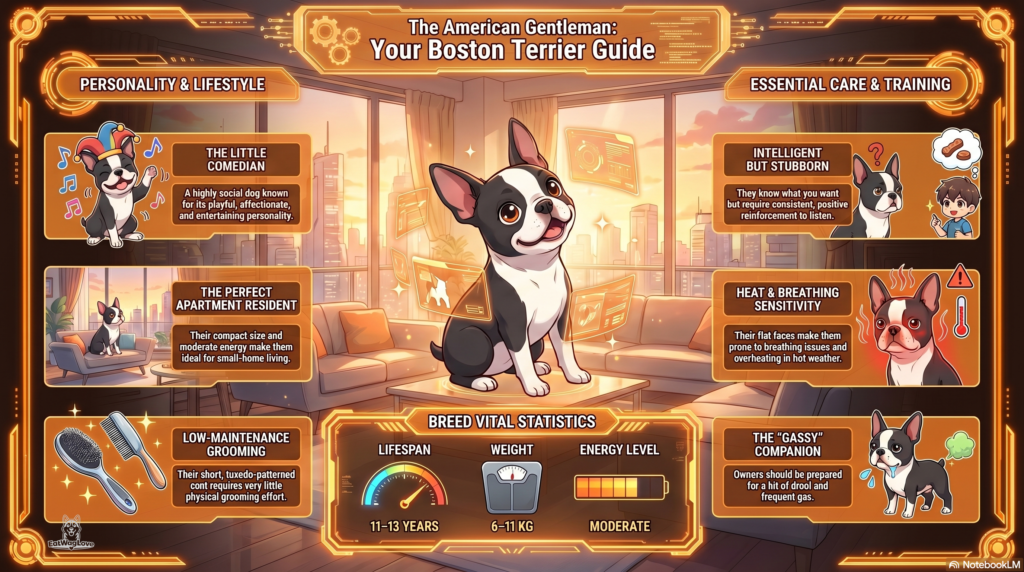
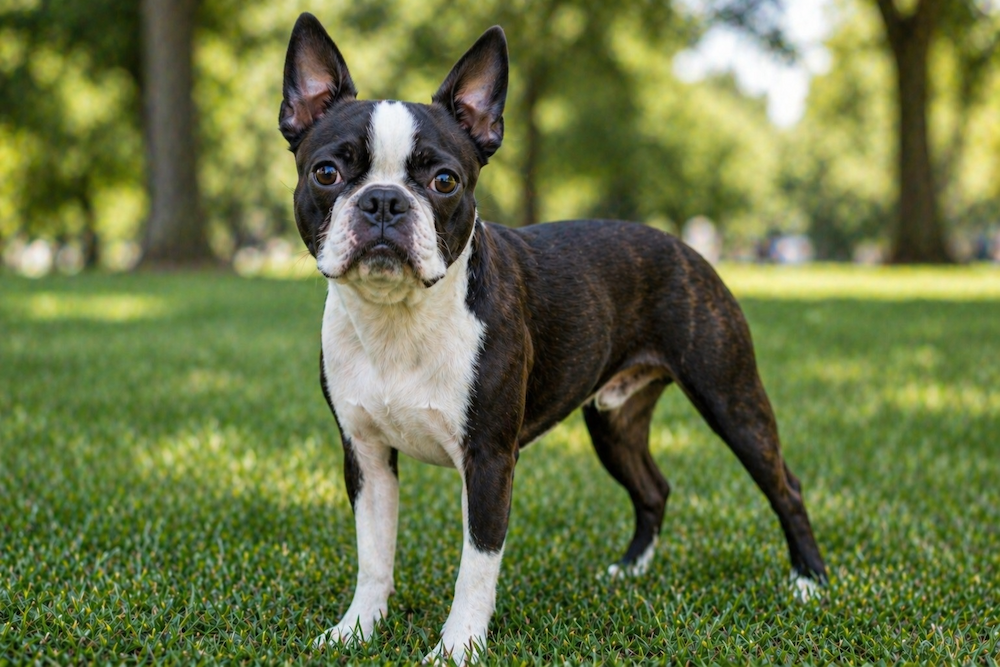
The Boston Terrier is a small, well-balanced breed known for its tuxedo-like markings and friendly personality. Often called the “American Gentleman,” they are social dogs that enjoy being around people and fit well into both apartments and houses.
They are playful, intelligent, and make excellent companions.
✅ PROS & CONS
Pros
- Friendly and affectionate
- Great for apartments
- Easy to groom
- Good with families and children
Cons
- Can be prone to breathing issues
- Sensitive to heat
- Needs regular attention
- Can be stubborn at times
Is a Boston Terrier a Good Family Dog?
Yes, the Boston Terrier is generally an excellent family dog, known for being affectionate, playful and strongly people-oriented.
Boston Terriers usually enjoy being involved in family activities and can be very good with respectful children. Their compact size makes them easier to manage than many larger breeds, while their cheerful personality has helped make them popular companion dogs.
They’re often friendly with visitors rather than serious guardians.
The Boston Terrier earned the nickname “American Gentleman” partly because of its distinctive tuxedo-like markings — although individual Bostons don’t always behave quite as formally as the nickname suggests.
How Much Exercise Does a Boston Terrier Need?
Most Boston Terriers need around 30–60 minutes of moderate exercise each day.
Daily walks and interactive games are usually sufficient, although younger dogs can be surprisingly energetic.
Because the Boston Terrier is a brachycephalic or flat-faced breed, strenuous exercise requires additional care, particularly in hot or humid weather.
They can have greater difficulty cooling themselves through panting than longer-muzzled dogs.
Several shorter activity sessions can therefore be safer than prolonged strenuous exercise.
Is a Boston Terrier Easy to Train?
Boston Terriers are generally intelligent and quite easy to train.
They tend to enjoy interacting with people and usually respond well to positive reinforcement, food rewards and enthusiastic praise.
Some can have an independent or mischievous streak, so consistency helps.
Early socialisation and basic obedience training are important.
Their expressive faces can also make discipline unexpectedly difficult when they’ve done something they very clearly understand they weren’t supposed to do.
Does a Boston Terrier Shed?
Yes, Boston Terriers shed, but their short coat is relatively easy to maintain.
Shedding is generally light to moderate.
Weekly brushing can remove loose hair and help maintain healthy skin and coat.
They don’t require professional coat trimming, although nail care, dental hygiene and cleaning of facial folds where necessary remain important.
Boston Terriers aren’t considered hypoallergenic.
What Health Problems Are Common in Boston Terriers?
Boston Terriers can be affected by several important inherited and structural health problems.
Their short skull can contribute to brachycephalic obstructive airway syndrome (BOAS), which can impair breathing and heat tolerance.
Eye problems are also important because their prominent eyes are vulnerable to injuries, corneal ulcers and other disorders. Patellar luxation, deafness and certain spinal abnormalities can occur as well.
Responsible breeding should prioritise functional breathing, healthy eyes and sound structure, rather than increasingly exaggerated flat faces.
How Long Do Boston Terriers Live?
Boston Terriers typically live around 11–13 years, although many reach their mid-teens.
Genetics, body condition, breathing function and preventive veterinary care all influence longevity.
Maintaining a healthy weight is especially important because excess body fat can worsen breathing difficulties.
Dental care also deserves attention in this small, short-jawed breed.
A healthy Boston can remain remarkably playful and entertaining well into its senior years.
How Big Does a Boston Terrier Get?
The Boston Terrier is a small, compact dog, generally standing around 38–43 cm tall.
Adults typically weigh no more than approximately 11 kg, although individual size varies.
Breed standards traditionally divide Boston Terriers into weight classes.
Despite their relatively small size, they should appear sturdy and well balanced rather than fragile.
Their combination of compact proportions, square outline and large expressive eyes gives the breed its unmistakable appearance.
Can a Boston Terrier Live in an Apartment?
Yes, Boston Terriers are generally excellent apartment dogs.
Their compact size, manageable exercise requirements and people-oriented temperament suit smaller homes well.
They still need daily walks, play and mental stimulation.
Many are relatively adaptable provided they receive sufficient attention.
Temperature control is particularly important because brachycephalic dogs can struggle in excessive heat.
For city dwellers wanting a small companion, the Boston Terrier’s adaptability is one of its greatest attractions.
Can a Boston Terrier Be Left Alone?
Boston Terriers can learn to spend reasonable periods alone, but they generally prefer being with their people.
They were developed primarily as companion dogs and often form very strong attachments to family members.
Dogs routinely left alone for long periods can become bored or develop separation-related behaviour.
Gradual independence training during puppyhood is useful.
A Boston Terrier is generally happiest when it’s treated as a genuine member of the household rather than a dog that spends most of its life by itself.
Do Boston Terriers Bark a Lot?
Boston Terriers are generally not considered excessive barkers, although individuals vary.
They may bark when visitors arrive, during play or when something unusual attracts their attention.
Boredom and separation distress can increase vocalisation.
Their relatively moderate barking is one reason they’re often well suited to apartment living.
However, some Boston Terriers produce an impressive collection of other noises, including snorts, snores and grunts.
Do Boston Terriers Snore?
Yes, many Boston Terriers snore, snort and make noticeable breathing sounds because of their shortened facial anatomy.
However, owners shouldn’t automatically assume that severe noisy breathing is normal simply because the dog is brachycephalic.
Heavy breathing at rest, difficulty exercising, gagging, collapse or extreme heat intolerance can indicate clinically significant airway obstruction.
A dog struggling to breathe isn’t simply making a cute “Boston noise.”
Breathing comfortably should always take priority over maintaining an extremely flat facial appearance.
Are Boston Terriers Good With Other Dogs?
Boston Terriers are generally sociable with other dogs, particularly when appropriately socialised.
Many enjoy playing and can live successfully in multi-dog households.
Individual temperament still varies, and some can be surprisingly confident or assertive.
Early socialisation should encourage calm, appropriate interactions.
Their historical ancestry includes dogs used in fighting, but the modern Boston Terrier has been selectively developed for generations primarily as a companion.
Are Boston Terriers Good With Cats?
Yes, Boston Terriers can often live very successfully with cats, particularly when raised alongside them.
They generally don’t have the extreme prey drive seen in some hunting breeds.
Individual dogs may still chase cats, especially if the cat runs.
Gradual introductions and supervision are sensible.
Cats should have elevated or dog-free spaces where they can retreat whenever they want some peace.
Can Boston Terriers Swim?
Some Boston Terriers can swim, but they aren’t naturally strong swimmers and should be supervised very carefully around water.
Their relatively large heads, compact bodies and short muzzles can make swimming more difficult than it is for many longer-bodied breeds.
A properly fitted canine life jacket is sensible around pools, boats and open water.
Owners shouldn’t assume that throwing a Boston into water will automatically teach it to swim.
For this breed, water safety deserves serious attention.
Can Boston Terriers Handle Hot Weather?
Boston Terriers can have significant difficulty coping with hot weather.
Their shortened airways make cooling through panting less efficient, increasing their vulnerability to overheating and heatstroke.
Exercise should be reduced during hot conditions and scheduled for cooler parts of the day.
Dogs should always have access to shade, water and a cool indoor environment.
Hot cars are particularly dangerous.
Heat intolerance isn’t simply an inconvenience with brachycephalic dogs — it can become a medical emergency extremely quickly.
Why Does a Boston Terrier Have Such a Short Face?
The Boston Terrier’s short muzzle is the result of selective breeding for brachycephalic head shape.
Over generations, breeders selected dogs with shorter, broader skulls until the flat-faced appearance became characteristic of the breed.
Unfortunately, shortening the skull doesn’t proportionally reduce all the soft tissues within the airway.
This can contribute to breathing obstruction in affected dogs.
Modern responsible breeding should therefore aim for dogs that retain recognisable Boston Terrier characteristics while still being able to breathe, exercise and regulate temperature comfortably.
Why Is the Boston Terrier Called the American Gentleman?
The Boston Terrier is nicknamed the “American Gentleman” because of its smart appearance, pleasant companion temperament and characteristic dark-and-white markings.
Those markings can resemble a formal tuxedo.
The nickname also reflects the breed’s strong American identity.
Unlike many popular breeds that originated in Europe or Asia, the Boston Terrier was developed in the United States.
It’s one of the rare dogs whose natural wardrobe looks appropriate for a formal dinner it wasn’t actually invited to.
What Colours Can Boston Terriers Be?
Recognised Boston Terrier colours include black, brindle or seal with characteristic white markings.
Seal appears black under ordinary conditions but can show reddish tones in bright light.
The traditional white markings contribute heavily to the breed’s famous tuxedo appearance.
Other colours are sometimes marketed as “rare”, but unusual colour shouldn’t be prioritised over health, temperament and responsible breeding.
Prospective owners should be particularly cautious when rarity is being used primarily to justify dramatically higher puppy prices.
Why Do Boston Terriers Have Such Big Eyes?
The Boston Terrier’s large, round, expressive eyes are a characteristic feature of the breed’s appearance.
However, prominent eyes can be more exposed to injury than eyes sitting deeper within the skull.
Corneal scratches, ulcers and trauma can therefore be significant concerns.
Owners should be cautious around thorny vegetation, rough play and situations where the eyes could be injured.
Squinting, redness, cloudiness or suddenly keeping an eye closed warrants prompt veterinary attention.
Eye problems can deteriorate rapidly.
Are Boston Terriers Born With Short Tails?
Yes, Boston Terriers are naturally born with short tails.
The breed standard describes the tail as naturally short and set low, and it may be straight or screw-shaped.
A Boston Terrier shouldn’t require routine tail docking to achieve the characteristic appearance.
Extremely tight screw tails can sometimes be associated with skin-fold problems or underlying vertebral abnormalities.
As with the face, extreme physical exaggeration shouldn’t be confused with desirable breed type.
Is a Boston Terrier Actually a Terrier?
Despite its name, the Boston Terrier isn’t a traditional working terrier in quite the same sense as breeds such as the Border Terrier or Jack Russell Terrier.
Its ancestry includes bull-and-terrier-type dogs, but the Boston Terrier was progressively transformed into a compact companion breed.
Modern kennel organisations generally classify it among companion or non-sporting dogs rather than traditional working terriers.
So the word “Terrier” remains in the name largely because of its ancestry rather than its modern job description.
What Were Boston Terriers Originally Bred For?
The ancestors of the Boston Terrier came from bull-and-terrier dogs associated with blood sports, but the breed’s development quickly moved towards companionship and exhibition.
A dog named Judge, imported into Boston in the late 19th century, is widely regarded as a foundational ancestor.
Judge was bred to a smaller white female named Gyp, sometimes recorded as Burnett’s Gyp.
Their descendants were selectively bred smaller and increasingly consistent in appearance.
Over time, the rugged ancestry was transformed into the compact companion dog we recognise today.
Is the Boston Terrier Really an American Breed?
Yes. The Boston Terrier is one of the relatively few internationally famous dog breeds developed in the United States.
Its history is closely connected with Boston, Massachusetts, during the late 19th century.
Breed enthusiasts organised the Boston Terrier Club of America, and the American Kennel Club recognised the Boston Terrier in 1893.
The breed subsequently became an important symbol of American dog breeding.
It was also named the official state dog of Massachusetts in 1979.
Where Does the Boston Terrier Come From?
The Boston Terrier was developed in Boston, Massachusetts, in the United States during the late 1800s.
Much of its early history traces back to a dog named Judge, generally known as Hooper’s Judge after he was acquired by Boston resident Robert C. Hooper.
Judge’s descendants were bred selectively with smaller dogs, gradually producing a more compact and consistent companion type.
The dogs were initially known by various names before Boston Terrier became established.
AKC recognition followed in 1893.
The breed’s transformation is remarkable: from powerful bull-and-terrier ancestry emerged the compact, sociable companion now affectionately known as the American Gentleman.