
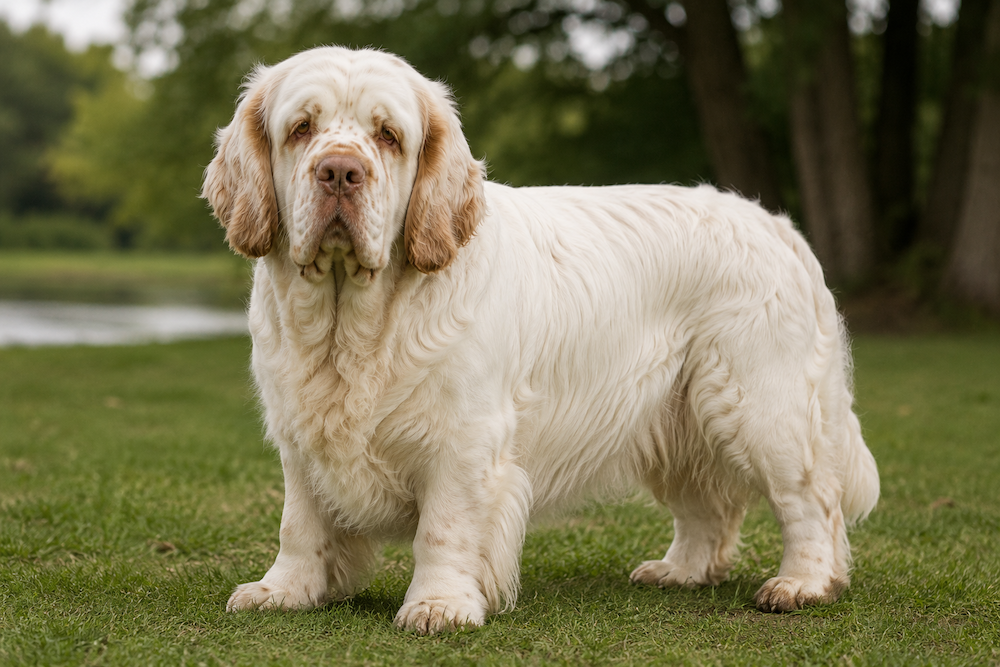







Calm, gentle, and quietly affectionate — a laid-back companion with a strong, sturdy build.
🧠 QUICK SNAPSHOT
- Temperament: Calm, loyal, gentle
- Energy Level: Low to moderate
- Size: Medium to large
- Good With Families: Yes
- Trainability: Moderate
- Grooming: Moderate
- Best For: Families, relaxed households
📚 OVERVIEW
The Clumber Spaniel is a heavy-set, low-energy spaniel known for its calm and affectionate nature. Originally bred for hunting, they are slower-moving than many other sporting breeds but still enjoy time outdoors.
They are loyal companions that bond closely with their family and prefer a relaxed lifestyle.
✅ PROS & CONS
Pros
- Calm and easy-going temperament
- Very loyal and affectionate
- Good with families
- Less demanding exercise needs
Cons
- Can drool significantly
- Prone to weight gain
- Needs regular grooming
- Slower and less energetic
Is a Clumber Spaniel a Good Family Dog?
Yes. The Clumber Spaniel can be an excellent family dog, particularly for households wanting a calmer, heavier and more easygoing spaniel.
Clumbers are typically affectionate, loyal and gentle with their families. They often have a dignified, slightly serious manner but can be surprisingly playful and comical at home.
They’re powerful dogs despite their low build, so young children should still be supervised.
Compared with many spaniels, the Clumber is generally less frantic and more laid-back.
How Much Exercise Does a Clumber Spaniel Need?
Most adult Clumber Spaniels need around 60 minutes of daily exercise, although younger working individuals may enjoy considerably more.
Walks, retrieving games, swimming and scent work are excellent activities.
They’re slower and heavier than breeds such as English Springer Spaniels, but shouldn’t be mistaken for lazy dogs.
Clumbers were developed to work through dense vegetation for hunters, requiring considerable stamina rather than outright speed.
Is a Clumber Spaniel Easy to Train?
Clumber Spaniels are intelligent and trainable, although they can have an independent streak.
They generally respond well to positive reinforcement, particularly food rewards.
Their hunting ancestry means interesting smells can occasionally become more important than their owner’s instructions.
Early recall training is particularly valuable.
They’re often described as thoughtful workers rather than lightning-fast responders.
Does a Clumber Spaniel Shed?
Yes. Clumber Spaniels can shed heavily.
Their dense, straight coat continually releases hair and can shed particularly heavily at certain times of year.
Regular brushing helps remove loose coat and prevent tangles around the feathering.
Their predominantly white hair also has a remarkable ability to become highly visible on dark clothing and furniture.
Is a Clumber Spaniel Hypoallergenic?
No. Clumber Spaniels aren’t considered hypoallergenic.
They shed considerably and produce the same allergenic proteins found in other dogs.
Their dander, saliva and skin secretions can all trigger allergies.
Someone specifically seeking a low-shedding breed will probably find the Clumber unsuitable.
What Health Problems Are Common in Clumber Spaniels?
Important Clumber Spaniel health concerns include hip and elbow dysplasia, eye disorders and spinal problems, including intervertebral disc disease in some dogs.
Entropion and ectropion can occur because of the breed’s eye and facial structure.
Hypothyroidism and other conditions are also reported.
Their long, heavy bodies make maintaining a healthy weight particularly important.
Responsible breeders should screen breeding dogs for relevant inherited conditions.
How Long Do Clumber Spaniels Live?
Clumber Spaniels commonly live around 10–12 years.
Some live longer with good genetics, appropriate exercise and preventive veterinary care.
Obesity is particularly important to avoid because extra weight places unnecessary strain on the hips, elbows and spine.
Keeping a Clumber lean may require discipline because many are extremely enthusiastic about food.
How Big Does a Clumber Spaniel Get?
The Clumber Spaniel is a surprisingly large and substantial dog.
Males can weigh around 32–39 kg, while females are often approximately 25–32 kg.
They generally stand only around 43–51 cm at the shoulder, depending on sex and individual variation.
This combination creates an unusually low, heavy and powerful spaniel.
A Clumber may not be particularly tall, but picking one up quickly reveals just how much dog is packed into that body.
Is the Clumber Spaniel the Heaviest Spaniel Breed?
Yes. The Clumber Spaniel is generally regarded as the heaviest of the recognised spaniel breeds.
Its substantial bone, broad body and powerful construction distinguish it immediately from lighter sporting spaniels.
This build had a practical purpose.
Clumbers were intended to push steadily through dense vegetation rather than race across open countryside.
Their working style was based more on persistence and strength than speed.
Can a Clumber Spaniel Live in an Apartment?
A Clumber Spaniel can live in an apartment if it receives adequate daily exercise, although its considerable size can make smaller homes challenging.
They’re generally calm indoors once mature.
Their relatively quiet nature can also suit close neighbours.
However, owners need to consider shedding, drooling and the practical challenge of moving a 30-plus-kilogram low-set dog up stairs if it becomes elderly or injured.
Can a Clumber Spaniel Be Left Alone?
Adult Clumber Spaniels can learn to spend reasonable periods alone, but they’re social dogs that generally enjoy being with their families.
Long periods of isolation can lead to boredom or unwanted behaviour.
Gradual independence training helps.
Providing safe chews, enrichment and sufficient exercise before leaving the dog can make alone time easier.
Do Clumber Spaniels Bark a Lot?
Clumber Spaniels are generally not excessive barkers.
They may alert their owners when someone approaches or something unusual happens, but they aren’t typically famous for constant vocalisation.
Individual dogs still vary.
Boredom, anxiety or inadequate exercise can increase barking in almost any breed.
Are Clumber Spaniels Good With Children?
Clumber Spaniels are generally gentle and patient with children when properly socialised.
Their calm temperament can make them excellent family companions.
However, they’re much heavier than they appear.
An enthusiastic Clumber can easily knock over a small child without intending any harm.
As with every breed, interactions between young children and dogs should be supervised.
Are Clumber Spaniels Good With Other Dogs?
Yes. Clumber Spaniels are generally sociable with other dogs, particularly when properly socialised.
They were historically expected to work alongside other dogs during shoots, so extreme dog intolerance would have been undesirable.
Individual temperament still matters.
Appropriate introductions are especially important when bringing an adult dog into an established multi-dog household.
Are Clumber Spaniels Good With Cats?
Clumber Spaniels can live successfully with cats, particularly when raised with them.
However, they are genuine sporting dogs and may retain hunting instincts.
A household cat may be treated very differently from an unfamiliar animal running outdoors.
Early introductions and training provide the best chance of peaceful coexistence.
Do Clumber Spaniels Have a Strong Prey Drive?
Clumber Spaniels can have a moderate to strong hunting instinct.
They were specifically developed to locate and flush game birds from cover.
Their prey drive may be less visually dramatic than that of a fast sighthound, but an interesting scent can quickly capture their attention.
Secure areas and reliable recall training are therefore important.
Are Clumber Spaniels Good Swimmers?
Many Clumber Spaniels enjoy water and can swim, reflecting their sporting ancestry.
However, their unusually heavy bodies and short legs mean owners shouldn’t assume every Clumber will automatically be an exceptional swimmer.
Dogs should be introduced to water gradually and supervised.
A canine flotation vest can be useful during boating or extended water activities.
Why Do Clumber Spaniels Drool?
Clumber Spaniels can drool considerably, particularly around food, drinking or exercise.
Their heavy heads and relatively loose lips contribute to saliva escaping from the mouth.
Some individuals drool much more than others.
Prospective owners should therefore be comfortable with occasional slobber.
Between the shedding and drooling, a Clumber tends to make its presence in the home fairly easy to detect.
Why Do Clumber Spaniels Have Red or Brown Tear Stains?
Clumber Spaniels can develop reddish-brown staining beneath their eyes because tears contain pigments called porphyrins.
The staining becomes particularly visible against their white coats.
Persistent excessive tearing can also result from irritation, eyelid abnormalities, blocked tear drainage or other eye problems.
Because entropion and ectropion occur in the breed, chronic tearing should be assessed rather than assumed to be purely cosmetic.
Why Does a Clumber Spaniel Have Such a Heavy Head?
The Clumber’s large, broad head is one of its defining breed characteristics.
Combined with a deep muzzle, substantial bone and relatively low body, it gives the breed its distinctive powerful appearance.
The head should remain functional.
Excessive loose skin or exaggerated eyelids can contribute to health problems, so more extreme isn’t necessarily better.
Why Are Clumber Spaniels So Low to the Ground?
The Clumber’s low, substantial build helped it push through dense vegetation while searching for game.
Rather than covering huge distances at high speed, Clumbers traditionally worked methodically through thick cover.
Their strong bodies and relatively short legs suited this deliberate working style.
The characteristic shape therefore has functional origins, although exaggerated body length or excessive weight can increase physical stress.
What Were Clumber Spaniels Originally Bred to Do?
Clumber Spaniels were developed as gundogs for finding and flushing game birds from dense cover.
They worked methodically, using their noses to locate birds before pushing them into the open for hunters.
They could also retrieve shot game.
Their slow, steady style was particularly suitable for hunting in thick woodland and heavy undergrowth.
Speed wasn’t their speciality — persistence was.
Is a Clumber Spaniel a Flushing Spaniel?
Yes. The Clumber is traditionally a flushing spaniel.
Its job was to search vegetation for game birds and force, or “flush”, them into flight where hunters could take a shot.
Afterwards, the dog could retrieve fallen birds.
This places the Clumber within the same broad sporting tradition as Springer and Cocker Spaniels, despite its dramatically heavier appearance.
Why Does the Clumber Spaniel Have a Mostly White Coat?
The Clumber Spaniel’s predominantly white coat may have helped hunters see their dogs clearly while working through dense cover.
White dogs are easier to distinguish from game and surrounding vegetation.
Typical markings are lemon or orange, particularly around the head and ears.
The breed’s colouring gives it a very distinctive appearance compared with many darker sporting dogs.
What Colours Can Clumber Spaniels Be?
Clumber Spaniels are predominantly white with lemon or orange markings.
Markings are commonly found around the ears, eyes and head, with some body markings also possible.
Freckling or ticking can occur.
The breed doesn’t come in the huge range of colours seen in some spaniels.
Its white coat with warm-coloured markings is one of its signature features.
What Is the Difference Between a Clumber Spaniel and an English Springer Spaniel?
Both are flushing spaniels, but they’re very different in build and working style.
The English Springer Spaniel is lighter, faster and more athletic-looking.
The Clumber is lower, heavier and traditionally works at a slower, more deliberate pace.
Springers generally have considerably higher-speed exercise requirements, while Clumbers often have a calmer household temperament.
The Clumber can weigh substantially more despite standing lower to the ground.
What Is the Difference Between a Clumber Spaniel and a Sussex Spaniel?
Both breeds are low-set, substantial British spaniels, but they are easily distinguished by colour and overall appearance.
Clumbers are predominantly white with lemon or orange markings.
Sussex Spaniels have their characteristic rich golden-liver coat.
The Clumber is generally larger and heavier.
Both were developed for methodical work through dense cover rather than the high-speed hunting style associated with lighter spaniels.
Why Is It Called a Clumber Spaniel?
The breed takes its name from Clumber Park in Nottinghamshire, England, the estate associated with the Dukes of Newcastle.
Clumber Park became strongly connected with the development and breeding of these distinctive heavy spaniels.
The name therefore isn’t describing a working technique or physical characteristic.
It’s a geographical name preserving the breed’s aristocratic English history.
Did the Clumber Spaniel Really Come From France?
Possibly — but the famous story isn’t firmly proven.
One traditional account says that during the French Revolution, the Duc de Noailles sent his spaniels to the Duke of Newcastle at Clumber Park for safekeeping.
These French dogs supposedly became the foundation of the Clumber Spaniel.
It’s a wonderful story, but documentary evidence is limited, and historians have questioned whether the timeline works as neatly as later breed histories suggest.
The breed’s definitive development is much more securely associated with Britain.
Is the Basset Hound Part of the Clumber Spaniel’s Ancestry?
Basset-type dogs are sometimes mentioned in theories about the Clumber Spaniel’s ancestry because of the breed’s heavy body, low stature and substantial head.
Alpine Spaniels have also featured prominently in traditional origin stories.
However, the exact mixture of breeds that produced the early Clumber isn’t securely documented.
These should therefore be regarded as historical theories rather than proven pedigrees.
What Was the Alpine Spaniel?
The Alpine Spaniel was a large historical dog type associated with the western Alps and is now extinct.
It appears in several old breed-origin stories, including those involving the Saint Bernard and Clumber Spaniel.
However, claims that it was a direct Clumber ancestor are difficult to verify.
Like many breeds developed before modern stud books, the Clumber’s early ancestry is much less precisely recorded than later histories sometimes imply.
Were Clumber Spaniels Dogs of the British Aristocracy?
Yes. Clumber Spaniels became strongly associated with British aristocratic sporting estates.
Their connection with Clumber Park and the Dukes of Newcastle helped establish the breed’s identity.
For much of their early history, Clumbers were comparatively uncommon outside wealthy sporting circles.
They were working gundogs, but ones with distinctly aristocratic connections.
Did British Royalty Own Clumber Spaniels?
Yes. Clumber Spaniels became favourites of several members of the British royal family.
Prince Albert, husband of Queen Victoria, kept Clumbers, and the breed was later strongly associated with King Edward VII.
King George V also maintained an interest in working Clumbers.
Royal patronage helped increase the breed’s visibility while reinforcing its association with Britain’s country estates and sporting tradition.
Did King Edward VII Own Clumber Spaniels?
Yes. King Edward VII was a notable Clumber Spaniel enthusiast and kept them at the royal estate at Sandringham.
His interest helped bring greater attention to the breed around the turn of the 20th century.
Photographs and accounts of royal Clumbers contributed to their prestige.
Few spaniel breeds have been so closely connected with Britain’s aristocracy and monarchy.
Was the Clumber Spaniel One of the First Dog Breeds Shown in Britain?
The Clumber Spaniel was among the breeds appearing during the very early years of organised dog showing in Britain.
Clumbers were exhibited at some of the first major dog shows during the 19th century.
This is significant because formal dog shows and kennel clubs were only beginning to transform traditional working dog types into standardised pedigree breeds.
The Clumber was therefore established surprisingly early in the modern dog-show era.
Was the Clumber Spaniel One of the First AKC Breeds?
Yes. The Clumber Spaniel was among the earliest breeds recognised by the American Kennel Club.
The AKC was founded in 1884, and the Clumber was recognised during the organisation’s earliest period.
Despite this long official history, the breed has never achieved the enormous popularity of breeds such as Labradors, Golden Retrievers or Cocker Spaniels.
Why Is the Clumber Spaniel So Rare?
Clumber Spaniels remain relatively uncommon partly because they’re a specialised breed with a small breeding population.
They’re large for spaniels, shed heavily, can drool and have several important health considerations.
They also no longer perform a working role required by large numbers of people.
Enthusiasts value their unusual combination of calm temperament, powerful build and traditional gundog ability, but the breed has remained comparatively niche.
Where Does the Clumber Spaniel Come From?
The Clumber Spaniel was developed primarily in England and takes its name from Clumber Park in Nottinghamshire, home of the Dukes of Newcastle.
Traditional stories suggest French dogs may have contributed to its ancestry, but the exact early history remains uncertain.
What is clear is that British sporting estates shaped the breed into a powerful, deliberate flushing spaniel capable of pushing through dense cover.
With royal owners, aristocratic estates and nearly two centuries of organised breed history behind it, the Clumber may look like a spaniel built in slow motion — but it was built that way for a very practical reason.