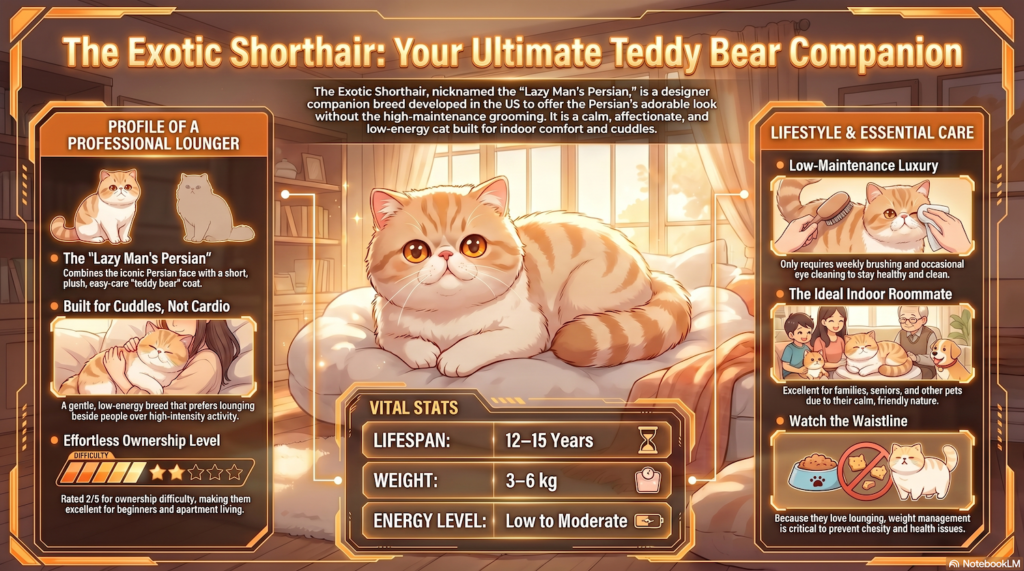
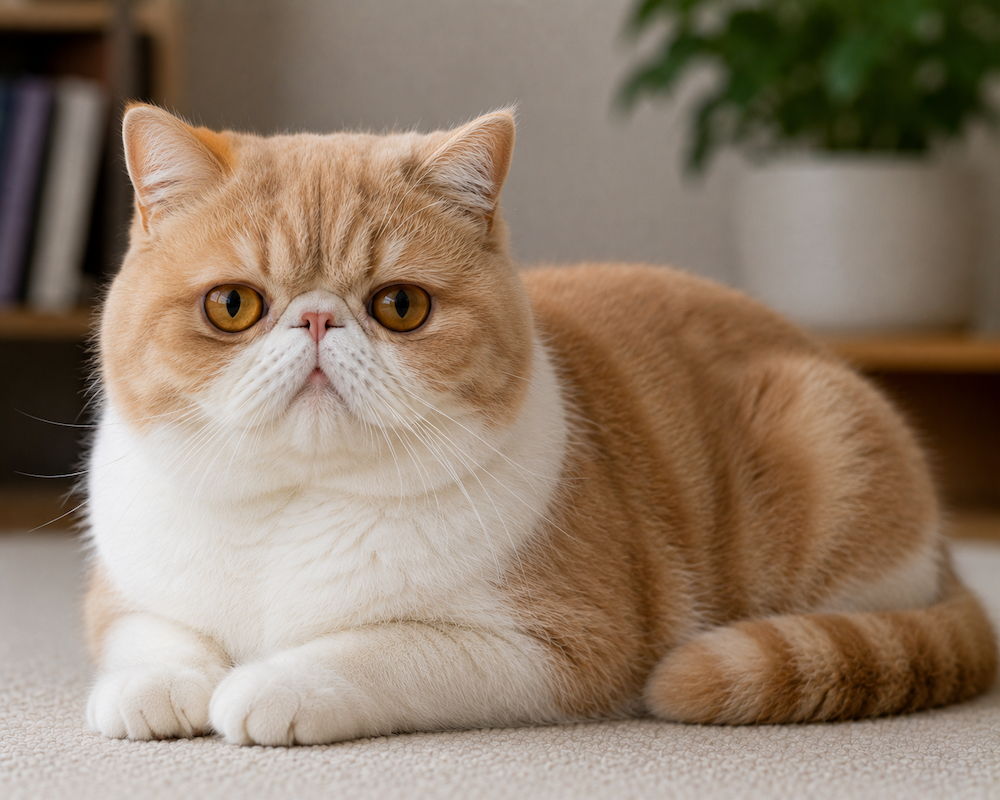






Sweet, cuddly, and wonderfully relaxed — a plush companion often described as the short-haired Persian.
🧠 QUICK SNAPSHOT
- Temperament: Gentle, affectionate, calm
- Energy Level: Low to moderate
- Size: Medium
- Good With Families: Yes
- Trainability: Moderate
- Grooming: Low to moderate
- Best For: Families, indoor living, relaxed households
📚 OVERVIEW
The Exotic Shorthair combines the sweet personality of the Persian with a shorter, easier-to-maintain coat. Known for their round face, large eyes, and teddy bear-like appearance, they are affectionate cats that enjoy spending time with their family.
They are generally quiet, easy-going, and well suited to indoor living.
✅ PROS & CONS
Pros
- Calm and affectionate personality
- Easier coat maintenance than a Persian
- Great family companion
- Adaptable to apartment living
Cons
- Can be prone to weight gain
- May inherit breathing issues associated with flat-faced breeds
- Prefers companionship and attention
- Less active than many other breeds
Is an Exotic Shorthair a Good Family Cat?
Yes. The Exotic Shorthair is generally an excellent family cat, particularly for households wanting a calm, affectionate and relatively easygoing companion.
Exotics tend to combine the gentle personality associated with the Persian with a much shorter coat. They often enjoy attention without being constantly demanding.
They’re usually happiest living indoors as part of the family.
Can an Exotic Shorthair Live Indoors or in an Apartment?
Yes. Exotic Shorthairs are extremely well suited to indoor and apartment living.
They’re generally calm cats that don’t require enormous amounts of space.
A comfortable home with scratching posts, climbing opportunities, toys and daily interaction can provide everything they need.
Indoor living also protects them from traffic, predators, disease and extreme weather.
How Much Exercise and Play Does an Exotic Shorthair Need?
Exotic Shorthairs need daily interactive play, but they’re generally less intensely active than breeds such as Bengals or Abyssinians.
Several short play sessions using wand toys, balls or interactive toys usually work well.
Exercise is particularly important because their relaxed lifestyle can make weight gain relatively easy.
Is an Exotic Shorthair Easy to Train?
Yes. Exotic Shorthairs are intelligent and can learn household routines, basic cues and simple tricks.
Food rewards and short positive training sessions generally work well.
They may not possess the relentless problem-solving enthusiasm of some highly active breeds, but they’re far from unintelligent.
Many quickly learn exactly where the treats are stored.
Does an Exotic Shorthair Shed?
Yes. Despite its short coat, the Exotic Shorthair can shed considerably.
The coat is exceptionally dense and plush, with substantial undercoat.
Regular brushing helps remove loose hair before it reaches furniture and clothing.
“Shorthair” definitely doesn’t mean “no shedding.”
Is an Exotic Shorthair Hypoallergenic?
No. Exotic Shorthairs aren’t considered hypoallergenic.
Cat allergens are primarily associated with proteins produced in saliva and skin secretions rather than simply coat length.
A shorthaired Persian-type cat can therefore still trigger significant reactions in people with cat allergies.
How Often Should You Groom an Exotic Shorthair?
Most Exotic Shorthairs benefit from brushing several times each week.
Although the coat doesn’t tangle as readily as a Persian’s, it’s exceptionally thick.
Regular grooming removes dead undercoat, reduces hairballs and helps prevent small mats.
Some individuals require more grooming during seasonal shedding.
Why Is an Exotic Shorthair’s Coat So Thick?
The Exotic Shorthair inherited its dense plush coat from Persian ancestry.
The hairs stand somewhat away from the body because of the coat’s density, creating the characteristic soft, rounded teddy-bear appearance.
This texture distinguishes the Exotic from ordinary domestic shorthaired cats.
What Health Problems Are Common in Exotic Shorthairs?
Important health concerns can include brachycephalic airway problems, eye disorders, dental abnormalities, polycystic kidney disease and hypertrophic cardiomyopathy.
Their flattened facial structure can also contribute to excessive tearing and difficulty coping with heat.
Responsible breeding should prioritise functional anatomy rather than increasingly extreme facial flattening.
Is the Exotic Shorthair a Brachycephalic Cat?
Yes. Exotic Shorthairs are brachycephalic, meaning their skull and muzzle are shortened compared with cats with more typical facial proportions.
The degree varies considerably.
Extremely flat-faced cats can experience breathing, eye and dental problems.
A dramatic show-ring appearance shouldn’t be prioritised over the cat’s ability to breathe comfortably.
Do Exotic Shorthairs Have Breathing Problems?
Some do.
Severely brachycephalic Exotic Shorthairs can develop narrowed airways and restricted airflow.
Signs can include noisy breathing, exercise intolerance, open-mouth breathing or difficulty coping with heat.
Persistent respiratory noise shouldn’t automatically be dismissed as normal simply because the cat is flat-faced.
Why Does My Exotic Shorthair Snore?
Snoring can result from the Exotic’s shortened muzzle and upper-airway anatomy.
Mild sleeping noises may occur in some individuals.
However, loud or persistent respiratory noise, laboured breathing or reduced exercise tolerance deserves veterinary investigation.
Being brachycephalic doesn’t make breathing difficulty harmless.
Why Does My Exotic Shorthair Have Watery Eyes?
The breed’s shortened facial anatomy can affect normal tear drainage.
Tears may therefore spill onto the face rather than draining efficiently through the tear ducts.
Some Exotics require regular gentle cleaning around the eyes.
Sudden excessive tearing, squinting, redness or discharge requires veterinary attention because eye injuries can also cause these signs.
Why Does My Exotic Shorthair Get Tear Stains?
Constant tearing can leave reddish-brown staining beneath the eyes, particularly on pale-coloured cats.
The flat facial structure can make this especially noticeable.
Regular gentle cleaning helps keep the area comfortable.
Persistent irritation, odour or abnormal discharge should be investigated rather than treated merely as a cosmetic problem.
Are Exotic Shorthairs Prone to Eye Problems?
Yes. Their prominent eyes and flattened faces can increase susceptibility to corneal injury, irritation and tear-drainage problems.
The eyes may be more exposed than those of cats with conventional facial anatomy.
Squinting, cloudiness, redness or suddenly keeping an eye closed should receive prompt veterinary attention.
Eye problems can become painful very quickly.
Are Exotic Shorthairs Prone to Dental Problems?
They can be.
Brachycephalic skull structure can produce crowded or abnormally positioned teeth and altered jaw alignment.
Regular dental checks are therefore particularly important.
Home dental care and professional treatment when required can help prevent painful periodontal disease.
What Is Polycystic Kidney Disease in Exotic Shorthairs?
Polycystic kidney disease (PKD) is an inherited disorder in which fluid-filled cysts develop within the kidneys.
The condition became particularly associated with Persian populations and can also affect Exotic Shorthairs because of their close Persian ancestry.
DNA testing allows breeders to identify the relevant mutation and avoid producing affected kittens.
Are Exotic Shorthairs Prone to Heart Problems?
Hypertrophic cardiomyopathy (HCM) can occur in Exotic Shorthairs.
HCM causes abnormal thickening of the heart muscle and is one of the most important cardiac diseases affecting cats generally.
Some affected cats initially show few obvious symptoms.
Breeders should take cardiac health seriously alongside the breed’s better-known facial and kidney concerns.
Do Exotic Shorthairs Handle Hot Weather Well?
Extreme heat can be particularly challenging for flat-faced Exotic Shorthairs.
Shortened airways may make efficient cooling more difficult.
Cats should have access to cool indoor areas, fresh water and appropriate ventilation or air conditioning during hot conditions.
Open-mouth breathing or obvious respiratory distress in a cat is an emergency warning sign.
How Long Do Exotic Shorthairs Live?
Exotic Shorthairs commonly live around 12–15 years, with some living longer.
Longevity depends on genetics, facial structure, body weight and veterinary care.
Responsible breeding that screens for inherited disease and avoids excessively extreme brachycephaly can significantly influence welfare.
How Big Does an Exotic Shorthair Get?
Exotic Shorthairs are medium-sized, heavily built cats.
Many adults weigh approximately 3.5–6.5 kg, although males can be larger.
Their body should feel solid and muscular rather than merely overweight.
The dense coat and rounded shape can make them appear larger than they really are.
Are Exotic Shorthairs Prone to Obesity?
They can be.
Exotic Shorthairs tend to be less intensely active than many athletic cat breeds, making calorie control important.
Their naturally stocky build can also make gradual weight gain difficult to notice.
Daily play, measured feeding and regular body-condition checks can help maintain a healthy weight.
Are Exotic Shorthairs Lazy?
They’re generally calm rather than truly lazy.
Many enjoy energetic bursts of play followed by long periods of relaxation.
They don’t usually demand constant activity.
An Exotic Shorthair may enthusiastically chase a toy for ten minutes and then conclude that several hours of lying somewhere comfortable is the appropriate recovery programme.
Are Exotic Shorthairs Cuddly?
Many are very affectionate and cuddly.
They often enjoy sitting beside or on their owners and can develop strong family bonds.
However, they’re generally less demanding than some intensely social breeds.
Many seem perfectly satisfied simply being close to their favourite person.
Are Exotic Shorthairs Lap Cats?
Many Exotic Shorthairs make excellent lap cats, although individual preferences vary.
Their Persian ancestry contributes a calm, affectionate temperament.
Some prefer sitting beside their owners rather than directly on them.
Either way, they generally enjoy human companionship.
Do Exotic Shorthairs Follow Their Owners Around?
Many do.
Exotics can be quietly people-oriented, following family members between rooms without constantly demanding attention.
Their style of attachment is often more understated than highly vocal or energetic breeds.
You may suddenly realise the same round face has silently appeared in every room you’ve entered all morning.
Can an Exotic Shorthair Be Left Alone?
Adult Exotic Shorthairs can usually tolerate reasonable periods alone, but they still require companionship and stimulation.
They shouldn’t routinely be ignored for entire days.
Interactive toys, climbing spaces and comfortable observation areas can help.
Some individuals particularly enjoy having another compatible cat as company.
Are Exotic Shorthairs Good With Children?
Generally, yes.
Well-socialised Exotic Shorthairs are usually gentle and tolerant family cats.
Their calm temperament can suit respectful children particularly well.
Children should still learn not to chase, squeeze or repeatedly pick up a cat that wants to leave.
Are Exotic Shorthairs Good With Other Cats?
Usually, yes.
Their generally easygoing temperament can make them good companions for other friendly cats.
Introductions should still occur gradually.
Personality and previous social experience matter more than breed alone.
Are Exotic Shorthairs Good With Dogs?
Many can live successfully with calm, cat-friendly dogs.
Their relaxed nature can help them adapt well when introductions are handled carefully.
A boisterous dog that repeatedly chases the cat can create stress regardless of how tolerant the Exotic normally is.
Are Exotic Shorthairs Vocal?
Exotic Shorthairs are generally relatively quiet cats.
They may communicate with soft meows or other gentle sounds rather than constant loud vocalisation.
Individuals vary, but they’re usually considerably less talkative than breeds such as Siamese or Oriental Shorthairs.
What Does an Exotic Shorthair Sound Like?
Many have soft, relatively quiet voices.
Some communicate more through staring, following, purring or simply positioning themselves directly in front of whatever their owner is trying to do.
Their communication style often matches their personality: gentle but remarkably effective.
Do Exotic Shorthairs Purr a Lot?
Many do.
Affectionate Exotics may purr readily when being stroked, resting with family or anticipating attention.
Purring usually reflects contentment in these situations, although cats can also purr when stressed or unwell.
Behaviour should always be interpreted in context.
Are Exotic Shorthairs Playful?
Yes. Exotic Shorthairs can be surprisingly playful, particularly as kittens and young adults.
Balls, wand toys and interactive games are often popular.
Their play tends to occur in shorter bursts than in highly energetic breeds.
The round teddy-bear appearance can hide a surprisingly enthusiastic toy hunter.
Are Exotic Shorthairs Good Hunters?
They retain normal feline hunting instincts, but the breed wasn’t developed specifically for high-performance hunting.
Individual Exotics may still enthusiastically stalk insects or toys.
Their compact build and brachycephalic facial structure make them very different from athletic working mousers or naturally developed hunting cats.
Can Exotic Shorthairs Jump High?
Yes. Exotic Shorthairs are still cats and can jump, although their stocky build and relatively relaxed temperament mean many aren’t spectacular aerial athletes.
They generally appreciate cat trees and elevated resting areas.
Moderate climbing opportunities also encourage exercise.
What Does an Exotic Shorthair Look Like?
The Exotic Shorthair is a stocky, round-headed cat with large round eyes, small ears, a short nose and an exceptionally dense plush coat.
Its body is compact and muscular with relatively short sturdy legs.
The overall effect is sometimes described as a living teddy bear.
Structurally, it closely resembles a shorthaired Persian.
Why Does an Exotic Shorthair Have Such a Flat Face?
The flat face comes primarily from Persian ancestry and selective breeding for brachycephalic features.
Over generations, breeders favoured increasingly short noses and rounded heads.
Unfortunately, taking these characteristics to extremes can compromise breathing, tear drainage and dental alignment.
Moderation is therefore important for welfare.
Are All Exotic Shorthairs Extremely Flat-Faced?
No.
The degree of brachycephaly varies considerably between individuals and breeding lines.
Some have extremely flat profiles, while others retain more visible muzzle length and more open facial anatomy.
Less extreme facial structure can offer meaningful welfare advantages.
What Is a Traditional or Doll-Face Exotic Shorthair?
“Doll-face” is an informal term sometimes used for Persian-type cats with less extreme facial flattening and a more projecting muzzle.
It isn’t necessarily an official separate variety.
The term can be useful descriptively, but buyers should focus on actual respiratory and eye health rather than marketing labels.
Is an Exotic Shorthair Just a Shorthaired Persian?
In practical terms, that’s a surprisingly good description.
The Exotic Shorthair was developed largely from Persian breeding programmes while selecting for a short, dense coat.
Its body type, head and temperament remain strongly Persian-like.
The major obvious difference is coat length.
This is why the breed is sometimes affectionately called the “Lazy Man’s Persian.”
Why Is the Exotic Shorthair Called the “Lazy Man’s Persian”?
The nickname refers to its Persian-like appearance and temperament combined with a shorter, easier-care coat.
A Persian’s long coat can require daily intensive grooming.
The Exotic still needs brushing, but generally much less.
The nickname refers to reduced grooming effort, not because the cat itself is necessarily lazy.
Is the Exotic Shorthair Related to the Persian?
Very closely.
The Persian is the principal foundation breed behind the Exotic Shorthair.
Indeed, some cat registries treat Exotic breeding and Persian breeding as closely interconnected.
Longhaired kittens can still appear in certain Exotic breeding programmes depending on genetics and registry rules.
Can Two Exotic Shorthairs Produce a Longhaired Kitten?
Yes, depending on their genetics.
The gene for long hair is recessive, so shorthaired parents carrying the longhair variant can produce longhaired kittens.
Because Persian ancestry is fundamental to the Exotic, longhair genetics aren’t surprising.
Registry classification of these kittens varies between organisations.
What Is an Exotic Longhair?
An Exotic Longhair is essentially a longhaired cat produced within Exotic breeding lines, although classification differs among cat registries.
Some organisations may register such cats as Persians, while others recognise or describe them differently.
Genetically, the appearance reflects the Persian ancestry already embedded in the Exotic.
What Is the Difference Between an Exotic Shorthair and a Persian?
The major difference is coat length.
Persians have long flowing coats requiring extensive grooming, while Exotic Shorthairs have short but extremely dense plush coats.
Otherwise, the breeds share many structural and temperamental characteristics.
Both can also experience similar brachycephalic and inherited health concerns.
What Is the Difference Between an Exotic Shorthair and a British Shorthair?
Although both are round, stocky cats, they’re distinct breeds with very different histories.
The British Shorthair has a more conventional muzzle and developed from British domestic cat populations.
The Exotic Shorthair was deliberately developed largely from Persian ancestry.
The Exotic usually has a much flatter face and more obviously Persian-like expression.
What Is the Difference Between an Exotic Shorthair and a Scottish Fold?
The Exotic Shorthair has normal upright ears, while the Scottish Fold’s defining feature is folded ears caused by a cartilage mutation.
They also have different breed histories.
Importantly, the Scottish Fold mutation affects cartilage throughout the body and can cause painful skeletal disease; the Exotic’s principal structural welfare concern is instead extreme brachycephaly.
What Colours Can Exotic Shorthairs Be?
Exotic Shorthairs occur in an enormous range of colours and patterns, reflecting their Persian heritage.
These can include solid colours, tabby patterns, tortoiseshell, calico, smoke, shaded, silver, golden, bicolour and colourpoint varieties depending on registry standards.
Colour diversity is one of the breed’s striking features.
Can Exotic Shorthairs Have Blue Eyes?
Yes.
Eye colour is associated partly with coat colour and genetics.
Colourpoint Exotic Shorthairs typically have blue eyes, while other coat varieties can have copper, green or other accepted eye colours.
The large round eyes are among the breed’s most recognisable characteristics regardless of colour.
Can an Exotic Shorthair Be Colourpoint?
Yes. Colourpoint patterns occur in Exotic Shorthairs under various registry systems.
These cats have darker extremities on the face, ears, legs and tail with a lighter body, generally accompanied by blue eyes.
The pattern reflects colourpoint genetics introduced through the breed’s ancestry.
Why Does the Exotic Shorthair Have Such Big Eyes?
Large round eyes were deliberately emphasised through selective breeding for the Persian-type head.
They contribute strongly to the breed’s sweet, almost kitten-like expression.
However, very prominent eyes can also be more exposed to irritation and injury.
Aesthetic exaggeration can therefore have genuine health consequences.
Why Does the Exotic Shorthair Look Grumpy?
The combination of a flat face, short nose, prominent cheeks and large round eyes can create expressions humans interpret as grumpy or disapproving.
That expression says very little about the cat’s actual mood.
Most well-socialised Exotics are gentle, affectionate cats despite sometimes looking profoundly unimpressed with everything around them.
Is Grumpy Cat an Exotic Shorthair?
No. Grumpy Cat, whose real name was Tardar Sauce, wasn’t an Exotic Shorthair.
She was a mixed-breed domestic cat whose distinctive appearance was associated with feline dwarfism and an underbite.
Her flattened, permanently displeased expression is sometimes confused with brachycephalic breeds, but she wasn’t an Exotic.
Is Garfield an Exotic Shorthair?
Garfield is a fictional orange tabby cat, and his creator Jim Davis didn’t originally define him as an Exotic Shorthair pedigree cat.
However, real Exotic Shorthairs — particularly round orange tabbies — are frequently compared with Garfield because of their stocky bodies, round faces and relaxed personalities.
The resemblance can be uncanny, but it doesn’t make Garfield officially an Exotic.
Was the Exotic Shorthair Deliberately Created?
Yes. Unlike naturally developed cat populations, the Exotic Shorthair is a deliberately developed modern pedigree breed.
Its creation arose largely from attempts by American Shorthair breeders to introduce Persian characteristics while retaining short hair.
The resulting cats eventually became sufficiently distinctive to form their own breed.
Why Were Persians Crossed With American Shorthairs?
During the mid-20th century, some American Shorthair breeders used Persians to introduce a rounder head, heavier body and plush coat characteristics.
The crosses created cats that differed noticeably from the traditional American Shorthair.
Rather than allowing those characteristics to transform the American Shorthair, breeders eventually developed the Persian-influenced cats separately.
That ultimately helped create the Exotic Shorthair.
What Breeds Were Used to Create the Exotic Shorthair?
The Persian and American Shorthair were central to the breed’s early development.
Other breeds, including the Burmese and Russian Blue, were also used historically in some programmes to establish short hair and broaden the early breeding population.
Persian breeding subsequently became overwhelmingly important in establishing the modern Exotic type.
Who Was Jane Martinke?
American cat judge and breeder Jane Martinke played an important role in recognising that Persian-influenced American Shorthairs represented something distinctive.
She advocated establishing them as a separate breed rather than allowing covert Persian crossing to continue altering American Shorthairs.
Her involvement helped move the developing cats towards formal recognition.
Was the Exotic Shorthair Originally Called the Sterling?
Yes. “Sterling” was proposed as an early breed name, reflecting the silver colouring prominent among some of the original cats.
However, breeders realised the developing breed would encompass far more colours.
The broader name Exotic Shorthair was ultimately adopted instead.
Why Is It Called the Exotic Shorthair?
“Exotic Shorthair” reflected the unusual Persian-like appearance combined with short hair.
At the time, these cats looked distinctly exotic compared with conventional American Shorthairs.
As additional colours became accepted, the name was also much more practical than the originally proposed “Sterling.”
When Was the Exotic Shorthair Created?
Development occurred primarily during the 1950s and 1960s in the United States.
Persian crosses had begun appearing within American Shorthair breeding, creating cats with increasingly Persian-like features.
Organised development transformed those crosses into a distinct breed rather than simply an altered American Shorthair.
When Was the Exotic Shorthair Officially Recognised?
The Cat Fanciers’ Association recognised the Exotic as a championship breed during the 1960s, with formal recognition dating to 1967.
The breed subsequently gained recognition from other major cat organisations.
Its rapid rise demonstrates how strongly breeders and owners responded to the concept of a shorthaired Persian-type cat.
Is the Exotic Shorthair an American Cat Breed?
Yes. The Exotic Shorthair was developed primarily in the United States.
Its foundation combined American breeding programmes with the much older Persian breed.
The result is therefore an American-developed pedigree cat with extremely strong Persian ancestry.
Is the Exotic Shorthair a Natural Breed?
No. It’s a deliberately created pedigree breed.
The Exotic didn’t arise as a naturally isolated landrace population.
Breeders intentionally combined and selected cats to produce a Persian-style body, head and temperament with a short plush coat.
Its history is therefore relatively recent and well documented.
Why Did the Exotic Shorthair Become So Popular?
The breed offered something many cat owners found extremely appealing: the round Persian appearance and gentle temperament with substantially easier coat maintenance.
Its teddy-bear face also proved enormously photogenic.
However, popularity has sometimes encouraged increasingly extreme facial features, making responsible breeding for health especially important.
Is the Exotic Shorthair Rare?
No. The Exotic Shorthair has become a well-established international pedigree breed, although its popularity varies between countries.
It’s much easier to find than many genuinely rare cat breeds.
Responsible breeders should still be prioritised because health and facial structure can differ significantly between breeding lines.
Where Does the Exotic Shorthair Come From?
The Exotic Shorthair was developed primarily in the United States during the mid-20th century, when Persian ancestry was introduced into American Shorthair breeding.
The resulting cats became so distinctive that breeders eventually developed them as their own breed, with Persian type and temperament but a short, exceptionally plush coat.
The concept proved remarkably successful: essentially the luxurious Persian experience with far less coat maintenance — although the Exotic’s dense fur, watery eyes and unmistakable flat face mean nobody should mistake “shorthaired” for “maintenance-free.”