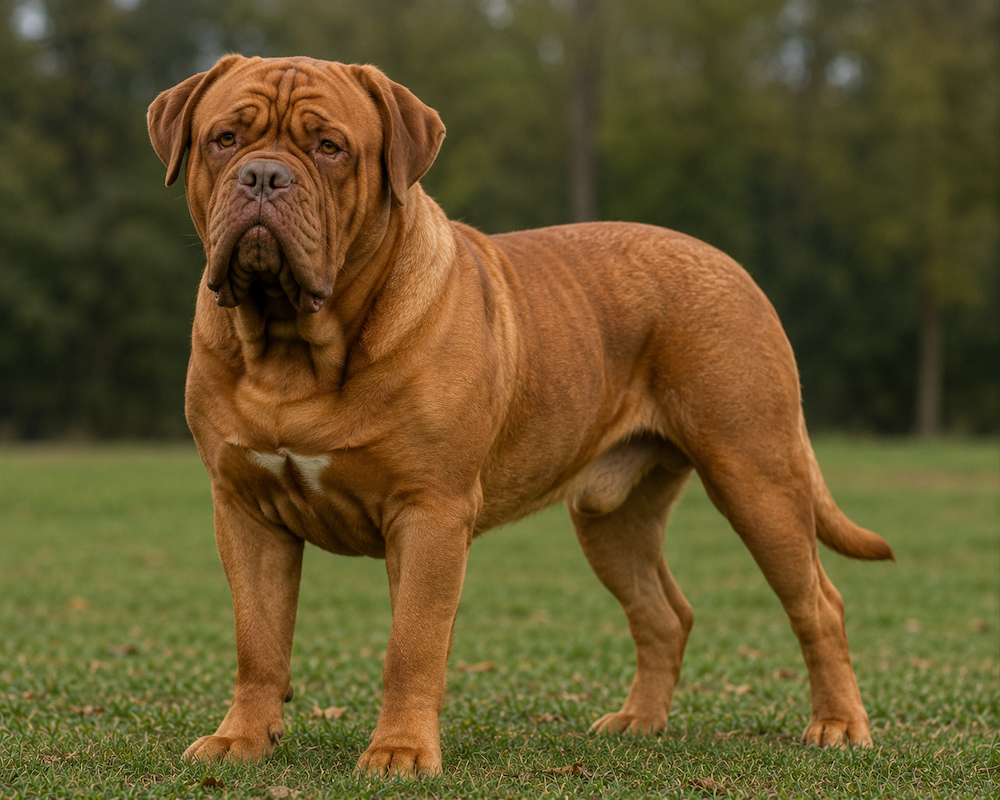







Powerful, gentle, and deeply devoted — a massive companion with a calm nature and an unwavering loyalty to its family.
🧠 QUICK SNAPSHOT
- Temperament: Loyal, calm, protective
- Energy Level: Moderate
- Size: Giant
- Good With Families: Yes
- Trainability: Moderate
- Grooming: Low
- Best For: Families with space, experienced owners, companionship
📚 OVERVIEW
The Dogue de Bordeaux, also known as the French Mastiff, is one of the oldest and most powerful mastiff breeds. Known for its massive head, muscular build, and deeply loyal nature, this breed forms incredibly strong bonds with its family.
Despite its imposing appearance, the Dogue de Bordeaux is generally calm, affectionate, and surprisingly gentle with those it loves. They thrive in homes where they can be close to their family and receive consistent guidance and companionship.
✅ PROS & CONS
Pros
- Extremely loyal and devoted
- Calm and affectionate with family
- Excellent natural guardian
- Low grooming requirements
Cons
- Large size requires space
- Can drool heavily
- Needs early socialisation and training
- Short lifespan compared to many breeds
Is a Dogue de Bordeaux a Good Family Dog?
Yes. A well-bred and properly socialised Dogue de Bordeaux can be a devoted, affectionate family dog, particularly for experienced owners comfortable managing a very large and powerful breed.
They’re typically calm and deeply attached to their household.
Their enormous strength means early training and socialisation are essential, and interactions with small children should be supervised.
Despite their formidable appearance, many Dogues are remarkably gentle and affectionate at home.
How Much Exercise Does a Dogue de Bordeaux Need?
Most adult Dogues de Bordeaux need around 45–60 minutes of moderate daily exercise.
They’re considerably less energetic than breeds such as Dobermans or Belgian Malinois.
Regular walks and gentle play help maintain muscle and prevent obesity, but excessive high-impact exercise isn’t appropriate, particularly while puppies are growing.
Their heavy build and short muzzle also make strenuous exercise in hot weather potentially dangerous.
Is a Dogue de Bordeaux Easy to Train?
The Dogue de Bordeaux is intelligent but can be independent and strong-willed.
They usually respond best to calm, consistent, reward-based training.
Because an adult can weigh more than many of its owners, basic behaviours such as loose-lead walking, recall and impulse control need to be established while the dog is young.
Physical strength should never be the owner’s primary method of control.
Does a Dogue de Bordeaux Shed?
Yes. The Dogue de Bordeaux has a short coat that sheds moderately.
Grooming is relatively straightforward, with regular brushing usually sufficient to remove loose hair.
Their facial wrinkles require additional attention because moisture and debris can accumulate within skin folds.
For many owners, however, loose hair isn’t the breed’s most noticeable contribution to household cleaning.
That distinction belongs to drool.
Is a Dogue de Bordeaux Hypoallergenic?
No. The Dogue de Bordeaux isn’t considered hypoallergenic.
It sheds hair and produces allergens through dander, saliva and skin secretions.
Given the amount of saliva some Dogues distribute around their environment, this isn’t an obvious breed choice for someone with significant dog allergies.
Does a Dogue de Bordeaux Drool a Lot?
Yes. The Dogue de Bordeaux can be a very heavy drooler.
Its large head, loose lips and facial structure allow saliva to escape easily.
Drooling often increases after drinking, eating, exercising or watching someone prepare food.
Experienced owners frequently keep strategically positioned towels around the house.
Why Does a Dogue de Bordeaux Have So Many Wrinkles?
The breed’s loose facial skin and wrinkles are characteristic features of its Mastiff-type anatomy.
The wrinkles become particularly prominent when the dog is alert.
However, excessively deep folds can trap moisture and create skin problems.
Wrinkles should be checked and kept clean and dry rather than regarded as completely maintenance-free decoration.
What Health Problems Are Common in Dogues de Bordeaux?
Important health concerns can include hip and elbow dysplasia, cardiac disease, gastric dilatation-volvulus, eye disorders, skin problems and breathing difficulties associated with brachycephalic anatomy.
The breed’s large size also contributes to orthopaedic stresses.
Responsible breeders should screen breeding dogs appropriately and avoid exaggerating features that compromise normal movement or breathing.
Is the Dogue de Bordeaux Brachycephalic?
Yes. The Dogue de Bordeaux is a brachycephalic, or short-muzzled, breed.
Its muzzle isn’t as extremely shortened as that of some Bulldogs, but reduced muzzle length can still compromise breathing in affected individuals.
Snoring, noisy breathing and poor exercise or heat tolerance shouldn’t automatically be dismissed as harmless breed characteristics.
Dogs with significant respiratory difficulty need veterinary assessment.
Does the Dogue de Bordeaux Have Breathing Problems?
Some Dogues de Bordeaux can develop breathing problems associated with brachycephalic obstructive airway syndrome (BOAS).
Severity varies between individuals.
Dogs with more open nostrils, adequate muzzle length and less extreme anatomy may breathe considerably better than severely affected animals.
Responsible breeding should prioritise functional breathing rather than increasingly exaggerated heads.
Does the Dogue de Bordeaux Handle Hot Weather Well?
No. Dogues de Bordeaux can be particularly vulnerable to overheating.
Their short muzzle makes cooling through panting less efficient, while their enormous body mass generates and retains substantial heat.
Exercise should be limited during hot conditions, with constant access to shade, cool indoor areas and fresh water.
Heatstroke is a genuine emergency in this breed.
Are Dogues de Bordeaux Prone to Heart Problems?
Yes. Cardiac disease is an important health concern in the Dogue de Bordeaux.
Conditions affecting the heart muscle, valves or major blood vessels can occur within the breed.
Responsible breeding programmes should therefore consider appropriate cardiac screening.
Collapse, unusual fatigue, coughing or breathing difficulty warrants veterinary investigation.
Are Dogues de Bordeaux Prone to Bloat?
Yes. Like many large, deep-chested dogs, the Dogue de Bordeaux is at risk of gastric dilatation-volvulus (GDV).
The stomach expands with gas and can rotate, cutting off blood flow.
Signs include restlessness, a swollen abdomen, excessive drooling and repeated attempts to vomit without producing anything.
GDV requires immediate emergency veterinary treatment.
How Long Does a Dogue de Bordeaux Live?
The Dogue de Bordeaux unfortunately has a relatively short lifespan, commonly around 5–8 years, although some individuals live longer.
Large and giant breeds generally have shorter lifespans than smaller dogs, and significant cardiac, orthopaedic and other health problems can further affect longevity.
Health-focused breeding is particularly important in a breed with such a limited average lifespan.
Why Does the Dogue de Bordeaux Have Such a Short Lifespan?
There isn’t one single explanation.
The breed combines very large body size with inherited risks involving the heart, joints, cancer and other health conditions.
Giant dogs generally age faster than smaller breeds.
Keeping a Dogue lean, maintaining appropriate exercise and choosing puppies from comprehensively health-tested parents may improve the odds, but no breeder can guarantee longevity.
How Big Does a Dogue de Bordeaux Get?
The Dogue de Bordeaux is a large, extremely powerful Mastiff breed.
Adult males generally stand around 60–68 cm at the shoulder, with females around 58–66 cm.
Males commonly weigh at least around 50 kg and females around 45 kg, with many individuals considerably heavier.
A correctly built Dogue should be massive without becoming so overweight that movement and health are compromised.
Is the Dogue de Bordeaux a Giant Dog Breed?
The Dogue de Bordeaux is commonly regarded as a giant or very large breed, although some classification systems simply describe it as large.
What makes the dog particularly impressive isn’t extreme height.
It’s the combination of enormous head, broad chest, heavy bone and muscular body.
A Dogue may be shorter than a Great Dane but can look considerably more substantial.
How Big Is a Dogue de Bordeaux’s Head?
The Dogue de Bordeaux is famous for having an exceptionally large head in proportion to its body.
Breed standards even describe head circumference in relation to the dog’s height.
In males, the circumference of the skull can approach the dog’s height at the withers.
Few breeds carry quite so much dog above the shoulders.
Does the Dogue de Bordeaux Have the Biggest Head of Any Dog?
The Dogue de Bordeaux is frequently described as having one of the largest heads relative to body size among dog breeds.
However, declaring a single breed the absolute “biggest-headed dog” depends on whether you’re measuring circumference, width, weight or proportion.
What isn’t debatable is that the enormous head is one of the Dogue’s defining characteristics.
Can a Dogue de Bordeaux Live in an Apartment?
Potentially, yes.
Adult Dogues are often calm indoors and don’t require enormous amounts of high-intensity exercise.
The practical problem is their physical size.
Stairs, lifts, narrow hallways and carrying an injured 55-kilogram dog can all become significant considerations.
Apartment living is possible, but planning matters.
Can a Dogue de Bordeaux Be Left Alone?
Adult Dogues can learn to spend reasonable periods alone, but they’re generally strongly attached to their families.
They shouldn’t be treated as outdoor guard dogs that receive little human interaction.
Gradual independence training from puppyhood can help prevent separation-related problems.
Their calm appearance shouldn’t be mistaken for emotional indifference.
Do Dogues de Bordeaux Bark a Lot?
Generally, no. Dogues de Bordeaux aren’t usually known as excessive barkers.
They’re naturally watchful and may bark when something genuinely attracts their attention.
Their sheer physical presence means they rarely need to make constant noise to appear intimidating.
When a Dogue does produce a serious warning bark, most visitors notice.
Are Dogues de Bordeaux Protective?
Yes. The Dogue de Bordeaux has strong historical guarding instincts.
Many are naturally watchful of their home and family.
However, responsible ownership should focus on creating a stable, confident and controllable dog rather than deliberately increasing aggression.
A 50-plus-kilogram Mastiff doesn’t need encouragement to become more intimidating.
Is a Dogue de Bordeaux a Good Guard Dog?
Historically, yes. Guarding is one of the roles for which Dogue-type dogs were used.
Their size, courage, loyalty and territorial awareness made them effective guardians of homes, estates and property.
Modern family Dogues should still be thoroughly socialised.
A good guardian needs judgment and control, not indiscriminate hostility.
Are Dogues de Bordeaux Aggressive?
Dogues de Bordeaux aren’t inherently indiscriminately aggressive, but they are powerful guardian-type dogs requiring responsible breeding and socialisation.
Some individuals can be reserved with strangers or selective with other dogs.
Fear, poor breeding, inadequate socialisation and irresponsible management can create serious problems in a dog of this size.
Stable temperament should be one of the highest priorities when selecting a puppy.
Are Dogues de Bordeaux Good With Children?
Many Dogues de Bordeaux can be gentle and affectionate with children in their family.
However, their enormous weight means accidental collisions can easily knock over a small child.
Interactions should always be supervised.
Children also need to learn appropriate behaviour around dogs, particularly around food, sleeping areas and resting dogs.
Are Dogues de Bordeaux Good With Other Dogs?
Compatibility varies.
Some Dogues live very successfully with other dogs, while dog selectivity or same-sex aggression can occur in the breed.
Early socialisation is important but doesn’t guarantee universal adult sociability.
Careful introductions and thoughtful household matching are particularly important because separating two giant dogs during a serious conflict can be extremely difficult.
Are Dogues de Bordeaux Good With Cats?
Dogues de Bordeaux can live successfully with cats, particularly when raised alongside them.
However, individual prey and chase instincts vary.
A household cat may be regarded as family while unfamiliar animals outside receive a different response.
Introductions should be gradual and controlled.
Do Dogues de Bordeaux Have a Strong Prey Drive?
Prey drive varies considerably between individuals.
The breed’s ancestors were used for a variety of demanding roles, including guarding and hunting large animals, so some Dogues retain substantial chase instincts.
Early socialisation around other animals can help.
Secure fencing is sensible for any large, powerful dog with an uncertain response to wildlife.
Can a Dogue de Bordeaux Swim?
Some Dogues can swim, but they’re not naturally ideal swimmers.
Their enormous head, heavy muscular body and relatively short muzzle can make swimming difficult and tiring.
They should always be closely supervised around pools, rivers and deep water.
A properly fitted canine life jacket is sensible when boating or around open water.
Why Does My Dogue de Bordeaux Snore?
Snoring is common because of the breed’s shortened muzzle and upper-airway anatomy.
Mild occasional snoring doesn’t necessarily indicate severe disease.
However, extremely noisy breathing, choking, gagging, exercise intolerance or struggling to breathe while awake shouldn’t simply be accepted because the dog is a Dogue de Bordeaux.
Those signs deserve veterinary assessment.
Why Does My Dogue de Bordeaux Fart So Much?
Some Dogues can be impressively flatulent.
Swallowed air, diet, eating speed and gastrointestinal sensitivity can all contribute.
Brachycephalic dogs may swallow additional air when breathing or eating.
Persistent or unusually severe flatulence, diarrhoea or digestive discomfort should be discussed with a veterinarian rather than accepted as an unavoidable Mastiff feature.
What Colour Is a Dogue de Bordeaux?
The traditional Dogue de Bordeaux coat is fawn, ranging from lighter shades through rich reddish or mahogany tones.
A mask may be black, brown or absent depending on the individual and breed standard.
Small amounts of white may occur in permitted areas under some standards.
The rich reddish coat is responsible for the breed’s occasional nickname, the French Mastiff or Bordeaux Mastiff.
Why Do Some Dogues de Bordeaux Have Black Masks?
Mask colour is controlled by coat-colour genetics.
Some Dogues have a clearly defined black mask, others a brown mask, while some have relatively little contrasting facial pigmentation.
These differences can also affect nose and eye-rim pigmentation.
Mask colour doesn’t create a different breed or temperament.
Is the Dogue de Bordeaux the Same as a French Mastiff?
Yes. French Mastiff is a commonly used English description for the Dogue de Bordeaux.
However, Dogue de Bordeaux is the breed’s proper historical name.
It distinguishes the breed from other French Mastiff-type dogs that existed historically.
What Does “Dogue de Bordeaux” Mean?
“Dogue” is a French term historically used for a Mastiff-type dog, while Bordeaux refers to the famous city and surrounding region in southwestern France.
The name can therefore be understood roughly as the Mastiff of Bordeaux.
“Dogue” isn’t simply the French word for every dog — the ordinary French word for dog is chien.
How Do You Pronounce Dogue de Bordeaux?
In French, the name is approximately pronounced “dog duh bor-DOH.”
The final letters in Dogue and Bordeaux don’t sound the way many English speakers initially expect.
Fortunately, the dog itself is unlikely to object to your accent as long as dinner arrives on schedule.
Is the Dogue de Bordeaux Related to the Bullmastiff?
The Dogue de Bordeaux and Bullmastiff are both large Mastiff-type breeds, but they’re distinct breeds with separate histories.
The Bullmastiff was developed in Britain primarily from Mastiff and Bulldog ancestry.
The Dogue de Bordeaux is a much older French Mastiff type.
They share broad heads, muscular bodies and guarding ancestry, which explains their superficial similarity.
What Is the Difference Between a Dogue de Bordeaux and a Bullmastiff?
The Dogue de Bordeaux typically has a larger, more wrinkled head, shorter muzzle and characteristic reddish-fawn colouring.
Bullmastiffs commonly appear in fawn, red or brindle and generally have a dark mask.
Both are powerful guardians, but their histories and breed development differ.
The Dogue’s facial structure is often more exaggerated.
What Is the Difference Between a Dogue de Bordeaux and an English Mastiff?
The English Mastiff is generally taller and substantially heavier overall, while the Dogue de Bordeaux tends to be shorter and more compact.
The Dogue often has a proportionally larger and more wrinkled head.
Both are ancient Mastiff-type breeds with guarding histories.
They’re not simply French and English versions of exactly the same dog.
What Is the Difference Between a Dogue de Bordeaux and a Boerboel?
The Boerboel originated in South Africa, while the Dogue de Bordeaux is French.
Boerboels are generally more athletic and have longer muzzles, reflecting their development as versatile farm guardians.
The Dogue is typically heavier through the head and more brachycephalic.
Both require experienced ownership because of their size and guarding instincts.
Is the Dogue de Bordeaux an Ancient Breed?
The Dogue de Bordeaux has very old Mastiff-type roots in France, although claims of a perfectly documented lineage stretching back thousands of years should be treated cautiously.
Large guarding and fighting dogs existed in France long before modern pedigree breeding.
The breed as we recognise it today was standardised much more recently.
Its history is therefore ancient in type but modern in formal pedigree organisation.
Is the Dogue de Bordeaux Descended From Roman War Dogs?
Roman Molossian dogs are frequently mentioned in histories of European Mastiff breeds, including the Dogue de Bordeaux.
However, claiming a direct, uninterrupted descent from specific Roman war dogs goes beyond what historical evidence can firmly establish.
Ancient large working dogs probably contributed broadly to European Mastiff populations.
The precise family tree has been lost.
Is the Dogue de Bordeaux Related to the Alaunt?
The Alaunt, a now-extinct type of powerful working dog found across medieval Europe, is frequently discussed as a possible contributor to European Mastiff breeds.
Connections to the Dogue de Bordeaux are plausible within the broader development of French Mastiff-type dogs.
However, the historical record doesn’t provide the kind of pedigree documentation available for modern breeds.
It is better viewed as probable historical influence than a proven straight-line ancestry.
Were Dogues de Bordeaux Used for Hunting?
Yes. Dogs of this general type were historically used for hunting dangerous large animals, including boar.
Strength, courage and the ability to hold or confront large quarry were valuable characteristics.
They were considerably more functional and athletic than someone seeing only a sleepy modern Dogue on a sofa might imagine.
Were Dogues de Bordeaux Used to Guard Vineyards?
Dogues and related Mastiff-type dogs were historically used to guard property, estates and valuable goods, and Bordeaux’s agricultural and wine-producing region naturally forms part of the breed’s history.
However, romantic claims that the breed existed specifically or exclusively as a vineyard guardian oversimplify its working past.
It was a versatile powerful dog used for several demanding purposes.
Were Dogues de Bordeaux Used as Cattle Dogs?
Yes. Historical Dogue-type dogs were used for driving and controlling cattle, as well as guarding property and performing other heavy work.
Their muscular bodies and courage made them capable of handling large livestock.
This helps explain why the breed shouldn’t be thought of simply as a decorative giant companion.
Were Dogues de Bordeaux Used for Dog Fighting?
Unfortunately, powerful Mastiff-type dogs including ancestors of the Dogue de Bordeaux were historically used in animal fighting and blood sports.
Dogs could be pitted against other dogs or large animals.
These practices belong to a brutal period of animal entertainment and are illegal in many countries today.
The modern breed’s future should be defined by companionship and responsible ownership rather than recreating historical cruelty.
Were There Different Types of Dogue de Bordeaux?
Historically, descriptions refer to regional or physical types including the Bordeaux, Toulouse and Paris varieties of French Dogue-type dogs.
They weren’t necessarily separate modern breeds in the way kennel clubs define breeds today.
Over time, the Bordeaux type became the foundation of the recognised Dogue de Bordeaux.
This is another reminder that breeds often existed as variable working populations before modern standards narrowed their appearance.
When Was the First Dogue de Bordeaux Dog Show?
One important milestone occurred at a French dog exhibition in Paris in 1863, where Dogues de Bordeaux were shown and compared.
A dog named Magentas is often associated with winning at this early exhibition.
Events like this helped transform regional working dogs into formally defined pedigree breeds.
Who Was Magentas the Dogue de Bordeaux?
Magentas is frequently identified as an important early Dogue de Bordeaux associated with the 1863 Paris dog show.
His success helped draw attention to the Bordeaux type at a time when French Mastiff dogs still showed considerable regional variation.
The emergence of organised dog shows gradually encouraged breeders to define what the Dogue de Bordeaux should look like.
Did the Dogue de Bordeaux Nearly Become Extinct?
The breed’s numbers were severely affected by war, social upheaval and changing lifestyles, particularly during the 20th century.
Like many large European breeds, maintaining giant dogs became extremely difficult during periods of food shortages and conflict.
Dedicated breeders helped preserve and rebuild the population.
The Dogue’s international popularity today hides just how vulnerable the breed once became.
Did World War II Nearly Wipe Out the Dogue de Bordeaux?
World War II was particularly difficult for large European dog breeds because food shortages made maintaining enormous dogs challenging.
The Dogue de Bordeaux population declined severely.
Claims that only a precise handful survived should be treated cautiously unless tied to reliable records, but the breed unquestionably required significant post-war recovery.
When Did the Dogue de Bordeaux Become Popular Outside France?
For much of its history, the Dogue de Bordeaux remained relatively uncommon outside France.
International awareness grew substantially during the late 20th century.
Dog shows, expanding pedigree populations and one particularly memorable Hollywood appearance introduced the breed to millions of people who had never previously heard of it.
Was the Dog in Turner & Hooch a Dogue de Bordeaux?
Yes. Hooch in the 1989 film Turner & Hooch was a Dogue de Bordeaux.
The film starred Tom Hanks alongside an enormous, drooling Dogue.
For many people outside France, it was their first encounter with the breed.
The movie dramatically increased international recognition of the Dogue de Bordeaux.
What Was the Name of the Dog That Played Hooch?
The principal Dogue de Bordeaux associated with the role of Hooch was named Beasley.
Additional dogs were reportedly involved in production for particular scenes and tasks.
Beasley’s expressive face, enormous head and prodigious drooling helped make Hooch one of cinema’s most memorable canine characters.
Did Turner & Hooch Make the Dogue de Bordeaux Popular?
It certainly contributed enormously to the breed’s international visibility.
Before the film, relatively few people outside specialist dog circles knew what a Dogue de Bordeaux was.
Afterwards, millions recognised the giant red Mastiff as “the dog from Turner & Hooch.”
As with any breed popularised by entertainment, increased demand also created concerns about inexperienced ownership and irresponsible breeding.
Why Is the Dogue de Bordeaux So Famous for Drooling?
The breed combines large jowls, loose lips, a huge head and Mastiff anatomy, making saliva difficult to contain.
Turner & Hooch turned this already genuine breed characteristic into a major part of the dog’s public image.
The film exaggerated some situations for comedy, but the basic premise was accurate.
A Dogue can produce impressive quantities of saliva without requiring assistance from Hollywood special effects.
Is the Dogue de Bordeaux Rare?
The Dogue de Bordeaux is no longer extraordinarily rare internationally, but it remains far less common than breeds such as Labradors, German Shepherds or Golden Retrievers.
Numbers vary significantly by country.
Its enormous size, short lifespan, health concerns and specialised ownership requirements naturally limit its suitability for the average household.
Where Does the Dogue de Bordeaux Come From?
The Dogue de Bordeaux comes from France, particularly the region associated with Bordeaux in the country’s southwest.
Its ancestors belonged to an old tradition of powerful French Mastiff-type dogs used for guarding, hunting large game, handling livestock and protecting property.
The modern breed eventually emerged from those working dogs and survived enormous social changes, two world wars and periods of very low numbers.
Then in 1989, millions of people met one through Turner & Hooch.
Behind that famous slobbering movie star is a much older story: a massive French working dog that once guarded property and confronted dangerous animals, but today is often happiest leaning its enormous head against its favourite human while quietly redecorating their trousers with drool.