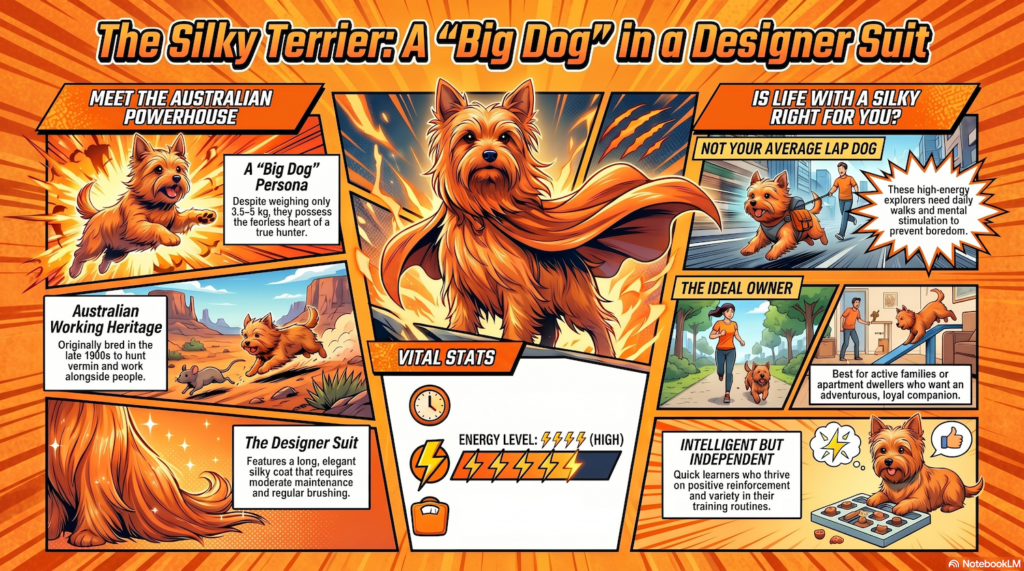
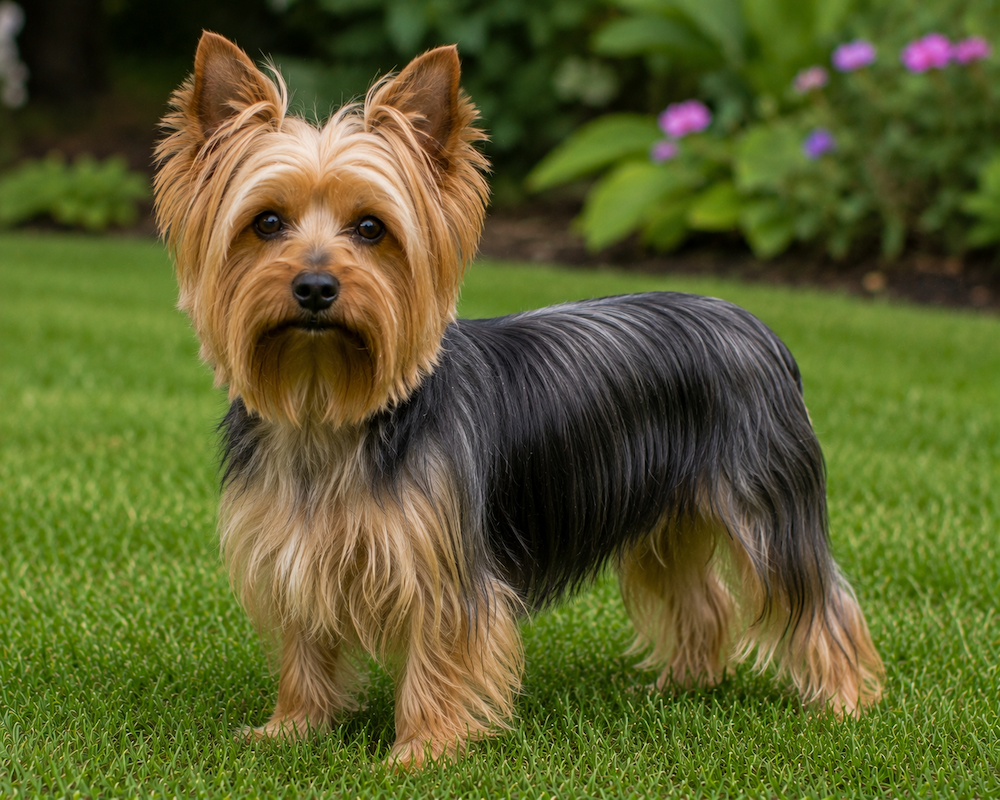







Confident, spirited, and full of charm — a small companion with a big personality and a luxurious coat.
🧠 QUICK SNAPSHOT
- Temperament: Alert, affectionate, confident
- Energy Level: Moderate to high
- Size: Small
- Good With Families: Yes
- Trainability: High
- Grooming: Moderate to high
- Best For: Families, apartments, companionship
📚 OVERVIEW
The Silky Terrier is a lively Australian breed known for its beautiful flowing coat and fearless terrier spirit. Despite its elegant appearance, the Silky Terrier is an energetic and adventurous dog that loves exploring, playing, and being involved in family activities.
They combine the loyalty of a companion dog with the bold confidence of a working terrier, making them entertaining and engaging pets.
✅ PROS & CONS
Pros
- Affectionate and loyal companion
- Intelligent and easy to train
- Compact size suits many homes
- Alert and excellent watchdog
Cons
- Requires regular grooming and coat maintenance
- Can be vocal at times
- Strong prey drive toward small animals
- May become stubborn without consistent training
Is a Silky Terrier a Good Family Dog?
Yes. Silky Terriers can be affectionate, lively and loyal family companions.
They’re small dogs with genuine terrier personalities, so they’re generally more energetic and assertive than their elegant appearance suggests.
They do best with families prepared to provide regular exercise, training and plenty of interaction.
Are Silky Terriers Good With Children?
Silky Terriers can be good with respectful children, particularly older children.
Their small size makes them vulnerable to rough handling, while their confident terrier personality means they may not appreciate being grabbed or teased.
Interactions with young children should always be supervised.
How Much Exercise Does a Silky Terrier Need?
Most Silky Terriers need around 30–60 minutes of exercise each day, along with play and mental stimulation.
They’re considerably more active than many traditional toy breeds.
Walks, games, training and opportunities to investigate interesting scents can help satisfy their terrier instincts.
Are Silky Terriers Easy to Train?
Silky Terriers are intelligent and capable learners, but they can also be independent and strong-minded.
Short, interesting training sessions using positive reinforcement usually work best.
Early training is important because a Silky can quickly discover that being small and charming allows it to get away with quite a lot.
Do Silky Terriers Shed a Lot?
No. Silky Terriers are generally low-shedding dogs.
Their long, fine coat is more hair-like than the typical fur of many breeds.
However, low shedding doesn’t mean low maintenance because the coat requires regular grooming to prevent tangles.
Are Silky Terriers Hypoallergenic?
Silky Terriers are often considered a better option for some allergy sufferers because they shed relatively little, but no dog is completely hypoallergenic.
Dog allergens are also found in saliva and skin secretions.
Anyone with significant allergies should spend time around the breed before deciding whether it’s suitable.
How Often Should You Groom a Silky Terrier?
A Silky Terrier’s long coat should generally be brushed several times a week, potentially daily if kept in full length.
Regular bathing and trimming may also be required.
Pet Silkies can be kept in shorter trims to make everyday coat maintenance easier.
What Health Problems Are Common in Silky Terriers?
Potential health concerns include patellar luxation, Legg-Calvé-Perthes disease, eye disorders, dental disease and tracheal problems.
Like many small breeds, maintaining good dental health is particularly important.
Responsible breeding and appropriate health screening can reduce the risk of some inherited conditions.
How Long Do Silky Terriers Live?
Silky Terriers commonly live around 13–15 years, with some living longer.
Their relatively small size contributes to a good potential lifespan.
Healthy weight, appropriate exercise, dental care and regular veterinary checks can help support longevity.
How Big Does a Silky Terrier Get?
Silky Terriers are small dogs, generally standing around 23–26 cm at the shoulder and weighing approximately 3.5–5 kg.
Despite their compact size, they’re substantially built compared with some delicate toy breeds.
Underneath the flowing coat is a genuine working terrier body.
Can a Silky Terrier Live in an Apartment?
Yes. Silky Terriers can adapt very well to apartment living.
Their small size makes them practical for smaller homes, provided they receive sufficient daily exercise.
Barking can be the bigger consideration in apartments because Silkies tend to be alert and responsive to noises.
Can Silky Terriers Be Left Alone?
Adult Silky Terriers can learn to tolerate reasonable periods alone, but they’re companionable dogs that enjoy being involved with their families.
Long periods without exercise or stimulation can contribute to barking, digging or destructive behaviour.
Providing toys and enrichment can help keep them occupied.
Do Silky Terriers Bark a Lot?
They can.
Silky Terriers are naturally alert and vocal, and many quickly announce visitors, unfamiliar noises or activity outside the home.
Early training can help prevent alert barking from becoming excessive.
Are Silky Terriers Good Watchdogs?
Yes. Their small size prevents them from functioning as conventional guard dogs, but they can make excellent watchdogs.
Silkies are alert, confident and quick to notice unusual activity.
They generally have no difficulty telling the household that something interesting is happening.
Are Silky Terriers Affectionate?
Yes. Silky Terriers are generally affectionate and strongly attached to their families.
They’re often more people-oriented than their independent terrier ancestry might suggest.
Many enjoy cuddling and spending time close to their owners while still retaining a bold, adventurous personality.
Are Silky Terriers Good With Other Dogs?
They can be, particularly when properly socialised.
Silky Terriers are confident little dogs and may occasionally challenge dogs much larger than themselves.
Early positive experiences with other dogs can help encourage appropriate social behaviour.
Are Silky Terriers Good With Cats?
Some Silky Terriers can live successfully with cats, particularly when raised alongside them.
However, their terrier ancestry means they may have a strong instinct to chase smaller animals.
Careful introductions and early training are important.
Do Silky Terriers Have a High Prey Drive?
Many do.
Silky Terriers were developed partly as vermin hunters, and the instinct to pursue rodents and other small animals remains strong in some individuals.
Pet rodents and other very small animals should therefore be kept securely separated.
Do Silky Terriers Dig?
They certainly can.
Digging is a natural terrier behaviour, particularly when a dog detects an interesting smell or suspects something might be underneath the ground.
Providing sufficient exercise and stimulation can help reduce unwanted excavation.
Can Silky Terriers Be Trusted Off Leash?
Caution is advisable.
Their prey drive and independent terrier instincts can cause a Silky to chase a small animal despite otherwise good recall.
Securely fenced areas are generally the safest places for unrestricted running.
Are Silky Terriers High-Energy Dogs?
They’re surprisingly energetic for their size.
Silky Terriers were developed from working terrier stock rather than purely as decorative lap dogs.
They generally enjoy walks, games, exploring and training and need more activity than their elegant appearance might suggest.
What Colours Do Silky Terriers Come In?
The Silky Terrier is famous for its blue-and-tan coat.
The blue can range in shade, while rich tan colouring typically appears around areas such as the face and legs.
Puppies are born much darker, with their adult colouring developing as they mature.
What Is the Difference Between a Silky Terrier and a Yorkshire Terrier?
Silky Terriers and Yorkshire Terriers look similar, but they’re separate breeds.
The Silky is generally slightly larger and more substantially built, reflecting its development as both a companion and vermin-hunting terrier.
Yorkshire Terriers are typically smaller and have a different breed history and standard.
What Is the Difference Between a Silky Terrier and an Australian Terrier?
The breeds are closely connected historically but look quite different.
The Australian Terrier has a harsh, weather-resistant coat, while the Silky Terrier has the long, fine coat responsible for its name.
The Silky was developed using Australian Terrier-type dogs along with Yorkshire Terrier influence.
Is a Silky Terrier the Same as an Australian Silky Terrier?
Yes. The breed has historically been known as the Australian Silky Terrier, and that name is still used by some kennel organisations and in some countries.
“Silky Terrier” is the name commonly used in places such as the United States.
Both names refer to the same breed.
What Were Silky Terriers Originally Bred For?
Silky Terriers were developed as both companions and capable vermin hunters.
Despite their glamorous coats, they retained genuine terrier instincts and were capable of dealing with rodents and other small pests.
That combination of elegant appearance and working-dog attitude remains one of the breed’s defining characteristics.
Where Does the Silky Terrier Come From?
The Silky Terrier originated in Australia, with development particularly associated with Sydney during the late 19th and early 20th centuries.
Australian Terrier-type dogs were crossed with Yorkshire Terriers and selectively bred to establish the distinctive silky-coated dog.
The breed was consequently known historically as the Sydney Silky and later the Australian Silky Terrier.
Is a Silky Terrier a Good First Dog?
Yes. A Silky Terrier can be a good first dog for an owner prepared for regular grooming, training and terrier behaviour.
They’re conveniently small and don’t require enormous amounts of exercise.
However, their intelligence, prey drive and confidence mean they shouldn’t be treated simply as decorative lap dogs.
What Makes the Silky Terrier Unique?
The Silky Terrier is a wonderful example of why you should never judge a dog by its hairstyle.
With its long, glossy blue-and-tan coat, it looks as though it belongs on a cushion somewhere being carefully admired.
Its ancestors had other ideas.
The breed was developed in Australia from genuine terrier stock and retained the confidence and hunting instincts needed to tackle vermin.
That means underneath one of the most elegant coats in the dog world is a small dog prepared to chase, dig, investigate and sound the alarm whenever necessary.
It can happily spend part of the day looking like canine royalty.
Then something small moves in the garden.
And suddenly the glamorous little show dog remembers:
“Oh yes. I’m a terrier.”