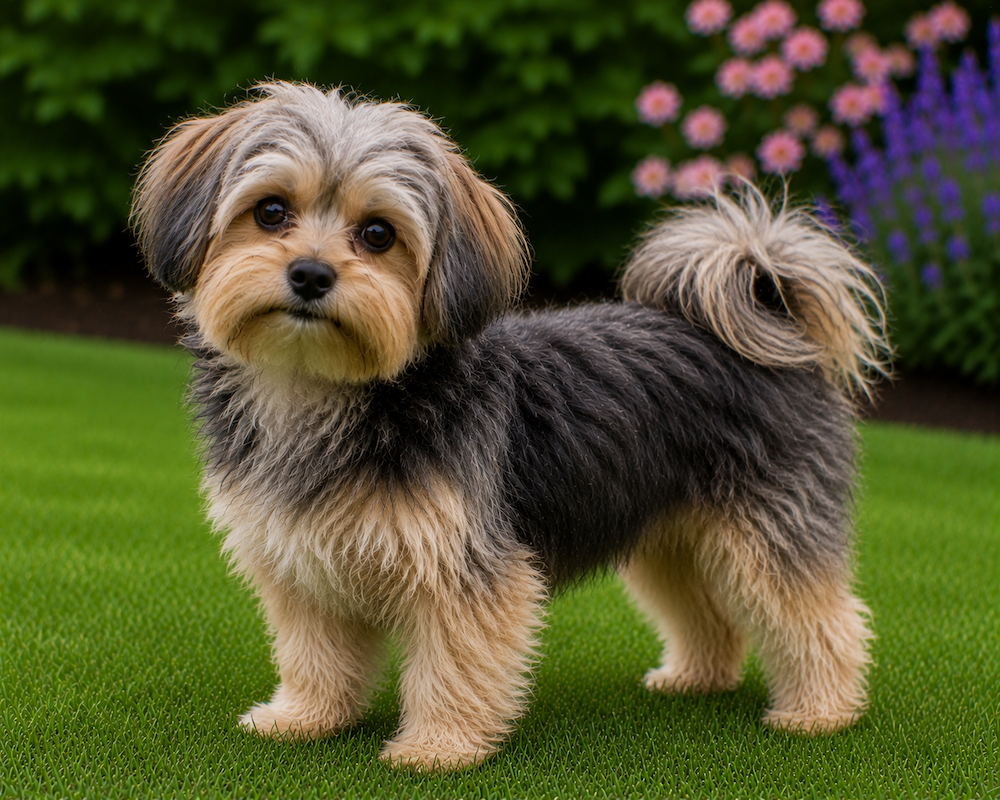







Tiny, affectionate, and full of confidence — a lovable companion with a playful spirit and a huge personality.
🧠 QUICK SNAPSHOT
- Temperament: Affectionate, playful, confident
- Energy Level: Moderate
- Size: Small
- Good With Families: Yes
- Trainability: Moderate
- Grooming: Moderate to high
- Best For: Families, apartments, companionship
📚 OVERVIEW
The Shorkie is a cross between a Shih Tzu and a Yorkshire Terrier, combining the affectionate nature of the Shih Tzu with the lively confidence of the Yorkie. Small in size but big in personality, Shorkies love being the centre of attention and quickly become devoted family companions.
They are adaptable dogs that fit well into apartments or family homes and thrive when they receive plenty of love, companionship, and daily interaction.
✅ PROS & CONS
Pros
- Extremely affectionate and people-oriented
- Compact size suits apartment living
- Playful and entertaining personality
- Intelligent and quick to learn
Cons
- Requires regular grooming and coat maintenance
- Can develop separation anxiety
- May be vocal when excited or alerting owners
- Small size requires gentle handling around young children
Is a Shorkie a Good Family Dog?
Yes. Shorkies can be affectionate, lively and devoted family companions.
A Shorkie is a cross between a Shih Tzu and a Yorkshire Terrier, so temperament can vary. Many are strongly attached to their owners and pack a surprisingly large personality into a very small body.
Are Shorkies Good With Children?
Shorkies can be good with gentle, respectful children, particularly older children.
Because they’re small and relatively delicate, they can be accidentally injured by rough play or being dropped.
Supervision is especially important around toddlers and young children.
How Much Exercise Does a Shorkie Need?
Most Shorkies need around 30–60 minutes of daily exercise, usually divided between short walks and play sessions.
They’re energetic for their size but don’t need enormous amounts of outdoor exercise.
Interactive toys and training also provide valuable mental stimulation.
Are Shorkies Easy to Train?
Shorkies are intelligent but can inherit an independent or stubborn streak from either parent.
They generally respond well to short, enjoyable training sessions using positive reinforcement.
Consistency is important because a cute Shorkie can quickly discover which household rules are negotiable.
Are Shorkies Hard to Toilet Train?
Some Shorkies can be challenging to toilet train.
Small dogs have small bladders, and both Yorkshire Terriers and Shih Tzus can sometimes require patience with house training.
Frequent toilet opportunities, a consistent routine and rewards for successful toileting are particularly helpful.
Do Shorkies Shed?
Many Shorkies are relatively low-shedding, particularly when they inherit the hair-like coats of their parent breeds.
However, coat characteristics vary between individual crossbred dogs.
Low shedding also doesn’t mean low maintenance, as their coats can tangle and mat easily.
Are Shorkies Hypoallergenic?
Shorkies are sometimes promoted as hypoallergenic, but no Shorkie can be guaranteed to be allergy-friendly.
Both parent breeds are relatively low shedding, which may make some Shorkies easier for certain allergy sufferers to tolerate.
However, dog allergens are also present in saliva and skin secretions.
How Often Should You Groom a Shorkie?
Most Shorkies need brushing several times a week, potentially daily with a longer coat.
Many owners keep their dogs in a shorter puppy-style trim to make maintenance easier.
Professional grooming is commonly required every six to eight weeks, depending on coat length and type.
What Health Problems Are Common in Shorkies?
Potential health concerns include dental disease, patellar luxation, eye problems, tracheal collapse and certain respiratory problems.
Very small individuals can also be more vulnerable to injury and other toy-dog health issues.
Crossbreeding doesn’t automatically eliminate conditions found in the parent breeds.
Do Shorkies Have Breathing Problems?
Some can.
A Shorkie that inherits the Shih Tzu’s shortened muzzle may be more susceptible to brachycephalic airway problems, including noisy breathing, poor heat tolerance and reduced exercise tolerance.
Facial structure varies considerably between individual Shorkies.
How Long Do Shorkies Live?
Shorkies commonly live around 12–15 years, although some may live longer.
Their small size generally contributes to a relatively long potential lifespan.
Genetics, dental health, weight and preventive veterinary care can all influence longevity.
How Big Does a Shorkie Get?
Shorkies are small dogs, commonly weighing around 3–7 kg, although individuals can fall outside this range.
Adult size depends heavily on the size of the Shih Tzu and Yorkshire Terrier parents.
There is no single official Shorkie size standard.
What Does a Shorkie Look Like?
Shorkies vary considerably in appearance.
They commonly have a small body, expressive face and soft, straight or slightly wavy coat.
Some look strongly Shih Tzu-like, while others inherit the finer features and colouring of a Yorkshire Terrier.
Can a Shorkie Live in an Apartment?
Yes. Shorkies are generally very well suited to apartment living.
Their small size and moderate exercise requirements make them practical companions for smaller homes.
Barking can be the bigger consideration, particularly in buildings with close neighbours.
Can Shorkies Be Left Alone?
Shorkies generally prefer plenty of companionship.
Both parent breeds were developed to live closely with people, and some Shorkies can become distressed when routinely left alone for long periods.
Gradual alone-time training from puppyhood can help encourage independence.
Do Shorkies Bark a Lot?
They can.
Yorkshire Terriers are famously alert little dogs, and Shorkies can inherit a strong tendency to announce visitors, noises and suspicious activity outside the home.
Early training can help prevent alert barking from becoming excessive.
Are Shorkies Affectionate?
Usually, very.
Many Shorkies form extremely strong bonds with their owners and enjoy staying close to them throughout the day.
They’re often enthusiastic lap dogs and can be remarkably devoted companions.
Do Shorkies Like to Cuddle?
Many do.
The Shih Tzu’s companion-dog heritage can contribute to a particularly cuddly personality, while Yorkshire Terriers can also be strongly attached to their owners.
Individual Shorkies vary, but physical affection is common.
Are Shorkies Good With Other Dogs?
Generally, yes, when properly socialised.
Shorkies often live happily with other dogs, although their tiny size should be considered when introducing them to large or highly energetic dogs.
Some can also inherit the Yorkshire Terrier’s considerable confidence around dogs much larger than themselves.
Are Shorkies Good With Cats?
Many Shorkies can live successfully with cats, especially when introduced while young.
However, the Yorkshire Terrier was developed to hunt vermin, so some Shorkies may inherit stronger chasing instincts.
Careful introductions are important.
Do Shorkies Have a High Prey Drive?
Prey drive varies considerably.
A Shorkie inheriting stronger Yorkshire Terrier characteristics may be interested in chasing rodents, birds and other small animals.
Others may display very little prey drive.
Are Shorkies High-Energy Dogs?
Shorkies are energetic but usually manageable.
They often enjoy bursts of enthusiastic play followed by plenty of time relaxing with their owners.
Their exercise requirements are substantially easier to meet than those of most large working breeds.
What Colours Do Shorkies Come In?
Shorkies can appear in many colours and combinations inherited from their parent breeds.
These can include black, tan, gold, brown, white and various combinations of these colours.
Their coat colour can also change noticeably as they mature.
What Is an F1 Shorkie?
An F1 Shorkie is a first-generation cross between a Shih Tzu and a Yorkshire Terrier.
The label describes its parentage but doesn’t guarantee a particular size, coat or temperament.
One puppy may strongly resemble a Yorkie while a littermate inherits considerably more Shih Tzu characteristics.
What Is the Difference Between a Shorkie and a Yorkie?
A Yorkshire Terrier is an established pedigree breed, while a Shorkie combines Yorkshire Terrier and Shih Tzu ancestry.
Shorkies may inherit a broader face, sturdier body or more companion-oriented temperament from the Shih Tzu.
However, individual crossbred dogs vary considerably.
What Is the Difference Between a Shorkie and a Shih Tzu?
A Shih Tzu is an established companion breed, while a Shorkie has both Shih Tzu and Yorkshire Terrier ancestry.
The Yorkie influence may produce a finer build, greater alertness and more terrier-like behaviour.
Neither appearance nor personality can be predicted precisely.
Is a Shorkie a Recognised Dog Breed?
The Shorkie isn’t generally recognised as a standardised pedigree breed by major kennel clubs.
It’s a Shih Tzu–Yorkshire Terrier cross.
Consequently, there is no official breed standard defining exactly how large a Shorkie should be or precisely how it should look.
Where Did the Shorkie Come From?
Shih Tzu–Yorkshire Terrier crosses have likely occurred for many years, while deliberately bred Shorkies became more visible during the growing popularity of small designer crosses.
There isn’t a reliably documented single breeder or exact date responsible for creating the Shorkie.
Is a Shorkie a Good First Dog?
Yes. A Shorkie can be a good first dog for someone prepared for its grooming, training and companionship needs.
Their small size and moderate exercise requirements make them relatively manageable.
Potential owners shouldn’t assume that a tiny dog requires no training, however.
What Makes the Shorkie Unique?
The Shorkie combines two dogs that couldn’t have started with more different job descriptions.
The Shih Tzu spent centuries as a prized companion dog, while the Yorkshire Terrier’s ancestors were small working terriers developed to tackle vermin.
Put them together and you can get a tiny dog that wants to spend the evening curled up on your lap — while remaining completely convinced that it’s also responsible for household security.
That’s one of the charms of the Shorkie.
Its body may weigh only a few kilograms.
Its bark suggests something considerably larger.
And its confidence?
Nobody remembered to make that small at all.