
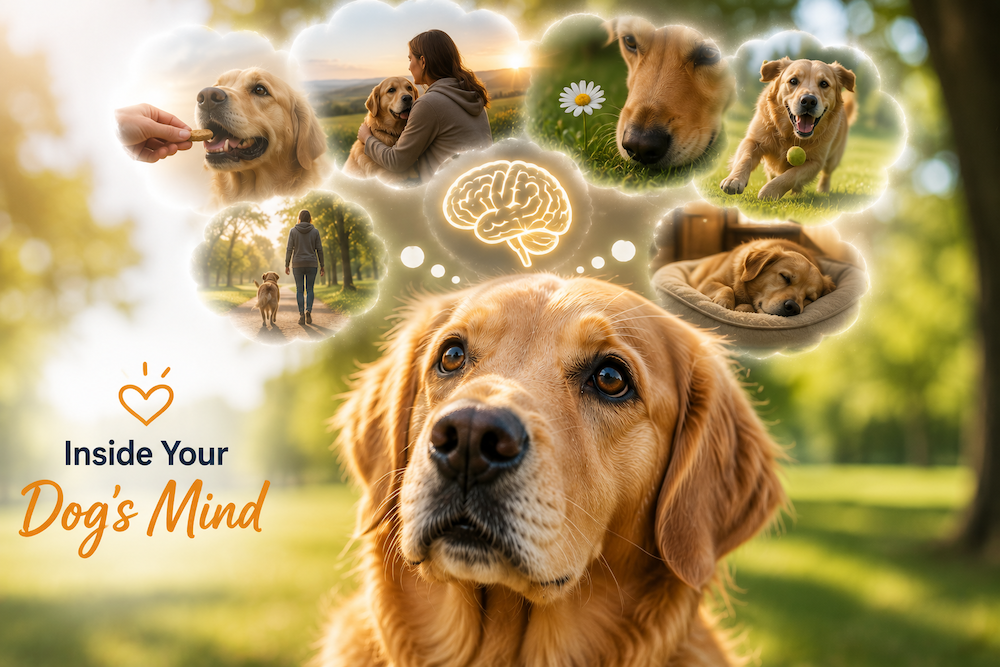
Have you ever looked into your dog’s eyes and wondered what they’re actually thinking?
Dogs don’t experience the world in the same way we do. They don’t appear to think through long sentences or inner conversations like humans, yet they are remarkably intelligent. They learn patterns, remember experiences, solve problems and become extraordinarily skilled at understanding the people around them.
So, how do dogs think? To understand the mind of a dog, we first need to understand that their world is built very differently from ours.
What is Your Dog Thinking?
Dogs are thought to process much of their world through associations, emotions, sensory information and learned patterns.
Your dog may not think, “It’s nearly 5pm, so dinner must be coming.” Instead, they recognise a collection of clues.
The light outside has changed. You have finished working. You walked towards the kitchen. A familiar cupboard opened.
To your dog, these patterns predict what happens next.
Dogs are experts at making associations
Dogs constantly connect events with outcomes.
They quickly learn that:
- The lead means a walk may be coming.
- Car keys can mean someone is leaving.
- A food bowl predicts dinner.
- A particular cupboard contains treats.
- Certain words lead to exciting activities.
- Your shoes and jacket can reveal what you’re about to do.
This ability to recognise patterns helps dogs navigate a human world they cannot understand through language alone.
A dog’s world is built around smell
Humans tend to experience the world visually. Dogs rely far more heavily on scent.
When your dog stops to investigate a patch of grass, they may be gathering an extraordinary amount of information. Scent can tell them that another animal has been there and provide clues about its identity and condition.
A sniffing walk isn’t wasted time. For your dog, it can be a rich information-gathering experience.
Do dogs think in words?
Dogs can learn the meaning or significance of many spoken words and sounds, but that doesn’t necessarily mean they experience an internal verbal monologue like humans do.
They are more likely to connect a familiar word with an object, action, emotion or expected outcome.
Say “walk”, and your dog may immediately anticipate the lead, the door opening and the adventure that follows.
What Do Dogs Think About?
We can’t ask a dog to describe its thoughts, so science cannot give us a complete answer. However, behaviour and cognitive research suggest that dogs can remember, anticipate, learn and make decisions based on previous experiences.
Dogs remember what matters to them
Dogs may remember:
- Familiar people.
- Important places.
- Daily routines.
- Learned behaviours.
- Positive and negative experiences.
- Sounds associated with significant events.
This is why a dog may recognise the sound of a familiar car before anyone else in the house notices it.
Dogs can solve problems
Give a dog a puzzle containing food and you’ll often see genuine problem-solving behaviour.
Some dogs use their paws. Others push with their nose. Some experiment with several approaches until something works.
Dogs can learn through:
- Trial and error.
- Repetition
- Observation
- Training
- Previous experience.
The way an individual dog approaches a problem can also vary enormously. Just like people, dogs have different personalities, motivations and levels of persistence.
Dogs anticipate what happens next
One of the most fascinating aspects of canine thinking is anticipation.
Your dog may know that something exciting is about to happen before you’ve consciously realised you’re giving them clues.
A tiny change in your routine, the clothes you’re wearing or the direction you’re walking may be enough.
Dogs are constantly watching, smelling and learning.
Do Dogs Understand Human Emotions?
Dogs have lived alongside humans for thousands of years. During that extraordinary relationship, they have become remarkably skilled at paying attention to us.
They observe:
- Facial expressions.
- Tone of voice.
- Body posture.
- Movement
- Daily habits.
- Emotional changes.
Your dog may notice that something is different before you say a single word.
Do dogs understand love?
Science cannot tell us whether a dog experiences love in exactly the same way a human does. However, dogs clearly form strong social attachments and seek comfort, security and companionship from people they trust.
They may:
- Seek physical closeness.
- Become excited when you return.
- Relax when you’re nearby.
- Look to you for reassurance.
- Choose to spend time with you.
Whatever label we give it, the bond can be profound.
Do dogs feel guilt or jealousy?
Dogs can display behaviours that humans interpret as guilt or jealousy, but we should be careful not to assume their emotions work exactly like ours.
The famous “guilty look”, for example, may sometimes be a response to an owner’s body language or tone rather than evidence that the dog is reflecting on a past wrongdoing.
Dogs certainly experience emotions, but interpreting those emotions accurately means seeing the world from a canine perspective rather than automatically applying human motivations.
Your dog is constantly learning about you
Perhaps the most remarkable thing about the canine mind is how much attention dogs give us.
They learn the sound of our footsteps.
They recognise our routines.
They notice when our behaviour changes.
They wait at windows, react to familiar cars and somehow seem to know when a walk is about to happen before we’ve even touched the lead.
We spend years teaching dogs to understand our world.
All the while, they are studying us too.
How intelligent are dogs?
Dog intelligence varies between individuals and can take different forms. Some dogs excel at learning commands, while others are exceptional problem solvers, scent workers or social communicators.
Do dogs remember their owners?
Dogs can form strong, long-lasting associations with familiar people, using scent, appearance, voice and past experiences to recognise them.
Does my dog know when I’m sad?
Dogs can detect changes in human behaviour, voice, posture and potentially scent. While we can’t know exactly how they interpret sadness, many dogs clearly respond to emotional changes in the people they know.
Do dogs think about the past?
Dogs have memory, but their experience of remembering may differ from human autobiographical memory. Previous experiences can clearly influence their expectations, emotions and future behaviour.
Final Thoughts
Dogs may not think exactly as humans do, but that doesn’t make their inner world any less remarkable.
They experience a world filled with scents we cannot detect, patterns we barely notice and tiny changes in our behaviour that we may not even realise we’re making.
They learn from us, remember us and build powerful emotional bonds with us.
Perhaps the most fascinating thing about understanding how dogs think is discovering just how closely they have been paying attention all along.
Dogs may never understand the human world exactly as we do.
But sometimes, it feels as though they understand us better than we understand ourselves.