






Alert, athletic, and full of character — an ancient Portuguese hunting dog with sharp instincts and an adventurous spirit.
🧠 QUICK SNAPSHOT
- Temperament: Intelligent, lively, alert
- Energy Level: High
- Size: Small to large
- Good With Families: Yes
- Trainability: Moderate to high
- Grooming: Low
- Best For: Active families, outdoor enthusiasts, experienced owner
📚 OVERVIEW
The Portuguese Podengo is an ancient hunting breed from Portugal that comes in three sizes — Pequeno, Médio, and Grande — as well as smooth-coated and wirehaired varieties. Traditionally used to hunt rabbits and larger game, the Podengo is known for its speed, agility, keen senses, and independent thinking.
Lively and affectionate with its family, the Portuguese Podengo thrives in an active home where it can explore, exercise, and use its natural intelligence. Because the three sizes can differ considerably, prospective owners should consider which variety best suits their lifestyle.
✅ PROS & CONS
Pros
- Intelligent and highly alert
- Loyal and affectionate with family
- Athletic and adventurous
- Generally low-maintenance coat
Cons
- Strong prey drive
- Can be independent during training
- Needs plenty of exercise and mental stimulation
- Secure fencing is important due to its hunting instincts
Is a Portuguese Podengo a Good Family Dog?
Yes. Portuguese Podengos can be affectionate, lively, intelligent and loyal family dogs, particularly for active households.
They’re hunting dogs with strong instincts rather than purely companion breeds, so they need regular exercise, mental stimulation and consistent training.
The breed comes in three sizes — Pequeno, Médio and Grande — and both smooth- and wire-coated varieties.
Are Portuguese Podengos Good With Children?
Generally, yes, particularly when well socialised.
They’re playful and energetic, making them enjoyable companions for active children.
The tiny Podengo Pequeno requires more careful handling, while interactions between any dog and young children should be supervised.
How Much Exercise Does a Portuguese Podengo Need?
Portuguese Podengos are active dogs and generally need around 60–90 minutes of daily exercise, although requirements vary with size and individual temperament.
Walks, running, games, scent activities and opportunities to explore are excellent outlets.
Their hunting heritage means physical exercise alone may not be enough — they also benefit greatly from activities that engage their brains and noses.
Is a Portuguese Podengo Easy to Train?
Portuguese Podengos are intelligent and capable learners, but they can also be independent thinkers.
They were developed to hunt with considerable independence rather than wait constantly for instructions from a handler.
Positive reinforcement, short training sessions and strong motivation generally produce the best results.
Does a Portuguese Podengo Shed?
Yes, although shedding is generally manageable.
Both smooth- and wire-coated Portuguese Podengos shed to some degree.
Regular brushing helps remove loose hair and keeps the coat in good condition.
Is a Portuguese Podengo Hypoallergenic?
No.
Neither the smooth nor wire-haired Portuguese Podengo is considered truly hypoallergenic.
Allergens are produced through saliva and skin secretions as well as being carried on shed hair.
How Often Should You Groom a Portuguese Podengo?
Portuguese Podengos are generally relatively low-maintenance dogs.
Weekly brushing is usually sufficient for the smooth coat, while the wire coat benefits from regular brushing and occasional additional coat maintenance.
Routine nail, ear and dental care are also important.
What Health Problems Are Common in Portuguese Podengos?
Portuguese Podengos are generally considered relatively robust dogs, but health risks vary between the three sizes.
Potential concerns can include patellar luxation, eye disorders and joint problems, depending on the variety and bloodline.
Responsible breeders should use health screening appropriate to the size and breeding population rather than assuming an old working breed is automatically free from inherited disease.
How Long Does a Portuguese Podengo Live?
Portuguese Podengos commonly live around 12–15 years, with smaller individuals sometimes living longer.
Their traditionally functional build and active lifestyle can contribute to good overall longevity.
Healthy weight, exercise, preventive veterinary care and responsible breeding remain important.
What Are the Three Sizes of Portuguese Podengo?
The Portuguese Podengo comes in three established sizes:
Pequeno – small
Médio – medium
Grande – large
These aren’t simply marketing terms such as “Mini” or “Teacup”. They’re traditional varieties developed for somewhat different hunting roles.
How Big Does a Portuguese Podengo Pequeno Get?
The Podengo Pequeno is the smallest variety, generally standing around 20–30 cm tall and weighing approximately 4–6 kg.
Despite its tiny size, it isn’t a delicate lap dog.
It’s a genuine little hunting dog with considerable energy, agility and confidence.
How Big Does a Portuguese Podengo Médio Get?
The Podengo Médio generally stands around 40–54 cm tall and commonly weighs approximately 16–20 kg.
It’s considerably larger and more athletic than the Pequeno.
Historically, the Médio became particularly associated with rabbit hunting.
How Big Does a Portuguese Podengo Grande Get?
The Podengo Grande generally stands around 55–70 cm tall and may weigh approximately 20–30 kg, although individuals vary.
It’s the largest and rarest of the three varieties.
Historically, the Grande was used for hunting larger game, including wild boar.
Is There a Miniature or Teacup Portuguese Podengo?
There is no recognised Teacup Portuguese Podengo.
The Podengo Pequeno is already the breed’s established small variety.
Terms such as “Teacup Podengo” shouldn’t be confused with the genuine traditional Portuguese size classifications.
Can a Portuguese Podengo Live in an Apartment?
The Podengo Pequeno can adapt particularly well to apartment living if given sufficient daily exercise and enrichment.
Médio and Grande Podengos generally benefit from more space and opportunities for vigorous activity.
Barking, prey drive and boredom can become bigger problems than the physical size of the home.
Do Portuguese Podengos Bark a Lot?
They can be quite vocal.
Podengos are alert hunting dogs, and barking historically had practical value when locating or pursuing game.
Training can reduce unnecessary barking, but prospective owners shouldn’t necessarily expect a silent breed.
Are Portuguese Podengos Good With Other Dogs?
Generally, yes.
Podengos historically worked in hunting situations that could involve other dogs, and many are sociable with canine companions.
Early socialisation remains important, particularly because individual temperament varies.
Are Portuguese Podengos Good With Cats?
Some can live successfully with cats, particularly when raised with them.
However, the Portuguese Podengo has a genuine hunting background and potentially strong prey drive.
An individual that’s friendly with the household cat may still chase unfamiliar cats or small animals outdoors.
Do Portuguese Podengos Have a High Prey Drive?
Yes. A strong prey drive is one of the most important characteristics prospective owners should understand.
Podengos were developed specifically to locate, chase and hunt game.
Fast-moving rabbits, rodents and other small animals can therefore trigger powerful chasing instincts.
Are Portuguese Podengos Good Off Leash?
They can be challenging off leash.
A well-trained Podengo may develop good recall, but its hunting instincts can override training when an interesting animal suddenly appears.
Secure fenced areas are the safest option for many individuals.
Are Portuguese Podengos Fast?
Yes.
Portuguese Podengos are quick, agile and athletic dogs capable of rapid acceleration when pursuing prey.
Their hunting style required much more than straight-line speed — they needed to negotiate rough terrain, change direction quickly and locate game using multiple senses.
What Does a Portuguese Podengo Look Like?
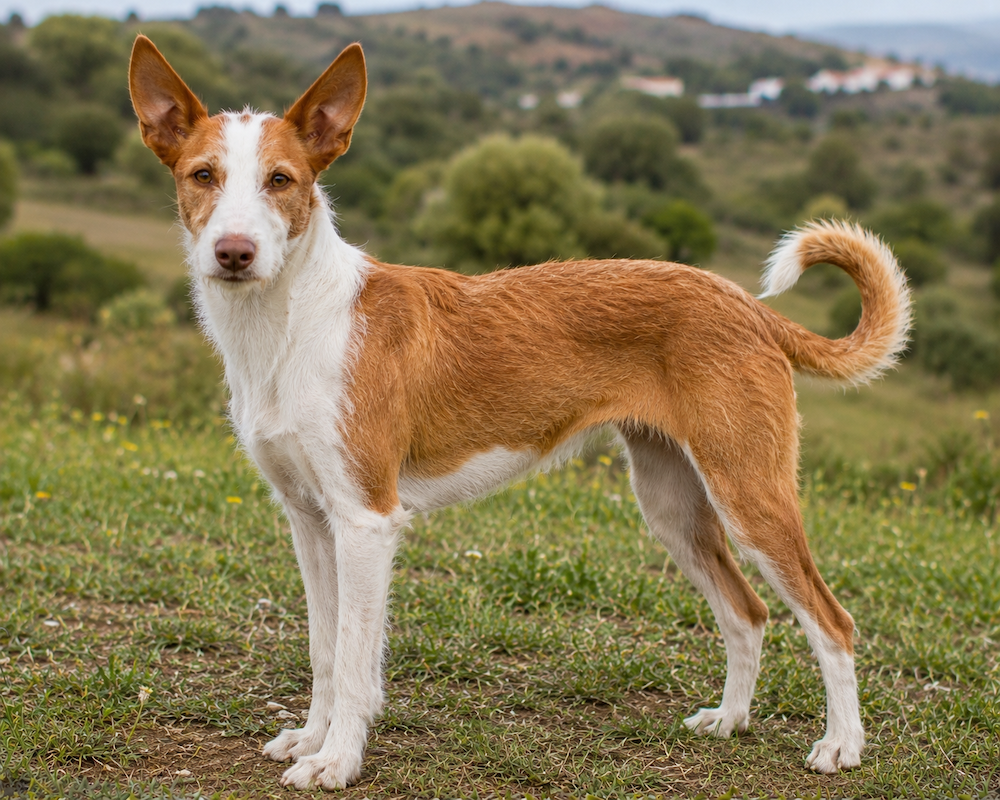
The Portuguese Podengo has a distinctive primitive hunting-dog appearance, with large upright triangular ears, a wedge-shaped head, athletic body and alert expression.
The coat can be either smooth and short or longer and wire-haired.
Despite the enormous difference between the Pequeno and Grande, all three sizes share a recognisable family resemblance.
What Colours Can Portuguese Podengos Be?
Typical colours include yellow and fawn in shades ranging from light to dark, either solid or combined with white.
Black and brown can also occur under some breed standards, although the classic Portuguese Podengo appearance is strongly associated with yellow or fawn colouring.
Colour should always be secondary to health, temperament and functional structure.
What Is the Difference Between a Smooth and Wire-Haired Portuguese Podengo?
Both coat types belong to the same breed.
The smooth-haired Podengo has a short, dense coat, while the wire-haired Podengo has longer, harsher hair and often develops distinctive facial furnishings.
The wire coat offered useful protection when dogs worked through rough vegetation and challenging terrain.
What Is the Difference Between a Portuguese Podengo and a Podengo Pequeno?
A Portuguese Podengo Pequeno is a Portuguese Podengo.
“Pequeno” simply identifies the smallest of the breed’s three traditional sizes.
The distinction can become confusing because some kennel organisations internationally have treated the Pequeno separately for registration or recognition purposes.
What Is the Difference Between a Portuguese Podengo and a Portuguese Podengo Pequeno?
The Portuguese Podengo is the overall breed family, traditionally occurring as Grande, Médio and Pequeno.
The Portuguese Podengo Pequeno specifically refers to the smallest size.
In some countries, the Pequeno has become much more familiar than its larger relatives, which can make it appear to be an entirely separate breed.
Is a Portuguese Podengo a Sighthound?
The Portuguese Podengo is often grouped with primitive hunting or hound breeds, but describing it simply as a sighthound doesn’t fully explain how it hunts.
Podengos can use sight, scent and hearing to locate game.
Their enormous upright ears are therefore more than a distinctive appearance — they’re part of a hunting system built around detecting prey.
What Were Portuguese Podengos Bred to Hunt?
Their hunting role varied according to size.
The Pequeno was particularly useful for pursuing rabbits into dense vegetation and rocky spaces.
The Médio became strongly associated with rabbit hunting, sometimes working in packs.
The much larger Grande was historically used for bigger game, including wild boar.
Where Does the Portuguese Podengo Come From?
The Portuguese Podengo comes from Portugal and belongs to an old tradition of Mediterranean hunting dogs.
Dogs of broadly similar primitive type have existed around the Mediterranean for a very long time, although claims that the modern breed has remained completely unchanged for thousands of years should be treated cautiously.
In Portugal, different sizes developed around practical hunting requirements.
Is the Portuguese Podengo an Ancient Dog Breed?
The Portuguese Podengo has very old Mediterranean-type ancestry, but it’s difficult to draw an uninterrupted pedigree line from ancient dogs directly to today’s registered Podengos.
The breed’s erect ears, wedge-shaped head and hunting style resemble other traditional Mediterranean dogs.
Its modern breed standard and organised pedigree population are naturally much more recent than those ancient dog populations.
Why Does the Portuguese Podengo Have Such Big Ears?
Those enormous upright ears aren’t merely decorative.
Podengos use hearing alongside sight and scent when locating prey, particularly in dense vegetation where an animal may disappear from view.
The ears can swivel toward sounds and contribute to the breed’s permanently alert appearance.
Is a Portuguese Podengo a Rare Dog?
Outside Portugal, the Portuguese Podengo is relatively uncommon, particularly the Médio and Grande varieties.
The Pequeno has achieved greater international recognition and is considerably more likely to be encountered as a companion dog.
The Grande remains especially rare.
Is a Portuguese Podengo a Good First Dog?
It can be, particularly the Pequeno, but prospective owners need to appreciate that they’re getting a real hunting dog rather than simply a cute small companion.
Podengos can be intelligent, affectionate and relatively easy to groom, but their prey drive, independence, energy and recall can challenge inexperienced owners.
An active owner willing to train consistently can find them extremely rewarding companions.
What Makes the Portuguese Podengo Unique?
The Portuguese Podengo is unusual because one traditional breed effectively comes in three dramatically different sizes and two different coats.
And those sizes weren’t created simply because people wanted different-looking pets.
They had jobs.
The tiny Pequeno could work around rocks, holes and dense cover in pursuit of rabbits.
The athletic Médio became an accomplished rabbit hunter.
The much larger Grande was powerful enough to participate in hunting bigger game such as wild boar.
Yet all three retain the same unmistakable Podengo character — upright ears, athletic construction, alert expression and strong hunting instincts.
Those enormous ears also hint at something important about the way the breed works. Podengos don’t depend solely on their eyes or noses. They can combine sight, scent and hearing while searching for game.
So when a Portuguese Podengo suddenly freezes during a walk and points those satellite-dish ears toward a distant hedge, there’s a reasonable chance it has detected something you haven’t.
And there’s an equally reasonable chance it considers investigating that something far more important than whatever you were planning to do next.