






Boldly patterned, remarkably adaptable and famous for its extraordinary snake-hunting abilities, the Californian Kingsnake is a fascinating non-venomous reptile known for its striking black-and-white bands, curious personality and impressive natural resistance to certain snake venoms.
🧠 QUICK SNAPSHOT
Trait | Californian Kingsnake |
|---|---|
Scientific Name | Lampropeltis californiae |
Other Names | California Kingsnake, Cal King |
Pet Type | Reptile / Non-Venomous Snake |
Natural Origin | Western United States and northwestern Mexico |
Typical Lifespan | Approximately 15–20 years in captivity; some live longer |
Adult Size | Commonly 90–120 cm; some exceed 150 cm |
Adult Weight | Approximately 400 g–1 kg, depending on size and condition |
Skin Type | Smooth, glossy scales |
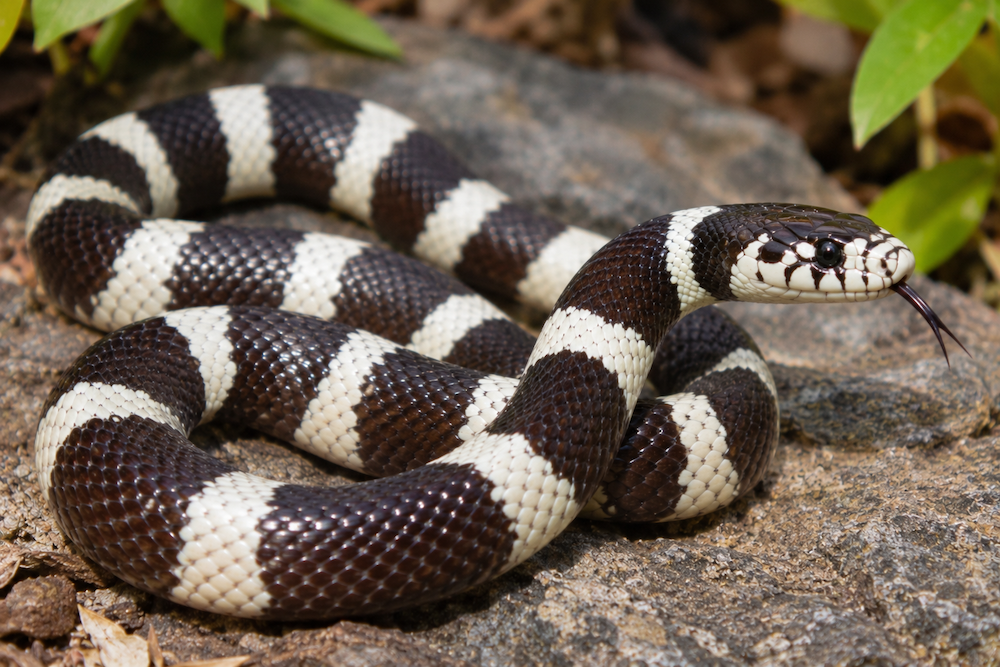
Natural Colours | Black or dark brown with white, cream or yellowish markings |
Popular Patterns | Banded, striped and various captive-bred morphs |
Distinctive Feature | Powerful constrictor capable of eating other snakes |
Diet | Carnivore |
Activity | Often diurnal or crepuscular, varying with temperature and season |
Temperament | Curious, active and generally manageable; sometimes defensive |
Noise Level | Silent apart from occasional defensive hissing |
Social Needs | Solitary |
Housing | Secure terrestrial enclosure with hides and enrichment |
Temperature | Warm area approximately 29–32°C; cooler retreat around 22–25°C |
Humidity | Generally moderate; approximately 40–60%, adjusted to conditions |
Substrate | Suitable reptile-safe substrate that permits burrowing |
Grooming | No grooming required |
Exercise Needs | Moderate; benefits from exploration and climbing opportunities |
Handling | Usually manageable with calm, appropriate handling |
Beginner Friendly? | Yes, where legally permitted and properly cared for |
Famous Feature | Hunting other snakes, including rattlesnakes |
📚 OVERVIEW
The Californian Kingsnake, more commonly called the California Kingsnake, is one of the best-known members of the genus Lampropeltis. Native to the western United States and northwestern Mexico, this beautifully patterned snake is famous for its adaptability, impressive hunting abilities and striking appearance.
Wild Californian Kingsnakes inhabit a wide range of environments, including grasslands, deserts, scrubland, woodland edges and agricultural areas. Their smooth, glossy scales commonly display contrasting bands of dark brown or black and white or cream, although naturally occurring striped forms and numerous captive-bred colour varieties also exist.
These snakes are active, curious predators that spend considerable time investigating their surroundings. Many captive-bred individuals become accustomed to gentle handling, although they are enthusiastic feeders and may occasionally mistake fingers for food. Their natural diet includes rodents, lizards, birds, eggs and other snakes.
Their care requires a secure escape-proof enclosure, an appropriate temperature gradient, suitable hiding places, correctly sized whole prey and individual housing. Their tendency to consume other snakes makes cohabitation particularly dangerous.
✅ PROS & CONS
👍 Pros
Beautiful contrasting bands and patterns
Non-venomous and generally manageable
Often suitable for prepared beginner reptile keepers
Fascinating hunting and exploratory behaviour
Relatively modest adult size
Usually accepts appropriately sized frozen-thawed rodents
Numerous attractive captive-bred colour varieties
Long-lived companion for dedicated enthusiasts
👎 Cons
Must be housed individually
Can bite during feeding or when frightened
Excellent escape artists
Requires carefully controlled heating
May musk or vibrate its tail when defensive
Needs whole-animal prey
Can live for more than 20 years
Ownership is restricted or prohibited in some countries or regions
Are Californian Kingsnakes Good Pets?
Yes. Californian Kingsnakes can make excellent reptile companions for people interested in snakes.
Their manageable size, striking appearance and generally hardy nature make them popular in countries where ownership is permitted.
However, they require suitable housing, careful feeding and a long-term commitment.
Are Californian Kingsnakes Good for Beginners?
Yes.
Captive-bred Californian Kingsnakes are often recommended for prepared beginners because they are generally robust and relatively straightforward to feed.
However, their enthusiastic feeding responses, escape abilities and environmental requirements must be understood before obtaining one.
How Long Do Californian Kingsnakes Live?
Californian Kingsnakes commonly live approximately 15–20 years in captivity.
Some individuals may live for 25 years or longer with excellent care.
Their lifespan depends on genetics, nutrition, housing conditions and veterinary attention.
How Big Do Californian Kingsnakes Get?
Most adult Californian Kingsnakes reach approximately 90–120 cm in length.
Some individuals grow beyond 150 cm.
Their relatively slender, muscular bodies make them agile and capable of moving through narrow spaces.
How Much Do Californian Kingsnakes Weigh?
Adult Californian Kingsnakes vary considerably in weight.
Many weigh approximately 400 grams to 1 kilogram, although larger individuals may exceed this range.
Healthy body condition is more important than achieving a particular weight.
What Colours Do Californian Kingsnakes Come In?
Wild Californian Kingsnakes commonly display dark brown or black markings contrasted with white, cream or pale yellow.
Captive breeding has produced numerous additional appearances.
These include albino, lavender, high-white, striped and other selectively bred colour and pattern varieties.
What Is the Difference Between a Californian Kingsnake and a Milk Snake?
Both belong to the genus Lampropeltis and share similar hunting behaviours.
Californian Kingsnakes are particularly associated with bold black-and-white bands or stripes.
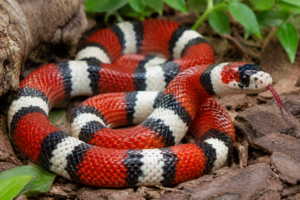
Many Milk Snakes display red, black and pale bands or reddish blotches, although patterns vary widely between species.
Are Californian Kingsnakes Venomous?
No.
Californian Kingsnakes are non-venomous snakes.
They subdue prey primarily through constriction.
Although they possess small, sharp teeth, they don’t inject venom.
Are Californian Kingsnakes Dangerous to Humans?
Californian Kingsnakes are generally not dangerous to healthy adults.
They are non-venomous and usually attempt to escape or defend themselves when threatened.
However, they can bite, and appropriate hygiene and handling precautions remain important.
Do Californian Kingsnakes Bite?
Yes.
Californian Kingsnakes may bite when frightened or when they mistake a hand for food.
Their strong feeding response can make accidental feeding bites more likely.
Using feeding tongs and washing hands after handling prey can help reduce this risk.
Are Californian Kingsnakes Aggressive?
Californian Kingsnakes aren’t inherently aggressive towards humans.
However, juveniles and nervous individuals may display defensive behaviour.
This can include striking, hissing, tail vibration or releasing foul-smelling musk.
Are Californian Kingsnakes Friendly?
Californian Kingsnakes don’t form affectionate relationships like dogs or cats.
However, many become accustomed to routine care and tolerate gentle handling.
Their curious nature makes them particularly interesting to observe.
Do Californian Kingsnakes Recognise Their Owners?
Californian Kingsnakes can learn to associate environmental cues with feeding and other routines.
Some appear calmer during familiar interactions.
However, scientific evidence that they recognise individual human caregivers is limited.
Do Californian Kingsnakes Like Being Held?
Many captive-bred Californian Kingsnakes tolerate gentle handling.
However, handling isn’t necessarily enjoyable for the snake.
Sessions should be brief, supportive and avoided when the animal is stressed, preparing to shed or digesting a recent meal.
Are Californian Kingsnakes Active?
Yes.
Californian Kingsnakes are generally active and curious.
They may explore their enclosures, investigate hiding places and climb suitable furnishings.
Their activity varies with temperature, season and individual behaviour.
Are Californian Kingsnakes Nocturnal?
Californian Kingsnakes can be active during the day, evening or night.
In cooler weather, they may be more active during daylight hours.
During hot conditions, they often shift towards crepuscular or nocturnal activity to avoid excessive heat.
Can Californian Kingsnakes Live Together?
No.
Californian Kingsnakes should generally be housed individually.
They naturally consume other snakes, including members of their own species.
Cohabitation creates a serious risk of injury or cannibalism.
Can Californian Kingsnakes Live With Other Snakes?
No.
Californian Kingsnakes should not share an enclosure with other snakes.
Their natural hunting behaviour includes consuming reptiles, including other snakes.
Separate housing is essential.
What Size Enclosure Does a Californian Kingsnake Need?
Adult Californian Kingsnakes require spacious, secure accommodation.
An enclosure measuring approximately 120 × 60 × 60 cm is a useful starting point for many adults, although larger accommodation is preferable.
The enclosure should allow the snake to stretch out fully and move between different temperature zones.
Are Californian Kingsnakes Escape Artists?
Yes.
Californian Kingsnakes are particularly skilled at investigating small openings.
They may push against loose lids or exploit gaps around ventilation panels.
Secure locks, properly fitted doors and escape-proof construction are essential.
What Temperature Do Californian Kingsnakes Need?
A suitable temperature gradient is important.
Many captive Californian Kingsnakes benefit from a warm area around 29–32°C and a cooler retreat approximately 22–25°C.
Exact conditions should be adjusted to the individual and enclosure, with heating equipment controlled by a reliable thermostat.
What Humidity Do Californian Kingsnakes Need?
Californian Kingsnakes generally tolerate moderate humidity.
A range around 40–60% is often suitable, although conditions vary according to ventilation, substrate and shedding needs.
A humid hide can help support healthy shedding without making the entire enclosure excessively damp.
Do Californian Kingsnakes Need UVB Lighting?
Californian Kingsnakes can benefit from appropriately provided low-level UVB lighting.
Although they can survive without strong ultraviolet exposure, suitable UVB may support natural physiological processes.
Shaded hiding places and a consistent day-night cycle should always be available.
What Substrate Is Best for Californian Kingsnakes?
Suitable options may include aspen bedding, reptile-safe soil mixtures or other appropriate substrates.
Californian Kingsnakes often enjoy burrowing.
Substrate should be clean, free from hazardous chemicals and suitable for maintaining appropriate moisture levels.
Do Californian Kingsnakes Need Hiding Places?
Yes.
At least two secure hiding places should be provided.
One should be located in the warm area and another in the cooler area.
Additional cork bark, branches and other furnishings provide opportunities for exploration.
Are Californian Kingsnakes Good Climbers?
Yes.
Although primarily terrestrial, Californian Kingsnakes can climb surprisingly well.
They may investigate branches, rocks and elevated enclosure structures.
Secure climbing opportunities provide valuable enrichment.
What Do Californian Kingsnakes Eat?
Californian Kingsnakes are carnivores.
Wild individuals consume rodents, lizards, birds, eggs and other snakes.
Captive individuals are commonly fed appropriately sized, commercially sourced frozen-thawed rodents.
Whole prey provides more complete nutrition than isolated meat.
How Often Should You Feed a Californian Kingsnake?
Feeding frequency depends on age, size and body condition.
Juveniles generally require smaller meals more frequently than adults.
Many healthy adults are fed approximately every 10–14 days, although individual needs vary.
Overfeeding should be avoided.
Do Californian Kingsnakes Eat Rattlesnakes?
Yes.
Californian Kingsnakes are famous for consuming other snakes, including rattlesnakes.
They possess natural resistance to certain components of rattlesnake venom.
However, this resistance isn’t absolute immunity, and interactions with venomous snakes remain potentially dangerous.
Are Californian Kingsnakes Immune to Snake Venom?
Californian Kingsnakes possess resistance to certain snake venoms, particularly some rattlesnake venoms.
This adaptation helps them hunt venomous snakes.
However, resistance varies and doesn’t mean they are immune to every venom or incapable of being harmed.
Why Are They Called Kingsnakes?
The name reflects their remarkable habit of eating other snakes.
Kingsnakes may consume species that are themselves formidable predators.
Their ability to overpower other snakes helped establish their reputation as powerful reptile hunters.
How Do Californian Kingsnakes Kill Their Prey?
Californian Kingsnakes use constriction.
They coil around prey and apply muscular pressure that interferes with circulation.
Constrictors generally subdue prey through circulatory disruption rather than simply suffocating it.
Can Californian Kingsnakes Change Colour?
Californian Kingsnakes don’t rapidly change colour like some lizards.
However, their appearance may become duller before shedding.
Some colour and pattern differences also become more noticeable as individuals mature.
How Often Do Californian Kingsnakes Shed Their Skin?
Californian Kingsnakes shed periodically throughout their lives.
Young, growing snakes generally shed more frequently than adults.
Appropriate hydration, humidity and environmental conditions help support complete shedding.
Do Californian Kingsnakes Hibernate?
Wild Californian Kingsnakes may undergo seasonal winter dormancy, often called brumation.
During this period, activity and feeding decrease.
Captive brumation isn’t necessary for every pet snake and should only be managed with appropriate knowledge and veterinary guidance.
How Do Californian Kingsnakes Breed?
Californian Kingsnakes reproduce by laying eggs.
After mating, females deposit eggs in protected locations.
Clutch size varies according to the female’s age, size and condition.
Captive breeding requires careful environmental management and responsible planning for offspring.
What Health Problems Are Common in Californian Kingsnakes?
Potential concerns include respiratory infections, mites, retained shed, mouth infections, obesity and digestive problems.
Incorrect temperatures, unsuitable humidity and poor hygiene can contribute to illness.
A reptile-experienced veterinarian should assess persistent refusal to eat, abnormal breathing, swelling or unusual behaviour.
Are Californian Kingsnakes Hypoallergenic?
Californian Kingsnakes don’t produce fur or mammalian dander.
However, no pet is completely allergen-free.
People may still react to enclosure materials, feeder animals or other environmental substances.
Are Californian Kingsnakes Legal to Keep as Pets?
Californian Kingsnakes are legal pets in some countries, including parts of the United States, but some countries or regions restrict or prohibit their ownership, breeding, sale or importation.
In Australia, Californian Kingsnakes are exotic reptiles and are generally prohibited as private pets under strict biosecurity and wildlife regulations.
Prospective owners should verify current national, state and local laws before attempting to obtain one.
What Makes the Californian Kingsnake Unique?
Imagine a beautifully patterned snake capable of hunting and consuming a venomous rattlesnake.
A reptile that can overpower animals which many other predators avoid.
That’s the extraordinary Californian Kingsnake.
Among North America’s many snake species, few have developed such an impressive reputation as specialised predators.
Californian Kingsnakes belong to the genus Lampropeltis, a group of non-venomous constrictors famous for their ability to consume other snakes.
Their scientific name is particularly appropriate.
Lampropeltis comes from Greek roots meaning shining shield, referring to the smooth, glossy appearance of their scales.
The species name californiae reflects their association with California and surrounding regions.
One of their most remarkable abilities is their resistance to certain snake venoms.
Californian Kingsnakes can prey upon rattlesnakes despite the serious danger these venomous reptiles pose to many other animals.
Research has demonstrated that Kingsnakes possess physiological resistance to some components of pit viper venom.
This resistance provides an important evolutionary advantage.
However, it isn’t universal immunity.
Kingsnakes can still be harmed under certain circumstances, and their resistance varies depending on the venom involved.
Their hunting technique is equally impressive.
Californian Kingsnakes are powerful constrictors.
They wrap their muscular bodies around prey and apply pressure that disrupts circulation.
Research comparing Kingsnakes with other constricting snakes has found that some Kingsnakes can generate particularly high constriction pressures relative to their body size.
This ability is especially useful when subduing other snakes.
Their natural diet is remarkably varied.
Although famous for eating other snakes, Californian Kingsnakes also consume rodents, lizards, birds and eggs.
Their adaptability helps them survive in a wide range of environments.
They inhabit deserts, scrublands, grasslands, woodland edges and agricultural landscapes.
Their striking colour patterns are another fascinating feature.
Many wild Californian Kingsnakes display bold black-and-white or dark brown-and-cream bands.
Others possess longitudinal stripes rather than crossbands.
These contrasting markings can help break up the snake’s outline against natural backgrounds.
Captive breeding has produced numerous additional colour and pattern varieties, making Californian Kingsnakes particularly popular among reptile enthusiasts.
Another interesting adaptation is their defensive behaviour.
When threatened, Californian Kingsnakes may vibrate their tails rapidly.
If the tail contacts dry leaves or other loose material, the resulting sound can resemble a rattlesnake’s warning.
Unlike rattlesnakes, however, Kingsnakes don’t possess a specialised tail rattle.
They may also release foul-smelling musk or attempt to bite when frightened.
Their ability to escape through narrow openings is equally remarkable.
Californian Kingsnakes possess flexible bodies that allow them to investigate crevices and sheltered spaces.
In the wild, this helps them locate prey and avoid predators.
In captivity, it means that even a small gap in an enclosure can become an escape route.
Their reproductive biology is another fascinating aspect of their natural history.
Female Californian Kingsnakes lay eggs, usually depositing them in protected locations where suitable temperatures and moisture support development.
Young snakes emerge fully capable of hunting small prey.
They don’t require parental feeding or care after hatching.
Perhaps most surprising is the contrast between their formidable reputation and their relatively manageable size.
A Californian Kingsnake may be capable of overpowering a rattlesnake, yet many adults measure only around one metre in length.
Its success comes not from enormous size or venom, but from muscular strength, specialised hunting behaviour and remarkable physiological adaptations.
For reptile enthusiasts, these qualities make the Californian Kingsnake one of the most fascinating snakes to observe.
Its beautiful patterns attract attention, but its extraordinary natural abilities reveal an even more remarkable animal.
The Californian Kingsnake isn’t simply a beautifully patterned reptile — it’s one of nature’s most impressive snake hunters, equipped with powerful constriction, remarkable venom resistance and extraordinary adaptations that have earned it the title of Kingsnake.