





Intelligent, energetic, and unmistakably unique — a talented water dog with a playful personality and a distinctive curly coat.
🧠 QUICK SNAPSHOT
- Temperament: Intelligent, playful, loyal
- Energy Level: High
- Size: Large
- Good With Families: Yes
- Trainability: High
- Grooming: High
- Best For: Active families, outdoor enthusiasts, experienced owners
📚 OVERVIEW
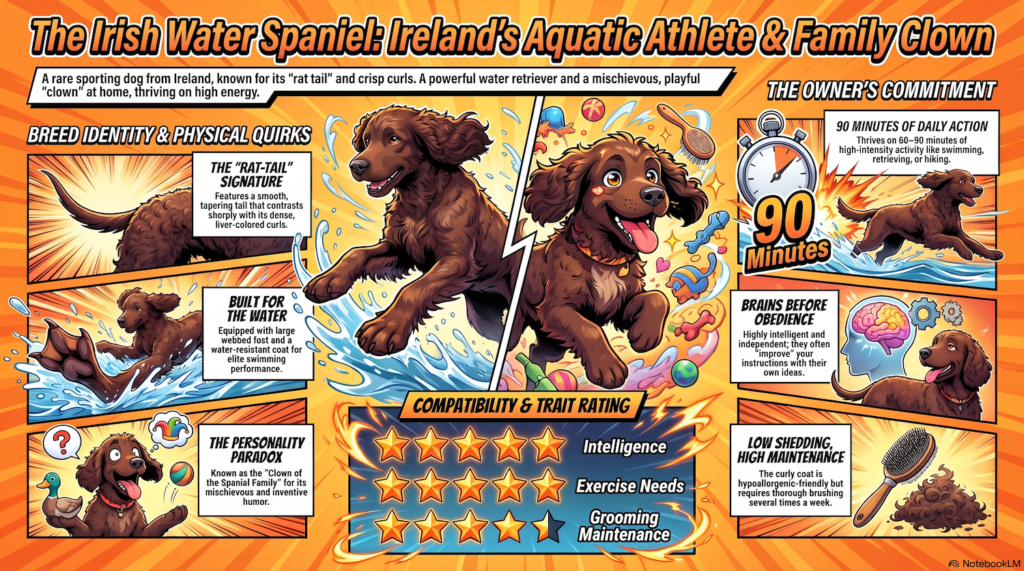
The Irish Water Spaniel is one of the oldest and most distinctive spaniel breeds, originally developed in Ireland as a skilled water retriever. Easily recognised by its dense, curly liver-coloured coat, smooth face, and unusual tapered “rat tail,” this athletic breed was built to work in and around water.
Intelligent, energetic, and often described as having a playful sense of humour, the Irish Water Spaniel forms strong bonds with its family. It thrives in active homes where it can enjoy regular exercise, training, swimming, and plenty of mental stimulation.
✅ PROS & CONS
Pros
- Highly intelligent and trainable
- Loyal and affectionate with family
- Excellent swimmer and retrieving dog
- Low-shedding coat
Cons
- Requires regular grooming and coat maintenance
- Needs significant daily exercise
- Can be reserved with strangers
- May become bored or mischievous without enough stimulation
Is an Irish Water Spaniel a Good Family Dog?
Yes, particularly for an active family. Irish Water Spaniels are generally affectionate, intelligent, playful and strongly attached to their people.
They can be more reserved with strangers than many sporting breeds and need early socialisation.
Their high exercise requirements, large size and demanding curly coat mean they’re best suited to owners prepared for an active working dog.
How Much Exercise Does an Irish Water Spaniel Need?
Most adults need around 60–90 minutes of substantial daily exercise, with energetic working dogs potentially requiring more.
Swimming, retrieving, hiking, running and scent-based activities are particularly suitable.
Mental stimulation matters just as much because this is an intelligent breed developed to work closely with hunters.
Is an Irish Water Spaniel Easy to Train?
Generally, yes, although they can have an independent streak.
Irish Water Spaniels are intelligent, quick learners and capable working dogs, but repetitive training may bore them.
Positive reinforcement, variety and giving the dog a genuine task usually produce excellent results.
Are Irish Water Spaniels Intelligent?
Yes. They’re highly intelligent sporting dogs.
Historically they needed to locate, flush and retrieve game from difficult wet environments.
They also have a reputation for problem-solving, mischievous behaviour and a surprisingly humorous personality.
Are Irish Water Spaniels Stubborn?
They can be independent.
This doesn’t necessarily mean they don’t understand what they’re being asked to do.
An Irish Water Spaniel may simply have developed a different opinion about how the task should be completed.
Does an Irish Water Spaniel Shed?
Very little compared with many sporting breeds.
Their dense, tightly curled coat tends to trap loose hair, meaning relatively little ends up around the home.
Low visible shedding comes with significant grooming requirements.
Is an Irish Water Spaniel Hypoallergenic?
It’s frequently described as hypoallergenic because of its low-shedding coat, but no dog is completely allergen-free.
Allergens are also present in saliva and skin secretions.
Some allergy sufferers tolerate Irish Water Spaniels well, while others don’t.
What Type of Coat Does an Irish Water Spaniel Have?
The breed has a dense, naturally curly, water-resistant coat.
The body is covered in tight curls, while the face has much shorter, smoother hair.
Its coat evolved as a practical feature for a dog expected to work repeatedly in cold water.
How Often Should You Groom an Irish Water Spaniel?
The coat should usually be brushed or combed thoroughly several times each week and professionally trimmed periodically.
Without maintenance, curls can form mats.
Regular ear, nail and dental care are also important.
Does an Irish Water Spaniel Need Haircuts?
Yes.
Most companion Irish Water Spaniels require periodic trimming and shaping to keep their coat manageable.
The traditional breed trim preserves the natural curly outline rather than creating an exaggerated sculpted appearance.
Can You Shave an Irish Water Spaniel?
The coat can be clipped when necessary, particularly if severe matting develops.
However, routine very close shaving isn’t usually required.
Regular grooming and appropriate trimming maintain the coat more effectively.
What Health Problems Are Common in Irish Water Spaniels?
Potential concerns include hip and elbow dysplasia, eye disorders, thyroid disease and certain immune or skin conditions.
Because the breed has a relatively small population, responsible health testing and careful genetic management are particularly important.
Are Irish Water Spaniels Prone to Hip Dysplasia?
They can be.
Hip dysplasia occurs within the breed and breeding dogs should undergo formal hip assessment.
Maintaining an appropriate body condition also reduces unnecessary stress on the joints.
Are Irish Water Spaniels Prone to Eye Problems?
Some inherited eye disorders occur within the breed.
Responsible breeders should use appropriate ophthalmic screening and available genetic testing.
Any unexplained vision change, eye pain or cloudiness requires veterinary attention.
Do Irish Water Spaniels Get Ear Infections?
They can.
Their hanging ears can trap warmth and moisture, particularly because many Irish Water Spaniels swim frequently.
Regular checks and appropriate drying after swimming can help reduce problems.
Persistent odour, redness or discharge needs veterinary attention.
How Long Does an Irish Water Spaniel Live?
Irish Water Spaniels commonly live around 10–13 years, although some live longer.
Longevity depends on genetics, body condition, exercise, veterinary care and inherited health.
How Big Does an Irish Water Spaniel Get?
They’re medium-to-large sporting dogs.
Males commonly stand around 56–61 cm, while females are approximately 53–58 cm.
Adults generally weigh around 20–30 kg, depending on sex and individual build.
Is the Irish Water Spaniel the Tallest Spaniel?
Yes. The Irish Water Spaniel is generally regarded as the tallest of the spaniel breeds.
Its long legs and substantial body reflect its role as a powerful water-working dog rather than a compact flushing spaniel.
Can an Irish Water Spaniel Live in an Apartment?
It’s possible but not ideal for most.
Their size and high activity requirements mean they generally suit homes where substantial daily outdoor exercise is easy to provide.
A garden is useful but doesn’t replace proper walks, training and activity.
Can an Irish Water Spaniel Be Left Alone?
A well-adjusted adult can learn to tolerate reasonable periods alone.
However, this is an intelligent working breed that needs substantial companionship, exercise and mental stimulation.
Bored Irish Water Spaniels can become inventive.
Are Irish Water Spaniels Velcro Dogs?
Many form extremely close relationships with their families.
They can be affectionate and people-focused without necessarily being constantly dependent.
Their working heritage encouraged cooperation with handlers while retaining enough independence to solve problems.
Are Irish Water Spaniels Cuddly?
Many are affectionate with their families.
Some are highly cuddly, while others show affection by simply remaining close to their people.
They can be more reserved than Labradors with unfamiliar people.
Are Irish Water Spaniels Good With Children?
They can be excellent family companions for respectful children.
Their playful nature is a major advantage.
However, they’re relatively large, energetic dogs and can accidentally knock over small children during enthusiastic play.
Are Irish Water Spaniels Good With Other Dogs?
Many are, particularly when well socialised.
Some individuals can be more reserved or selective than extremely sociable sporting breeds.
Early positive experiences with other dogs are valuable.
Are Irish Water Spaniels Good With Cats?
They can live successfully with cats, particularly when raised together.
However, they’re sporting dogs with hunting instincts, so unfamiliar small animals can trigger interest.
Careful introductions remain important.
Do Irish Water Spaniels Have a Strong Prey Drive?
They can have significant hunting drive.
They were developed to find and retrieve birds, particularly waterfowl.
Their instincts are generally directed toward sporting work rather than the intense vermin-killing behaviour seen in many terriers.
Are Irish Water Spaniels Good Off Leash?
They can be with strong training.
Their intelligence and handler focus are advantages, but wildlife and water can become powerful distractions.
Recall should be developed carefully before off-leash freedom is allowed.
Do Irish Water Spaniels Bark a Lot?
Usually not excessively.
They may bark to alert their owners or when excited.
Individual temperament varies, but constant barking isn’t generally considered a defining characteristic.
Are Irish Water Spaniels Good Watchdogs?
They can be.
Many are naturally alert and somewhat reserved with strangers, making them more effective watchdogs than some highly outgoing sporting breeds.
They should remain stable and confident rather than suspicious or aggressive.
Are Irish Water Spaniels Good Guard Dogs?
They’re not specialist guarding dogs.
Their size, bark and reserve may provide some deterrence, but their historical purpose was hunting and retrieving rather than protection work.
Are Irish Water Spaniels Friendly With Strangers?
They can be more reserved than breeds such as the Labrador Retriever.
A well-socialised Irish Water Spaniel should be confident and appropriately behaved, but may not immediately regard every stranger as a new best friend.
This reserve is normal within the breed.
Are Irish Water Spaniels High-Energy Dogs?
Yes.
They’re athletic working dogs with considerable stamina.
Swimming and retrieving can consume energy particularly effectively because these activities closely resemble the work for which they were developed.
When Does an Irish Water Spaniel Calm Down?
Many begin becoming more settled between two and three years of age.
Their playful, mischievous personality can remain throughout life.
Regular exercise and teaching calm behaviour help considerably.
Are Irish Water Spaniels Good Running Dogs?
Healthy adults can make good running companions.
They’re athletic and have considerable endurance.
Structured distance running should wait until skeletal maturity.
Are Irish Water Spaniels Good Hiking Dogs?
Yes.
They’re strong, athletic and capable of travelling over varied terrain.
Their coat can collect burrs and vegetation, so post-hike grooming is useful.
Do Irish Water Spaniels Like Water?
Usually — very much.
Water work is central to the breed’s history.
Many Irish Water Spaniels enthusiastically seek opportunities to swim and retrieve.
Are Irish Water Spaniels Good Swimmers?
Excellent.
Their powerful build, water-resistant coat and sporting instincts make them natural swimmers.
They were specifically developed to retrieve birds from lakes, rivers, marshes and other wet environments.
Do Irish Water Spaniels Have Webbed Feet?
Their feet are broad and adapted for effective movement in water, and the toes may appear strongly webbed.
Webbing between canine toes isn’t unique to the breed, but its functional feet contribute to excellent swimming ability.
Are Irish Water Spaniels Good Retrievers?
Yes. Retrieving is one of their fundamental jobs.
They were developed to recover shot waterfowl from water and return it to the hunter.
Many retain strong natural retrieving instincts.
Do Irish Water Spaniels Have a Soft Mouth?
Working retrievers are expected to carry game without unnecessarily damaging it.
Irish Water Spaniels were selected for this type of controlled retrieving behaviour.
Training and individual temperament still influence how gently a particular dog carries objects.
Can Irish Water Spaniels Work on Land?
Yes.
Despite the name, they’re versatile sporting dogs capable of working on both land and water.
Historically, they could locate, flush and retrieve game in varied environments.
Water retrieving simply became their most famous speciality.
What Birds Did Irish Water Spaniels Retrieve?
They were particularly associated with waterfowl such as ducks, although they could work with other game birds.
Their coat and swimming ability made them especially useful in cold, wet environments where less specialised dogs might struggle.
Are Irish Water Spaniels Used for Hunting Today?
Yes, although they’re much less common than Labradors or other mainstream gundogs.
Enthusiasts continue to use them for hunting, retrieving tests and sporting events.
Modern working dogs preserve abilities that shaped the breed centuries ago.
Are Irish Water Spaniels Good at Dog Sports?
Yes.
They can excel in obedience, agility, tracking, scent work, retrieving events and dock-related activities.
Their intelligence and athleticism make them versatile.
They generally perform best when training remains engaging.
What Does an Irish Water Spaniel Look Like?
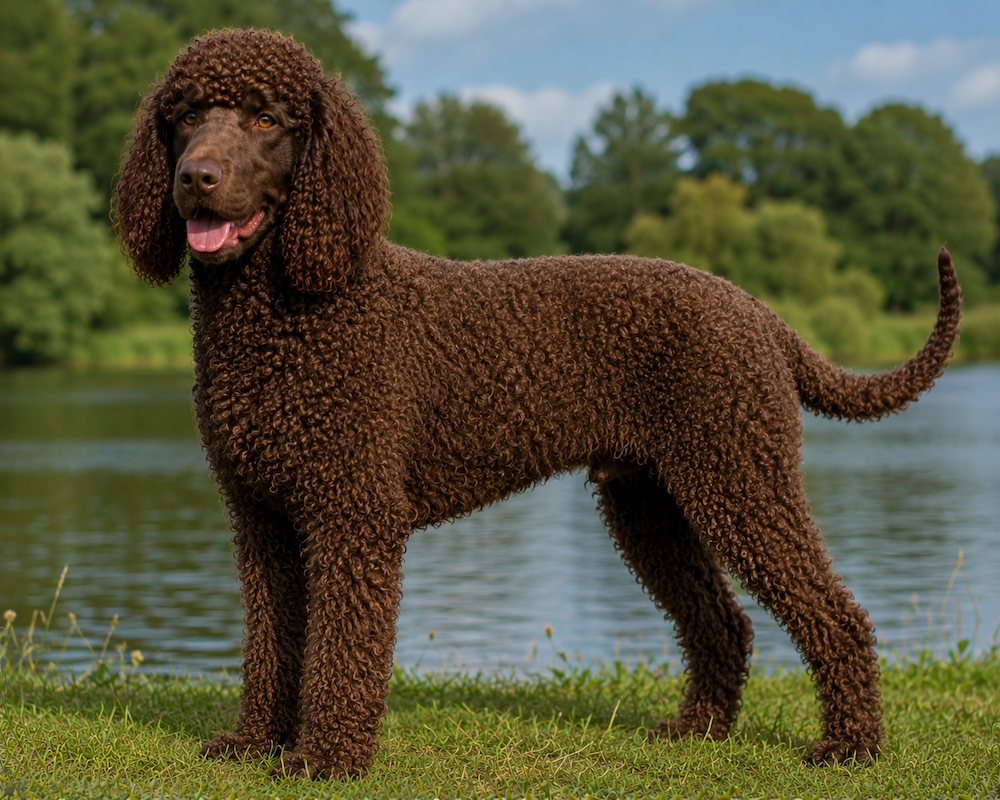
The Irish Water Spaniel is a distinctive medium-to-large dog with a dense liver-coloured curly coat, long ears, pronounced topknot and almost hairless-looking tail.
Its unusual tail makes the breed instantly recognisable.
Why Does an Irish Water Spaniel Have a Topknot?
Long curls naturally form a distinctive topknot over the skull.
This feature is part of the traditional breed appearance.
Combined with the smooth face and long curly ears, it gives the Irish Water Spaniel one of the most unusual heads among sporting dogs.
Why Does an Irish Water Spaniel Have a “Rat Tail”?
The breed’s tail is thick at the base and covered with short hair for most of its length, creating the famous “rat tail” appearance.
Unlike the heavily feathered tail of many spaniels, it remains relatively smooth.
It’s one of the breed’s defining characteristics.
Is the Irish Water Spaniel Called the Rat-Tail Spaniel?
Yes. Rat-Tail Spaniel is one of several historical nicknames associated with the breed.
The name refers to its unmistakable smooth, tapering tail.
It shouldn’t be interpreted as meaning the breed was primarily developed for ratting.
Does the Irish Water Spaniel Have a Completely Hairless Tail?
No.
The tail isn’t truly hairless.
It has short, smooth hair over much of its length, particularly compared with the dense curls covering the dog’s body.
The contrast creates the appearance of a bare rat-like tail.
Does the Irish Water Spaniel Use Its Tail as a Rudder?
The tail can assist balance and directional control during swimming, as canine tails generally can.
However, claims that its unusual smooth tail was specifically engineered as a specialised aquatic rudder are difficult to prove historically.
Its distinctive appearance remains one of the breed’s mysteries.
What Colour Is an Irish Water Spaniel?
The breed is characteristically solid liver, a rich dark brown.
The coat may show a subtle purplish tone sometimes poetically described as “puce liver.”
Large white markings aren’t characteristic of the modern breed.
Can Irish Water Spaniels Be Black?
Black isn’t a recognised normal colour of the modern Irish Water Spaniel.
Its characteristic coat is liver brown.
A black dog resembling an Irish Water Spaniel would require another explanation.
Can Irish Water Spaniels Be White?
No, not as a normal recognised colour.
A small amount of white can occasionally occur, but the breed’s classic appearance is a solid liver coat.
Extensive white would be highly atypical.
Why Is the Irish Water Spaniel Brown?
The solid liver colouring became fixed through selective breeding.
Brown pigmentation affects both coat and associated pigmentation.
Together with the curls and rat tail, the liver coat forms an important part of the breed’s identity.
Does an Irish Water Spaniel Look Like a Poodle?
Yes, particularly because of the dense curly coat and long-legged athletic build.
The resemblance has led to extensive speculation about historical connections between water spaniels and Poodle-type water dogs.
However, the Irish Water Spaniel has distinctive features including its smooth face, topknot and rat tail.
Is the Irish Water Spaniel Related to the Poodle?
They likely share broader ancestry among European water-working dogs, but their precise relationship isn’t fully documented.
Curly-coated water dogs existed across Europe long before modern closed breed registries.
It’s too simplistic to say one modern breed directly descended from the other.
Is the Irish Water Spaniel Related to the Portuguese Water Dog?
They belong to the broader historical family of European water-working dogs and share some functional characteristics.
However, they’re distinct breeds with different regional development.
Exact ancestral connections are difficult to reconstruct.
Is the Irish Water Spaniel Related to the Barbet?
Historical European water dogs such as the Barbet and other water-spaniel types are often discussed when examining the deeper ancestry of curly-coated retrieving breeds.
Precise relationships remain uncertain because these dogs existed before reliable pedigree records.
Is the Irish Water Spaniel Related to the Curly-Coated Retriever?
There are likely historical connections among Britain’s and Ireland’s curly-coated water dogs and retrievers.
Both breeds were developed for retrieving game from water.
The exact genetic contribution of Irish Water Spaniels to early Curly-Coated Retriever development is debated rather than perfectly documented.
Is the Irish Water Spaniel Actually a Spaniel?
Yes, although its working style overlaps significantly with retrievers.
Historically, the boundaries between water spaniels, flushing spaniels and retrievers weren’t as rigid as modern kennel classifications.
The Irish Water Spaniel developed from this older water-spaniel tradition.
Is the Irish Water Spaniel the Largest Spaniel?
It’s generally regarded as both the tallest and one of the largest spaniel breeds.
Its substantial size reflects the demanding physical work of retrieving birds from difficult water.
Is the Irish Water Spaniel an Ancient Breed?
Water-spaniel-type dogs have existed for centuries, but the modern Irish Water Spaniel was standardised during the 19th century.
Claims that today’s breed has existed unchanged since ancient times should therefore be treated cautiously.
Were There Different Irish Water Spaniels Before the Modern Breed?
Yes.
Historical accounts describe different regional water-spaniel types in Ireland, particularly Northern and Southern Irish Water Spaniels.
These weren’t necessarily breeds in the modern pedigree sense.
The modern Irish Water Spaniel became associated primarily with the southern type.
What Was the Southern Irish Water Spaniel?
The Southern Irish Water Spaniel was a historical water-dog type characterised by features that strongly resemble the modern breed, including curly coat and distinctive smooth tail.
It became particularly important in the development of today’s Irish Water Spaniel.
What Was the Northern Irish Water Spaniel?
Historical descriptions suggest the Northern Irish Water Spaniel differed in appearance, including having a more conventionally feathered tail.
The type eventually disappeared as a distinct population.
The modern breed is much more closely associated with southern Irish dogs.
Where Does the Irish Water Spaniel Come From?
The modern breed developed in Ireland, drawing on older Irish water-spaniel populations.
Water dogs had worked in Ireland for centuries, but the breed we recognise today emerged primarily during the 19th century.
One man and one extraordinary dog became particularly important in that process.
Who Created the Modern Irish Water Spaniel?
The breeder most strongly associated with establishing the modern Irish Water Spaniel is Justin McCarthy of Dublin.
During the 19th century, McCarthy bred dogs displaying the distinctive characteristics that became associated with the modern breed.
However, he left limited documentation explaining exactly which dogs he used.
Who Was Justin McCarthy?
Justin McCarthy was a Dublin sportsman and breeder who played a central role in shaping the modern Irish Water Spaniel during the mid-19th century.
His breeding programme produced dogs with a consistent appearance and working ability.
Much of the exact ancestry remained his closely guarded secret.
Who Was Boatswain?
Boatswain, born around 1834, was Justin McCarthy’s extraordinarily influential Irish Water Spaniel.
He is frequently described as one of the most important foundation dogs in the history of the breed.
His appearance strongly resembled the modern Irish Water Spaniel.
Why Was Boatswain So Important?
Boatswain became enormously influential through breeding and helped establish the recognisable modern type.
His curly liver coat, topknot and distinctive tail became strongly associated with the breed.
Many later Irish Water Spaniels traced their development back to McCarthy’s dogs.
Is Boatswain the Ancestor of Modern Irish Water Spaniels?
He’s traditionally regarded as a foundational ancestor of the modern breed.
However, the limited pedigree documentation of the era means it would be difficult to establish every ancestral relationship using modern genetic standards.
His influence on breed type is nevertheless historically significant.
Did Justin McCarthy Keep His Breeding Programme Secret?
To a significant extent, yes.
McCarthy apparently didn’t leave a definitive explanation of exactly which dogs produced his line.
That has encouraged more than a century of speculation involving older Irish water spaniels, Poodles and other European water dogs.
The exact recipe remains uncertain.
Was the Poodle Used to Create the Irish Water Spaniel?
It’s possible that related curly-coated water-dog ancestry contributed, but there is no definitive documented recipe proving a straightforward Poodle cross created the breed.
Poodles and Irish Water Spaniels likely share broader historical connections through Europe’s water-working dog populations.
Was the Portuguese Water Dog Used to Create the Irish Water Spaniel?
Claims about Portuguese Water Dog influence occasionally appear, but definitive evidence is limited.
Water-working dogs moved around Europe through trade, fishing and hunting communities.
Their deeper relationships are considerably more complicated than modern breed names suggest.
When Did Irish Water Spaniels Become Popular?
The breed became highly regarded during the Victorian era, particularly among sportsmen seeking capable water retrievers.
Irish Water Spaniels were exported to Britain and North America and became established relatively early in organised dog showing.
Were Irish Water Spaniels Popular Before Labradors?
Yes. Irish Water Spaniels were established as respected sporting dogs before the Labrador Retriever became internationally dominant.
During the 19th century, they were considered highly capable waterfowl retrievers.
Changing hunting preferences and the rise of specialised retriever breeds later reduced their popularity.
Why Did Labradors Become More Popular Than Irish Water Spaniels?
Labradors offered a relatively easy-care coat, highly cooperative temperament and exceptional retrieving ability.
The Irish Water Spaniel’s more complex coat, independent streak and specialised appearance appealed to a narrower group of owners.
Over time, Labradors became far more numerous.
Did Irish Water Spaniels Help Create Other Retriever Breeds?
Irish Water Spaniels are frequently discussed in histories of early retriever development, particularly among curly-coated retrieving dogs.
Water spaniels contributed broadly to the creation of modern retrievers.
However, exact breed-by-breed ancestry should be treated cautiously because early breeding records are incomplete.
When Did Irish Water Spaniels Arrive in America?
They were exported to the United States during the 19th century, where hunters valued their water-retrieving ability.
The breed was established in America well before many modern companion breeds existed.
Was the Irish Water Spaniel One of the First AKC Breeds?
Yes.
The Irish Water Spaniel was among the breeds recognised during the early history of the American Kennel Club.
Its early recognition reflects how prominent the breed once was in the sporting-dog world.
Why Is the Irish Water Spaniel Called the “Clown of the Spaniel Family”?
The breed has long had a reputation for being playful, mischievous and entertaining.
Its unusual appearance certainly helps, but the nickname primarily reflects personality.
Many owners describe dogs that actively seem to enjoy making people laugh.
Are Irish Water Spaniels Funny Dogs?
Frequently.
They can be inventive, expressive and occasionally ridiculous despite being serious working dogs.
This combination of intelligence and mischief earned them their reputation as the “clown of the spaniel family.”
Why Is the Irish Water Spaniel So Rare?
Several factors contributed.
Labradors and other retrievers eventually dominated the sporting market, while the Irish Water Spaniel’s specialised grooming, high exercise needs and independent temperament limited mass appeal.
Its relatively small breeding population has kept it uncommon.
Is the Irish Water Spaniel One of the Rarest Spaniels?
Yes. It’s among the less commonly encountered established spaniel breeds internationally.
Finding a responsible breeder can therefore require patience.
Its rarity also makes maintaining genetic diversity particularly important.
Is an Irish Water Spaniel a Good First Dog?
It can be, but it’s not the easiest first breed.
They’re intelligent and affectionate, but owners need to manage high exercise requirements, coat care, strong working instincts and occasional independence.
An active owner interested in training can find them exceptionally rewarding.
What Makes the Irish Water Spaniel Unique?
Few breeds combine so many unusual characteristics in one package: tight liver curls, a dramatic topknot, smooth face, rat tail, exceptional swimming ability and a mischievous personality.
It’s also a surviving representative of an old water-spaniel tradition that once played a much larger role in bird hunting.
Where Did the Irish Water Spaniel Get Its Rat Tail?
The precise origin isn’t known.
The smooth tapering tail was already strongly associated with the Southern Irish Water Spaniel type and became firmly established in Justin McCarthy’s breeding programme.
Why breeders originally preserved this unusual feature remains uncertain.
Why Is the Irish Water Spaniel Historically Important?
Before Labradors became dominant, water spaniels were among the key dogs used to recover birds from difficult aquatic environments.
The Irish Water Spaniel represents one of the few surviving breeds from this older sporting tradition.
Its history provides a link between early water spaniels and the modern retriever world.
Where Does the Irish Water Spaniel Come From?
The Irish Water Spaniel developed in Ireland from older water-spaniel populations, including a distinctive southern type known for its curly coat and smooth “rat tail.” Water dogs had worked in Ireland for centuries, but the modern breed took recognisable form during the 19th century.
The key figure was Dublin breeder Justin McCarthy, whose breeding programme helped establish a consistent type. His famous dog Boatswain, born around 1834, became enormously influential and is remembered as one of the breed’s great foundation dogs. McCarthy never left a definitive explanation of exactly which dogs went into his breeding programme, leaving the Irish Water Spaniel’s deeper ancestry surrounded by intriguing uncertainty.
During the Victorian era, the breed became a respected waterfowl retriever and was exported internationally. It later lost much of that market to Labradors and other retrievers, leaving it relatively rare today.
Yet the dog itself remains extraordinary: Ireland’s tall, curly water retriever with a topknot, a nearly naked-looking rat tail and such a mischievous personality that it became known as the “clown of the spaniel family.”