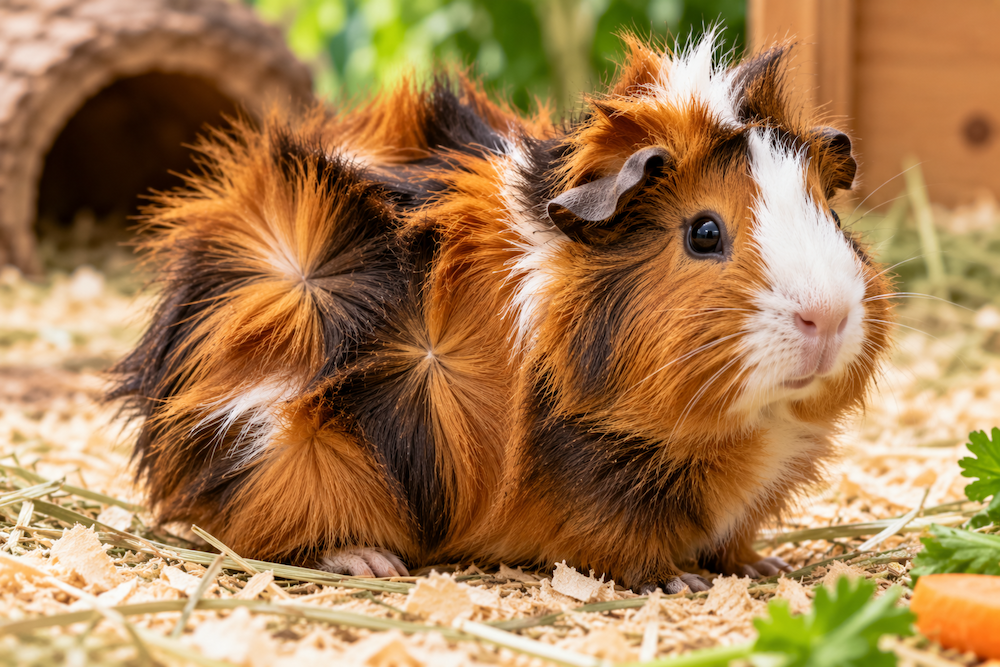






Bold, curious and instantly recognisable by its wild, rosette-covered coat, the Abyssinian Guinea Pig has one of the most distinctive looks in the guinea pig world.
🧠 QUICK SNAPSHOT
| Trait | Abyssinian Guinea Pig |
|---|---|
| Scientific Name | Cavia porcellus |
| Pet Type | Small mammal / Rodent |
| Breed Type | Rosette-coated guinea pig |
| Ancestral Origin | South America |
| Typical Lifespan | Around 5–7 years |
| Adult Size | Around 20–30 cm |
| Typical Weight | Roughly 700–1,200 g |
| Diet | Herbivore |
| Coat | Short, coarse and arranged in rosettes |
| Temperament | Social, curious and lively |
| Social Needs | High |
| Grooming | Moderate |
| Beginner Friendly? | Generally yes |
| Famous Feature | Distinctive whorls or “rosettes” across the coat |
📚 OVERVIEW
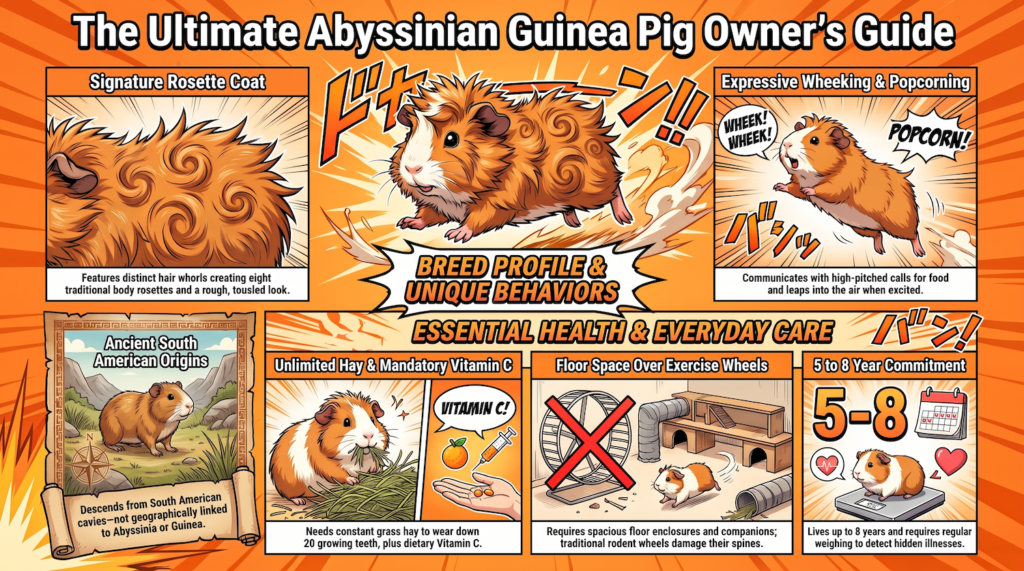
The Abyssinian Guinea Pig is one of the oldest and most recognisable domestic guinea pig breeds, distinguished by the dramatic swirls of hair known as rosettes covering its body.
Despite the exotic-sounding name, Abyssinians don’t originate from Abyssinia. Like other domestic guinea pigs, their ancestry traces back to South America.
They’re often described as particularly curious and energetic, although personality varies between individuals. Like all guinea pigs, they’re highly social and generally benefit from living with compatible guinea pig companions.
Their care centres around unlimited grass hay, dietary vitamin C, generous floor space, companionship and regular health checks.
✅ PROS & CONS
Pros
- Unique rosette-covered coat
- Generally social and friendly
- Curious and entertaining
- Easier coat care than long-haired breeds
- Can form strong bonds with familiar people
- Wonderful range of vocalisations
- Active and engaging to watch
- Often suitable for first-time guinea pig owners
Cons
- Should normally have guinea pig companionship
- Needs substantial floor space
- Requires dietary vitamin C
- Coat needs more checking than a smooth-haired guinea pig
- Needs unlimited hay
- Can be nervous about being picked up
- Produces plenty of hay and bedding mess
- Requires regular nail and health care
Are Abyssinian Guinea Pigs Good Pets?
Yes. Abyssinians can make excellent companion animals.
They’re generally social, curious and entertaining, while their unusual coat gives them a very distinctive appearance.
Are Abyssinian Guinea Pigs Good for Beginners?
Yes. They’re generally suitable for well-prepared first-time guinea pig owners.
Their coat requires slightly more attention than a smooth-coated American Guinea Pig, but it’s considerably easier to manage than long-haired varieties.
Are Abyssinian Guinea Pigs Good With Children?
They can be good family pets when handled gently and supervised appropriately.
Guinea pigs are prey animals and can become frightened by sudden grabbing or rough handling.
Adults should remain responsible for their daily care.
How Long Do Abyssinian Guinea Pigs Live?
Abyssinian Guinea Pigs commonly live around 5–7 years, although some can live longer.
Nutrition, genetics, environment and veterinary care all influence lifespan.
How Big Do Abyssinian Guinea Pigs Get?
Adults are commonly around 20–30 cm long and may weigh approximately 700–1,200 grams.
Individual size varies, and males are often somewhat larger than females.
Why Do Abyssinian Guinea Pigs Have Rosettes?
Their distinctive appearance comes from inherited patterns of hair growth that create circular whorls called rosettes.
These rosettes cause sections of the coat to grow in different directions, producing the Abyssinian’s famously tousled appearance.
How Many Rosettes Should an Abyssinian Guinea Pig Have?
Show standards traditionally favour a well-arranged pattern of eight or more clearly defined rosettes, depending on the organisation and standard being used.
Pet Abyssinians don’t need a perfect show coat to be wonderful companions.
Do Abyssinian Guinea Pigs Need Grooming?
Yes, although their short coat is relatively manageable.
Regular gentle brushing and coat checks help remove loose hair and identify skin problems, tangles or debris caught between the rosettes.
What Do Abyssinian Guinea Pigs Eat?
Their diet should be based around unlimited grass hay, suitable fresh vegetables and an appropriate amount of nutritionally balanced guinea pig pellets.
Fresh drinking water should always be available.
Why Do Abyssinian Guinea Pigs Need Vitamin C?
Guinea pigs cannot produce their own vitamin C and therefore need a reliable dietary source.
Deficiency can lead to serious health problems, making vitamin C-rich foods and correctly formulated guinea pig diets particularly important.
Why Is Hay So Important for Guinea Pigs?
Hay provides the fibre necessary for healthy digestion and encourages prolonged chewing.
Because guinea pig teeth grow continuously, this chewing also helps provide essential natural dental wear.
Should Abyssinian Guinea Pigs Be Kept in Pairs?
Guinea pigs are highly social animals and generally benefit from living with compatible guinea pig companions.
They naturally communicate, rest, eat and explore together.
Human attention doesn’t completely replace interaction with another guinea pig.
Can Abyssinian Guinea Pigs Live With Other Guinea Pig Breeds?
Yes. Guinea pig companionship isn’t restricted by breed.
An Abyssinian can potentially form an excellent bond with an American, Teddy, Peruvian or another guinea pig variety.
Compatibility matters far more than coat type.
How Much Space Does an Abyssinian Guinea Pig Need?
Guinea pigs need considerably more horizontal floor space than many traditional cages provide.
They should have enough room to run, explore, forage and move away from one another when desired.
Floor space is more important than tall climbing areas.
Do Abyssinian Guinea Pigs Like Being Held?
Many become comfortable with gentle handling, although being lifted can initially be frightening.
Supporting the whole body and handling calmly helps the guinea pig feel secure.
Some individuals become much more enthusiastic about lap time than others.
Are Abyssinian Guinea Pigs Affectionate?
They can become very trusting and interactive with familiar people.
An Abyssinian may approach its owner, accept gentle stroking or enthusiastically announce that dinner is late.
Guinea pig affection is often expressed through trust, proximity and vocal communication.
Why Do Abyssinian Guinea Pigs Wheek?
The famous wheek is often associated with anticipation and excitement, particularly around food.
Guinea pigs quickly learn household sounds connected with feeding.
A refrigerator door or rustling vegetable bag can trigger an immediate vocal response.
What Is Popcorning in Guinea Pigs?
Popcorning is a sudden excited movement in which a guinea pig jumps, twists or springs into the air.
It’s especially common in young guinea pigs and is generally associated with playful excitement.
It can look wonderfully chaotic.
What Does It Mean When a Guinea Pig Rumbles?
A low rumbling sound can have several meanings depending on the situation and accompanying body language.
It may occur during courtship, dominance displays or social communication.
Watching the entire interaction gives more information than the sound alone.
Do Abyssinian Guinea Pigs Bite?
They can, but well-socialised guinea pigs aren’t generally aggressive towards humans.
Fear, pain, rough handling or fingers smelling like food can occasionally result in a nip.
A sudden behavioural change can also indicate discomfort or illness.
Do Abyssinian Guinea Pigs Smell?
Healthy guinea pigs themselves aren’t usually strongly smelly.
Odour normally comes from wet bedding, urine and an enclosure that needs cleaning.
Regular spot cleaning and adequate living space help keep the environment fresh.
Can Abyssinian Guinea Pigs Be Litter Trained?
They may develop preferred toilet areas, particularly around feeding and hay stations.
However, guinea pigs generally aren’t as reliably litter trained as rabbits.
Owners should expect regular cleaning throughout the enclosure.
What Health Problems Are Common in Abyssinian Guinea Pigs?
Potential concerns include dental disease, vitamin C deficiency, respiratory illness, digestive problems, urinary disease and skin conditions.
Their unusual coat also makes regular skin and coat checks worthwhile.
Reduced appetite in a guinea pig should always be taken seriously.
Where Do Abyssinian Guinea Pigs Come From?
Despite their name, Abyssinian Guinea Pigs don’t come from Abyssinia, the historical region associated with modern Ethiopia.
Domestic guinea pigs trace their ancestry to South America.
Exactly how the Abyssinian breed acquired its misleading name isn’t firmly established.
What Colours Do Abyssinian Guinea Pigs Come In?
Abyssinians occur in many colours and combinations, including black, red, cream, white, chocolate and various mixed or patterned coats.
The defining characteristic isn’t colour — it’s the distinctive arrangement of rosettes.
What Is the Difference Between an Abyssinian and American Guinea Pig?
The easiest difference to spot is the coat.
The American Guinea Pig has a smooth coat lying close to the body, while the Abyssinian has multiple rosettes that make its coat stand in different directions.
Their fundamental care requirements are otherwise very similar.
Is an Abyssinian Guinea Pig a Good First Pet?
Yes, provided the owner understands what guinea pigs actually need.
They’re generally friendly and manageable, but require companionship, substantial floor space, unlimited hay and carefully managed vitamin C intake.
They’re simple enough for beginners to learn — but they aren’t disposable starter pets.
What Makes the Abyssinian Guinea Pig Unique?
Most animals look better after you’ve brushed their hair into place.
The Abyssinian Guinea Pig appears to have rejected the concept entirely.
Its coat grows in multiple circular rosettes, sending hair in different directions and creating that unmistakable permanently tousled appearance.
Then there’s the personality.
Open the refrigerator?
WHEEK!
Rustle a vegetable bag?
WHEEK! WHEEK!
Something particularly exciting happens?
The guinea pig may suddenly launch itself into the air in a spectacular little movement known as popcorning.
And despite the name, this isn’t an African guinea pig from Abyssinia.
Its ancestry, like other domestic guinea pigs, lies in South America.
So you get an animal with a misleading name, an apparently unbrushable hairstyle and a voice capable of detecting vegetables from another room.
The Abyssinian Guinea Pig was never going to be boring.
Discover why Abyssinian Guinea Pigs have extraordinary rosette-covered coats, where they really come from, why guinea pigs wheek and what that hilarious popcorning behaviour actually means.
Watch our Abyssinian Guinea Pig video and discover what makes this wonderfully scruffy little companion so distinctive.