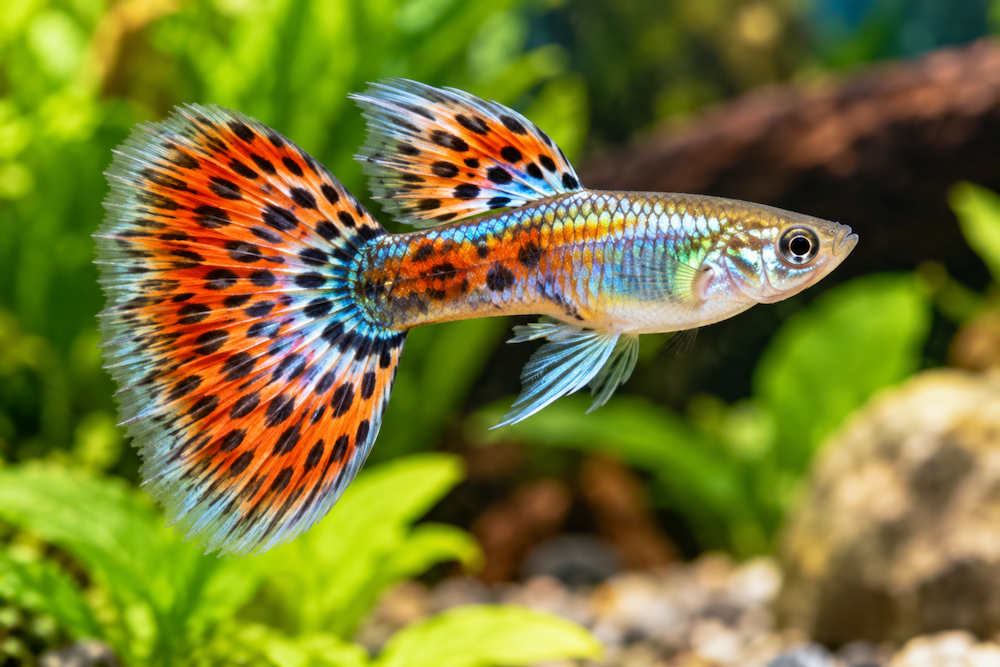







Colourful, active and remarkably easy to breed, the Guppy is one of the world's most popular freshwater aquarium fish. Guppies are relatively beginner-friendly, but they still need good water quality.
🧠 QUICK SNAPSHOT
| Trait | Guppy Fish |
|---|---|
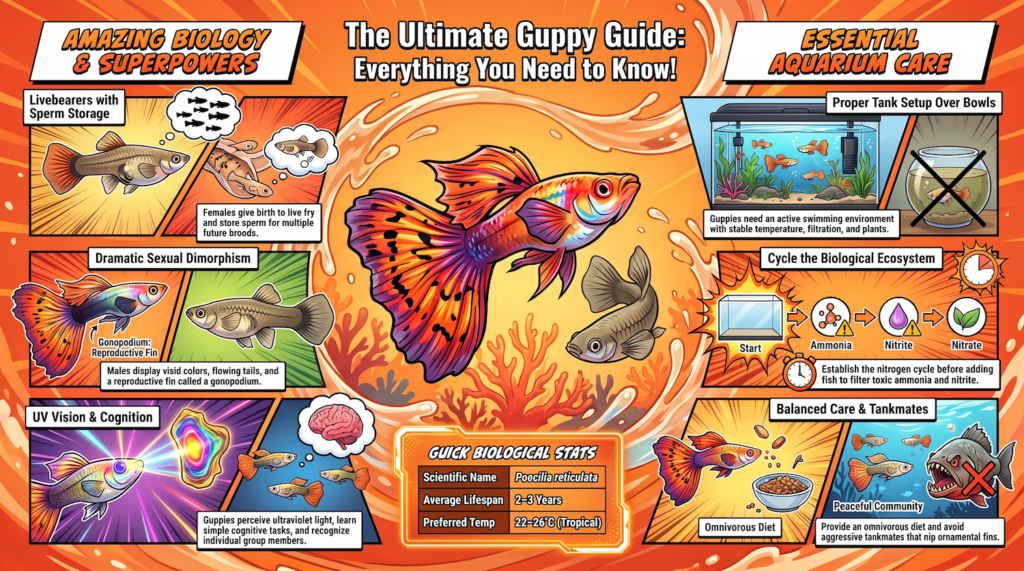
| Scientific Name | Poecilia reticulata |
| Pet Type | Freshwater tropical fish |
| Natural Origin | Northeastern South America and parts of the Caribbean |
| Typical Lifespan | Around 2–3 years |
| Adult Size | Around 3–6 cm |
| Diet | Omnivore |
| Activity | Diurnal |
| Temperament | Peaceful, active and social |
| Water Type | Freshwater |
| Temperature | Warm tropical water |
| Social Needs | Best kept with compatible fish |
| Beginner Friendly? | Yes |
| Famous Feature | Spectacular colours and flowing tails |
📚 OVERVIEW
The Guppy (Poecilia reticulata) is a small tropical freshwater fish famous for its extraordinary range of colours, patterns and tail shapes.
Male Guppies are usually smaller and dramatically more colourful than females, with selective breeding producing everything from brilliant blues and reds to metallic, spotted and multicoloured varieties.
Guppies are livebearers, meaning females give birth to free-swimming young rather than laying eggs. They’re such enthusiastic breeders that a small group can become a considerably larger group surprisingly quickly.
They’re adaptable and relatively easy to keep, making them popular first aquarium fish. However, stable water conditions, good filtration and proper aquarium maintenance remain essential.
✅ PROS & CONS
Pros
- Brilliant colours and patterns
- Active and entertaining to watch
- Generally peaceful
- Relatively beginner-friendly
- Doesn’t require a huge aquarium
- Many varieties available
- Fascinating livebearing reproduction
- Usually mixes well with suitable community fish
Cons
- Can breed extremely quickly
- Poor water quality can cause serious health problems
- Needs a properly cycled aquarium
- Males may constantly pursue females
- Long fins can occasionally attract fin-nipping tank mates
- Selectively bred strains may vary in robustness
- Requires regular aquarium maintenance
- Shorter lifespan than many larger pets
Are Guppies Good Pets?
Yes. Guppies are excellent aquarium fish for many people.
They’re colourful, active and generally peaceful, and their relatively straightforward requirements make them particularly popular with new fish keepers.
Are Guppies Good for Beginners?
Yes. Guppies are commonly considered beginner-friendly tropical fish.
However, beginners still need to understand aquarium cycling, water quality, filtration and appropriate stocking.
A hardy fish isn’t immune to poor water conditions.
How Long Do Guppies Live?
Guppies commonly live around 2–3 years, although lifespan varies according to genetics, temperature, nutrition and water quality.
Excellent husbandry can help them reach the upper end of their potential lifespan.
How Big Do Guppies Get?
Adult Guppies are generally around 3–6 cm long.
Females are typically larger and fuller-bodied, while males are usually smaller with more elaborate colours and fins.
How Many Guppies Should Be Kept Together?
Guppies are social fish and are generally better kept in groups rather than alone.
The appropriate number depends on aquarium size, filtration and whether you’re keeping males, females or both.
Remember that mixed-sex groups can multiply very quickly.
Can You Keep Only Male Guppies?
Yes. An all-male group can be a practical option for owners who want colourful Guppies without producing large numbers of fry.
Enough space and suitable group management remain important because males can display and chase one another.
How Can You Tell a Male Guppy From a Female?
Male Guppies are usually smaller, slimmer and much more colourful, often with elaborate tails.
Females are generally larger, less brightly coloured and have a fuller abdomen.
Mature males also have a specialised reproductive fin called a gonopodium.
What Do Guppies Eat?
Guppies are omnivores.
A high-quality tropical fish food can form the foundation of the diet, supplemented with suitable small frozen, live or other nutritionally appropriate foods.
Variety can help support good health and colour.
How Often Should Guppies Be Fed?
Small amounts once or twice daily can work well for many adult Guppies.
Only offer what the fish can consume promptly.
Overfeeding doesn’t simply make fish fat — uneaten food can also deteriorate and damage water quality.
What Temperature Do Guppies Need?
Guppies are tropical fish and generally thrive in warm, stable aquarium conditions, commonly around the low-to-mid 20s°C.
Consistency is important, and sudden temperature changes should be avoided.
Do Guppies Need a Heater?
In environments where room temperature doesn’t remain within an appropriate stable range, an aquarium heater is useful or necessary.
A reliable thermometer should be used to monitor actual water temperature rather than relying on guesswork.
Do Guppies Need a Filter?
Yes. A suitable filter helps manage waste and provides a home for beneficial bacteria involved in the aquarium’s biological filtration cycle.
The filter should match the aquarium size without creating excessive current.
Do Guppies Need a Cycled Tank?
Yes.
A properly established nitrogen cycle allows beneficial bacteria to process toxic ammonia and nitrite produced by fish waste.
Adding Guppies to an unprepared aquarium can expose them to dangerous water conditions.
How Often Do Guppies Have Babies?
Female Guppies can produce new broods roughly every few weeks under suitable conditions.
Brood size varies considerably according to the female’s age, size and health.
This reproductive speed is one reason Guppy populations can increase dramatically.
Do Guppies Lay Eggs?
No. Guppies are livebearers.
The young develop inside the female, and she gives birth to free-swimming fry.
The babies are immediately capable of swimming and searching for food.
Can Female Guppies Have Babies Without a Male?
A female that has previously mated can potentially produce multiple broods after being separated from males because Guppies can store sperm.
This can be surprising to owners who thought separating the sexes had immediately stopped reproduction.
Do Guppies Eat Their Babies?
They can.
Adult Guppies don’t provide parental care and may eat newly born fry.
Dense plants and other hiding places can increase the chances of some young surviving in a community aquarium.
Why Are Male Guppies So Colourful?
Bright colours and elaborate fins are strongly connected with sexual selection.
Females can show preferences for particular male characteristics, helping drive the evolution of spectacular male colouration.
Predation creates an opposing pressure because being conspicuous can also make males easier to spot.
Can Guppies Live With Other Fish?
Yes. Guppies generally work well in peaceful community aquariums with species that share compatible water and environmental requirements.
Aggressive or persistent fin-nipping species can be problematic, particularly for long-finned male Guppies.
Can Guppies Live With Betta Fish?
Sometimes, but it’s not automatically a safe combination.
Individual Betta temperament varies, and a Betta may react aggressively to a colourful, flowing-tailed male Guppy.
Tank size, planting and individual behaviour all matter.
Do Guppies Need Live Plants?
Live plants aren’t essential, but they can be extremely beneficial.
Plants provide cover, enrichment and hiding places for fry while contributing to a more natural-looking environment.
Guppies often look particularly striking against dense green planting.
Why Is My Guppy Staying at the Surface?
Occasional surface activity can be normal, but persistent gasping or crowding near the surface can indicate problems such as poor water quality or insufficient oxygen.
Water parameters should be checked promptly rather than assuming the fish simply likes the top of the tank.
What Health Problems Are Common in Guppies?
Guppies can experience problems including fin rot, parasites, fungal or bacterial infections and buoyancy disorders.
Poor water quality, stress and inappropriate stocking can increase disease risk.
Changes in swimming, appetite, fins or appearance deserve investigation.
What Are Fancy Guppies?
“Fancy Guppy” generally refers to selectively bred Guppies developed for particular colours, patterns and fin shapes.
Decades of breeding have produced an enormous range of varieties with names based on traits such as tail shape, body pattern and colour.
Where Do Guppies Come From?
Wild Guppies originate from northeastern South America and parts of the Caribbean.
They naturally inhabit freshwater environments including streams, pools and other waterways.
They’ve since been introduced to many other parts of the world.
Are Guppies Used to Control Mosquitoes?
Guppies have historically been introduced into waterways in various places because they consume mosquito larvae.
However, introducing non-native fish can cause ecological problems, so pet Guppies should never be released into natural waterways.
Are Guppies Legal to Keep as Pets?
Guppies are widely kept as aquarium fish, but regulations can vary.
Some countries or regions may restrict particular fish because of environmental or biosecurity concerns.
Always check local regulations and never release aquarium fish into the wild.
Are Guppies Good First Fish?
Yes. Guppies can be an excellent choice for a first tropical aquarium.
They’re colourful, active and relatively adaptable.
The key is learning that successful fishkeeping isn’t really about keeping the fish.
It’s about keeping the water healthy enough for the fish to thrive.
What Makes the Guppy Fish Unique?
Few animals demonstrate evolution quite as colourfully as the Guppy.
Wild females tend to be relatively understated.
Males?
They went in another direction entirely.
Orange. Blue. Red. Green. Spots. Metallic flashes. Enormous tails.
Female choice helped drive males towards increasingly conspicuous colours — while predators created pressure in exactly the opposite direction.
Then humans started selectively breeding them, producing an extraordinary collection of colours and tail shapes.
And Guppies have another trick.
They don’t lay eggs.
Females give birth to tiny, fully formed swimming fish — and can even store sperm and produce later broods after males have disappeared.
Put males and females together and one thing becomes apparent very quickly:
Guppies are exceptionally good at making more Guppies.
Discover why male Guppies are so colourful, how females give birth to live young, why they can produce multiple broods after mating and how this tiny fish became an aquarium favourite around the world.
Watch our Guppy Fish video and discover what makes this colourful little livebearer so fascinating.