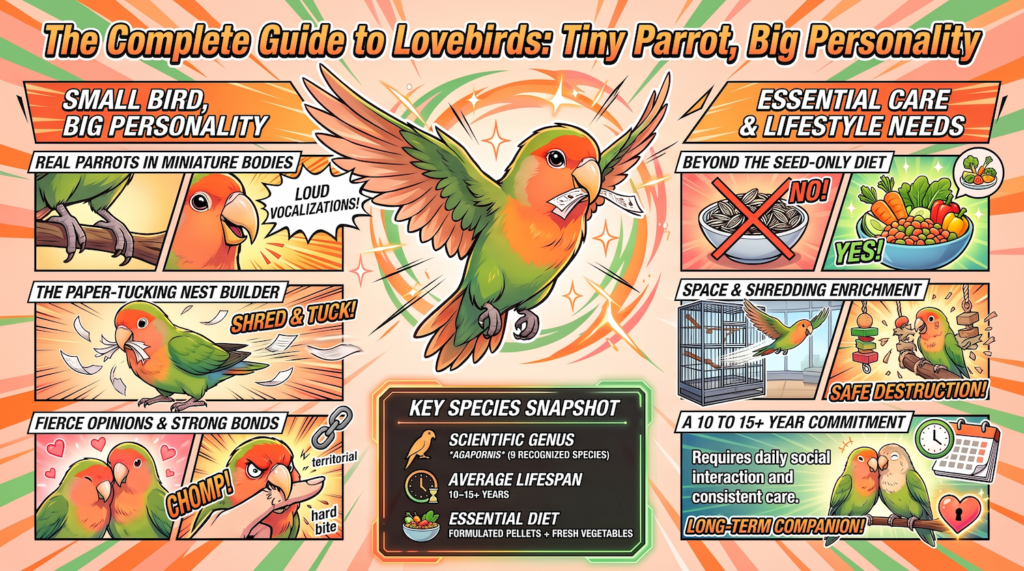
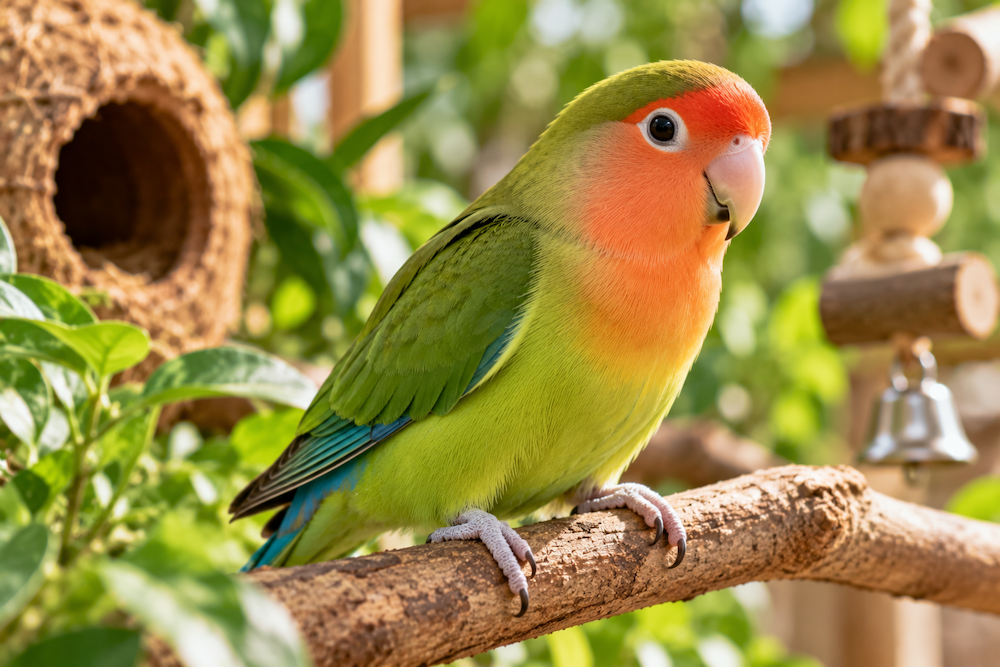







Small, colourful and bursting with personality, Lovebirds are energetic little parrots famous for forming close social bonds
🧠 QUICK SNAPSHOT
| Trait | Lovebird |
|---|---|
| Scientific Genus | Agapornis |
| Pet Type | Small parrot / Companion bird |
| Natural Origin | Africa and Madagascar |
| Typical Lifespan | Around 10–15 years |
| Adult Size | Around 13–17 cm |
| Typical Weight | Roughly 40–60 g |
| Diet | Balanced formulated diet with suitable fresh foods |
| Activity | Diurnal |
| Temperament | Social, energetic, curious and bold |
| Noise Level | Moderate; surprisingly loud for their size |
| Social Needs | High |
| Trainability | Good |
| Beginner Friendly? | Moderate |
| Famous Feature | Strong pair bonds and colourful plumage |
📚 OVERVIEW
Lovebirds are small parrots belonging to the genus Agapornis, which contains several species native to Africa and Madagascar. Popular companion species include the Peach-faced, Fischer’s and Yellow-collared Lovebird.
Their name comes from their reputation for forming strong pair bonds. Bonded birds may sit closely together, preen one another and spend much of their time side by side.
But Lovebirds aren’t simply tiny romantic parrots. They’re active, intelligent and often remarkably bold. They need opportunities to fly, climb, chew, forage and interact every day.
With good care, these colourful little parrots can remain lively companions for 10–15 years or longer.
✅ PROS & CONS
Pros
- Colourful and attractive
- Intelligent and highly curious
- Playful and entertaining
- Can form strong social bonds
- Small, manageable body size
- Can learn tricks and routines
- Active during the daytime
- Big personality in a tiny parrot
Cons
- Needs substantial daily interaction
- Can be surprisingly loud
- Powerful beak for such a small bird
- Requires regular out-of-cage exercise
- Can become territorial
- Needs plenty of toys and enrichment
- Creates feathers, food and general bird mess
- Long-term commitment
Are Lovebirds Good Pets?
Yes. Lovebirds can make excellent companion birds for owners who enjoy active, intelligent parrots.
They’re playful, curious and highly social, but require considerably more attention and enrichment than their small size might suggest.
Are Lovebirds Good for Beginners?
They can be, although Cockatiels and some other companion birds may be easier for complete beginners.
Lovebirds can be assertive, territorial and surprisingly strong-willed.
An owner prepared to learn parrot behaviour, nutrition and positive training can find them extremely rewarding.
Are Lovebirds Good With Children?
Lovebirds can suit responsible older children when interactions are supervised.
They’re small and physically delicate, but they also have strong beaks and may nip when frightened or overstimulated.
Adults should remain responsible for the bird’s care.
How Long Do Lovebirds Live?
Lovebirds commonly live around 10–15 years, although some individuals can live longer with excellent care.
Nutrition, genetics, exercise and veterinary care all influence longevity.
They’re therefore a substantial commitment despite their tiny size.
How Big Do Lovebirds Get?
Most Lovebirds are around 13–17 cm long and weigh roughly 40–60 grams.
They’re among the smaller parrots commonly kept as companion birds.
Don’t let the size fool you — their behaviour can be remarkably bold.
Why Are They Called Lovebirds?
The name reflects their tendency to form strong social and pair bonds.
Bonded Lovebirds may sit pressed together, groom one another and maintain close physical contact.
Their scientific genus name, Agapornis, also reflects this reputation, combining Greek roots associated with love and birds.
Do Lovebirds Have to Be Kept in Pairs?
Not necessarily.
A single Lovebird can thrive when it receives plenty of daily interaction, enrichment and companionship from its human family.
However, Lovebirds are highly social, so an isolated bird shouldn’t spend most of its life alone without meaningful interaction.
Will Two Lovebirds Bond With Their Owner?
They can.
Keeping two Lovebirds doesn’t automatically prevent them from developing relationships with people.
Regular positive interaction and training can help maintain human bonds, although a compatible pair may naturally devote considerable attention to each other.
Are Lovebirds Affectionate?
Many can be very affectionate with people they trust.
A well-socialised Lovebird may enjoy sitting on its owner, receiving head scratches or simply being nearby.
Individual personality and early socialisation make a substantial difference.
Do Lovebirds Like Being Held?
Most parrots prefer perching on a hand, finger or shoulder rather than being physically restrained.
Some Lovebirds enjoy gentle head scratches, while others prefer less physical contact.
Forcing interaction can quickly damage trust.
Can Lovebirds Talk?
Some Lovebirds can learn words and sounds, but they’re generally not famous for human speech compared with parrots such as African Greys or Budgerigars.
Their natural vocalisations, whistles and social sounds tend to dominate.
Are Lovebirds Loud?
They can be surprisingly loud for such small birds.
Lovebirds produce sharp calls that can carry considerable distance.
They’re usually less overwhelming than very large parrots, but they’re not a good choice for someone expecting a quiet pet.
What Do Lovebirds Eat?
A nutritionally balanced formulated parrot food can form the foundation of the diet, supplemented with appropriate vegetables, leafy greens and other bird-safe fresh foods.
A seed-only diet can lead to nutritional imbalance and shouldn’t be the default feeding strategy.
Fresh water should always be available.
What Foods Are Toxic to Lovebirds?
Several everyday foods can be dangerous to parrots, including avocado, chocolate, alcohol and caffeine.
Owners should check whether unfamiliar foods are bird-safe before offering them.
Human food isn’t automatically suitable simply because the bird wants to steal it.
How Big Should a Lovebird Cage Be?
A Lovebird needs enough room to move, climb, stretch its wings and play comfortably.
Wider cages that provide usable flight and movement space are preferable to tiny decorative cages.
If two birds are housed together, substantially more space is required.
Do Lovebirds Need Time Outside Their Cage?
Yes.
Regular supervised out-of-cage time provides important opportunities for flight, exercise, exploration and social interaction.
The room must first be made bird-safe by managing windows, doors, fans, hot surfaces, toxic plants and other animals.
Do Lovebirds Need Toys?
Absolutely.
Lovebirds are busy parrots that enjoy chewing, shredding, climbing and foraging.
A variety of safe toys and natural enrichment helps prevent boredom.
Rotating toys periodically can make their environment more interesting.
Do Lovebirds Bite?
They can.
Lovebirds have surprisingly powerful beaks and may bite when frightened, territorial or overstimulated.
Understanding their body language and using positive reinforcement is more effective than punishment.
Are Lovebirds Intelligent?
Yes. Lovebirds are intelligent parrots capable of learning routines, solving simple problems and responding to training.
Foraging activities and reward-based training provide valuable mental stimulation.
Their curiosity also means they frequently investigate things their owners would rather they ignored.
Can You Train a Lovebird?
Yes.
Positive reinforcement can teach behaviours such as stepping onto a hand, coming when called, targeting and performing simple tricks.
Training also helps build trust and makes everyday handling easier.
Why Does My Lovebird Shred Paper?
Shredding is natural parrot behaviour and can also be connected with nest-building behaviour, particularly in some females.
Providing appropriate shreddable materials can be excellent enrichment.
However, nesting behaviour may need to be managed if it begins encouraging excessive hormonal or territorial behaviour.
Why Do Lovebirds Preen Each Other?
Mutual preening helps bonded birds maintain feathers while also reinforcing their social relationship.
Birds often concentrate on areas such as the head and neck, which are difficult to groom thoroughly themselves.
It’s one of the behaviours that helped create the Lovebird’s romantic reputation.
Can Lovebirds Live With Other Bird Species?
Sometimes, but they shouldn’t automatically be housed together.
Lovebirds can be territorial and assertive despite their small size, potentially injuring more passive birds.
Separate housing is often safer even when different birds enjoy supervised interaction.
What Are the Different Types of Lovebirds?
There are several species within the genus Agapornis. Well-known examples include:
- Peach-faced Lovebird
- Fischer’s Lovebird
- Yellow-collared Lovebird
- Black-cheeked Lovebird
- Red-headed Lovebird
- Madagascar Lovebird
Selective breeding has also created numerous colour mutations within popular pet species.
How Can You Tell a Male Lovebird From a Female?
In several commonly kept Lovebird species, males and females look extremely similar.
Visual characteristics aren’t always reliable enough for accurate sex identification.
DNA sexing is often the most dependable method when knowing the bird’s sex is important.
What Health Problems Are Common in Lovebirds?
Potential problems include nutritional disease, respiratory illness, feather problems, reproductive disorders and obesity.
Birds often hide signs of illness, so changes in appetite, droppings, activity, breathing or behaviour deserve attention.
Regular care from an avian-experienced veterinarian is valuable.
Where Do Lovebirds Come From?
Lovebirds originate from Africa and Madagascar, with different species occupying different geographical ranges and habitats.
They typically live highly social lives and often gather in groups.
Their natural activity and social behaviour help explain why captive Lovebirds need so much stimulation.
Are Lovebirds Legal to Keep as Pets?
Lovebird ownership is permitted in many places, but regulations can vary.
Some countries or regions may restrict particular species or require permits, so prospective owners should check current local regulations.
Is a Lovebird a Good First Bird?
A Lovebird can be an excellent first parrot for someone who wants an energetic and interactive companion.
They’re small, intelligent and trainable, but their noise, social needs and occasionally feisty temperament shouldn’t be underestimated.
Small bird does not mean small personality.
What Makes the Lovebird Unique?
The Lovebird’s name makes it sound like the sweetest little romantic in the bird world.
And sometimes it is.
A bonded pair may sit shoulder-to-shoulder, gently preening one another and looking like the perfect Valentine’s Day advertisement.
Then one of them spots something interesting.
Suddenly the tiny romantic becomes a fearless miniature parrot determined to climb it, chew it or dismantle it.
That’s the other side of the Lovebird.
These birds combine strong social bonds with enormous curiosity, impressive intelligence and an attitude that seems completely disproportionate to their size.
They’re colourful.
They’re clever.
They’re noisy.
And they can fit comfortably in your hand.
The Lovebird may be tiny, but nobody remembered to tell the Lovebird.
Discover why Lovebirds form such close bonds, whether they really need a partner, how intelligent they are and why these tiny parrots have such enormous personalities.
Watch our Lovebird video and discover what makes this colourful little parrot such a fascinating companion.