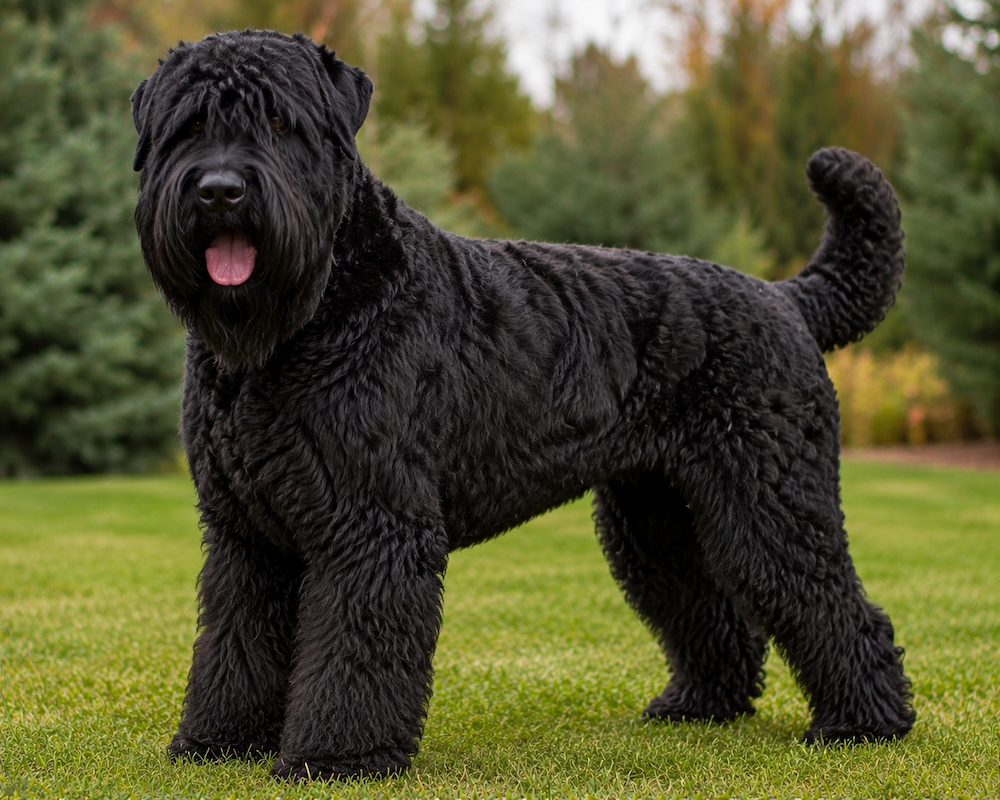







Powerful, intelligent, and deeply loyal — a formidable guardian with a calm temperament and an unwavering devotion to its family.
🧠 QUICK SNAPSHOT
- Temperament: Loyal, confident, intelligent
- Energy Level: High
- Size: Large
- Good With Families: Yes
- Trainability: Very high
- Grooming: High
- Best For: Experienced owners, active families, guarding
📚 OVERVIEW
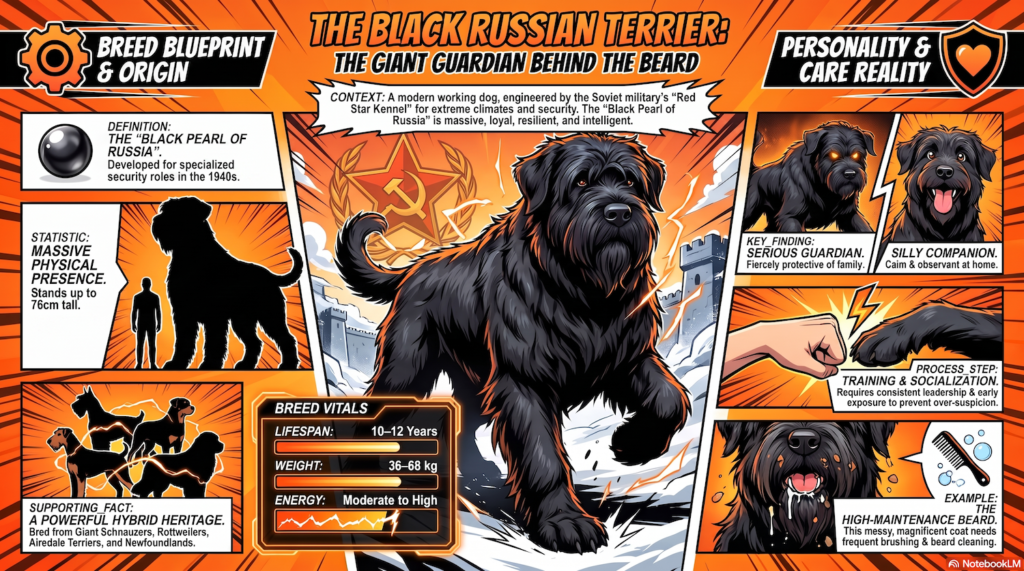
The Black Russian Terrier is a powerful working breed developed in the former Soviet Union for military and security work. Despite its name, it is not a true terrier but a carefully developed working dog created from several breeds, including the Giant Schnauzer, Rottweiler, and Airedale Terrier.
Known for its impressive size, weather-resistant black coat, and calm confidence, the Black Russian Terrier is a loyal and protective companion that forms exceptionally strong bonds with its family. It thrives when given structured training, daily activity, and a clear role within the household.
✅ PROS & CONS
Pros
- Exceptionally loyal and protective
- Highly intelligent and trainable
- Calm and confident temperament
- Excellent family guardian
Cons
- Requires regular grooming
- Needs extensive daily exercise and mental stimulation
- Best suited to experienced owners
- Early socialisation is essential
Is a Black Russian Terrier a Good Family Dog?
Yes, a well-bred and properly trained Black Russian Terrier can be an excellent family dog, particularly for experienced owners who want a loyal, protective companion.
These dogs tend to form exceptionally strong bonds with their household and usually want to remain close to their people. Despite their imposing appearance, many are calm and affectionate at home.
Their enormous size and protective instincts mean early socialisation is essential. Children should also be supervised around them, particularly because an enthusiastic adult can accidentally knock over a small child.
The Black Russian Terrier isn’t typically a casual, everyone-is-my-best-friend breed. Its family is important to it, and strangers may be treated with considerably more suspicion.
Are Black Russian Terriers Aggressive?
Black Russian Terriers are not supposed to be indiscriminately aggressive, but they were deliberately developed as powerful military and guarding dogs and can be naturally suspicious of unfamiliar people.
A stable adult should be confident, controlled and capable of distinguishing normal situations from genuine threats.
Poor breeding, inadequate socialisation or inappropriate training can become particularly serious problems in a dog this large and powerful.
Early exposure to different people, dogs, environments and situations is therefore extremely important.
Owners shouldn’t try to make a Black Russian Terrier “more protective”. The instinct is already there.
The training priority should be control, confidence and good judgement.
How Much Exercise Does a Black Russian Terrier Need?
A healthy adult Black Russian Terrier generally needs around 60–90 minutes of meaningful daily exercise, although individual requirements vary.
Walking is useful, but physical exercise alone isn’t enough.
This is an intelligent working breed that benefits from obedience training, scent work, tracking, retrieving and other activities requiring concentration.
Despite their size, Black Russian Terriers don’t need to spend the entire day running. Excessive high-impact exercise should actually be avoided while puppies are growing because their large joints and skeleton are still developing.
A combination of physical activity and purposeful mental work is usually ideal.
The Black Russian Terrier was created to work.
Giving its brain nothing to do can be just as problematic as giving its legs nothing to do.
Are Black Russian Terriers Easy to Train?
Black Russian Terriers are highly intelligent and capable of advanced training, but they aren’t necessarily easy dogs for inexperienced owners.
They learn quickly and were specifically developed to perform demanding working roles.
However, they’re also confident, independent dogs capable of making their own decisions.
Training should begin early and remain consistent throughout the dog’s life. Positive reinforcement combined with clear boundaries generally produces the best results.
Harsh training can damage trust and potentially create conflict with a powerful guardian breed.
Socialisation should be treated as part of training rather than an optional extra.
A Black Russian Terrier needs to learn not only what commands mean, but how to behave calmly in a world full of unfamiliar people, animals and situations.
Does a Black Russian Terrier Shed?
Yes, but the Black Russian Terrier is generally considered a relatively low-shedding breed compared with many other large dogs.
That doesn’t mean the coat is low maintenance.
Its dense, coarse double coat requires thorough brushing several times each week to prevent tangles and matting.
The beard and facial furnishings also collect water, food and debris and need regular attention.
Professional grooming and trimming are commonly required every several weeks, depending on how the coat is maintained.
Black Russian Terriers aren’t guaranteed to be hypoallergenic. Dog allergies involve proteins found in dander, saliva and other secretions rather than simply loose hair.
Less hair on the furniture doesn’t necessarily mean less work with the grooming brush.
How Big Does a Black Russian Terrier Get?
The Black Russian Terrier is a very large, powerfully built dog.
Adult males commonly stand roughly 72–76 cm at the shoulder, with females generally somewhat smaller. Healthy adults can weigh approximately 36–68 kg, depending on sex, height, build and breed standard.
Their dense black coat makes them appear even more substantial.
This size matters when choosing the breed.
Everything becomes larger: the dog bed, food bill, grooming workload, veterinary costs and consequences of poor lead manners.
Training a 10 kg puppy not to pull is considerably easier than attempting to solve the same problem once that puppy has become a 60 kg adult with somewhere important to go.
Can a Black Russian Terrier Live in an Apartment?
A Black Russian Terrier can theoretically adapt to spacious apartment living, but it usually isn’t the easiest environment for the breed.
These are enormous dogs that need daily exercise, training and sufficient room to move comfortably.
Interestingly, many adults can be relatively calm indoors after their needs have been met. The bigger issue is whether the owner can consistently provide adequate activity outside the apartment.
Lift access, stairs, neighbours, hot weather and simply manoeuvring such a large dog through communal areas also need consideration.
A house doesn’t automatically make someone a suitable Black Russian Terrier owner, and an apartment doesn’t automatically make them unsuitable.
The important question is whether the dog’s physical, mental and behavioural needs can genuinely be met every day.
Can a Black Russian Terrier Be Left Alone?
A mature Black Russian Terrier can usually tolerate reasonable periods alone when gradually trained to do so, but this isn’t a breed that thrives on being isolated from its family for most of every day.
Despite its intimidating appearance, the Black Russian Terrier tends to form very close relationships with its people.
Puppies should learn independence gradually through short, positive periods alone.
Adequate exercise and mental stimulation before longer absences can also help.
A bored adolescent Black Russian Terrier is a particularly undesirable home-renovation consultant.
With the size and strength of this breed, destructive behaviour can move beyond chewing a slipper remarkably quickly.
Are Black Russian Terriers Good With Other Dogs?
Black Russian Terriers can live successfully with other dogs, particularly when raised and socialised appropriately, but compatibility varies considerably between individuals.
Some can be assertive or territorial, and same-sex relationships may occasionally be more challenging.
Early socialisation helps dogs learn appropriate communication and reduces the likelihood of unnecessary reactivity.
Introductions to new dogs should be controlled rather than assuming every Black Russian Terrier will enjoy dog parks or unrestricted interaction with unfamiliar animals.
This breed was developed primarily for working ability and guarding rather than universal sociability.
A Black Russian Terrier doesn’t need to become best friends with every dog it meets.
It does need to learn to remain under control around them.
Do Black Russian Terriers Bark a Lot?
Black Russian Terriers are generally purposeful rather than constantly noisy barkers, but they can be highly alert to unusual activity around their home.
Guarding instinct means they may bark when someone approaches the property or when they detect something unfamiliar.
Training can help distinguish appropriate alerting from excessive barking.
Owners should avoid accidentally encouraging suspicious behaviour by repeatedly praising the dog for reacting to every passing person, vehicle or noise.
A Black Russian Terrier’s size and deep bark already make an impressive announcement.
It usually doesn’t need much assistance convincing visitors that someone is home.
What Health Problems Are Common in Black Russian Terriers?
Black Russian Terriers can be affected by several inherited health conditions, making responsible health screening particularly important.
Hip and elbow dysplasia are major concerns in a dog of this size and can contribute to pain and arthritis.
Eye disorders can occur, and responsible breeding programs should use appropriate ophthalmic screening.
The breed can also be affected by juvenile laryngeal paralysis and polyneuropathy (JLPP), an inherited neurological disorder for which genetic testing is available.
Other conditions reported within the breed include cardiac problems and certain urinary issues.
Prospective owners should ask breeders for documented health-test results rather than simply accepting that the parents “have never been sick”.
With large working breeds, responsible breeding begins well before the puppies are born.
How Long Do Black Russian Terriers Live?
Black Russian Terriers generally have a lifespan of around 10–12 years, although individual dogs can live longer.
That’s relatively respectable for such a large breed.
Maintaining a healthy weight is particularly important because excess body weight places additional strain on joints and can contribute to other health problems.
Appropriate exercise, good nutrition, dental care and regular veterinary checks all contribute to healthy ageing.
Owners should also adjust activity as the dog becomes older rather than assuming a senior Black Russian Terrier can maintain the same workload it handled in early adulthood.
For a dog this imposing, one of the breed’s surprises is how quickly those years can pass — particularly when the enormous black guardian gradually becomes an equally enormous grey-bearded senior.