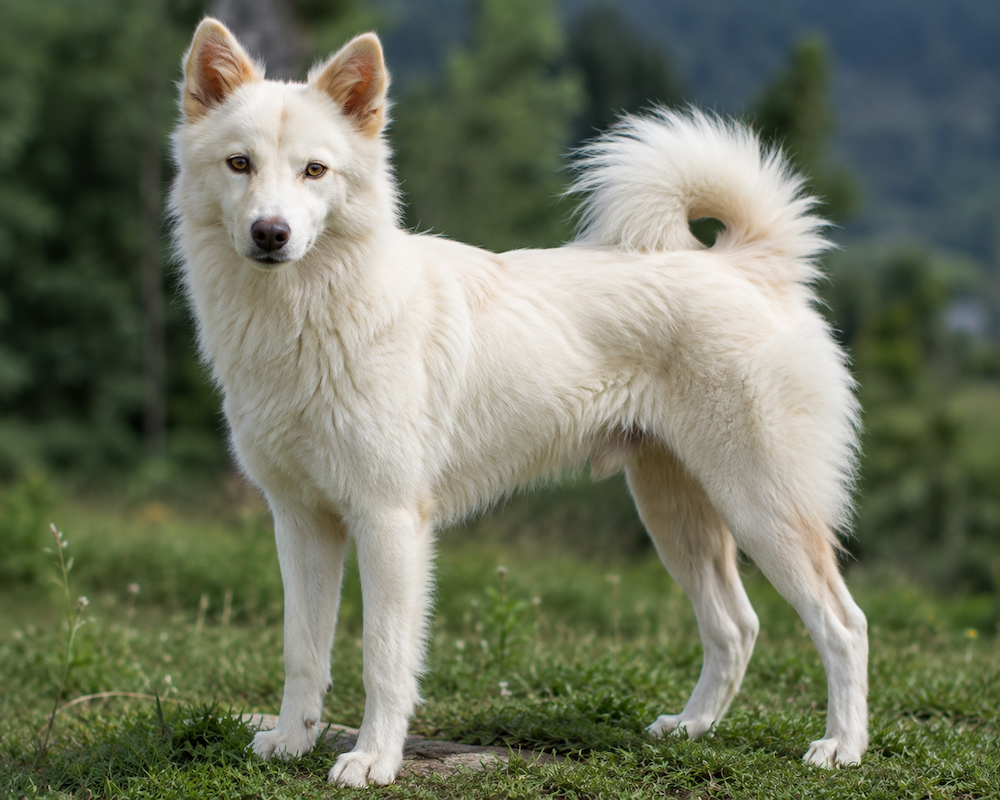







Loyal, alert, and proudly Balinese — the Kintamani is a rare Indonesian dog breed known for its striking appearance, independent intelligence, and strong attachment to its family.
🧠 QUICK SNAPSHOT
- Temperament: Loyal, alert, independent
- Energy Level: Moderate to High
- Size: Medium
- Good With Families: Yes, with good socialisation
- Trainability: Moderate
- Grooming: Moderate
- Best For: Active families, experienced owners, homes with secure outdoor space
📚 OVERVIEW
The Kintamani, formally known as the Kintamani-Bali Dog, is a distinctive Indonesian breed originating around the mountainous Kintamani region of Bali. Unlike many modern breeds created through deliberate crosses, the Kintamani developed from Bali’s long-established local dog population and became recognised for its relatively consistent appearance and temperament.
The breed is medium-sized, agile, and strongly built, with erect ears, a wedge-shaped head, a plumed tail typically carried over the back, and a thick double coat. White is particularly associated with the breed, although other recognised colours occur.
Kintamani dogs are intelligent, alert, and naturally independent. They tend to form close relationships with their families while remaining more cautious around unfamiliar people. Their watchful nature can make them effective watchdogs, but early socialisation is important to prevent natural caution from becoming excessive suspicion.
Internationally, the breed remains relatively uncommon, although recognition by the Fédération Cynologique Internationale (FCI) has helped introduce this fascinating Balinese dog to a much wider audience.
✅ PROS & CONS
Pros
- Loyal and affectionate with its family
- Intelligent and highly observant
- Naturally alert watchdog
- Athletic and agile
- Fascinating Balinese heritage
- Adaptable when properly exercised
Cons
- Can be independent and strong-willed
- May be wary of unfamiliar people
- Requires early and ongoing socialisation
- Double coat sheds
- Can become vocal when alert
- Rare outside Indonesia
Is a Kintamani a Good Family Dog?
Yes, a Kintamani can be a very good family dog when properly socialised and given clear, consistent guidance. The breed tends to form strong bonds with its household and can be affectionate, playful, and deeply loyal to the people it knows.
Kintamani dogs can live successfully with respectful children, particularly when raised with them. As with any breed, interactions with younger children should be supervised and children should learn how to behave appropriately around dogs.
The breed can also coexist with other dogs, although early socialisation is valuable. Individual Kintamanis may be more selective with unfamiliar dogs, particularly as they mature. Introductions to cats and smaller pets should be managed carefully.
One important consideration is the breed’s natural watchfulness. A Kintamani may not greet every visitor like an old friend. Families should positively expose puppies to different people and everyday situations so they learn to distinguish normal activity from something that genuinely deserves attention.
How Much Exercise Does a Kintamani Need?
A Kintamani generally needs around 60 to 90 minutes of exercise each day, together with regular mental stimulation. This is an agile, active breed that enjoys exploring and benefits from considerably more than occasional trips into the garden.
Brisk walks, hiking, interactive play, scent games, training exercises, and supervised running in securely enclosed areas can all provide excellent activity. Variety is useful because the Kintamani is intelligent enough to become bored with an overly repetitive routine.
Mental enrichment is particularly important. Puzzle feeders, hide-and-seek, scent trails, trick training, and problem-solving games allow the dog to exercise its brain as well as its body.
A secure garden is beneficial but shouldn’t replace daily interaction and exercise. Given sufficient activity, most Kintamanis can settle comfortably at home. Without it, their intelligence and alertness may instead appear as excessive barking, digging, escaping, or other unwanted behaviours.
Is a Kintamani Easy to Train?
The Kintamani is intelligent and capable of learning quickly, but its independent nature means training can require patience. Rather than automatically following every instruction, this breed may assess situations for itself before deciding how to respond.
Positive reinforcement using treats, praise, toys, and play is generally the most effective approach. Short, varied training sessions help maintain interest, while repetitive exercises can cause an independent dog to disengage.
Training should begin early, with particular attention to recall, lead walking, calm greetings, and settling around unfamiliar people and dogs.
Socialisation is equally important. Puppies benefit from controlled, positive experiences involving visitors, children, friendly dogs, traffic, household noises, different environments, veterinary handling, and travel.
A committed first-time owner may succeed with a Kintamani, but someone experienced with independent breeds may find its temperament easier to understand. Building cooperation rather than demanding unquestioning obedience usually produces the best results.
Does a Kintamani Shed?
Yes, the Kintamani does shed. It has a double coat consisting of a denser undercoat beneath a straighter outer coat, and shedding may become considerably heavier during seasonal coat changes.
Brushing once or twice each week is normally sufficient during much of the year. When the undercoat is shedding more heavily, increasing the frequency of brushing helps remove loose hair and reduces the amount deposited around the home.
The coat does not normally require elaborate trimming or professional styling. Occasional bathing, regular nail trimming, dental care, and routine ear checks complete the basic grooming schedule.
Its naturally clean appearance can make the Kintamani seem like a particularly low-maintenance breed, but prospective owners should still be prepared for loose hair.
The Kintamani is not considered hypoallergenic, so people specifically seeking a low-shedding dog may be better suited to another breed.
What Health Problems Are Common in a Kintamani?
The Kintamani is generally regarded as a hardy dog, but there is less extensive published health data available for the breed than for many internationally established breeds. Prospective owners should therefore be cautious about claims that the Kintamani has no significant inherited health concerns.
As with other medium-sized dogs, responsible breeders should pay attention to joint health and other conditions identified within their breeding lines. Routine veterinary examinations remain important for detecting problems early rather than relying on the breed’s reputation for natural robustness.
Responsible breeding is particularly important as the Kintamani becomes better known internationally. Breeders should prioritise genetic diversity, stable temperament, appropriate health screening, and overall soundness rather than selecting dogs purely for a particular appearance.
Good nutrition, regular exercise, parasite prevention, dental care, maintaining an appropriate body weight, and routine veterinary care provide the foundation for long-term wellbeing. Kintamani dogs can typically enjoy a lifespan of around 12 to 15 years, although individual longevity varies.
⭐ Where Does the Kintamani Come From?
The Kintamani is particularly fascinating because it is one of Indonesia’s best-known native dog breeds.
Its homeland lies around Kintamani in the highlands of Bali, an area of volcanic landscapes, villages, farmland, and considerably cooler conditions than Bali’s famous tropical beaches.
Dogs from this region gradually developed characteristics that distinguished them from Bali’s broader free-ranging dog population. The Kintamani became particularly associated with its upright ears, curled or plumed tail, substantial coat, and confident temperament.
The breed reached an important international milestone when the Fédération Cynologique Internationale recognised the Kintamani-Bali Dog on a provisional basis in 2019.
That recognition transformed what many people outside Indonesia had never heard of into an internationally recognised breed representing an important part of Bali’s canine heritage.
For anyone fascinated by rare dog breeds, the Kintamani offers something genuinely special: a dog whose story is closely connected to the landscape, communities, and history of Bali itself.