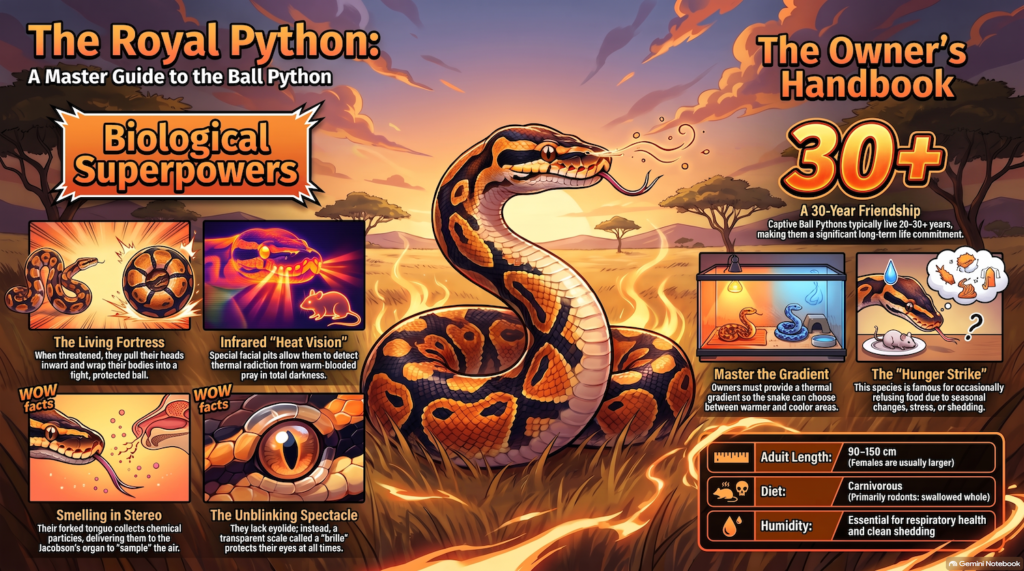
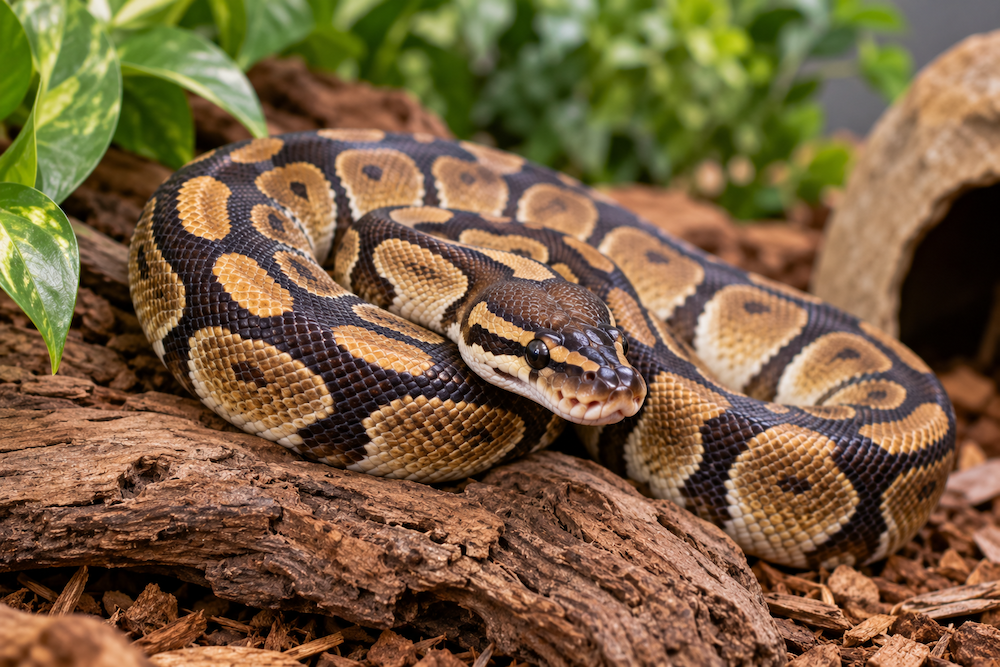







Calm, beautifully patterned, and famous for curling into a tight ball when frightened — the Ball Python is one of the world's most popular pet snakes, combining manageable size with a generally gentle temperament, extraordinary colour genetics, and a lifespan that can make owning one a commitment measured in decades.
🧠 QUICK SNAPSHOT
- Temperament: Generally calm, shy, docile
- Activity Level: Low to Moderate
- Adult Length: Commonly around 90–150 cm
- Adult Weight: Often around 1–2.5 kg, with females generally larger
- Good With Families: Good for responsible households
- Indoor Living: Essential in a secure, controlled enclosure
- Handling: Usually very good when accustomed to it
- Care Level: Moderate
- Diet: Carnivorous — appropriately sized whole prey
- Typical Lifespan: Commonly 20–30 years in captivity; potentially longer
- Best For: Responsible beginners, reptile enthusiasts, adults and older children under supervision
📚 OVERVIEW
The Ball Python, Python regius, is a non-venomous python native to West and Central Africa.
In North America it’s often called the Ball Python, while the name Royal Python is widely used elsewhere.
The “Ball” name comes from one of the snake’s most distinctive defensive behaviours.
When frightened, a Ball Python may curl tightly around itself, protecting its head inside the coils and effectively turning itself into a living ball.
Their relatively manageable adult size, generally calm temperament and spectacular variety of colours and patterns have made Ball Pythons enormously popular in the reptile world.
But “easy beginner snake” can be misleading.
Ball Pythons require carefully controlled temperatures, appropriate humidity, secure housing, suitable hides and a whole-prey diet. They can also become notoriously selective eaters.
And they’re definitely not a short-term pet.
A properly cared-for Ball Python may remain with its owner for 20 or 30 years — potentially considerably longer.
Buying one isn’t quite like getting a hamster.
It’s closer to acquiring a very quiet, legless roommate for the next few decades.
✅ PROS & CONS
Pros
- Generally calm temperament
- Manageable adult size
- Usually tolerates gentle handling well
- Non-venomous
- Doesn’t require daily feeding
- Relatively quiet
- Minimal shedding around the house
- Fascinating natural behaviour
- Hundreds of colour and pattern combinations exist
- Can live for several decades
Cons
- Potential 20–30+ year commitment
- Requires carefully controlled temperature and humidity
- Must eat whole prey
- Can refuse food for extended periods
- Needs specialised reptile veterinary care
- Enclosure must be extremely secure
- Some genetic morphs are associated with health or neurological problems
- Incorrect husbandry can cause serious illness
- Reptiles can carry Salmonella
- Ownership may be restricted or regulated depending on location
Is a Ball Python a Good Pet?
Yes, the Ball Python can be an excellent pet snake for a responsible owner prepared to provide appropriate reptile husbandry.
They’re popular partly because they remain relatively manageable in size and are generally less defensive than many larger python species.
Many captive Ball Pythons become comfortable with calm, gentle handling.
However, snakes don’t interact with humans in the same way as dogs or cats.
A Ball Python isn’t likely to crave cuddles, learn to fetch or greet you excitedly when you arrive home.
Much of the enjoyment comes from observing its behaviour, creating an excellent environment and learning about an extraordinary animal.
For someone fascinated by reptiles, that’s part of the appeal.
How Big Does a Ball Python Get?
Adult Ball Pythons commonly reach around 90–150 cm in length, although individual snakes can fall outside that range.
Females generally become larger and heavier than males.
Compared with giant constrictors such as Burmese Pythons or Reticulated Pythons, Ball Pythons remain remarkably manageable.
They’re relatively heavy-bodied snakes rather than extremely long, slender animals.
Growth depends on genetics, sex, nutrition and overall health.
Prospective owners should plan housing around the adult snake, not the small juvenile they initially bring home.
That adorable 40 cm baby is merely the travel-sized edition.
What Size Enclosure Does a Ball Python Need?
A Ball Python needs an enclosure large enough to fully stretch out, move normally, thermoregulate and choose between different microenvironments.
Adult housing should provide substantial horizontal floor space rather than forcing a snake into a small box simply because it spends time hiding.
A useful principle is that the enclosure should allow the snake to stretch out fully without being forced into tight coils.
It should include at least two secure hides — typically one toward the warm side and another toward the cooler side — along with appropriate substrate, water and enrichment.
Branches and other climbing opportunities can also be useful. Ball Pythons are often described as purely terrestrial, but many will climb when appropriate structures are available.
Security is critical.
A Ball Python only needs to find one enclosure weakness before your house becomes the enclosure.
What Temperature and Humidity Does a Ball Python Need?
Ball Pythons require a temperature gradient so they can regulate their body temperature by moving between warmer and cooler areas.
Rather than heating the entire enclosure uniformly, owners should provide an appropriate warm area and a cooler retreat.
Temperatures should be controlled using reliable thermostats and monitored with accurate digital equipment.
Humidity is equally important.
Ball Pythons generally require moderate-to-high humidity, with additional attention around shedding. Husbandry targets can vary somewhat depending on enclosure design and environmental conditions, but chronically dry conditions can contribute to dehydration and incomplete sheds.
The aim isn’t simply to achieve one magic thermometer number.
It’s to create a range of usable conditions that allows the snake to regulate itself.
What Does a Ball Python Eat?
Ball Pythons are carnivores that consume appropriately sized whole prey, most commonly rats or mice in captivity.
Many keepers use humanely pre-killed frozen-thawed rodents rather than live prey.
This avoids the welfare issue of live feeding and reduces the risk of rodents injuring the snake.
Prey size and feeding frequency depend on the snake’s age, body condition and size.
Juveniles generally eat more frequently than adults.
Overfeeding is possible.
A snake doesn’t need to eat every day simply because a mammalian pet might.
Owners uncomfortable with storing rodents in a freezer or feeding whole animals should seriously consider whether a Ball Python is the right pet.
The snake can’t be converted to pellets or salad because the owner finds rats unpleasant.
How Often Should a Ball Python Be Fed?
Ball Pythons don’t require daily feeding.
Young growing snakes may eat roughly every 7–14 days, while healthy adults are often fed less frequently depending on prey size, body condition and individual requirements.
There is no single perfect schedule for every Ball Python.
Monitoring body condition is more useful than blindly following a calendar.
One of the most important things new keepers learn is that reptiles operate on a very different metabolic timetable from mammals.
A healthy adult Ball Python can sometimes go surprisingly long between meals.
That doesn’t automatically mean something is wrong.
But unexplained food refusal combined with weight loss or other symptoms deserves investigation.
Why Won’t My Ball Python Eat?
Ball Pythons have a reputation for occasionally refusing food, sometimes for surprisingly long periods.
Possible reasons include seasonal changes, breeding behaviour, stress, incorrect temperatures, unsuitable prey, excessive handling or illness.
Some healthy adults may temporarily stop eating while maintaining normal body condition.
However, repeated refusal shouldn’t automatically be dismissed as “just what Ball Pythons do”.
Owners should review enclosure temperature, humidity, hiding opportunities, prey presentation and handling.
Regular weighing can help determine whether the snake is maintaining or losing body mass.
Significant weight loss, respiratory symptoms, abnormal behaviour or other signs of illness require veterinary attention.
A Ball Python skipping dinner can be normal.
A Ball Python losing condition while repeatedly refusing food isn’t something to ignore.
Are Ball Pythons Easy to Handle?
Ball Pythons are generally one of the more manageable pet snakes to handle, particularly when captive bred and accustomed to calm human interaction.
Handling should support the snake’s body rather than allowing it to hang unsupported.
Sudden grabbing around the head should be avoided.
Sessions should initially be short, allowing the snake to become accustomed to the experience.
Handling immediately after feeding should also be avoided because disturbance can contribute to regurgitation.
Snakes approaching a shed may prefer to be left alone.
Children should always be supervised.
Handling should be an interaction the animal tolerates comfortably — not a test of how much unwanted attention it will endure.
How Long Does a Ball Python Live?
A Ball Python can commonly live 20–30 years in captivity, and exceptional individuals may live considerably longer.
This is one of the most important facts to understand before buying one.
Ball Pythons frequently outlive university degrees, relationships, cars, rental homes and multiple generations of smartphones.
Long lifespan is wonderful for dedicated reptile enthusiasts.
It also creates a major responsibility.
Owners need to consider future housing, veterinary expenses, holidays and who will care for the animal if circumstances change.
A Ball Python bought for a teenager could realistically still be around when that teenager is approaching middle age.
What Health Problems Are Common in Ball Pythons?
Ball Pythons can develop several important health problems, many of which are closely connected with husbandry.
Respiratory infections may occur, particularly when environmental conditions are inappropriate. Signs can include wheezing, mucus, open-mouth breathing or unusual respiratory effort.
Incomplete shedding, retained eye caps and dehydration can occur when humidity or hydration is inadequate.
Mites are another important problem.
Mouth infections, digestive disorders, burns from poorly controlled heat sources and obesity can also occur.
A serious infectious concern within python collections is nidovirus, which can cause respiratory disease and spread between snakes.
Some selectively bred morphs also carry inherited abnormalities.
Good husbandry prevents many problems, but owners should identify a veterinarian experienced with reptiles before an emergency occurs.
⭐ Why Is It Called a Ball Python?
The name comes from the snake’s remarkable defensive behaviour.
When threatened, a Ball Python may coil tightly around itself and tuck its head into the centre.
The result looks remarkably like a ball.
This defensive strategy is very different from aggressively confronting a potential predator.
The snake effectively protects its most vulnerable area — the head — inside muscular coils.
Not every frightened Ball Python reacts exactly the same way, but the behaviour is characteristic enough to have given the species its most familiar English name.
It’s essentially the reptile version of:
“If I can’t see the problem, perhaps the problem can’t see me.”
⭐ Why Is the Ball Python Also Called the Royal Python?
The species’ scientific name is Python regius.
Regius means royal or kingly.
This connects with the alternative common name Royal Python, which is especially widespread in Europe and other parts of the world.
A popular story claims that African royalty, sometimes specifically Cleopatra, wore these snakes as jewellery.
The Cleopatra connection is frequently repeated but shouldn’t be treated as firmly documented historical fact.
What we can say confidently is that the species has carried a royal association through both its scientific and common names.
So Ball Python and Royal Python aren’t different snakes.
They’re two names for the same species.
⭐ Where Do Ball Pythons Come From?
Ball Pythons are native to West and Central Africa.
Their range includes countries such as Ghana, Togo, Benin and Nigeria, extending into parts of Central Africa.
They inhabit environments including grasslands, savannas, agricultural areas and open woodland.
Ball Pythons frequently make use of existing underground shelters such as rodent burrows and termite structures rather than spending every moment exposed above ground.
This helps explain their strong preference for secure hides in captivity.
A snake refusing to sit decoratively in the middle of its enclosure isn’t being antisocial.
From the snake’s perspective, hiding is perfectly sensible python behaviour.
⭐ Do Ball Pythons Have Heat Vision?
Ball Pythons possess specialised heat-sensitive pits around the mouth that allow them to detect infrared thermal radiation.
This is particularly useful when hunting warm-blooded prey in low-light conditions.
These pits don’t produce “vision” exactly like ordinary eyesight.
Instead, they provide additional sensory information about the location of warm objects.
Combined with smell, tongue-flicking and normal vision, this gives the snake an extraordinary sensory toolkit.
A mouse hiding in darkness may be difficult for a human to detect.
To a Ball Python, however, warm prey is broadcasting additional information we simply can’t sense.
⭐ Why Does a Ball Python Flick Its Tongue?
A Ball Python flicks its tongue to collect chemical information from the environment.
Tiny particles adhere to the forked tongue and are delivered to a specialised sensory structure called the vomeronasal or Jacobson’s organ in the roof of the mouth.
The forked tongue can help the snake compare chemical information arriving from slightly different directions.
This assists with locating prey, investigating surroundings and detecting other animals.
The snake isn’t tasting the air in quite the way humans taste food.
It’s effectively sampling a chemical map of the world.
⭐ Can Ball Pythons Smell Their Owners?
Ball Pythons can detect and distinguish chemical cues extremely well, so they can become familiar with scents associated with their environment and regular handlers.
However, this shouldn’t automatically be interpreted as human-like emotional recognition.
A snake’s sensory world is very different from ours.
A Ball Python may learn that a familiar handling routine isn’t threatening and become increasingly calm during interaction.
That is meaningful.
But describing the snake as recognising and loving its owner exactly like a dog would go beyond what we can reasonably conclude.
Part of responsible reptile ownership is appreciating snakes for what they actually are rather than requiring them to behave like mammals.
⭐ What Are Ball Python Morphs?
A morph is a genetically influenced variation in colour or pattern.
Selective breeding has produced an extraordinary number of Ball Python morphs.
Examples include Albino, Piebald, Clown, Banana, Pastel and many others.
Breeders can also combine mutations to produce increasingly complex appearances.
This has turned Ball Python genetics into an enormous specialist hobby.
Two snakes of the same species can look so different that someone unfamiliar with morphs might assume they’re entirely different animals.
But appearance shouldn’t be the only consideration.
Some morph-associated genes are connected with health or neurological abnormalities, making genetic knowledge important when breeding or buying these snakes.
⭐ What Is the Spider Ball Python Controversy?
The Spider morph is one of the best-known examples of appearance being linked with an inherited welfare problem.
Spider Ball Pythons are associated with a neurological abnormality commonly called “wobble”.
Affected snakes can show head tremors, poor coordination, corkscrewing or difficulty orienting normally.
Severity varies between individuals.
The issue is genetically linked with the Spider phenotype rather than being something that responsible husbandry can simply eliminate.
This has generated considerable debate within the reptile community about whether animals carrying mutations associated with predictable welfare problems should continue to be deliberately produced.
For prospective owners, the broader lesson is important:
A spectacular colour or pattern should never be prioritised above the animal’s health.
⭐ Can Ball Pythons Climb?
Yes.
Ball Pythons are frequently described as terrestrial snakes, but they can and do climb, particularly when appropriate structures are available.
Age, sex and individual behaviour can influence how much climbing occurs.
Providing securely anchored branches, platforms or other usable vertical structures can therefore increase environmental complexity.
Any climbing feature must be strong enough to support the snake and positioned so falls won’t cause injury.
The old idea that a Ball Python needs nothing more than a low box, water bowl and hide seriously underestimates the behavioural opportunities we can provide in modern reptile husbandry.
⭐ Can a Ball Python Swim?
Yes. Ball Pythons can swim when necessary, as snakes are capable of moving effectively through water.
But they’re not an aquatic species and don’t require a swimming pool in their enclosure.
A clean water bowl large and stable enough for drinking — and, depending on husbandry setup, potentially soaking — should be available.
Repeated or prolonged soaking can sometimes indicate a problem such as mites, overheating or husbandry issues rather than simply a snake enjoying recreational swimming.
Behaviour should always be interpreted in context.
⭐ Do Ball Pythons Shed Their Skin?
Yes. Like other snakes, Ball Pythons periodically shed the outer layer of their skin as they grow and renew it.
Before shedding, the snake’s colours often become dull and its eyes may develop a cloudy blue appearance.
This stage is sometimes called being “in blue.”
The eyes later clear before the actual shed occurs.
With appropriate hydration and humidity, the old skin should ideally come away cleanly.
Young snakes usually shed more frequently than adults because they’re growing faster.
The shed includes the transparent scale covering each eye.
So when a snake sheds, it isn’t merely changing clothes.
It’s even replacing the outer covering of its eyes.
⭐ Are Ball Pythons Venomous?
No. Ball Pythons are non-venomous constrictors.
They subdue prey by coiling around it and applying pressure rather than injecting venom.
Their teeth point backwards and help hold prey, so a defensive or feeding bite can still cause injury.
However, Ball Pythons generally have a reputation for being relatively reluctant to bite when calmly handled and appropriately cared for.
Their famous defensive response is often to curl into a ball rather than launch an attack.
“Non-venomous” doesn’t mean “incapable of biting”.
It means venom isn’t part of the equipment.
⭐ Can You Own a Ball Python Anywhere?
No. Reptile ownership laws vary dramatically between countries, states and regions.
This is particularly important for Australian readers.
Australia has strict biosecurity and wildlife regulations, and exotic reptiles that are commonplace pets overseas may not be legal private pets in Australia.
Prospective owners should always check the current rules applying to their exact location before purchasing or importing any reptile.
Never assume that because an animal appears widely on American or European pet websites it can legally be kept where you live.
For EWL’s global audience, this is especially important:
Check the law first — then start planning the enclosure.
⭐ How Rare Is the Ball Python?
Ball Pythons are extremely common in the international captive reptile trade, with large numbers bred each year in captivity.
Wild populations are a different matter.
The species is native to a defined African range and has historically been collected and traded internationally in substantial numbers.
Habitat pressures, collection and international trade make responsible sourcing important.
Captive-bred animals are generally preferable for pet ownership because their origin is clearer, they are typically better adapted to captive conditions, and purchasing them avoids directly removing another animal from the wild.
A Ball Python may be common at a reptile expo.
That doesn’t make the ecology of its wild African relatives irrelevant.