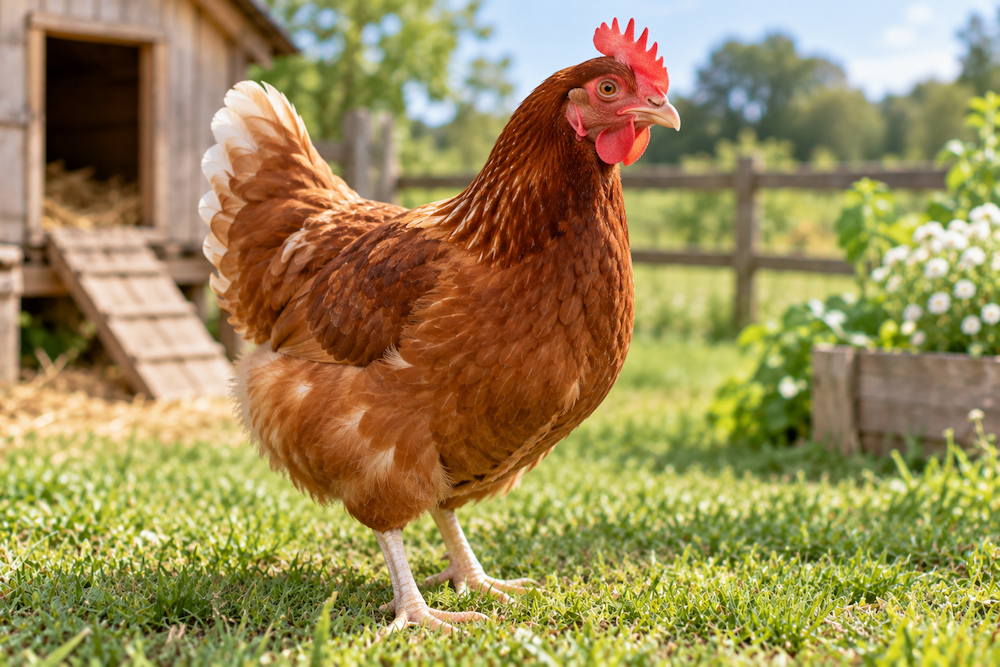







Friendly, fascinating and surprisingly full of personality, chickens can be rewarding pets as well as productive backyard companions.
🧠 QUICK SNAPSHOT
Temperament: Social, curious, alert and individual
Activity Level: Moderate
Size: Varies enormously by breed; roughly 0.5–5+ kg
Good With Families: Yes, with appropriate handling
Housing: Secure coop plus outdoor run or safe free-ranging area
Trainability: Better than many people expect
Grooming: Low, but housing requires regular cleaning
Best For: Families, backyard keepers, hobby farms and people wanting interactive outdoor pets
Lifespan: Commonly 5–10 years, sometimes longer
Social Needs: High — chickens should generally have chicken companions
Diet: Balanced poultry feed supplemented appropriately with greens, insects and suitable treats
📚 OVERVIEW
Chickens are far more interesting animals than their reputation sometimes suggests. They are social, intelligent birds capable of recognising individuals, learning routines, communicating with one another and developing distinct personalities.
Some become confident enough to follow their owners around the garden, respond when called and happily accept food from a hand. Others remain more cautious and prefer interacting at a distance.
Unlike most pets featured on EatWagLove, however, “chicken” isn’t a single breed. The domestic chicken (Gallus gallus domesticus) includes hundreds of breeds ranging from tiny bantams to enormous birds such as the Brahma and Jersey Giant.
Breed choice matters. Some chickens are prolific egg layers, others were developed primarily for meat, exhibition or ornamental purposes, while certain breeds have become especially popular as friendly backyard pets.
Chickens are flock animals and shouldn’t normally be kept alone. They also need considerably more than a small cage and some grain. A good setup provides a secure weatherproof coop, adequate ventilation, nesting areas, perches, outdoor space, protection from predators, nutritious food, fresh water and opportunities to scratch, forage and dust-bathe.
Given the right environment, chickens can become remarkably engaging animals to live with.
✅ PROS & CONS
Pros
- Can develop distinctive and entertaining personalities
- Many breeds become friendly with regular gentle handling
- Produce fresh eggs
- Fascinating natural social behaviour
- Relatively inexpensive to feed compared with many larger pets
- Don’t require walks
- Can forage for insects and vegetation
- Their manure can be composted for the garden
- Many breeds are suitable for families
- Available in an extraordinary variety of sizes, colours and appearances
- Can learn routines and recognise familiar people
- A well-managed backyard flock can be extremely rewarding
Cons
- Should generally be kept in a flock rather than alone
- Require secure housing against predators
- Coops need regular cleaning
- Chickens can damage gardens through scratching
- Some breeds can be noisy
- Roosters can be extremely loud and may be restricted by local regulations
- Veterinary care from an experienced avian or poultry vet may be difficult to access in some areas
- Chickens can carry parasites and infectious diseases
- Egg production naturally declines with age
- Owners need a plan for chickens after they stop laying regularly
- Extreme heat and cold can require additional management
- Local laws may restrict the number of chickens or prohibit roosters
Are Chickens Good Pets?
Yes. Chickens can make excellent pets for people able to provide suitable outdoor housing and companionship.
Individual chickens can become remarkably friendly, particularly when gently handled from a young age. Some will follow their owners, sit nearby, eat from their hands and actively seek interaction.
Their personalities also vary significantly. Within the same flock you may have a bold explorer, an enthusiastic food thief, a quiet observer and one bird apparently determined to supervise everything you do.
Are Chickens Good With Children?
Yes, many chickens can be wonderful animals for children.
Calm breeds and individual birds accustomed to gentle handling can teach children about animal care, responsibility and natural behaviour.
Children should learn to hold chickens securely without squeezing them and should wash their hands after handling chickens, eggs or anything from the coop.
Very young children should always be supervised.
What Are the Friendliest Chicken Breeds?
Several breeds have reputations for being particularly calm and people-friendly, including Silkies, Australorps, Orpingtons, Brahmas, Cochins and Sussex chickens.
However, breed isn’t everything.
Early handling, environment, individual personality and previous experiences can make two chickens of the same breed behave very differently.
How Much Space Do Chickens Need?
Chickens need enough room to move comfortably, perch, nest, scratch, forage and avoid one another when necessary.
Exact space requirements depend on breed size, flock size, climate and how much time birds spend outside their coop.
More usable space is generally better. Overcrowding increases stress, aggression, feather pecking, disease pressure and sanitation problems.
Do Chickens Need a Coop?
Yes. Chickens need a safe, dry and well-ventilated shelter.
A good coop provides protection from weather and predators and includes suitable perches and nesting boxes.
Ventilation is particularly important because moisture and ammonia can accumulate in poorly designed housing.
Do Chickens Need a Run?
Unless chickens can safely free-range, they should have access to a secure outdoor run.
The run allows natural behaviours such as scratching, foraging, sunbathing and dust-bathing while providing protection from predators.
Adding logs, branches, vegetation and other enrichment can make a run much more interesting.
Can Chickens Free Range?
Yes, but free-ranging comes with risks.
Chickens enjoy exploring, scratching and hunting insects, but free-ranging birds can encounter dogs, foxes, birds of prey, traffic, toxic plants and other hazards.
The safest arrangement depends heavily on the property and local predators.
How Many Chickens Should You Keep Together?
Chickens are highly social flock animals and shouldn’t normally be kept alone.
Keeping at least three is often practical because if one bird dies or requires temporary isolation, another chicken isn’t suddenly left completely alone.
Larger flocks can work extremely well when there is sufficient space and resources.
Do You Need a Rooster for Chickens to Lay Eggs?
No.
Hens lay eggs without a rooster.
A rooster is only required if you want the eggs to be fertilised for breeding.
This makes an all-female flock the most practical choice for many suburban households, particularly where local regulations restrict roosters.
How Often Do Chickens Lay Eggs?
Egg production varies enormously according to breed, age, nutrition, season, daylight and health.
Highly productive laying breeds may produce several eggs each week during their peak laying years, while ornamental or less productive breeds may lay considerably fewer.
Production usually decreases as a hen ages.
When Do Chickens Start Laying Eggs?
Many hens begin laying at approximately 18–24 weeks old, although breed and individual development make a significant difference.
Some lightweight laying breeds may start earlier, while large or slow-maturing breeds can take considerably longer.
Their first eggs may also be smaller than those produced once the hen fully matures.
How Long Do Chickens Live?
Backyard chickens commonly live around 5–10 years, although some survive considerably longer.
Breed, genetics, predators, disease, nutrition and living conditions all influence lifespan.
Importantly, a hen can live for years after her peak egg-producing period has passed.
Anyone keeping chickens as pets should therefore be prepared to care for them throughout retirement.
What Do Chickens Eat?
The foundation of a chicken’s diet should be a nutritionally complete poultry feed appropriate for its age and life stage.
Chickens also naturally eat seeds, vegetation and small invertebrates while foraging.
Kitchen scraps and treats can provide enrichment but shouldn’t replace balanced feed.
Laying hens also require adequate calcium for eggshell production.
Can Chickens Eat Fruit and Vegetables?
Yes. Chickens can eat many fruits and vegetables as occasional additions to a balanced diet.
Leafy greens, pumpkin, berries, melon and numerous other foods can provide useful enrichment.
However, not every human food is safe for chickens, and excessive treats can dilute the nutrition provided by their complete feed.
Do Chickens Need Grit?
Chickens that eat foods other than easily digested commercial feed may require access to insoluble grit.
Because chickens don’t have teeth, swallowed grit helps the muscular gizzard grind food.
This is different from calcium supplements such as oyster shell, which are provided to laying hens primarily as a calcium source.
Do Chickens Need Water Every Day?
Absolutely.
Chickens must have continuous access to clean, fresh drinking water.
Water consumption can increase dramatically during hot weather, making reliable water access particularly important in warm climates.
Even relatively short periods without water can affect health and egg production.
Why Do Chickens Take Dust Baths?
Dust bathing is an important natural behaviour.
A chicken will dig into loose, dry soil and vigorously work dust through its feathers.
This helps maintain feather condition and may assist with controlling external parasites and excess oil.
A suitable dry dust-bathing area should therefore be available to backyard chickens.
Do Chickens Recognise Their Owners?
Yes. Chickens can learn to recognise familiar people and associate particular humans with food, safety and routine.
Many quickly learn who normally arrives carrying treats.
Some chickens will approach their owners enthusiastically, follow them around and respond differently to familiar people than to strangers.
Are Chickens Intelligent?
Yes — considerably more than the expression “bird-brained” suggests.
Research into chicken cognition has demonstrated abilities involving learning, memory, social recognition, communication and problem-solving.
Their intelligence is adapted to life in a complex social flock rather than to performing the same tasks we traditionally use to judge dogs or primates.
Can Chickens Learn Their Names?
Some chickens can learn to respond consistently to a name or particular call, especially when it predicts food or another positive experience.
This doesn’t necessarily mean they understand a name exactly as humans do.
But chickens are very capable of learning sounds, routines and associations.
Can You Train a Chicken?
Yes.
Using food rewards, chickens can learn behaviours such as coming when called, following a target, entering their coop on cue and navigating simple tasks.
Their trainability can surprise people who have never spent much time around them.
Do Chickens Have a Pecking Order?
Yes — and this is where the famous expression “pecking order” actually comes from.
Chickens form social hierarchies in which individuals establish relationships and priority access to resources.
Some pecking and posturing is normal, particularly when new birds are introduced, but persistent bullying or injury requires intervention.
Do Chickens Talk to Each Other?
Yes. Chickens have a surprisingly varied repertoire of calls and signals.
Different vocalisations can be associated with food, contact, alarm, distress and other situations.
Hens also communicate with their chicks before hatching, and chicks can vocalise from inside the egg.
Why Do Roosters Crow?
Roosters crow to communicate territory, status and presence.
Although crowing is famously associated with sunrise, roosters don’t restrict themselves to a single morning performance.
They may crow repeatedly throughout the day in response to light, other roosters, activity and social cues.
Are Chickens Noisy?
Hens are usually considerably quieter than roosters, but they aren’t silent.
They cluck, chatter, call to one another and may produce a surprisingly enthusiastic “egg song” around laying.
Roosters can be extremely loud and may begin crowing early in the morning, which is why many suburban areas restrict them.
Can Chickens Fly?
Yes — but most domestic chickens are limited flyers.
Many can launch themselves onto fences, branches or roofs and cover short distances.
Lightweight breeds are generally more capable flyers than very heavy breeds such as Brahmas.
A chicken doesn’t need to fly like an eagle to end up exactly where you didn’t want it.
Do Chickens Need Perches?
Yes.
Chickens naturally prefer to roost above the ground at night, which historically helped their wild ancestors avoid some predators.
A coop should provide suitable perches that allow birds to roost comfortably without overcrowding.
Do Chickens Need Nesting Boxes?
Laying hens benefit from quiet, comfortable nesting boxes where they can lay their eggs.
Several hens may insist on using the same favourite box even when apparently identical empty boxes are available.
This is normal chicken logic and shouldn’t be interpreted as evidence that you didn’t provide enough boxes.
Can Chickens Live in Cold Weather?
Many breeds tolerate cold weather surprisingly well when they have a dry, sheltered and well-ventilated coop.
Cold-hardy breeds with substantial feathering can cope particularly well.
Frostbite can still affect combs and wattles in extreme conditions, and water must remain available rather than freezing.
Can Chickens Handle Hot Weather?
Heat can be a serious problem for chickens.
They don’t sweat like humans and rely heavily on behaviours such as panting and holding their wings away from their bodies to lose heat.
During hot weather they need shade, abundant cool drinking water and good ventilation.
Heavy and densely feathered breeds may struggle more in extreme heat.
What Are Common Health Problems in Chickens?
Chickens can experience mites and lice, internal parasites, respiratory disease, digestive problems, injuries and reproductive disorders.
Laying hens can also suffer conditions such as egg binding and reproductive tract disease.
Changes in appetite, activity, breathing, posture, droppings or egg production can indicate illness and warrant investigation.
Why Do Chickens Lose Their Feathers?
One common reason is moulting, a natural process in which chickens replace old feathers with new ones.
Feather loss can also result from parasites, nutritional problems, stress, mating damage or feather pecking by other chickens.
The pattern and circumstances of feather loss help determine whether it’s normal or a health concern.
Can Chickens Live With Other Pets?
Potentially, but interactions require careful management.
Some dogs and cats can learn to coexist peacefully with chickens, while others have strong prey drives and may seriously injure or kill them.
Chickens should always have a secure area that doesn’t depend on another animal behaving appropriately.
Do Chickens Need Vaccinations?
Vaccination requirements vary according to location, flock size, disease risk and how the birds were obtained.
Commercially raised chicks may already have received vaccinations against certain poultry diseases.
Backyard owners should obtain local veterinary or poultry-health advice rather than assuming every flock requires the same vaccination schedule.
Can You Keep Chickens in a Backyard?
Yes. Backyard chicken keeping is popular in many countries.
However, local council, municipal, zoning, strata or homeowners’ association rules may regulate flock numbers, coop placement and whether roosters are permitted.
Check the rules applying to your property before establishing a flock.
What Is the Best Chicken Breed for Beginners?
Calm, hardy breeds such as Australorps, Orpingtons, Sussex and Plymouth Rocks are frequently good choices for beginners.
The best breed also depends on climate, available space and whether the priority is eggs, companionship, appearance or a combination of these.
What Is a Bantam Chicken?
A bantam is a small chicken.
Some bantams are miniature versions of larger breeds, while others are true bantam breeds without a large equivalent.
Their smaller size makes them popular where space is limited, although they still require proper flock companionship and secure housing.
Where Do Domestic Chickens Come From?
Domestic chickens descend primarily from the red junglefowl (Gallus gallus) of South and Southeast Asia, with genetic contributions from other junglefowl populations.
Domestication occurred thousands of years ago, although research continues to refine exactly where, when and why the earliest domestication took place.
The wild ancestry remains surprisingly visible whenever a modern chicken scratches through leaves, searches for food or flies onto a perch to sleep.
Are Chickens Related to Dinosaurs?
Yes — and not merely in the loose sense sometimes suggested by popular culture.
Birds are living dinosaurs, belonging to the surviving lineage of theropod dinosaurs.
Chickens therefore share deep evolutionary ancestry with famous non-avian theropods such as Tyrannosaurus rex.
Your backyard hen isn’t descended directly from T. rex, but both occupy branches of the theropod evolutionary tree.
🔘 Thinking About Keeping Chickens?
Chickens can provide companionship, entertainment, fascinating natural behaviour and fresh eggs, but they need much more than a coop in the corner of the garden.
👉 Explore Chicken Care, Breeds & Pet Guides on EatWagLove