






Friendly, fascinating and full of personality, the Bearded Dragon is one of the world's most popular pet reptiles — but proper heat, UVB lighting and nutrition are essential to keeping one healthy.
🧠 QUICK SNAPSHOT
| Trait | Bearded Dragon |
|---|---|
| Scientific Name | Pogona vitticeps |
| Pet Type | Reptile / Lizard |
| Origin | Australia |
| Adult Size | Around 40–60 cm |
| Typical Lifespan | Around 8–15 years |
| Diet | Omnivore |
| Activity | Diurnal — active during the day |
| Temperament | Usually calm, curious and tolerant of handling |
| Housing | Large, secure, well-ventilated enclosure |
| Heat | Requires a proper temperature gradient and hot basking area |
| UVB Lighting | Essential |
| Social Needs | Usually best housed individually |
| Beginner Friendly? | Yes, with correct setup and research |
📚 OVERVIEW
The Central Bearded Dragon (Pogona vitticeps) is an Australian lizard that has become one of the world’s best-known pet reptiles.
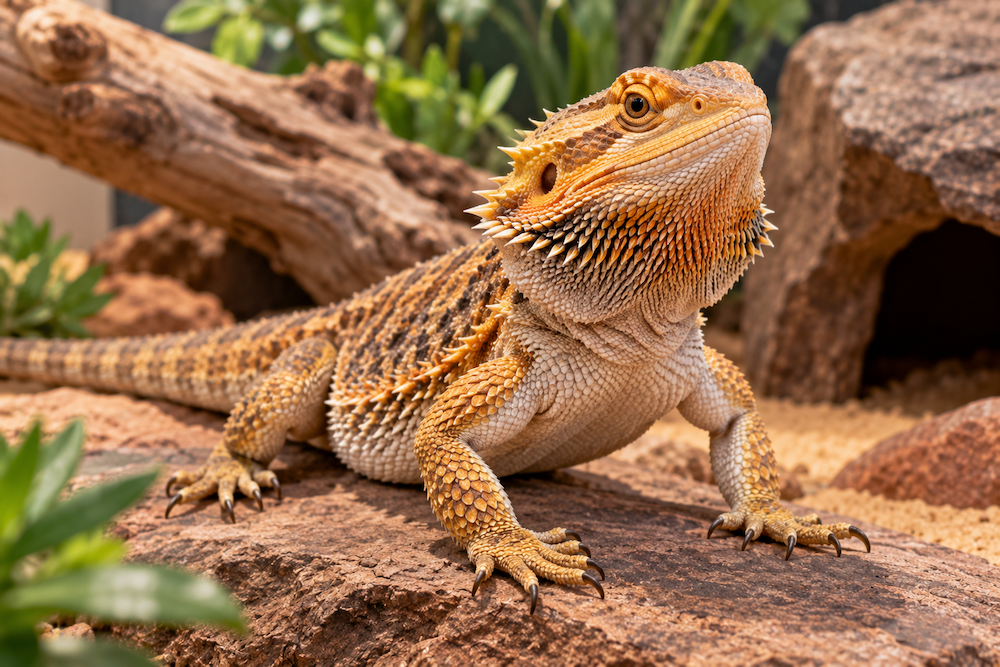
Bearded Dragons are famous for their triangular heads, spiky appearance and expandable throat — the “beard” that gives them their name. The beard can become darker and more prominent during communication, stress, courtship or territorial displays.
Despite their prehistoric appearance, captive-bred Bearded Dragons are often calm and relatively tolerant of human interaction. Many become comfortable being gently handled and learn familiar routines surrounding feeding and their owners’ presence.
They’re also diurnal, meaning they’re active during daylight hours. This makes them particularly interesting pets because owners can observe basking, climbing, feeding and exploring during the day rather than waiting for a nocturnal animal to wake up.
However, a Bearded Dragon isn’t simply a lizard that can be placed in a glass tank and fed insects.
Correct UVB exposure, basking temperatures, enclosure size, calcium intake and diet are fundamental to its health. Poor husbandry can result in serious problems, particularly metabolic bone disease.
With the right environment and care, a Bearded Dragon can be an engaging companion for well over a decade.
✅ PROS & CONS
Pros
- Usually calm and relatively easy to handle
- Active during the daytime
- Fascinating behaviour and body language
- Can become accustomed to regular human interaction
- Generally less demanding socially than dogs or cats
- Doesn’t require daily walks
- Relatively quiet
- Captive-bred animals are widely kept as pets
- Can live for more than a decade with excellent care
- Excellent reptile for owners willing to learn proper husbandry
Cons
- Requires specialised UVB lighting and heating
- Initial enclosure setup can be expensive
- Needs live insects as part of the diet, particularly when young
- Requires careful calcium and nutritional management
- Enclosure temperatures must be monitored accurately
- Incorrect husbandry can cause serious health problems
- Needs considerably more space than its small juvenile size suggests
- Veterinary care may require a reptile or exotic-pet veterinarian
- Long lifespan means a significant commitment
- Ownership laws and regulations vary between locations
Are Bearded Dragons Good Pets?
Yes. Bearded Dragons can make excellent pets for people prepared to provide the correct enclosure, lighting, heating and diet.
They’re generally calm, interesting to observe and more tolerant of handling than many reptiles.
However, they’re specialised exotic pets rather than low-maintenance pets.
Are Bearded Dragons Good Pets for Beginners?
Bearded Dragons are commonly recommended as beginner reptiles because of their generally manageable temperament and hardy nature under correct conditions.
The important qualification is that beginners must understand UVB lighting, temperature gradients, diet and calcium supplementation before bringing one home.
A simple tank with a heat lamp isn’t enough.
Are Bearded Dragons Good With Children?
Bearded Dragons can be fascinating pets for responsible children when an adult oversees their care.
They’re generally calmer than many reptiles and can tolerate gentle handling.
However, children should be taught correct handling and hand hygiene, and adults should remain responsible for ensuring the animal’s heating, lighting, feeding and veterinary needs are met.
How Long Do Bearded Dragons Live?
Pet Bearded Dragons commonly live around 8–15 years when properly cared for.
Diet, genetics, enclosure conditions, UVB exposure and veterinary care can all affect lifespan.
Buying one therefore represents a substantial long-term commitment.
How Big Do Bearded Dragons Get?
Adult Central Bearded Dragons commonly reach around 40–60 cm in total length, including the tail.
Males are often somewhat larger and more robust than females.
That cute little juvenile in a pet shop can therefore become a surprisingly substantial lizard.
How Big Should a Bearded Dragon Enclosure Be?
Adult Bearded Dragons require considerably more space than juveniles.
A commonly recommended minimum for an adult is around 120 × 60 × 60 cm (4 × 2 × 2 feet), although providing additional usable space can be beneficial.
The enclosure should allow the dragon to move between warmer and cooler areas and provide room for basking, climbing and exploration.
What Temperature Does a Bearded Dragon Need?
Bearded Dragons need a temperature gradient rather than one uniform enclosure temperature.
They require a hot basking area where they can raise their body temperature, alongside cooler areas where they can thermoregulate.
Temperatures should be measured using reliable digital thermometers and, where appropriate, an infrared temperature device rather than guessed.
Do Bearded Dragons Need UVB Light?
Yes. Appropriate UVB lighting is essential for Bearded Dragons.
UVB helps them synthesise vitamin D3 and properly utilise calcium.
Inadequate UVB exposure can contribute to metabolic bone disease and other serious health problems.
UVB bulbs also lose effectiveness over time, so they need replacement according to manufacturer recommendations even if they’re still producing visible light.
Do Bearded Dragons Need Heat at Night?
Healthy Bearded Dragons generally benefit from a natural nighttime temperature drop.
Additional overnight heating may only be necessary when the enclosure becomes too cold.
If supplemental nighttime heat is required, it should generally come from a heat source that doesn’t produce visible light rather than leaving a bright basking lamp operating throughout the night.
What Do Bearded Dragons Eat?
Bearded Dragons are omnivores.
Their diet can include appropriately sized live insects together with suitable leafy greens and vegetables.
Young dragons generally consume proportionally more animal-based food than adults, while mature dragons typically require a greater emphasis on plant material.
What Insects Can Bearded Dragons Eat?
Common feeder insects can include appropriately sized crickets, cockroaches, locusts and certain feeder larvae, depending on availability and local regulations.
Variety is preferable to relying permanently on a single feeder insect.
Insects should be appropriately sized and nutritionally managed before feeding.
What Vegetables Can Bearded Dragons Eat?
Adult Bearded Dragons can eat a variety of appropriate leafy greens and vegetables.
Good dietary variety is important, while foods excessively high in compounds that interfere with calcium availability shouldn’t dominate the diet.
A properly planned diet is preferable to simply feeding whatever vegetables happen to be in the refrigerator.
Do Bearded Dragons Need Calcium?
Yes. Calcium is extremely important.
Bearded Dragons require an appropriate balance of dietary calcium, vitamin D3 and UVB exposure for healthy bone development and maintenance.
Incorrect supplementation can also cause problems, so supplementation should be appropriate for the animal’s age, diet and lighting setup.
Do Bearded Dragons Drink Water?
Yes, although some may not frequently drink from a bowl.
They can obtain water through food and may drink droplets or moving water when offered appropriately.
Fresh water should be available, while enclosure humidity and hygiene should also be managed correctly.
Do Bearded Dragons Like Being Held?
Many captive-bred Bearded Dragons become comfortable with gentle handling.
Some will calmly sit on their owner’s hands, arms or lap.
However, tolerance varies between individuals, and handling should never be forced when the animal is displaying obvious stress.
Do Bearded Dragons Recognise Their Owners?
Bearded Dragons can learn to associate familiar people with food, handling and routine.
They may respond differently to familiar and unfamiliar people.
It’s better to think of this as recognition and learned association rather than assuming they experience human relationships exactly as mammals do.
Do Bearded Dragons Bite?
They can bite, but well-socialised captive Bearded Dragons generally aren’t known for frequent unprovoked biting.
Bites may occur when a dragon is frightened, stressed, handled incorrectly or mistakes fingers for food.
Understanding its body language helps reduce the risk.
Why Do Bearded Dragons Puff Out Their Beards?
A Bearded Dragon can expand its throat into the characteristic “beard” during communication.
This may occur during territorial displays, courtship, stress, fear or excitement.
The beard can also darken dramatically, making the display considerably more impressive.
Why Does a Bearded Dragon’s Beard Turn Black?
A dark or black beard can indicate stress, excitement, territorial behaviour, courtship or other forms of arousal.
Context matters.
Persistent colour changes accompanied by unusual behaviour, lethargy or other signs of illness should be investigated rather than automatically dismissed as normal communication.
Why Do Bearded Dragons Wave Their Arms?
Bearded Dragons sometimes perform a distinctive slow arm-waving behaviour.
It’s generally interpreted as a social signal and can be associated with submission or acknowledgement of another dragon.
It’s one of the species’ most recognisable behaviours.
Why Do Bearded Dragons Bob Their Heads?
Head bobbing is another form of Bearded Dragon communication.
Rapid or pronounced head bobbing is commonly associated with dominance, territorial displays and courtship, particularly in males.
The meaning depends on the situation and other body-language signals.
Can Bearded Dragons Change Colour?
Yes. Bearded Dragons can alter the darkness and intensity of parts of their body.
Colour changes can relate to temperature regulation, communication, stress and physiological state.
Darkening the body can help absorb heat more effectively while basking.
Do Bearded Dragons Sleep?
Yes. Bearded Dragons sleep at night and are primarily active during the day.
They should have a regular day-night lighting cycle that reflects their natural diurnal behaviour.
They may choose a favourite sleeping location within the enclosure.
What Is Brumation in Bearded Dragons?
Brumation is a reptile dormancy-like period somewhat comparable to hibernation.
During cooler seasonal conditions, some adult Bearded Dragons may become less active, eat less and spend extended periods resting.
Because illness can produce similar symptoms, unexplained lethargy or appetite loss shouldn’t automatically be assumed to be brumation.
Can Bearded Dragons Live Together?
It’s generally safest to house pet Bearded Dragons individually.
They don’t need another Bearded Dragon for companionship in the way many social mammals do.
Co-housing can result in competition, chronic stress, bullying and serious injuries, even when animals initially appear to tolerate each other.
What Health Problems Are Common in Bearded Dragons?
Potential health problems include metabolic bone disease, nutritional disorders, parasites, respiratory infections, impaction and reproductive problems.
Many preventable illnesses are closely linked to incorrect husbandry.
Finding a veterinarian experienced with reptiles before an emergency occurs is a sensible precaution.
What Is Metabolic Bone Disease in Bearded Dragons?
Metabolic bone disease is a serious condition involving abnormal bone development or weakening, often associated with inadequate calcium, inappropriate UVB exposure or nutritional imbalance.
Signs can include weakness, tremors, swollen or deformed limbs and difficulty moving.
Correct husbandry is critical to prevention.
Do Bearded Dragons Carry Salmonella?
Like many reptiles, Bearded Dragons can carry Salmonella bacteria without appearing sick.
Owners should wash their hands thoroughly after handling the dragon, its food or enclosure.
Reptiles and their equipment should also be kept away from areas where human food is prepared.
Where Do Bearded Dragons Come From?
Bearded Dragons are native to Australia.
The Central Bearded Dragon inhabits relatively dry environments including woodland, scrub and semi-arid regions.
Their natural environment helps explain their dependence on strong light, warmth and opportunities to bask.
Can You Keep a Bearded Dragon as a Pet in Australia?
Bearded Dragon ownership in Australia is subject to state and territory wildlife regulations, and requirements can differ depending on where you live and the species involved.
Prospective owners should check the current rules with their relevant wildlife authority before obtaining one.
Australian native reptiles shouldn’t simply be taken from the wild.
What Makes the Bearded Dragon Unique?
The Bearded Dragon is one of those animals that looks considerably more intimidating than it usually behaves.
It has spikes, claws, a triangular head and a throat capable of expanding into a dark, dramatic beard.
It looks like a miniature dragon.
Then it starts waving.
Bearded Dragons communicate using an extraordinary collection of visual signals, including arm waving, head bobbing, beard displays and colour changes. They’re also daytime-active animals that bask openly, investigate their surroundings and can become accustomed to familiar human routines.
That combination helps explain why they’ve become such popular reptiles.
But perhaps the greatest Bearded Dragon contradiction is this:
It has spent millions of years evolving the appearance of a tiny prehistoric monster…
only to become famous for sitting calmly under a heat lamp and occasionally waving at everyone.
Discover more about the Bearded Dragon’s behaviour, care, history and the fascinating adaptations that make this Australian reptile such an extraordinary animal.
Watch our Bearded Dragon video and discover what life with one is really like.