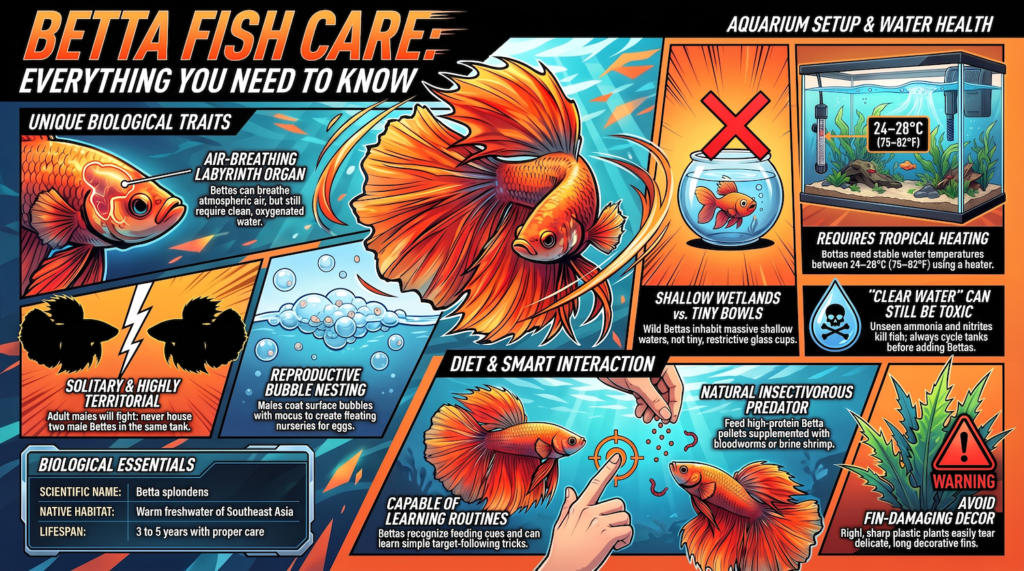
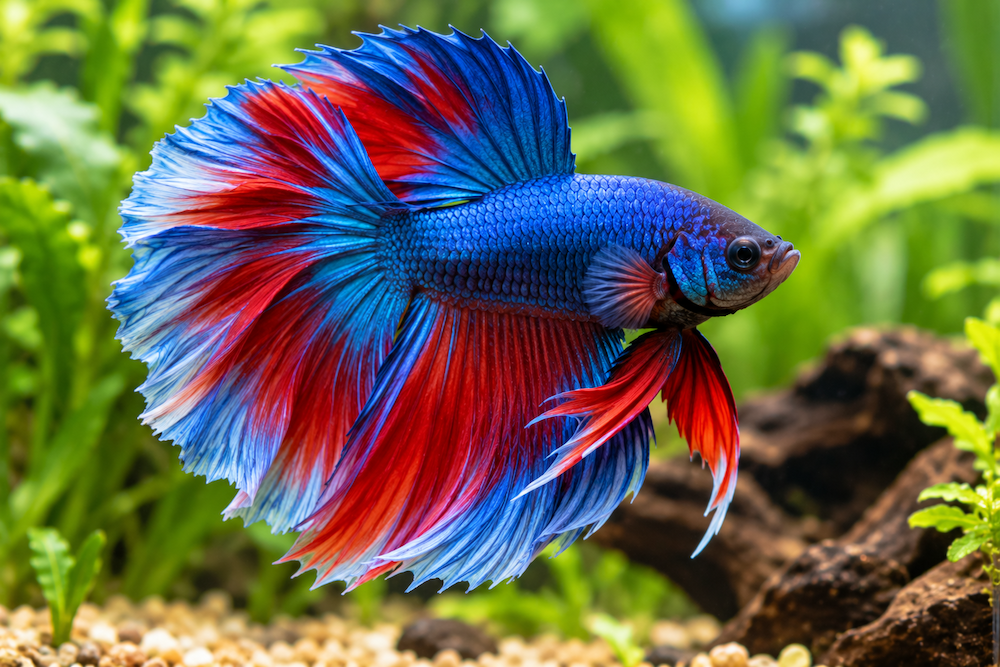







Brilliantly coloured, surprisingly intelligent and packed with personality, the Betta Fish is one of the world's most popular aquarium pets — but the idea that it can happily live in a tiny bowl is one of the biggest myths in fishkeeping.
🧠 QUICK SNAPSHOT
| Trait | Betta Fish |
|---|---|
| Scientific Name | Betta splendens |
| Other Names | Siamese Fighting Fish |
| Pet Type | Freshwater tropical fish |
| Origin | Southeast Asia |
| Typical Lifespan | Around 3–5 years |
| Adult Size | Usually around 5–7 cm body length |
| Diet | Primarily carnivorous / insectivorous |
| Water Temperature | Tropical — typically around 24–28°C |
| Temperament | Curious and territorial |
| Activity | Active during the day |
| Tank Requirement | Heated, filtered, cycled aquarium |
| Social Needs | Can live alone |
| Difficulty | Beginner-friendly with correct aquarium care |
| Famous Feature | Spectacular colours and fins |
📚 OVERVIEW
Few aquarium fish are as instantly recognisable as the Betta Fish (Betta splendens).
Also called the Siamese Fighting Fish, Bettas originate from Southeast Asia and are famous for their extraordinary colours, elaborate fins and territorial behaviour.
Generations of selective breeding have produced domestic Bettas in a spectacular range of colours and fin shapes that look dramatically different from their wild ancestors.
But their beauty has also contributed to one of the most persistent misconceptions in the pet world:
A Betta doesn’t belong in a tiny decorative bowl.
Bettas are tropical fish that benefit from a properly heated, filtered and cycled aquarium with enough room to swim, explore and display natural behaviour.
Their reputation for surviving in small amounts of water partly comes from an extraordinary adaptation.
Bettas possess a specialised labyrinth organ, allowing them to breathe atmospheric oxygen directly from the surface in addition to using their gills. This helps wild Bettas survive in warm, shallow and sometimes oxygen-poor environments.
But surviving difficult conditions isn’t the same as thriving in captivity.
Given appropriate housing, Bettas reveal another side of themselves.
They’re curious, observant and surprisingly interactive fish. Many learn to approach when their owner appears, anticipate feeding and investigate changes within their aquarium.
Some can even be trained to perform simple behaviours.
For such a small fish, the Betta has an extraordinary amount of personality.
✅ PROS & CONS
Pros
- Spectacular colours and fin varieties
- Can be kept individually
- Surprisingly intelligent and interactive
- Doesn’t require an enormous aquarium
- Relatively quiet!
- Fascinating natural behaviour
- Can learn feeding routines
- Suitable for beginner fishkeepers who learn proper aquarium care
- Available in many colours and forms
- Doesn’t need another Betta for companionship
- Can live several years with good care
Cons
- Tiny bowls and unheated containers are unsuitable
- Requires a properly cycled aquarium
- Needs tropical water temperatures
- Water quality must be monitored
- Male Bettas are highly territorial towards other males
- Long-finned varieties can suffer fin damage
- Some individuals may attack tank mates
- Prone to health problems when water quality is poor
- Overfeeding can cause problems
- Beautiful appearance sometimes leads to impulse purchases without proper preparation
Are Betta Fish Good Pets?
Yes. Bettas can make excellent aquarium pets.
They’re colourful, relatively manageable and often much more interactive than people expect from a fish.
Their care is straightforward once the aquarium is properly established, but they shouldn’t be treated as disposable pets that can live permanently in tiny bowls.
Are Betta Fish Good for Beginners?
Yes. Bettas can be good beginner fish provided the owner first learns basic aquarium care.
Understanding the nitrogen cycle, water testing, filtration, heating and appropriate feeding is more important than simply buying a fish and adding it to tap water.
A properly established aquarium makes Betta care considerably easier.
How Long Do Betta Fish Live?
Betta Fish commonly live around 3–5 years with good care.
Some individuals can live longer.
Genetics, water quality, temperature, nutrition and the age of the fish when purchased can all influence lifespan.
How Big Do Betta Fish Get?
Adult Betta splendens usually have a body length of around 5–7 cm, excluding particularly long fins.
Some selectively bred forms appear considerably larger because of their elaborate finnage.
There are also giant Betta lines that can grow larger than typical domestic Bettas.
What Size Tank Does a Betta Fish Need?
A Betta should have a proper aquarium rather than a bowl or tiny container.
A tank of around 20 litres (5 US gallons) or larger is a widely used practical starting point for a single Betta.
Larger aquariums can provide more swimming space and often maintain stable water conditions more easily than extremely small tanks.
Can Betta Fish Live in a Bowl?
A bowl isn’t an appropriate permanent home for a Betta.
Small bowls provide limited swimming space and can experience rapid changes in temperature and water quality.
A heated, filtered and properly cycled aquarium provides a much healthier and more stable environment.
Do Betta Fish Need a Filter?
Yes, filtration is strongly recommended.
A filter helps process waste and supports the beneficial bacteria responsible for the aquarium’s biological filtration.
Because Bettas aren’t powerful swimmers, excessively strong currents should be avoided.
Do Betta Fish Need a Heater?
In most homes, yes.
Bettas are tropical fish and generally thrive at water temperatures around 24–28°C.
A thermostatically controlled aquarium heater helps maintain a stable temperature rather than allowing the water to fluctuate with room conditions.
Do Betta Fish Need a Light?
Bettas benefit from a regular day-night cycle.
An aquarium light can support this routine and is particularly important when keeping live aquatic plants.
The light shouldn’t remain on continuously because fish also require a normal period of darkness.
What Water Temperature Do Betta Fish Need?
A temperature of approximately 24–28°C is generally appropriate for domestic Bettas.
Consistent temperature is important.
Water that’s persistently too cold can reduce activity and interfere with normal physiological function.
What Is the Aquarium Nitrogen Cycle?
The nitrogen cycle is the biological process that allows beneficial bacteria to convert toxic fish waste into less harmful compounds.
In a new aquarium, ammonia produced by waste can accumulate dangerously before sufficient bacteria become established.
This is why cycling an aquarium before adding a Betta is such an important part of responsible fishkeeping.
How Often Should You Change a Betta Fish’s Water?
Regular partial water changes are essential, but frequency depends on tank size, filtration, stocking and water-test results.
Many established aquariums benefit from weekly partial changes.
Replacing all the water unnecessarily can destabilise the aquarium and isn’t the same as maintaining good water quality.
What Do Betta Fish Eat?
Bettas are primarily carnivorous or insectivorous fish.
A high-quality Betta food formulated around appropriate animal proteins can form the foundation of the diet.
Suitable frozen or live foods can provide additional variety.
How Often Should You Feed a Betta Fish?
Adult Bettas are commonly fed small portions once or twice daily.
Overfeeding is a common problem.
The appropriate amount depends on the food, fish and feeding schedule, so owners should avoid simply adding large quantities because the Betta continues to appear interested.
Can Betta Fish Eat Tropical Fish Flakes?
Some Bettas will eat suitable flakes, but food specifically formulated for Bettas is generally a better primary option.
Bettas naturally consume animal-based foods and need an appropriately protein-rich diet.
Pellets, frozen foods and suitable live foods can provide useful variety.
Can Betta Fish Live Alone?
Yes. A Betta can live perfectly well alone.
Unlike genuinely social schooling fish, Bettas don’t require another Betta for companionship.
A stimulating aquarium with plants, hiding places and appropriate enrichment is more important than providing another Betta.
Can Two Male Betta Fish Live Together?
No. Male Betta splendens shouldn’t normally be housed together in the same aquarium.
They’re strongly territorial and may fight severely, potentially causing serious injury or death.
This behaviour is responsible for the species’ familiar name, Siamese Fighting Fish.
Can Male and Female Betta Fish Live Together?
Male and female Bettas shouldn’t normally be permanently housed together simply for companionship.
Courtship and breeding interactions can become aggressive, and both fish may be injured.
Breeding Bettas requires specialist preparation and shouldn’t be attempted casually.
Can Female Betta Fish Live Together?
Female Bettas can sometimes be maintained in carefully managed groups commonly called sororities, but this isn’t a beginner setup.
Aggression can still occur and individual personalities vary greatly.
Keeping females separately is considerably simpler and safer for inexperienced fishkeepers.
Can Betta Fish Live With Other Fish?
Sometimes.
A Betta’s compatibility with other fish depends heavily on individual temperament, tank size, layout and the species involved.
Peaceful tank mates that don’t resemble Bettas or nip long fins may work in sufficiently large aquariums.
Some Bettas, however, simply prefer living alone.
Can Betta Fish Live With Shrimp?
Sometimes, but there’s no guarantee.
Some Bettas ignore shrimp completely.
Others discover that their expensive new tank mates are conveniently packaged snacks.
Dense planting and hiding places may improve the shrimp’s chances, but the individual Betta’s temperament is critical.
Do Betta Fish Fight?
Yes. Bettas are territorial, particularly adult males confronting other males.
Selective breeding historically intensified fighting behaviour in some lines.
They may also display aggression towards other fish they perceive as competitors.
Why Do Betta Fish Flare Their Gills?
Bettas flare by extending their gill covers and fins to make themselves appear larger and more intimidating.
This is commonly a territorial display.
A Betta may flare at another fish, its own reflection or occasionally unfamiliar objects.
Why Are Betta Fish Called Siamese Fighting Fish?
The name reflects the species’ history in Siam, now Thailand, where Bettas were traditionally kept and selectively bred for fighting.
People wagered on contests between male fish.
Modern ornamental Bettas have also been selectively bred extensively for colour, finnage and appearance.
Can Betta Fish Breathe Air?
Yes.
Bettas possess a specialised structure called a labyrinth organ that allows them to breathe atmospheric oxygen from the water’s surface.
You’ll therefore regularly see a healthy Betta swim upwards and take a gulp of air.
If Bettas Can Breathe Air, Do They Still Need Clean Water?
Absolutely.
The labyrinth organ helps Bettas obtain oxygen, but it doesn’t protect them from ammonia, nitrite, poor water quality or inappropriate temperatures.
The ability to breathe atmospheric air is an adaptation — not permission to keep them in dirty water.
Why Do Betta Fish Make Bubble Nests?
Male Bettas often construct bubble nests at the water’s surface.
During breeding, fertilised eggs can be placed within the nest, where the male tends them.
A male may build bubble nests even when no female is present.
Does a Bubble Nest Mean My Betta Is Happy?
Not necessarily.
Bubble-nest construction is primarily associated with reproductive behaviour, rather than being a reliable measurement of happiness.
A Betta can build one under less-than-perfect conditions, while a healthy Betta may not build one at all.
Are Betta Fish Smart?
Yes. Bettas show impressive learning ability for such small animals.
They can learn feeding routines, associate people with food and respond to environmental cues.
With reward-based training, some Bettas can learn simple behaviours.
Do Betta Fish Recognise Their Owners?
Bettas can learn to associate familiar people with feeding and other predictable events.
Many approach the front of the aquarium when their regular caregiver appears.
It’s reasonable to describe this as recognition and learned association without assuming the fish experiences the relationship exactly like a dog or cat.
Can You Train a Betta Fish?
Yes.
Bettas can be trained using food rewards to perform simple behaviours such as following a target, swimming through a hoop or approaching a particular location.
Training also provides enrichment and demonstrates just how capable fish can be of learning.
Do Betta Fish Sleep?
Yes.
Bettas sleep and rest, often choosing leaves, decorations, the substrate or sheltered areas of the aquarium.
Because fish don’t close their eyes like humans, a resting Betta can occasionally alarm new owners who think something is wrong.
Why Is My Betta Fish Lying on a Leaf?
It may simply be resting.
Long-finned Bettas in particular may appreciate broad plant leaves or other safe surfaces close to the water’s surface.
However, persistent lethargy combined with loss of appetite, abnormal breathing or other symptoms can indicate illness or poor water conditions.
Do Betta Fish Need Plants?
Plants aren’t absolutely essential, but they can greatly improve a Betta aquarium.
Live or soft artificial plants provide cover, resting areas and environmental complexity.
Sharp plastic decorations should be avoided because delicate fins can be damaged.
Why Do Betta Fish Have Such Large Fins?
The extremely elaborate fins seen on many pet Bettas are largely the result of selective breeding by humans.
Wild-type Bettas have much shorter fins.
Long fins may be beautiful, but they can make swimming more demanding and are more vulnerable to tearing and damage.
What Types of Betta Fish Are There?
Selective breeding has produced many ornamental forms, including Bettas commonly described as:
- Veiltail
- Crowntail
- Halfmoon
- Plakat
- Double Tail
- Rosetail
- Dumbo or Elephant Ear
These terms generally describe fin shapes or physical characteristics rather than separate species.
What Colours Do Betta Fish Come In?
Domestic Bettas occur in an extraordinary range of colours and patterns, including red, blue, turquoise, white, black, yellow, orange, metallic and multicoloured combinations.
Selective breeding has also produced marble, koi-like, butterfly and dragon-scale patterns.
Few commonly kept fish display such enormous visual variety within one species.
Where Do Betta Fish Come From?
Betta splendens originates in Southeast Asia, particularly the region encompassing Thailand and neighbouring countries.
Its ancestors inhabited warm, shallow freshwater environments such as floodplains, marshes, canals and rice-growing landscapes.
Domestic ornamental Bettas have since been selectively bred far beyond their wild appearance.
Do Betta Fish Live in Tiny Puddles in the Wild?
This is an oversimplification.
Wild Bettas can inhabit shallow, slow-moving and seasonally changing waters, but shallow doesn’t necessarily mean tiny.
Rice paddies, wetlands, floodplains and interconnected waterways can cover enormous areas.
The species’ ability to survive temporary harsh conditions shouldn’t be used to justify permanent confinement in a tiny container.
Is a Betta Fish a Good First Pet?
A Betta can be an excellent first aquarium pet if the aquarium comes first and the fish comes second.
Set up an appropriately sized tank.
Add heating and gentle filtration.
Cycle it properly.
Learn how to test the water.
Then add the Betta.
Approached that way, keeping a Betta can provide an excellent introduction to responsible fishkeeping.
What Makes the Betta Fish Unique?
The Betta Fish has one of the strangest reputations in the pet world.
It’s simultaneously treated as an extraordinarily beautiful ornamental animal…
and as something that can supposedly spend its entire life in a container barely larger than a drinking glass.
The real Betta is much more interesting.
It can breathe atmospheric air using a labyrinth organ, build floating bubble nests, recognise feeding routines, learn simple behaviours and communicate through spectacular territorial displays.
Humans then took an already remarkable fish and selectively bred it into an astonishing collection of colours and fin shapes.
Give a Betta a proper planted aquarium and something else becomes obvious.
It doesn’t just sit there looking pretty.
It patrols.
It investigates.
It watches.
And when its favourite human approaches, it may race straight to the front of the aquarium.
For a fish sometimes sold as a decoration, the Betta has a remarkable habit of behaving much more like a tiny aquatic personality.
Discover how Bettas breathe air, why males build bubble nests, whether they really recognise their owners and how the Siamese Fighting Fish became one of the world’s most spectacular aquarium pets.
Watch our Betta Fish video and discover what this extraordinary little fish is really capable of.