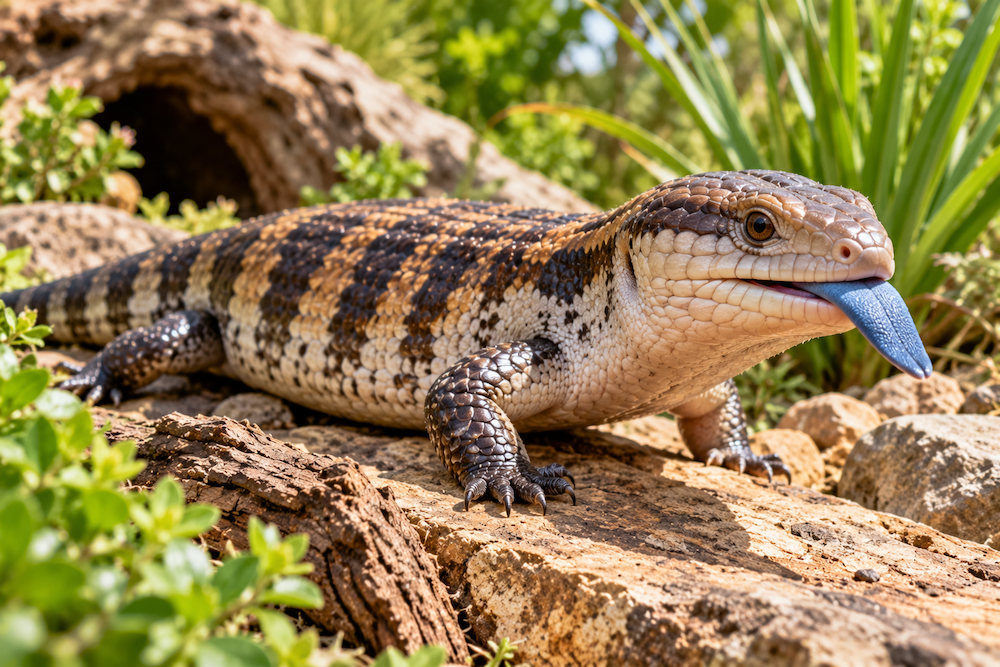







Stocky, intelligent and equipped with one of the reptile world's most spectacular tongues, the Blue-Tongued Skink is a fascinating companion lizard.
🧠 QUICK SNAPSHOT
| Trait | Blue-Tongued Skink |
|---|---|
| Scientific Genus | Tiliqua |
| Pet Type | Reptile / Lizard |
| Natural Range | Australia, New Guinea and nearby islands |
| Typical Lifespan | Around 15–20+ years |
| Adult Length | Commonly around 40–60 cm |
| Diet | Omnivore |
| Activity | Primarily diurnal |
| Temperament | Generally calm, curious and independent |
| Housing | Large terrestrial enclosure |
| UVB Lighting | Recommended |
| Social Needs | Generally solitary |
| Beginner Friendly? | Moderate |
| Famous Feature | Brilliant blue tongue |
📚 OVERVIEW
Blue-Tongued Skinks are a group of large, heavily built lizards belonging to the genus Tiliqua. Several species and subspecies are kept as pets, so exact size, appearance and husbandry requirements can vary.
Their most famous feature is impossible to miss: a vivid blue tongue that can be displayed dramatically when the lizard feels threatened.
Unlike highly arboreal reptiles, Blue-Tongued Skinks spend much of their time on the ground, exploring, burrowing and searching for food. They’re omnivorous and require a carefully balanced diet containing appropriate plant and animal foods.
Many become calm with regular gentle interaction, but their considerable adult size and potential lifespan of 20 years or more make them a significant commitment.
✅ PROS & CONS
Pros
- Extraordinary blue tongue
- Generally calm with appropriate handling
- Intelligent and curious
- Active during the daytime
- Doesn’t require same-species companionship
- Fascinating feeding and foraging behaviour
- Robust, substantial body size
- Can live for 20 years or longer
Cons
- Requires a large terrestrial enclosure
- Long-term commitment
- Needs carefully managed heating and lighting
- Diet requires more planning than some reptiles
- Can deliver a powerful bite if frightened
- Strong claws can scratch during handling
- Some types have different humidity requirements
- Reptile-experienced veterinary care may be needed
Are Blue-Tongued Skinks Good Pets?
Yes. Blue-Tongued Skinks can make excellent companion reptiles for owners prepared to provide appropriate housing and husbandry.
Many become calm and tolerant of gentle handling, while their daytime activity makes them interesting animals to observe.
Are Blue-Tongued Skinks Good for Beginners?
They can be suitable for a well-prepared beginner, although they’re more demanding than some smaller reptiles.
Their large enclosure, heating, lighting, diet and long lifespan need to be properly planned before bringing one home.
How Long Do Blue-Tongued Skinks Live?
Blue-Tongued Skinks can commonly live around 15–20 years, with some individuals potentially living longer under excellent captive care.
They’re therefore a very long-term pet.
How Big Do Blue-Tongued Skinks Get?
Size varies between species and subspecies, but many adults reach approximately 40–60 cm in total length.
Their bodies are broad and heavy, with relatively short legs, making them look substantially larger than many similarly long lizards.
Why Do Blue-Tongued Skinks Have Blue Tongues?
The brilliant tongue is primarily thought to function as a defensive warning display.
When threatened, a skink may open its mouth widely, hiss and expose the intense blue tongue, creating a sudden visual signal designed to startle or discourage a predator.
Are Blue-Tongued Skinks Venomous?
No. Blue-Tongued Skinks aren’t venomous.
Their main defences include camouflage, their powerful jaws and the dramatic open-mouth display featuring that unmistakable blue tongue.
Do Blue-Tongued Skinks Bite?
They can, particularly when frightened, stressed or handled improperly.
Because adults have powerful jaws, a defensive bite can be painful.
Learning the skink’s body language and using calm handling greatly reduces the likelihood of being bitten.
Do Blue-Tongued Skinks Like Being Handled?
Many captive Blue-Tongued Skinks become comfortable with regular gentle handling.
They should be fully supported along their body rather than allowed to dangle, and interactions should initially be short and calm.
Individual temperament varies.
Are Blue-Tongued Skinks Affectionate?
They’re better described as becoming comfortable and trusting around familiar people rather than affectionate in the mammalian sense.
Some individuals willingly approach their owners and appear relaxed during interaction.
What Do Blue-Tongued Skinks Eat?
Blue-Tongued Skinks are omnivores and require a varied diet containing suitable vegetables, leafy foods and animal-based protein.
The exact balance can vary with age and species.
A diet consisting only of insects or only of fruit isn’t appropriate.
Can Blue-Tongued Skinks Eat Fruit?
Suitable fruits can be offered in limited quantities as part of a balanced diet.
Fruit shouldn’t dominate the diet because of its relatively high sugar content.
Variety and overall nutritional balance are more important than any single favourite food.
Do Blue-Tongued Skinks Need Live Insects?
Live insects can provide useful nutrition and enrichment, but they aren’t necessarily the only appropriate protein source in a well-designed captive diet.
Any insects offered should be appropriately sized and safely sourced.
Do Blue-Tongued Skinks Need UVB?
Providing appropriate UVB lighting is recommended as part of good captive husbandry.
UVB supports natural vitamin D3 production and calcium metabolism.
Lighting needs to be correctly positioned and replaced according to manufacturer guidance.
Do Blue-Tongued Skinks Need a Heat Lamp?
Yes. As ectothermic reptiles, Blue-Tongued Skinks depend on environmental heat to regulate their body temperature.
Their enclosure should provide a suitable basking area and temperature gradient, allowing the animal to move between warmer and cooler zones.
What Size Enclosure Does a Blue-Tongued Skink Need?
Adults need a substantial terrestrial enclosure with enough floor space to walk, turn, explore, burrow and thermoregulate naturally.
Because they’re primarily ground-dwelling, horizontal floor area is particularly important.
Do Blue-Tongued Skinks Like to Burrow?
Yes. Many Blue-Tongued Skinks naturally dig and burrow.
Providing an appropriate depth of safe substrate allows them to express this behaviour and creates additional hiding opportunities.
Don’t be surprised if your expensive lizard occasionally chooses to disappear completely underground.
Can Blue-Tongued Skinks Climb?
They can negotiate low objects, rocks and logs, but they’re primarily terrestrial rather than specialised climbers.
Their short legs and heavy bodies are far better suited to exploring the ground than scaling tall branches.
Are Blue-Tongued Skinks Active During the Day?
Yes. Blue-Tongued Skinks are primarily diurnal, making them appealing to owners who want to observe their reptile during daylight hours.
They may spend parts of the day basking, exploring, feeding or hiding.
Can Blue-Tongued Skinks Live Together?
They’re generally best housed individually.
Blue-Tongued Skinks don’t need another skink for companionship, and housing adults together can result in stress, competition or serious aggression.
Why Does My Blue-Tongued Skink Hiss?
Hissing is usually a defensive signal.
A frightened skink may flatten or inflate its body, open its mouth, hiss and display its blue tongue.
It’s communicating that it feels threatened and would prefer more space.
Why Does My Blue-Tongued Skink Sneeze?
Occasional sneezing can help a skink clear particles of substrate or debris from its nostrils, particularly after burrowing.
Frequent sneezing accompanied by discharge, abnormal breathing or other symptoms can indicate a health problem and warrants veterinary attention.
Do Blue-Tongued Skinks Shed Their Skin?
Yes.
Like other reptiles, Blue-Tongued Skinks periodically shed their outer skin as they grow and renew it.
Unlike snakes, they generally shed in patches rather than one complete piece.
Do Blue-Tongued Skinks Drop Their Tails?
They can lose part of the tail as a defensive mechanism, although tail dropping isn’t something owners should ever attempt to trigger.
The tail can regrow to some degree, but the regenerated section may look different from the original.
What Health Problems Are Common in Blue-Tongued Skinks?
Potential concerns include metabolic bone disease, obesity, respiratory infections, parasites, skin problems and nutritional disorders.
Correct lighting, temperature, humidity and diet prevent many husbandry-related problems.
Why Is My Blue-Tongued Skink Not Eating?
Appetite can change because of temperature, seasonal behaviour, stress, shedding or illness.
If appetite loss is prolonged or accompanied by weight loss, lethargy or other symptoms, veterinary assessment is appropriate.
Correct enclosure temperatures should also be checked.
Are There Different Types of Blue-Tongued Skinks?
Yes. The genus Tiliqua contains several species and subspecies.
Examples include Northern, Eastern, Centralian, Western and Indonesian-associated Blue-Tongued Skinks, among others.
Appearance, adult size, natural environment and husbandry requirements can differ, so owners should know exactly which type they’re keeping.
Where Do Blue-Tongued Skinks Come From?
Blue-Tongued Skinks occur naturally across Australia, New Guinea and nearby islands, depending on species.
They inhabit environments ranging from relatively dry regions to more humid habitats.
This variation is one reason husbandry shouldn’t be identical for every Blue-Tongued Skink.
Are Blue-Tongued Skinks Legal to Keep as Pets?
Regulations vary considerably around the world.
Some countries or regions restrict particular species, require permits or prohibit ownership, so prospective owners should check current local regulations before obtaining one.
Is a Blue-Tongued Skink a Good First Reptile?
It can be an excellent first larger lizard for someone prepared to research its needs.
Their generally manageable temperament is appealing, but owners must provide substantial housing, correct heating and lighting, balanced nutrition and potentially two decades of care.
What Makes the Blue-Tongued Skink Unique?
At first glance, the Blue-Tongued Skink doesn’t look particularly intimidating.
It’s low to the ground.
Its legs seem almost comically small compared with its chunky body.
Then something frightens it.
The mouth opens.
The animal hisses.
And suddenly you’re looking at an astonishing electric-blue tongue.
That flash of colour isn’t there for decoration. It’s part of an elaborate defensive display designed to make a potential predator reconsider its plans.
And if the warning works?
The skink doesn’t need to fight.
It can return to the important business of exploring, burrowing and searching for food.
They’re also unusual-looking movers. Those short legs carry a surprisingly substantial body, creating an unmistakable side-to-side walking style.
It’s a lizard built like a sausage, armed with a blue warning flag — and somehow the whole design works brilliantly.
Discover why Blue-Tongued Skinks have brilliant blue tongues, how they use them against predators, why these chunky lizards love to burrow and what it’s really like to keep one as a companion reptile.
Watch our Blue-Tongued Skink video and discover what makes this extraordinary lizard so distinctive.