






Small, hardy and full of determination, the Russian Tortoise is a fascinating land-dwelling reptile with a surprisingly big personality.
🧠 QUICK SNAPSHOT
| Trait | Russian Tortoise |
|---|---|
| Scientific Name | Testudo horsfieldii |
| Other Names | Horsfield’s Tortoise, Central Asian Tortoise |
| Pet Type | Reptile / Land tortoise |
| Natural Range | Central Asia |
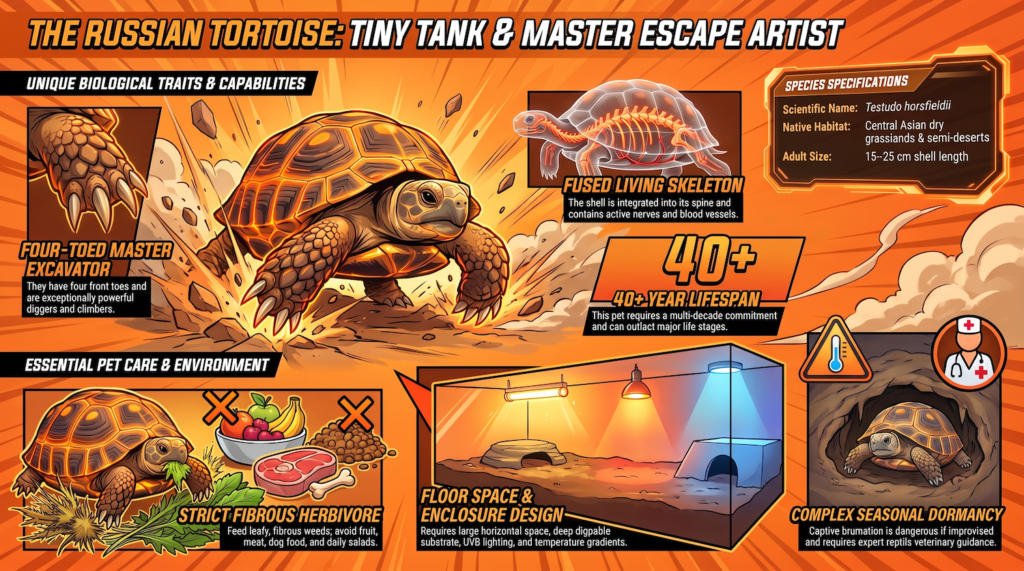
| Typical Lifespan | 40+ years possible |
| Adult Shell Length | Commonly around 15–25 cm |
| Diet | Herbivore |
| Activity | Diurnal |
| Temperament | Curious, active and independent |
| Housing | Spacious terrestrial enclosure |
| UVB Lighting | Essential |
| Social Needs | Generally best housed individually |
| Beginner Friendly? | Moderate |
| Famous Feature | Powerful digging ability and four toes on each foot |
📚 OVERVIEW
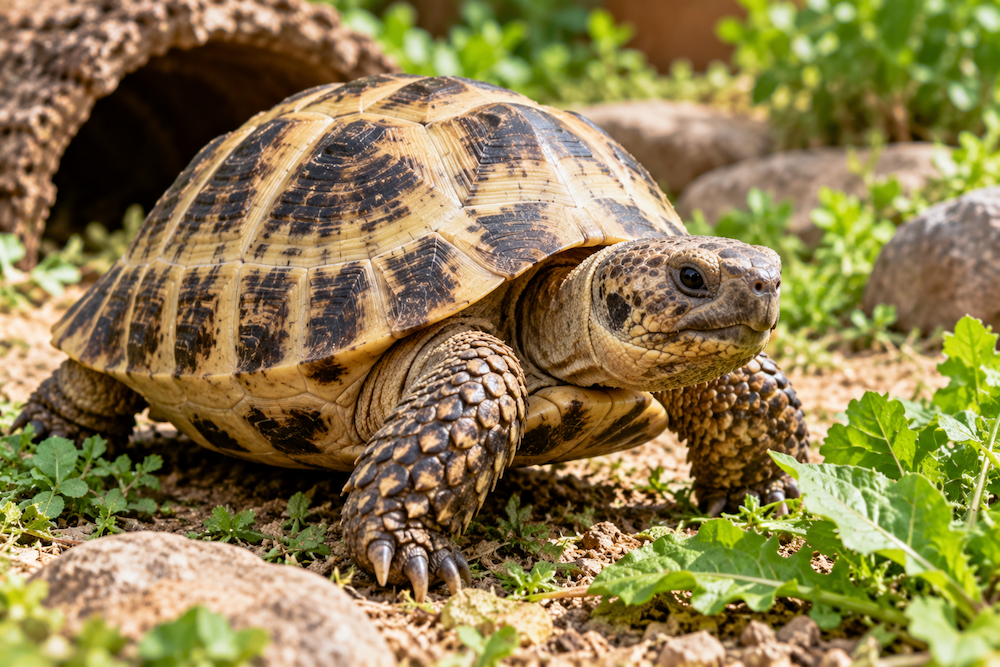
The Russian Tortoise (Testudo horsfieldii) is a relatively small terrestrial tortoise native to the dry environments of Central Asia.
Also known as the Horsfield’s or Central Asian Tortoise, it’s a determined digger with strong limbs adapted to excavating burrows and coping with challenging seasonal conditions.
Russian Tortoises are herbivores that thrive on a high-fibre diet dominated by appropriate leafy plants and weeds. They also require correct temperatures, UVB exposure, opportunities to burrow and considerably more floor space than their compact size might suggest.
They’re often considered relatively manageable tortoises, but their extraordinary longevity means obtaining one may represent a commitment measured in decades rather than years.
✅ PROS & CONS
Pros
- Relatively small for a tortoise
- Active and interesting to observe
- Curious and food-motivated
- Generally quiet
- Doesn’t need constant human attention
- Fascinating digging and foraging behaviour
- Herbivorous diet
- Can be exceptionally long-lived
Cons
- Potential commitment of several decades
- Requires appropriate UVB and heating
- Needs substantial floor space
- Powerful digger and escape artist
- Diet requires careful planning
- Not a cuddly or highly interactive pet
- Doesn’t need tortoise companionship
- Reptile-experienced veterinary care may be required
Are Russian Tortoises Good Pets?
Yes. Russian Tortoises can make rewarding pets for people prepared for their specialised care and extraordinary lifespan.
They’re active, fascinating reptiles that can become very familiar with household routines.
Are Russian Tortoises Good for Beginners?
They can be suitable for well-prepared beginners.
Their basic care is manageable once correctly established, but lighting, heating, diet and enclosure design all need to be understood properly.
The biggest consideration may simply be how long they can live.
How Long Do Russian Tortoises Live?
Russian Tortoises can potentially live for 40 years or considerably longer with appropriate care.
Exact lifespan varies, but anyone obtaining a young tortoise should plan for a genuinely long-term commitment.
How Big Do Russian Tortoises Get?
Adults commonly reach around 15–25 cm in shell length, with females generally growing larger than males.
They’re relatively compact compared with many other tortoise species.
Why Is It Called a Russian Tortoise?
The common name reflects part of the species’ broad Central Asian range and historical naming rather than accurately describing its entire distribution.
They’re also commonly called Horsfield’s Tortoises or Central Asian Tortoises.
Why Do Russian Tortoises Have Four Toes?
One distinctive feature of Testudo horsfieldii is having four toes on each foot.
This characteristic has even contributed to another common name sometimes used for the species: the Four-Toed Tortoise.
What Do Russian Tortoises Eat?
Russian Tortoises are herbivores adapted to a high-fibre plant-based diet.
Suitable leafy plants, weeds and other appropriate vegetation should form the foundation of their food.
A varied diet is preferable to relying heavily on one supermarket vegetable.
Can Russian Tortoises Eat Fruit?
Fruit isn’t an appropriate staple for Russian Tortoises and is generally best avoided or kept extremely limited.
Their digestive systems are adapted to a fibrous, relatively low-sugar plant diet.
Do Russian Tortoises Need Calcium?
Yes.
Appropriate calcium intake is essential for healthy bones and shell development.
Calcium needs to be considered together with the overall diet and appropriate UVB exposure.
Do Russian Tortoises Need UVB Light?
Yes. Appropriate UVB exposure is essential for captive Russian Tortoises housed without sufficient natural sunlight.
UVB enables vitamin D3 production, which is critical for proper calcium metabolism.
UVB lamps also need replacing periodically as their effective output declines.
Do Russian Tortoises Need a Heat Lamp?
Indoor enclosures require an appropriate heat source that creates a basking area and temperature gradient.
The tortoise should be able to move between warmer and cooler areas to regulate its body temperature.
Temperatures should be measured rather than guessed.
How Much Space Does a Russian Tortoise Need?
Much more than its relatively small body suggests.
Russian Tortoises are active terrestrial animals that naturally roam, forage and dig.
A spacious enclosure with substantial horizontal floor area is far better than a small glass tank.
Can Russian Tortoises Live Outdoors?
In suitable climates and conditions, secure outdoor housing can provide excellent opportunities for natural sunlight, grazing and exploration.
However, the enclosure must protect the tortoise from escape, predators, inappropriate temperatures and hazardous plants or materials.
Are Russian Tortoises Good Escape Artists?
Absolutely.
Russian Tortoises are surprisingly determined climbers and extremely capable diggers.
Outdoor enclosure walls need to account for what happens underneath the ground as well as above it.
If there’s a weak point, a determined tortoise may eventually find it.
Why Do Russian Tortoises Dig?
Digging is completely natural.
Wild Russian Tortoises use burrows to escape temperature extremes and environmental conditions.
Providing suitable substrate deep enough for natural digging behaviour is an important part of captive husbandry.
Do Russian Tortoises Like Being Held?
Generally, tortoises are better suited to observation and ground-level interaction than frequent handling.
Being lifted removes them from the surface where they feel secure.
Handling should therefore be gentle and purposeful rather than constant.
Do Russian Tortoises Recognise Their Owners?
They can learn to associate familiar people with food and regular routines.
A tortoise may approach when its caregiver appears, particularly when it expects feeding.
That shouldn’t necessarily be interpreted as mammal-like affection, but it does demonstrate learning and familiarity.
Do Russian Tortoises Bite?
They can.
A Russian Tortoise may bite because of food confusion, territorial behaviour or stress.
Their beak is strong enough to make a bite unpleasant, although well-managed animals aren’t generally considered aggressive towards people.
Can Russian Tortoises Live Together?
They’re generally safest housed individually.
Russian Tortoises don’t require another tortoise for companionship, and adults can become territorial or aggressive, particularly males.
Keeping multiple tortoises requires substantial space and careful management.
Do Russian Tortoises Need Water?
Yes.
Fresh drinking water should always be available in a shallow, easily accessible dish.
Regular access to water remains important even though the species evolved in relatively dry environments.
Do Russian Tortoises Hibernate?
In the wild, Russian Tortoises experience seasonal periods of greatly reduced activity, including winter dormancy.
Captive brumation is a more advanced husbandry consideration and should never simply be triggered by allowing a tortoise to become cold.
Health and conditions need to be carefully assessed.
Why Is My Russian Tortoise Not Eating?
Reduced appetite can be associated with incorrect temperatures, seasonal changes, stress or illness.
Because reptiles rely on environmental heat for digestion and normal activity, checking enclosure temperatures is an important first step.
Persistent appetite loss or weight loss warrants veterinary attention.
What Health Problems Are Common in Russian Tortoises?
Potential concerns include metabolic bone disease, respiratory infections, parasites, shell problems and nutritional disorders.
Many husbandry-related illnesses can be reduced through appropriate diet, UVB exposure, heating and enclosure management.
What Is Pyramiding in a Tortoise Shell?
Pyramiding describes abnormal raised growth of individual shell scutes rather than smooth shell development.
Its causes can be complex and associated with husbandry, nutrition, hydration and growth conditions.
Good care from an early age supports healthier shell development.
How Can You Tell a Male Russian Tortoise From a Female?
Mature males are usually smaller and tend to have a longer, thicker tail, while females are generally larger with shorter tails.
Sexing juveniles can be considerably more difficult.
Where Do Russian Tortoises Come From?
Russian Tortoises are native to Central Asia, where they inhabit dry grasslands, steppes, deserts and semi-desert environments.
They experience considerable seasonal temperature variation and spend significant periods sheltered underground.
Are Russian Tortoises Legal to Keep as Pets?
Regulations vary around the world.
Some countries or regions may restrict ownership, trade or importation, so prospective owners should check current local regulations before obtaining one.
Responsible sourcing is particularly important with long-lived exotic animals.
Is a Russian Tortoise a Good First Tortoise?
It can be an excellent choice for someone who has properly researched tortoise husbandry.
Its relatively small adult size is convenient, but it still requires substantial floor space, UVB, heating, correct nutrition and potentially many decades of care.
Small tortoise doesn’t mean small commitment.
What Makes the Russian Tortoise Unique?
Look at a Russian Tortoise and you might not immediately think escape artist.
That would be a mistake.
These compact tortoises are built for life in challenging Central Asian environments where digging can mean survival.
Give one suitable substrate and it may start excavating.
Put one in an outdoor enclosure and suddenly you’re not just designing a fence.
You’re designing a border.
It can dig underneath.
It may attempt to climb surprisingly well.
And if there is an interesting-looking gap somewhere, eventually that slow-moving reptile may investigate it.
Then there’s the longevity.
A dog may share part of your life.
A Russian Tortoise could potentially be around for several chapters of it.
That’s perhaps the most extraordinary thing about keeping one.
You’re not simply choosing a pet. You may be choosing a companion that needs a place in your plans decades from now.
Discover why Russian Tortoises are such determined diggers, why they have four toes, how they survive harsh seasonal conditions and what it really means to care for an animal that may live for decades.
Watch our Russian Tortoise video and discover what makes this remarkable little tortoise such an extraordinary reptile companion.