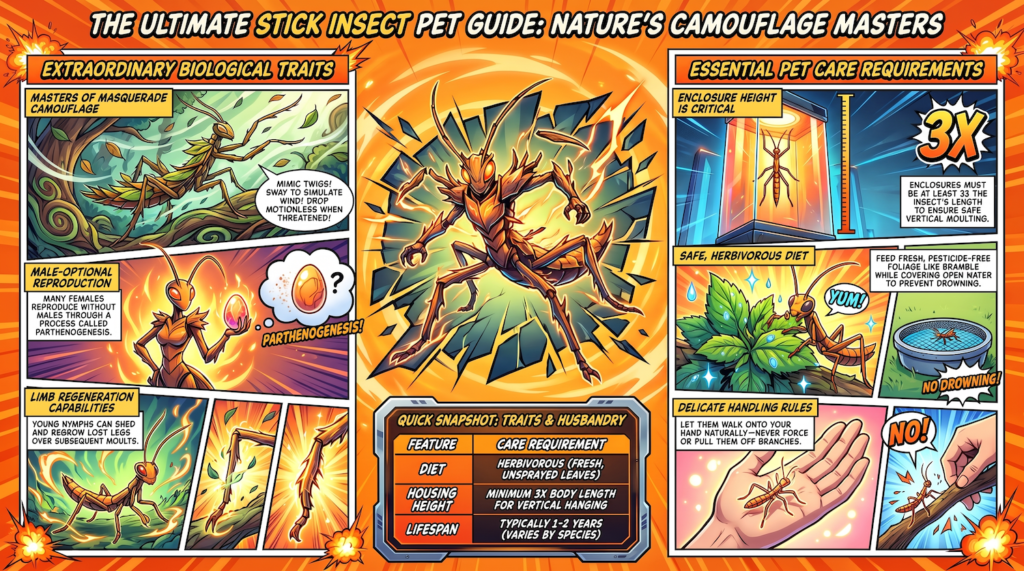
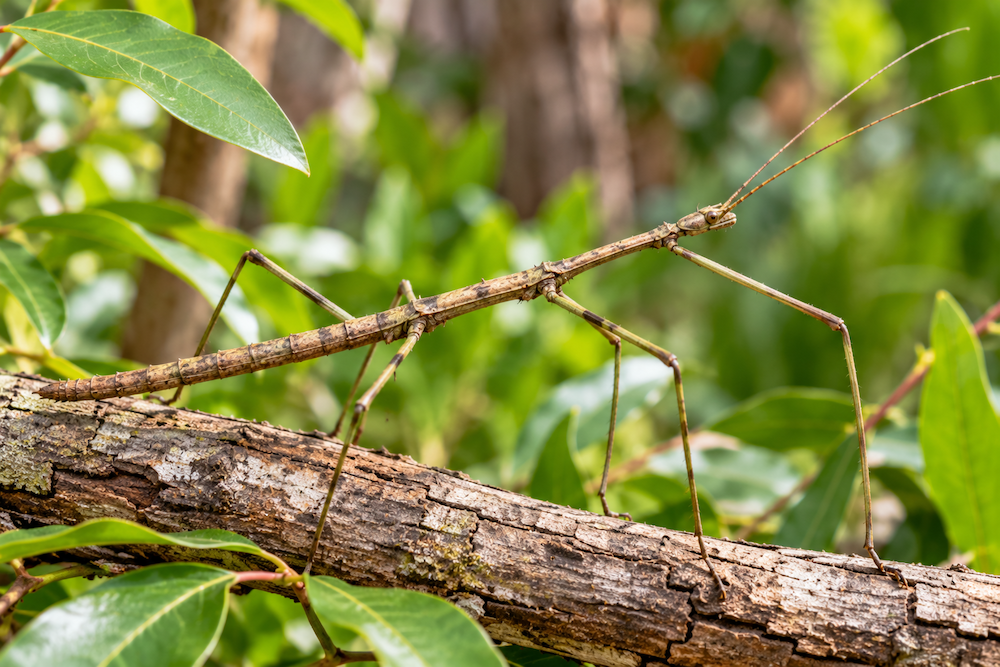







Masters of disguise, Stick Insects are among the strangest and most fascinating pets you can keep. Looking remarkably like twigs, leaves or pieces of bark, these gentle insects are quiet, inexpensive to feed and captivating to observe
🧠 QUICK SNAPSHOT
| Trait | Stick Insect |
|---|---|
| Scientific Order | Phasmatodea |
| Pet Type | Insect / Invertebrate |
| Other Names | Walking Stick, Phasmid |
| Natural Range | Worldwide, especially tropical and subtropical regions |
| Typical Lifespan | Around 6 months–2 years, depending on species |
| Adult Size | Roughly 5–30+ cm, depending on species |
| Diet | Herbivore |
| Activity | Often most active at night |
| Temperament | Generally calm and non-aggressive |
| Housing | Tall, secure, well-ventilated enclosure |
| Social Needs | Low |
| Beginner Friendly? | Yes, for suitable species |
| Famous Feature | Extraordinary camouflage |
📚 OVERVIEW
Stick Insects aren’t one single species but a large group of insects belonging to the order Phasmatodea. Thousands of species exist, ranging from slender twig mimics to broad insects resembling leaves and bark.
Their defining talent is camouflage. Some look so convincingly like vegetation that even their movements imitate a twig or leaf gently swaying in the wind.
Many commonly kept species are relatively straightforward pets. They require a secure enclosure with enough vertical height for moulting, suitable humidity and a constant supply of the correct fresh leaves.
They’re fascinating observation animals rather than conventional hands-on pets, and their exact requirements can vary considerably between species.
✅ PROS & CONS
Pros
- Extraordinary camouflage
- Quiet and virtually odourless
- Generally inexpensive to feed
- Doesn’t require a huge enclosure
- Fascinating natural behaviour
- Many species are beginner-friendly
- No daily walking or training
- Excellent introduction to invertebrate keeping
Cons
- Very delicate bodies and legs
- Relatively short lifespan
- Needs a reliable supply of suitable fresh leaves
- Moulting can be a vulnerable period
- Species have different humidity and temperature needs
- Some species can reproduce extremely quickly
- Handling should be limited and gentle
- Ownership of some species may be restricted
Are Stick Insects Good Pets?
Yes. Stick Insects can make fascinating pets, particularly for people interested in insects and natural behaviour.
They’re quiet, generally inexpensive to maintain and require less space than many conventional pets.
They’re primarily observation animals rather than cuddly companions.
Are Stick Insects Good for Beginners?
Many species are excellent for beginners.
The key is choosing a species with manageable temperature, humidity and food requirements.
Before obtaining one, you should know exactly which species you’re keeping because “Stick Insect” covers thousands of different insects.
How Long Do Stick Insects Live?
Lifespan varies significantly between species.
Many live for approximately 6 months to 2 years, with females of some species living considerably longer than males.
Temperature, diet, species and overall husbandry can influence longevity.
How Big Do Stick Insects Get?
Size varies enormously.
Some species measure only a few centimetres, while the largest Stick Insects can reach extraordinary lengths exceeding 30 cm when the body and extended legs are considered.
This group contains some of the longest insects known.
What Do Stick Insects Eat?
Stick Insects are herbivores and generally eat fresh leaves.
Suitable plants depend entirely on species. Commonly kept phasmids may accept plants such as bramble, rose, privet, eucalyptus or other appropriate foliage.
Never assume that a plant is safe simply because another Stick Insect species eats it.
How Often Do Stick Insects Need Fresh Leaves?
Fresh food should remain available continuously.
Branches should be replaced before leaves become dry or unsuitable.
Any foliage collected outdoors should come from areas where it hasn’t been exposed to pesticides or other harmful chemicals.
Do Stick Insects Need Water?
Stick Insects commonly obtain much of their water from fresh foliage and droplets.
Depending on species, lightly misting the enclosure can provide droplets for drinking while helping maintain appropriate humidity.
The enclosure shouldn’t simply be kept permanently wet.
What Size Enclosure Does a Stick Insect Need?
Vertical height is particularly important.
A Stick Insect needs enough space to hang freely while moulting, because it emerges downward from its old skin.
A useful general principle is providing considerably more enclosure height than the insect’s body length, with adequate climbing surfaces above.
Why Do Stick Insects Need a Tall Enclosure?
Moulting explains much of it.
A Stick Insect typically hangs from vegetation while shedding its old exoskeleton.
If it can’t hang freely, the new body and legs may not develop correctly.
For these animals, empty vertical space can literally be essential to successful growth.
How Often Do Stick Insects Moult?
Young Stick Insects moult several times as they grow.
The exact number and frequency vary according to species, sex, age and environmental conditions.
Once an insect reaches adulthood, it stops growing and no longer undergoes juvenile moults.
Do Stick Insects Eat Their Shed Skin?
Some Stick Insects may consume part or all of their shed exoskeleton after moulting.
Doing so can recycle nutrients and also remove evidence of the insect’s presence.
It may look strange, but it can be completely normal behaviour.
Can You Handle a Stick Insect?
Many species can tolerate occasional gentle handling, but extreme care is necessary.
Their legs can be fragile, and an insect should never be pulled from a branch or grabbed by a leg.
Allowing it to walk voluntarily onto a hand is much safer.
Do Stick Insects Bite?
Most commonly kept Stick Insects aren’t interested in biting people.
However, the Phasmatodea are extremely diverse and some species possess defensive mechanisms beyond simply hiding.
Owners should research the particular species rather than assuming all phasmids behave identically.
How Do Stick Insects Defend Themselves?
Camouflage is their most famous defence.
Some species also freeze, sway, drop to the ground, flash colourful wings or use defensive spines or chemical secretions.
A creature that appears to be a helpless twig can have a surprisingly sophisticated defensive toolkit.
Why Do Stick Insects Sway From Side to Side?
The characteristic rocking or swaying movement may help reinforce their camouflage by imitating vegetation moving in a breeze.
It can also influence how the insect perceives its surroundings.
To a predator, a swaying Stick Insect can look remarkably like just another moving twig.
Can Stick Insects Regrow Their Legs?
Young Stick Insects of some species can regenerate lost limbs during subsequent moults.
The replacement may initially be smaller and improve through later moults.
Adults can no longer rely on repeated juvenile moults, so their regenerative ability is much more limited.
Can Stick Insects Reproduce Without a Male?
Remarkably, females of many Stick Insect species can reproduce through parthenogenesis, producing viable eggs without mating with a male.
In some species, this can result in offspring that are overwhelmingly or entirely female.
One female can therefore become considerably more Stick Insects than a new owner anticipated.
How Many Eggs Do Stick Insects Lay?
This varies enormously between species.
Some females can produce hundreds of eggs during their lifetime.
The eggs may be dropped onto the enclosure floor, attached to vegetation or placed in substrate depending on the species.
What Do Stick Insect Eggs Look Like?
Phasmid eggs can look remarkably like tiny seeds.
Their shape, colour and texture vary between species, and the resemblance can be so convincing that it’s easy for an inexperienced keeper to mistake eggs for debris.
How Long Do Stick Insect Eggs Take to Hatch?
Incubation varies dramatically between species and environmental conditions.
Some hatch within a few months, while others can take many months or even longer.
Correct identification of the species is essential when determining incubation requirements.
Are Stick Insects Nocturnal?
Many Stick Insects are primarily nocturnal.
During daylight they may remain almost motionless, relying on camouflage, before becoming more active after dark to feed and move around.
Do Stick Insects Sleep?
Stick Insects have periods of inactivity and rest, although insect sleep isn’t identical to human sleep.
Long periods of stillness are also part of their camouflage strategy, so an apparently motionless phasmid isn’t necessarily inactive for the same reason every time.
Can Stick Insects Live Together?
Many commonly kept species can live in groups when given enough room and food.
However, compatibility varies by species, and overcrowding can interfere with moulting and access to foliage.
Research the specific species before establishing a communal enclosure.
Do Stick Insects Need Heating?
That depends on the species and ambient temperature.
Some commonly kept species tolerate ordinary indoor temperatures, while tropical species may require additional warmth.
Temperature requirements should always be based on the specific phasmid species being kept.
Do Stick Insects Need Light?
They benefit from a normal day-night cycle but generally don’t require intense specialised lighting in the way many reptiles do.
Direct sunlight through glass should be avoided because a small enclosure can overheat rapidly.
Why Is My Stick Insect Not Moving?
Remaining motionless is one of the things Stick Insects do best.
Stillness may be camouflage, daytime resting behaviour or preparation for moulting.
However, unusual inactivity combined with weakness, poor grip or other changes can indicate a problem.
What Health Problems Affect Stick Insects?
Common husbandry problems include failed moults, dehydration, injuries, missing limbs and problems associated with unsuitable humidity or diet.
Many issues can be prevented through correct enclosure height, ventilation, humidity and access to suitable fresh foliage.
Why Is My Stick Insect Hanging Upside Down?
It may simply be resting, but hanging can also indicate that the insect is preparing to moult.
A Stick Insect approaching a moult should be left undisturbed and given plenty of clear space underneath.
Where Do Stick Insects Come From?
Stick Insects occur across many parts of the world, with particularly high diversity in tropical and subtropical regions.
Different species inhabit forests, woodlands, grasslands and other vegetation-rich environments.
Are Stick Insects Legal to Keep as Pets?
That depends on the species and location.
Some countries or regions restrict the keeping, importation or movement of particular Stick Insects because non-native species could potentially affect local ecosystems.
Always check current local regulations before obtaining one.
Is a Stick Insect a Good First Insect Pet?
Yes. A suitable species can be one of the easiest and most fascinating introductions to keeping invertebrates.
The essentials are straightforward: correct foliage, enough moulting space, suitable temperature and humidity, good ventilation and very gentle handling.
The most important first step is knowing exactly which species you have.
What Makes the Stick Insect Unique?
Imagine surviving by convincing almost everything around you that you simply aren’t an animal.
That’s the Stick Insect’s speciality.
Its body looks like a twig.
Its legs resemble little branches.
And when it moves, some species gently sway from side to side as though they’re nothing more than vegetation moving in the breeze.
But camouflage is only the beginning.
Lose a leg while you’re young?
Some can grow it back through later moults.
No male around?
Females of many species can still produce offspring through parthenogenesis.
And those eggs?
Some look remarkably like seeds.
Even growing is dramatic. A young Stick Insect hangs from a branch, splits its old exoskeleton and carefully pulls out an entirely new, larger body.
For an animal famous for doing a convincing impression of absolutely nothing…
there’s an extraordinary amount going on.
Discover how Stick Insects disappear in plain sight, why they sway like branches, how some can regrow lost legs and how females of many species can reproduce without a male.
Watch our Stick Insect video and discover why these living twigs are among the strangest animals people keep as pets.