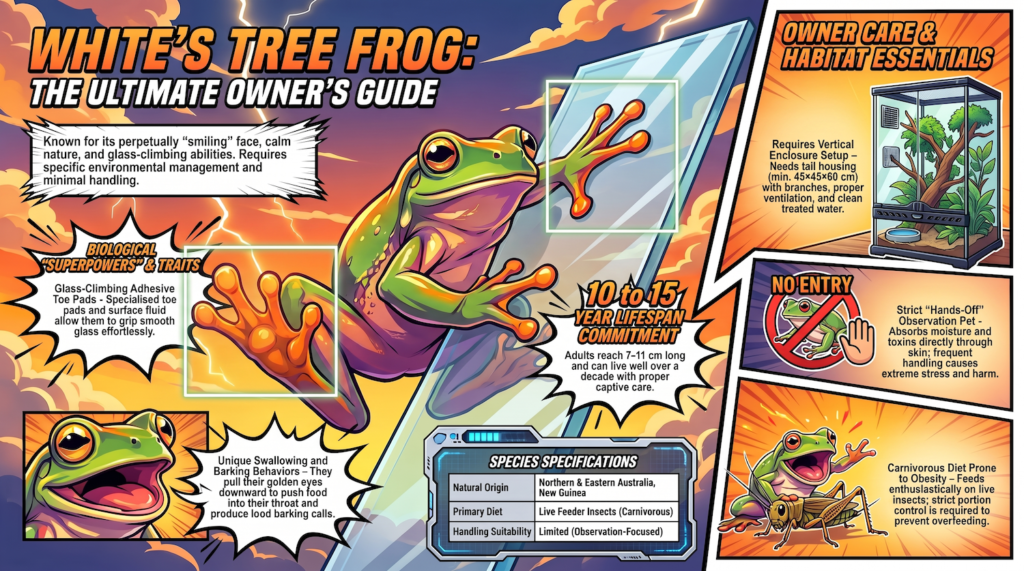
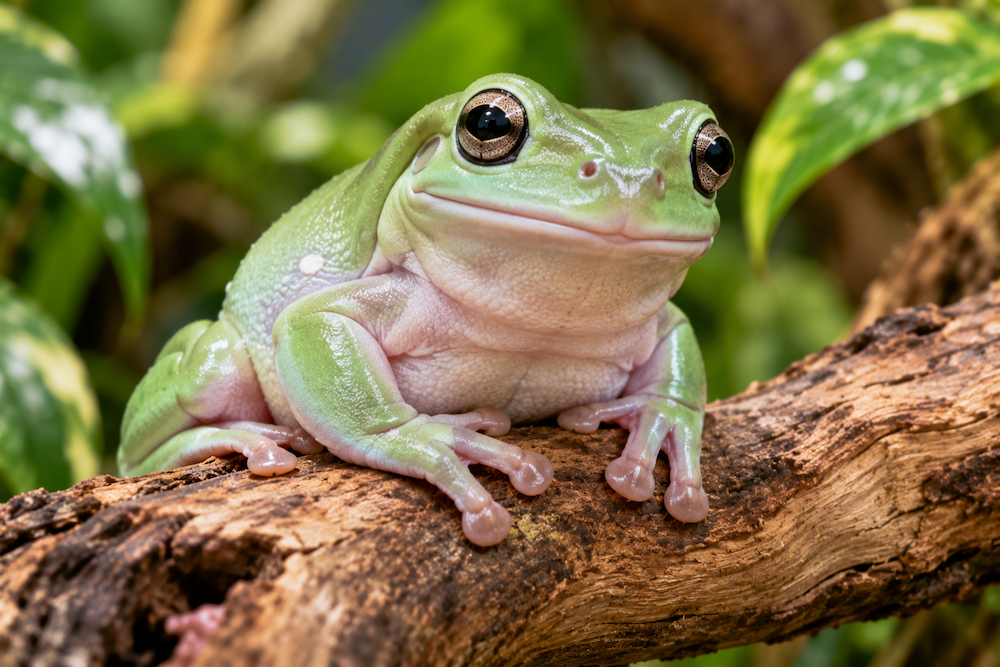







Chubby, charming and famous for its permanently smiling expression, the White's Tree Frog is one of the world's most popular pet amphibians. Also known as the Australian Green Tree Frog or Dumpy Tree Frog.
🧠 QUICK SNAPSHOT
Trait | White’s Tree Frog |
|---|---|
Scientific Name | Ranoidea caerulea (formerly Litoria caerulea) |
Other Names | Australian Green Tree Frog, Dumpy Tree Frog |
Pet Type | Amphibian |
Natural Origin | Australia and southern New Guinea |
Typical Lifespan | Around 10–20 years in captivity |
Adult Size | Approximately 7–11 cm |
Adult Weight | Commonly 50–100+ g |
Diet | Insectivore |
Activity | Primarily nocturnal |
Temperament | Generally calm and relatively tolerant of disturbance |
Noise Level | Low to moderate; males may call loudly |
Social Needs | Can live alone or with compatible individuals |
Housing | Spacious, vertically oriented tropical terrarium |
Handling | Minimal handling recommended |
Beginner Friendly? | Yes, with appropriate husbandry |
Famous Feature | Smiling face, sticky toe pads and rounded body |
📚 OVERVIEW
The White’s Tree Frog (Ranoidea caerulea) is a large, arboreal amphibian native to Australia and southern New Guinea. Its scientific name has also been widely recorded as Litoria caerulea, which remains familiar to many frog enthusiasts.
Despite its name, this frog isn’t necessarily white. Individuals range from bright green to blue-green, olive and brownish shades, sometimes changing colour in response to environmental conditions.
White’s Tree Frogs are known for their rounded bodies, large eyes, sticky toe pads and remarkably relaxed appearance. They’re often seen resting on branches, climbing glass or sitting motionless while waiting for insects.
Although relatively hardy compared with many amphibians, they still require appropriate temperature gradients, controlled humidity, clean water, UVB lighting and a carefully maintained enclosure.
Their amusing appearance and fascinating behaviours make them excellent observation pets.
✅ PROS & CONS
👍 Pros
Charming, expressive appearance
Generally calm temperament
Fascinating climbing abilities
Relatively hardy amphibian
Long potential lifespan
Interesting nighttime behaviour
Can recognise feeding routines
Suitable for dedicated beginners
👎 Cons
Not suitable for frequent handling
Requires controlled temperature and humidity
Needs live insect food
Primarily active at night
Sensitive to chemicals and contaminated water
Can become overweight
Requires regular terrarium maintenance
Males may call loudly at night
Are White’s Tree Frogs Good Pets?
Yes. White’s Tree Frogs are among the most popular pet amphibians because of their appealing appearance, relatively calm behaviour and manageable care requirements.
They’re particularly suitable for people who enjoy observing animals rather than regularly handling them.
With appropriate husbandry, they can become fascinating long-term companions.
Are White’s Tree Frogs Good for Beginners?
Generally, yes.
White’s Tree Frogs are often recommended for first-time amphibian keepers because they’re relatively adaptable compared with some more delicate frog species.
However, beginners still need to understand temperature, humidity, nutrition and water quality before bringing one home.
How Long Do White’s Tree Frogs Live?
White’s Tree Frogs commonly live around 10–20 years in captivity, with some individuals living longer under excellent conditions.
Their lifespan makes them a substantial commitment compared with many other small pets.
How Big Do White’s Tree Frogs Get?
Adult White’s Tree Frogs generally measure approximately 7–11 cm in body length.
Females are often larger and heavier than males.
Their rounded appearance can make them look even bigger, particularly when resting with their legs tucked underneath their bodies.
Why Are White’s Tree Frogs Called Dumpy Tree Frogs?
The nickname comes from their distinctive rounded bodies and plump appearance.
Unlike many slender tree frogs, White’s Tree Frogs have a broad head, sturdy body and prominent folds of skin.
However, excessive body fat is unhealthy, so their naturally chunky appearance shouldn’t be confused with obesity.
Are White’s Tree Frogs Friendly?
White’s Tree Frogs are generally calm and may become accustomed to familiar feeding routines.
However, they don’t experience companionship in the same way as dogs or cats.
Their apparent friendliness usually reflects tolerance, habituation and learned associations rather than a desire for affection.
Can You Hold a White’s Tree Frog?
Occasional necessary handling is possible, but frequent handling should be avoided.
Frogs have sensitive, permeable skin that can absorb substances from human hands.
When handling is unavoidable, use clean, wet, powder-free gloves and support the frog gently.
Do White’s Tree Frogs Bite?
White’s Tree Frogs rarely bite defensively.
However, they may accidentally grab a finger during feeding because they respond quickly to moving objects.
Their mouths are not designed to inflict serious injuries on humans.
Are White’s Tree Frogs Nocturnal?
Yes. White’s Tree Frogs are primarily nocturnal.
They usually spend much of the day resting in sheltered positions and become more active during the evening and night.
Their nighttime activities often include climbing, exploring and hunting insects.
Do White’s Tree Frogs Make Noise?
Yes, particularly males.
Male White’s Tree Frogs produce distinctive, repeated croaking calls, especially during breeding activity.
Their calls can be surprisingly loud for an animal of their size.
Why Do White’s Tree Frogs Croak?
Male White’s Tree Frogs call primarily to attract females and communicate during breeding periods.
Environmental conditions, including rainfall and humidity, can influence calling activity.
Some captive males also call in response to environmental sounds.
What Do White’s Tree Frogs Eat?
White’s Tree Frogs are insectivores.
Their diet commonly includes appropriately sized crickets, cockroaches and other suitable feeder insects.
Feeder insects should be gut-loaded and supplemented with calcium and vitamins according to an appropriate amphibian feeding plan.
How Often Should You Feed a White’s Tree Frog?
Feeding frequency depends on age, body condition and activity.
Young frogs generally require more frequent meals, while healthy adults can often be fed several times per week.
Portion control is important because White’s Tree Frogs can become overweight when overfed.
Can White’s Tree Frogs Eat Mealworms?
Mealworms can sometimes be offered as part of a varied diet.
However, they shouldn’t form the entire diet because of nutritional limitations.
A variety of appropriately sized, nutritious feeder insects is preferable.
Do White’s Tree Frogs Need Live Food?
Yes. White’s Tree Frogs naturally respond to moving prey and generally require live feeder insects.
Their hunting behaviour is an important part of their natural activity and enrichment.
Avoid feeding wild-caught insects, which may carry pesticides or parasites.
How Big Should a White’s Tree Frog Tank Be?
White’s Tree Frogs need a spacious, vertically oriented enclosure because they’re natural climbers.
For a single adult, an enclosure around 45 × 45 × 60 cm or larger is a useful starting point, with more space strongly encouraged.
Branches, secure climbing structures and suitable hiding places should be included.
Do White’s Tree Frogs Need High Humidity?
White’s Tree Frogs require moderate to elevated humidity, but they also need good ventilation.
A humidity range of approximately 50–70%, with natural fluctuations and opportunities for surfaces to dry, is commonly used in captivity.
Constantly wet, poorly ventilated conditions can contribute to health problems.
What Temperature Do White’s Tree Frogs Need?
White’s Tree Frogs benefit from a controlled temperature gradient.
Daytime ambient temperatures are commonly maintained around 24–28°C, with a slightly warmer area available and a modest nighttime reduction.
Excessive heat can be dangerous, so all heating equipment should be thermostatically controlled.
Do White’s Tree Frogs Need UVB Lighting?
Low-level UVB lighting is recommended as part of a well-designed enclosure.
Appropriate UVB exposure can help support vitamin D3 production and calcium metabolism.
Lighting should be selected according to the enclosure’s dimensions, distance from the frog and availability of shaded areas.
Do White’s Tree Frogs Need Water?
Absolutely.
White’s Tree Frogs need constant access to clean, amphibian-safe water for soaking and hydration.
A shallow, easily accessible water dish should be provided and cleaned regularly.
Water must be free from harmful chlorine or chloramine.
Can White’s Tree Frogs Swim?
Yes, White’s Tree Frogs can swim when necessary.
However, they’re primarily arboreal frogs rather than fully aquatic amphibians.
Their enclosure should focus on climbing opportunities rather than large areas of deep water.
Why Do White’s Tree Frogs Stick to Glass?
White’s Tree Frogs have specialised adhesive toe pads that allow them to cling to smooth surfaces.
These pads use microscopic structures and a thin layer of fluid to help create adhesion.
This remarkable adaptation allows them to climb branches, leaves and even vertical glass.
Why Does My White’s Tree Frog Change Colour?
White’s Tree Frogs can change between shades of green, blue-green, olive and brown.
Colour changes may be influenced by temperature, lighting, background and physiological condition.
However, dramatic changes accompanied by unusual behaviour or illness symptoms should be investigated.
Why Is My White’s Tree Frog Turning Brown?
A brownish colour can be a normal variation.
White’s Tree Frogs naturally change shade depending on environmental and physiological factors.
If the colour change occurs alongside lethargy, appetite loss or abnormal skin appearance, veterinary advice is recommended.
Can Two White’s Tree Frogs Live Together?
Yes, compatible White’s Tree Frogs of similar size can sometimes be housed together successfully.
However, the enclosure must provide sufficient space, feeding opportunities and hiding places.
Avoid housing significantly different-sized frogs together because larger individuals may attempt to swallow smaller ones.
Do White’s Tree Frogs Get Lonely?
White’s Tree Frogs don’t require constant social companionship.
A single frog can thrive when provided with suitable housing, enrichment and appropriate care.
Keeping multiple frogs together is optional rather than essential.
Why Is My White’s Tree Frog Not Eating?
Reduced appetite may result from temperature problems, stress, inappropriate prey, seasonal changes or illness.
A newly introduced frog may also need time to settle into its environment.
Persistent refusal to eat, especially with weight loss or unusual behaviour, requires veterinary attention.
Do White’s Tree Frogs Shed Their Skin?
Yes.
Like other frogs, White’s Tree Frogs periodically shed their outer skin.
They often use their legs and mouth to remove the shed skin and may eat it afterwards.
This is normal amphibian behaviour.
What Health Problems Are Common in White’s Tree Frogs?
Potential problems include obesity, bacterial infections, fungal disease, nutritional deficiencies and metabolic bone disease.
Poor environmental conditions can also contribute to skin and respiratory problems.
Correct husbandry and access to an amphibian-experienced veterinarian are important.
Are White’s Tree Frogs Poisonous?
White’s Tree Frogs produce skin secretions that help protect them from microorganisms and potential predators.
However, they aren’t considered dangerously poisonous to humans under normal circumstances.
Their skin secretions can still cause irritation, so hands should be washed after enclosure maintenance or necessary contact.
Are White’s Tree Frogs Legal to Keep as Pets?
Ownership regulations vary by country and region.
Some locations require permits or restrict the keeping, sale or transport of native amphibians.
Always check local laws and obtain frogs from responsible, legal captive-bred sources.
Never remove wild frogs from their habitat without appropriate authorisation.
Are White’s Tree Frogs Good Pets for Children?
White’s Tree Frogs can be excellent animals for children to observe and learn about.
However, their delicate skin and specialised environmental needs mean adults should supervise care.
They’re better suited to children interested in watching natural behaviour than those wanting a pet to cuddle.
What Makes the White’s Tree Frog Unique?
Imagine a frog that looks as though it’s permanently smiling.
Now give it enormous sticky toes, a rounded belly and the ability to climb straight up a glass wall.
That’s the White’s Tree Frog.
But its extraordinary appearance is only the beginning.
These frogs are masters of climbing.
Their specialised toe pads allow them to cling to smooth surfaces that would be impossible for most animals to navigate.
And their skin has another remarkable feature.
White’s Tree Frogs produce protective secretions containing biologically active compounds that have attracted scientific interest.
Researchers have studied some of these substances for their antimicrobial properties.
Then there’s their incredible adaptability.
In the wild, White’s Tree Frogs can inhabit forests, woodlands and even areas close to human settlements.
They’re sometimes discovered resting in unexpected places, including bathrooms, water tanks and outdoor structures.
Their large eyes, relaxed posture and permanently cheerful expression have made them favourites among amphibian enthusiasts.
Yet beneath that charming appearance is a highly specialised nocturnal predator, equipped with remarkable senses and lightning-fast feeding responses.
The White’s Tree Frog proves that one of nature’s most unusual creatures can also be one of its most endearing.
Discover why White’s Tree Frogs can climb glass, how their remarkable skin helps protect them, why they change colour and what makes these smiling amphibians such fascinating pets.
Watch our White’s Tree Frog video and discover the extraordinary secrets behind one of the world’s most charming amphibians.