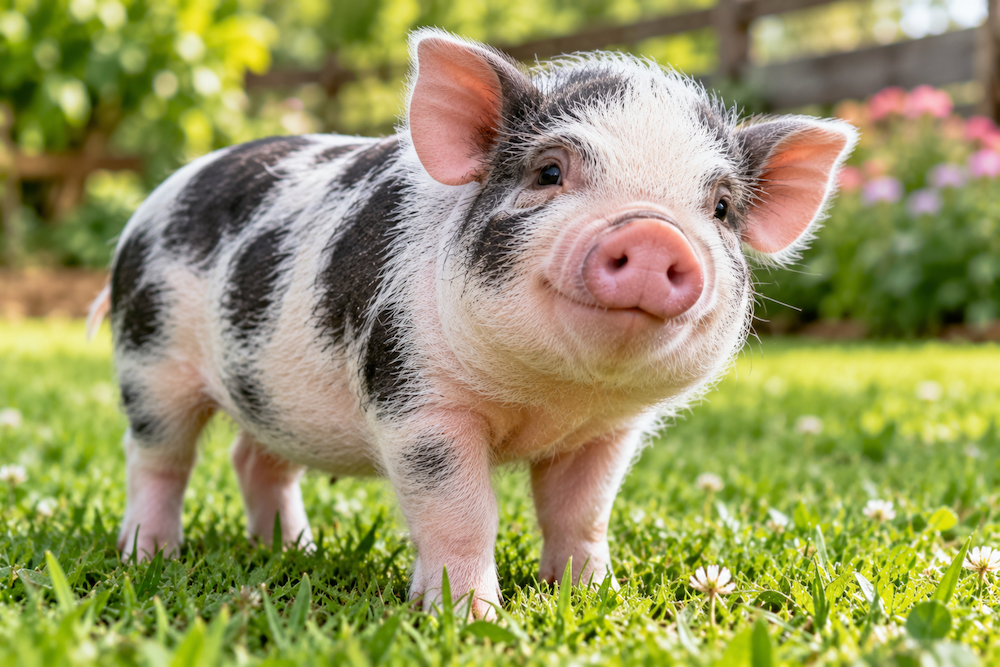







Intelligent, curious and full of personality, Mini Pigs are fascinating companions with remarkable memories and problem-solving abilities. Despite their name, these charming animals can grow surprisingly large.
🧠 QUICK SNAPSHOT
Trait | Mini Pig |
|---|---|
Scientific Name | Sus scrofa domesticus |
Other Names | Miniature Pig, Teacup Pig, Micro Pig |
Pet Type | Domestic pig / Companion animal |
Natural Origin | Domestic pig breeds developed worldwide |
Typical Lifespan | Around 12–18 years |
Adult Size | Approximately 35–60 cm at the shoulder |
Adult Weight | Commonly 35–90+ kg |
Diet | Omnivore |
Activity | Diurnal |
Temperament | Intelligent, curious and strong-willed |
Noise Level | Moderate |
Social Needs | High |
Trainability | Excellent |
Housing | Secure outdoor space with suitable shelter |
Beginner Friendly? | Moderate to advanced |
Famous Feature | Remarkable intelligence and powerful sense of smell |
📚 OVERVIEW
The Mini Pig isn’t a single recognised breed but a general term for smaller domestic pigs, including varieties developed from Vietnamese Pot-Bellied Pigs and other compact pig breeds.
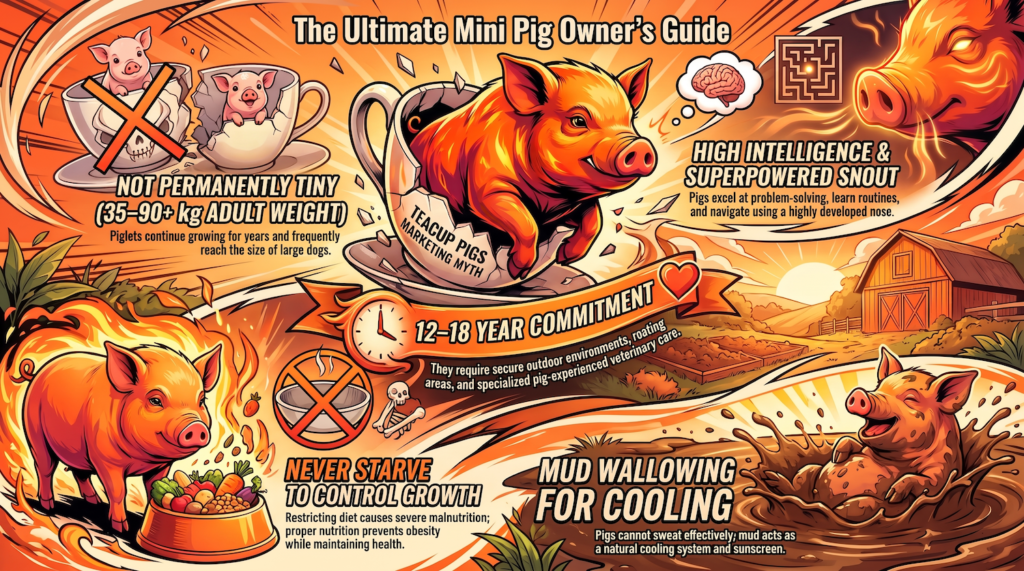
Despite marketing terms such as Teacup Pig or Micro Pig, no pig is guaranteed to remain tiny. Many Mini Pigs grow considerably larger than expected, sometimes weighing more than an adult human.
Mini Pigs are exceptionally intelligent, social animals that enjoy exploring, rooting, foraging and learning new behaviours. They can form strong relationships with familiar people and respond well to positive reinforcement training.
However, they require secure outdoor space, appropriate nutrition, mental stimulation, companionship and specialised veterinary care. Their intelligence and determination can make them challenging pets for unprepared owners.
✅ PROS & CONS
👍 Pros
Exceptionally intelligent
Affectionate personalities
Excellent trainability
Fascinating social behaviour
Relatively long lifespan
Can learn household routines
Entertaining and curious
Strong sense of smell
👎 Cons
Often grow much larger than expected
Need substantial outdoor space
Can be stubborn and destructive
Require specialised veterinary care
Need regular mental stimulation
Can become overweight
May be restricted by local regulations
Long-term commitment
Are Mini Pigs Good Pets?
Yes, Mini Pigs can make wonderful pets for experienced and committed owners.
They’re intelligent, curious and capable of forming strong relationships with familiar people.
However, their size, strength and behavioural needs make them considerably more demanding than their cute appearance suggests.
Are Mini Pigs Good for Beginners?
Generally, Mini Pigs are better suited to owners who have researched pig behaviour and husbandry thoroughly.
They require appropriate housing, nutrition, enrichment and veterinary care.
Their intelligence can make them challenging when they become bored or frustrated.
How Big Do Mini Pigs Get?
Adult Mini Pigs commonly weigh 35–90 kg or more, depending on genetics and breeding.
Some individuals remain smaller, while others grow substantially larger.
A pig’s adult size cannot reliably be predicted from its appearance as a piglet.
Are Teacup Pigs Real?
The term Teacup Pig is primarily a marketing description rather than a recognised breed classification.
There is no reliable guarantee that a pig sold as a Teacup Pig will remain extremely small.
Prospective owners should be cautious of breeders promising permanently tiny pigs.
How Long Do Mini Pigs Live?
Mini Pigs commonly live around 12–18 years, with some individuals living longer under excellent conditions.
Their lifespan makes them a substantial long-term responsibility.
Are Mini Pigs Intelligent?
Extremely.
Pigs demonstrate sophisticated learning, memory and problem-solving abilities.
They can learn commands, navigate obstacles, recognise familiar individuals and remember routines.
Their intelligence makes mental stimulation particularly important.
Can Mini Pigs Be Trained?
Yes. Mini Pigs respond well to positive reinforcement training.
They can learn behaviours such as coming when called, following cues and using designated toilet areas.
Consistency and suitable food rewards are often effective.
Can Mini Pigs Be Toilet Trained?
Yes, many Mini Pigs can learn to use designated toilet areas.
However, successful training depends on consistency, suitable facilities and individual behaviour.
Access to appropriate outdoor toileting areas is generally preferable.
Are Mini Pigs Affectionate?
Many Mini Pigs develop strong bonds with familiar caregivers.
They may enjoy gentle scratching, resting nearby and interacting with trusted people.
However, their affection should be respected on their terms, and not every pig enjoys being restrained or picked up.
Do Mini Pigs Recognise Their Owners?
Yes.
Pigs can recognise familiar people through combinations of visual, auditory and scent cues.
They may respond enthusiastically to familiar voices and established routines.
Do Mini Pigs Like Being Held?
Most adult Mini Pigs dislike being lifted.
Pigs are naturally ground-dwelling animals, and restraint can cause fear or distress.
Gentle interaction while the pig remains on the ground is usually preferable.
Do Mini Pigs Bite?
Yes, Mini Pigs can bite.
Biting may occur because of fear, frustration, competition for food or inappropriate handling.
Their strong jaws mean bites can cause significant injuries.
Proper training and respectful handling are essential.
What Do Mini Pigs Eat?
Mini Pigs are omnivores.
A balanced miniature pig feed should form the foundation of their diet, supplemented with suitable vegetables and controlled amounts of other appropriate foods.
Overfeeding can quickly lead to obesity and associated health problems.
Can Mini Pigs Eat Fruit?
Yes, suitable fruit can be offered occasionally.
However, fruit contains natural sugars and should be limited.
Vegetables and a nutritionally balanced pig diet are more appropriate as everyday foods.
What Foods Should Mini Pigs Avoid?
Chocolate, alcohol, caffeine, mouldy food and other unsuitable substances should be avoided.
Food scraps can also create nutritional and biosecurity risks.
Some regions prohibit feeding pigs certain food waste, particularly scraps containing meat or contaminated by meat products.
Do Mini Pigs Need a Garden?
Mini Pigs benefit greatly from secure outdoor space.
They naturally spend considerable time rooting, exploring and searching for food.
A suitable garden or outdoor enclosure provides opportunities for these essential behaviours.
Can Mini Pigs Live Indoors?
Mini Pigs can spend time indoors, but permanent indoor-only housing is generally unsuitable.
They need space for exercise, rooting and natural exploration.
Access to a secure outdoor environment is strongly recommended.
Do Mini Pigs Need Other Pigs?
Pigs are highly social animals.
They generally benefit from living with compatible pig companions rather than relying entirely on human interaction.
Careful introductions and sufficient space are important when keeping multiple pigs.
Do Mini Pigs Get Along With Dogs?
Some Mini Pigs and dogs can coexist peacefully, but interactions carry significant risks.
Dogs may chase or injure pigs, while pigs may respond aggressively when frightened.
Separate secure areas and careful supervision are essential.
Do Mini Pigs Smell?
Healthy Mini Pigs generally don’t have a particularly strong body odour.
However, their living areas can develop unpleasant smells without appropriate cleaning and drainage.
Regular enclosure maintenance helps keep their environment hygienic.
Do Mini Pigs Shed?
Yes.
Mini Pigs have coarse hair rather than a thick coat of fur.
They may shed seasonally, and some experience noticeable periods of hair loss.
Healthy skin and appropriate nutrition help maintain coat condition.
Why Do Mini Pigs Root With Their Noses?
Rooting is a natural pig behaviour.
Their powerful snouts allow them to investigate soil, locate food and explore their surroundings.
Rooting provides both physical activity and mental stimulation.
Without appropriate outlets, pigs may redirect this behaviour towards lawns, furniture or household objects.
Can Mini Pigs Swim?
Yes, many pigs can swim.
However, not every pig enjoys water, and swimming should never be forced.
Mini Pigs are generally more interested in shallow water and mud wallows for cooling than recreational swimming.
Do Mini Pigs Need Mud?
Pigs benefit from access to suitable cooling opportunities, including mud wallows.
Because pigs have limited effective sweating ability, wallowing helps regulate body temperature.
Shade, fresh drinking water and protection from extreme heat are essential.
What Health Problems Are Common in Mini Pigs?
Potential concerns include obesity, arthritis, hoof overgrowth, dental problems, skin conditions and reproductive disorders.
Routine veterinary care, appropriate nutrition and regular hoof maintenance are important.
Spaying or neutering may also be recommended depending on the individual animal.
Are Mini Pigs Legal to Keep as Pets?
Ownership regulations vary between countries, states and local councils.
Some locations classify Mini Pigs as livestock regardless of their size.
Permits, property restrictions or biosecurity requirements may apply.
Always check local regulations before purchasing a pig.
Are Mini Pigs Good Pets for Children?
Mini Pigs can be fascinating animals for children to observe and learn about.
However, their strength, size and sometimes unpredictable reactions make close supervision essential.
Adults must take responsibility for their care and training.
Where Do Mini Pigs Come From?
Mini Pigs have been developed from several domestic pig populations, including Vietnamese Pot-Bellied Pigs and other smaller breeds.
Selective breeding has produced pigs with varying sizes, colours and physical characteristics.
The term Mini Pig describes a general category rather than one standardised breed.
What Makes the Mini Pig Unique?
Imagine an animal that can learn commands, recognise familiar people and solve problems with surprising speed.
Now imagine that animal using its nose to investigate absolutely everything.
That’s the Mini Pig.
Pigs possess an extraordinary sense of smell, allowing them to locate food hidden beneath soil and vegetation.
Their powerful snouts are equipped with sensitive structures that help them explore their environment.
And their intelligence is remarkable.
Research has demonstrated that pigs can learn complicated tasks, remember information and adapt their behaviour when solving problems.
Some have even been trained to interact with specially designed computer interfaces using their snouts.
But perhaps the biggest surprise is their size.
A tiny piglet advertised as a miniature companion may eventually grow into an animal weighing 70 kilograms or more.
And because pigs are naturally social, intelligent and active, they need far more than food and a comfortable bed.
They need opportunities to explore, forage, interact and use their remarkable brains.
The Mini Pig may be smaller than a commercial farm pig, but its intelligence, personality and care requirements are anything but miniature.