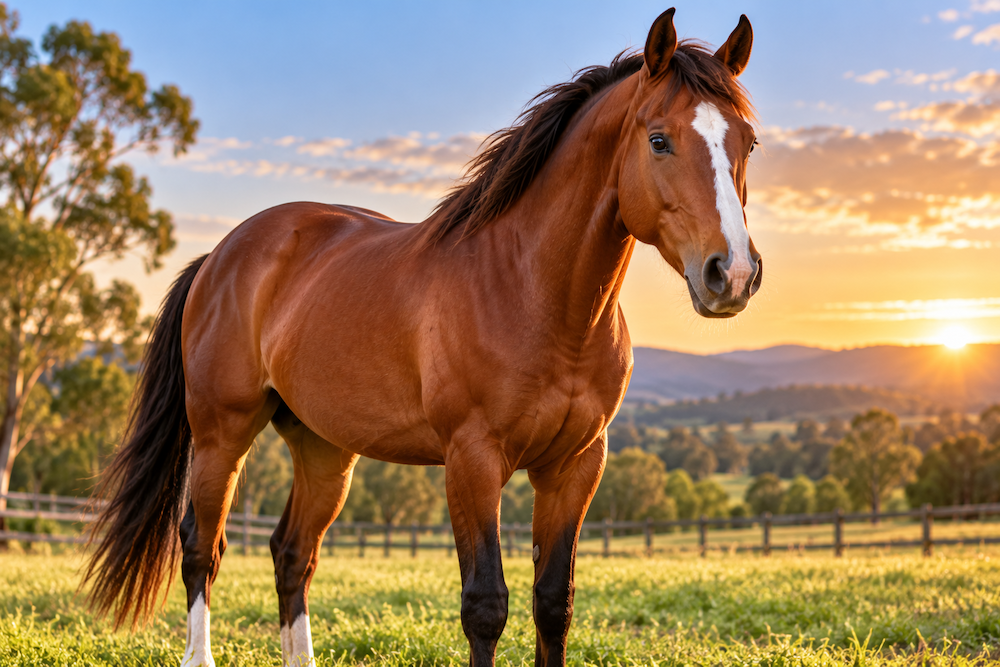







Majestic, intelligent and incredibly loyal, Horses are extraordinary companions known for their strength, beauty and remarkable ability to form lasting relationships with humans.
🧠 QUICK SNAPSHOT
Trait | Horse |
|---|---|
Scientific Name | Equus ferus caballus |
Other Names | Domestic Horse, Equine |
Pet Type | Large Domestic Animal / Equine |
Natural Origin | Domesticated from Eurasian wild horse populations |
Typical Lifespan | Around 25–30 years |
Adult Size | Approximately 140–180 cm at the withers for many riding horses |
Adult Weight | Approximately 400–700 kg; varies greatly by breed |
Coat Colours | Bay, chestnut, black, grey, palomino, roan, pinto and more |
Diet | Herbivore |
Activity | Active throughout the day and night |
Temperament | Social, intelligent, sensitive and alert |
Noise Level | Low to moderate |
Social Needs | Very high; equine companionship essential |
Grooming | Regular brushing and hoof care |
Housing | Secure pasture, shelter and suitable fencing |
Exercise Needs | High; daily free movement |
Beginner Friendly? | Suitable with professional guidance |
Famous Feature | Extraordinary speed, strength and human–horse partnership |
📚 OVERVIEW
The Horse is one of humanity’s most influential domesticated animals, having played an extraordinary role in transport, agriculture, exploration, sport and companionship for thousands of years.
Horses belong to the equine family and come in an enormous variety of breeds, from compact Icelandic Horses and elegant Arabians to powerful Clydesdales and athletic Thoroughbreds. Each breed has distinctive characteristics, abilities and care requirements.
These intelligent, highly social animals communicate through body language, vocalisations and subtle movements. They form strong relationships with other horses and can develop trusting partnerships with humans through consistent, positive interactions.
Horse ownership requires substantial space, daily care, suitable forage, professional hoof care, veterinary attention, exercise and appropriate companionship. Their size, strength and long lifespan make them a major financial and personal commitment.
✅ PROS & CONS
👍 Pros
Intelligent and highly trainable
Can form strong bonds with humans
Excellent riding and recreational companions
Fascinating social behaviours
Wide variety of breeds and sizes
Encourage outdoor activity
Suitable for many equestrian disciplines
Rewarding long-term companionship
👎 Cons
Expensive to purchase and maintain
Require substantial space
Daily care is essential
Need regular hoof and dental care
Can suffer serious health emergencies
Require compatible equine companionship
Riding and handling involve injury risks
Long-term financial commitment
Are Horses Good Pets?
Yes. Horses can make extraordinary companions for people with the appropriate facilities, experience and resources.
They’re intelligent, social and capable of developing trusting relationships with their caregivers.
However, their size, daily needs and considerable expenses make ownership a major responsibility.
Are Horses Good for Beginners?
Some calm, well-trained Horses are suitable for beginners.
An experienced, mature horse with a predictable temperament is generally preferable to a young or inexperienced animal.
Professional riding instruction and guidance from knowledgeable horse owners are strongly recommended.
How Long Do Horses Live?
Horses commonly live around 25–30 years.
Some individuals survive into their thirties or beyond with excellent care.
Ponies and certain smaller breeds may have particularly long lifespans.
How Big Do Horses Get?
Horse size varies considerably by breed.
Many riding Horses stand approximately 14–17 hands high, measured at the withers.
One hand equals 10.16 cm, or four inches.
Draft breeds can be considerably taller, while ponies are generally smaller.
How Much Do Horses Weigh?
An average riding Horse may weigh approximately 400–700 kg.
Smaller breeds and ponies can weigh considerably less.
Large draft Horses may exceed 900 kg, with some individuals weighing more than 1,000 kg.
What Are the Best Horse Breeds for Beginners?
Popular breeds that may suit beginners include:
Quarter Horse — often calm, versatile and trainable
Morgan Horse — adaptable and people-oriented
Haflinger — sturdy and generally manageable
Welsh Cob — versatile and suitable for various activities
Irish Cob — often steady and suitable for leisure riding
Appaloosa — versatile, with distinctive coat patterns
Individual temperament, training and experience matter more than breed alone.
Are Horses Friendly?
Horses are naturally social animals.
Many enjoy positive interactions with familiar people and other Horses.
Their behaviour depends on temperament, past experiences, handling and environmental conditions.
Do Horses Bond With Their Owners?
Yes.
Horses can develop trusting relationships with familiar caregivers.
They may recognise people through visual, auditory and scent cues and respond differently to individuals based on previous experiences.
Do Horses Recognise Their Owners?
Yes.
Research indicates that Horses can distinguish familiar humans and remember individuals.
They use several senses, including sight, hearing and smell.
Consistent, positive experiences help strengthen familiarity and trust.
Do Horses Like Being Petted?
Many Horses enjoy gentle scratching or grooming in preferred areas.
Commonly appreciated areas include the neck, shoulders and withers.
However, individual preferences vary, and their body language should always be respected.
Are Horses Intelligent?
Yes.
Horses demonstrate impressive learning abilities, memory and social awareness.
They can learn complex tasks, recognise routines and respond to subtle signals.
Their intelligence makes patient, consistent training particularly important.
How Fast Can Horses Run?
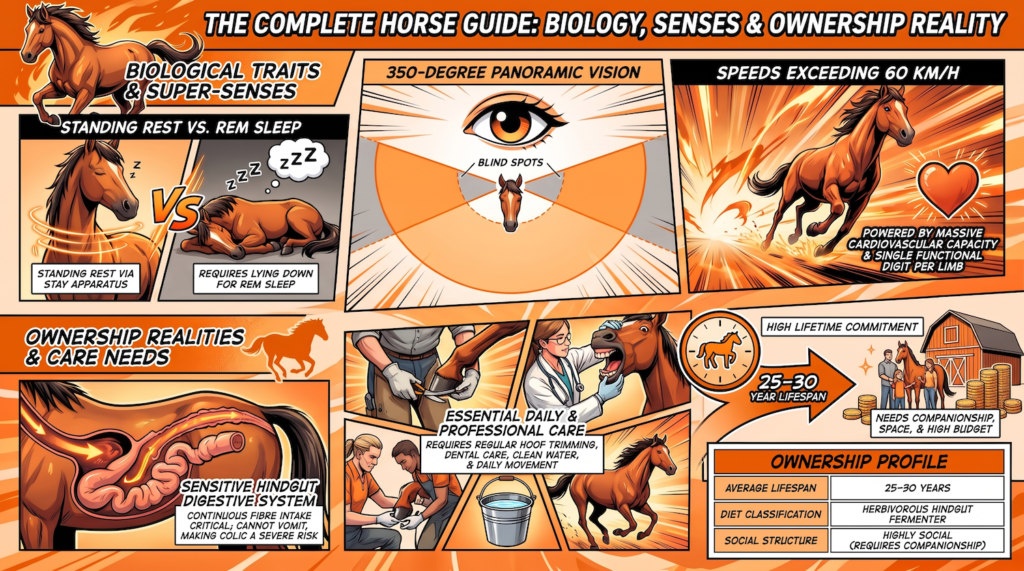
Many Horses can gallop at approximately 40–50 km/h.
Elite racehorses can reach speeds exceeding 60 km/h over short distances.
Speed depends on breed, fitness, terrain and individual ability.
How Much Exercise Do Horses Need?
Horses need opportunities for daily movement.
Regular turnout in a safe pasture or paddock allows walking, grazing and social interaction.
Riding or structured exercise may provide additional activity but shouldn’t replace natural freedom of movement.
How Much Land Does a Horse Need?
Land requirements depend on pasture quality, climate, management and the number of Horses.
Approximately 0.5–1 hectare per horse is sometimes used as a starting guide for grazing properties, but many locations require considerably more land.
Smaller areas can work with intensive management, adequate forage and suitable exercise facilities.
Can Horses Live Alone?
Horses are highly social herd animals and generally shouldn’t live in isolation.
Compatible equine companions support their psychological wellbeing.
Human attention alone cannot fully replace normal equine social interaction.
Can Horses Live With Ponies?
Yes.
Horses and ponies can often live together successfully.
However, introductions should be supervised, and feeding arrangements must account for different nutritional requirements.
Some ponies are particularly prone to obesity and laminitis.
What Do Horses Eat?
Horses are grazing herbivores.
Their diet should consist primarily of pasture, hay or other appropriate forage.
Additional feeds, vitamins or minerals may be necessary depending on age, workload, body condition and forage quality.
How Much Does a Horse Eat Each Day?
Horses generally consume approximately 1.5–2.5% of their body weight in forage dry matter daily.
For a 500 kg Horse, this may represent roughly 7.5–12.5 kg of dry matter.
Actual feeding requirements depend on the individual animal and forage moisture content.
How Much Water Does a Horse Drink?
An adult Horse may drink approximately 20–45 litres of water daily under moderate conditions.
Hot weather, exercise, lactation and dry forage can significantly increase requirements.
Clean, fresh drinking water should always be available.
How Often Do Horses Need Hoof Trimming?
Most Horses need professional hoof care approximately every 4–8 weeks.
The appropriate interval depends on hoof growth, workload, environment and whether the Horse wears shoes.
Regular farrier care is essential for comfort and soundness.
Do Horses Need Shoes?
Not all Horses need horseshoes.
Some remain comfortable and sound barefoot when their hooves are appropriately maintained.
Others benefit from shoes or hoof boots because of workload, hoof condition or terrain.
A qualified farrier can help determine the best approach.
Do Horses Sleep Standing Up?
Yes.
Horses possess a specialised anatomical mechanism called the stay apparatus, which allows them to rest while standing.
However, they also need opportunities to lie down for adequate REM sleep.
Safe, comfortable resting areas are important.
How Often Should Horses Be Groomed?
Regular grooming helps remove dirt, inspect the skin and maintain coat condition.
Horses used for riding should be checked and groomed before exercise, particularly beneath tack.
Hooves should also be inspected and cleaned routinely.
How Often Do Horses Need Dental Care?
Horses should receive regular dental assessments, generally at least annually for healthy adults.
Young, elderly or clinically affected Horses may require more frequent attention.
Dental problems can interfere with chewing, comfort and performance.
What Health Problems Are Common in Horses?
Common concerns include colic, laminitis, lameness, dental disease, respiratory conditions and parasitic infections.
Colic and laminitis can become serious emergencies.
Preventative veterinary care, appropriate nutrition and daily observation are essential.
How Much Does It Cost to Own a Horse?
Horse ownership can be expensive.
Ongoing costs include feed, agistment or property maintenance, hoof care, veterinary treatment, dental care, equipment and insurance.
Expenses vary greatly by location, and unexpected veterinary emergencies can add substantial costs.
Do You Need a Licence to Own a Horse?
Licensing and ownership requirements vary by country, state and local authority.
Some regions have identification, property registration, movement documentation or animal welfare requirements.
Owners should also check local zoning, fencing and land-use regulations.
What Makes the Horse Unique?
Imagine an animal powerful enough to carry a rider across vast distances, sensitive enough to detect subtle changes in human body language and intelligent enough to remember familiar individuals for years.
That’s the extraordinary Horse.
For thousands of years, Horses have helped shape human civilisation.
They transformed transport, agriculture, communication, warfare and exploration, allowing people to travel and work across distances that once seemed impossible.
But their natural abilities are even more remarkable.
Horses have an exceptionally wide field of vision because their eyes are positioned on the sides of their heads.
Their ears can rotate independently, helping them detect sounds from different directions.
They also possess the remarkable stay apparatus, allowing them to rest while standing without continuously using their muscles to maintain the same posture.
And despite their enormous size, Horses are extraordinarily sensitive animals.
They communicate through subtle ear movements, facial expressions, posture and interactions with other herd members.
Their powerful legs and specialised hooves allow them to travel efficiently across open landscapes.
Some breeds can reach impressive speeds, while others possess the strength to pull substantial loads.
Perhaps most fascinating is the relationship between Horses and humans.
Through patient training and positive experiences, these magnificent animals can develop extraordinary levels of trust and cooperation.
The Horse is far more than a beautiful animal — it’s an intelligent, powerful and deeply social companion that has helped change the course of human history.