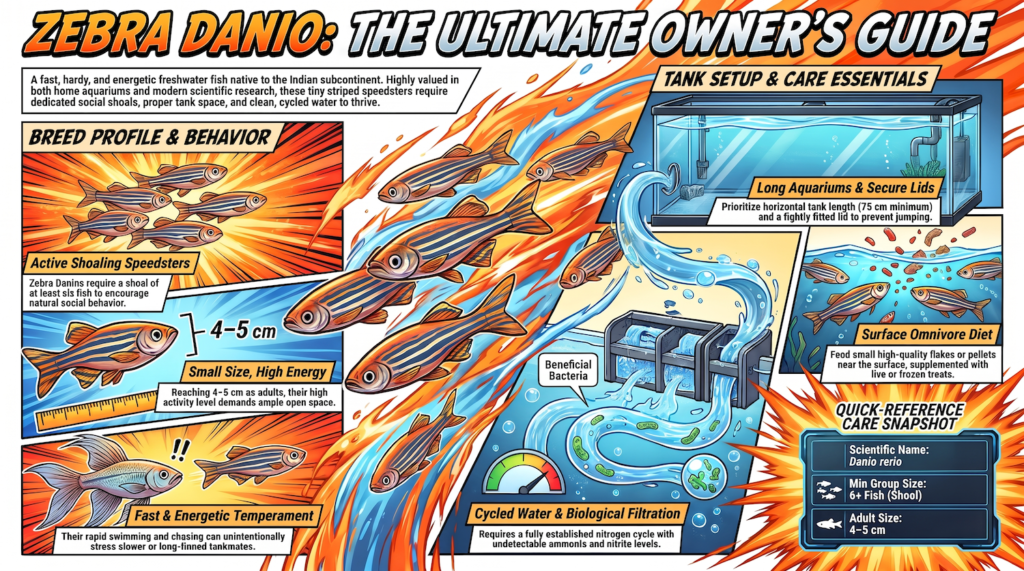







Small, colourful and bursting with energy, Danio Fish are fascinating freshwater aquarium favourites famous for their lightning-fast swimming, beautiful patterns, playful schooling behaviour and remarkable adaptability.
🧠 QUICK SNAPSHOT
Trait | Danio Fish |
|---|---|
Scientific Classification | Primarily Danio and Devario species |
Other Names | Danios, Zebra Danios, Leopard Danios, Giant Danios |
Pet Type | Freshwater Aquarium Fish |
Natural Origin | South and Southeast Asia |
Typical Lifespan | Approximately 3–5 years; some species live longer |
Adult Size | Approximately 2–15 cm, depending on species |
Adult Weight | Generally a few grams; varies by species |
Colours | Silver, blue, gold, yellow, orange, pink and striped |
Diet | Omnivore |
Activity | Diurnal |
Temperament | Peaceful, energetic, social and occasionally boisterous |
Noise Level | Silent to humans |
Social Needs | High; most thrive in groups of six or more |
Water Temperature | Commonly 20–26°C, depending on species |
Water pH | Commonly 6.5–7.5, depending on species |
Tank Size | Approximately 75–100 litres for many smaller species; larger for Giant Danios |
Breeding | Egg-scattering |
Grooming | No grooming required |
Exercise Needs | High; substantial swimming space required |
Beginner Friendly? | Yes, particularly Zebra Danios |
Famous Feature | Rapid swimming, distinctive stripes and importance in scientific research |
📚 OVERVIEW
The Danio Fish is a popular name for several closely related groups of small freshwater fish belonging to the carp family, Cyprinidae. Native primarily to South and Southeast Asia, these energetic fish inhabit streams, rivers, ponds and other freshwater environments.
Popular aquarium varieties include Zebra Danios, Leopard Danios, Celestial Pearl Danios and Giant Danios. Their appearance ranges from elegant horizontal stripes to spectacular spotted patterns and shimmering metallic colours.
Danios are famous for their constant movement and lively social interactions. Most commonly kept species thrive in groups, where they display coordinated swimming, chasing and other fascinating behaviours.
Their care requires adequate horizontal swimming space, stable water quality, suitable group sizes, a varied diet and compatible tankmates. Although many Danios are hardy and beginner-friendly, their environmental requirements and adult sizes vary considerably between species.
✅ PROS & CONS
👍 Pros
Beautiful stripes and colourful patterns
Extremely active and entertaining
Many species suitable for beginners
Generally peaceful community fish
Fascinating schooling and shoaling behaviour
Usually straightforward feeding requirements
Several species tolerate a range of temperatures
Relatively easy to maintain with proper care
👎 Cons
Require groups of compatible companions
Need substantial swimming space
Can be boisterous around slower fish
Some species are enthusiastic jumpers
May nip fins under unsuitable conditions
Very small species can be vulnerable to larger tankmates
Water requirements vary between species
Their constant activity may stress shy fish
Are Danio Fish Good Pets?
Yes. Danios make excellent aquarium pets for people who enjoy colourful, energetic freshwater fish.
Their constant movement and fascinating social behaviour make them entertaining to observe.
Many species are suitable for community aquariums when kept in appropriate groups.
Are Danio Fish Good for Beginners?
Yes.
Zebra Danios are particularly popular with beginners because they’re relatively hardy and adaptable.
However, they still require a properly cycled aquarium, stable water quality and suitable companions.
More specialised species may require additional experience.
How Long Do Danio Fish Live?
Many popular Danio species live approximately 3–5 years in captivity.
Some individuals may live longer with excellent care.
Lifespan depends on species, genetics, nutrition and aquarium conditions.
How Big Do Danio Fish Get?
Adult size varies considerably between species.
Zebra Danios generally reach approximately 4–5 cm, while Celestial Pearl Danios remain around 2–2.5 cm.
Giant Danios can reach approximately 10–15 cm and require considerably more swimming space.
What Are the Different Types of Danio Fish?
Popular aquarium varieties include:
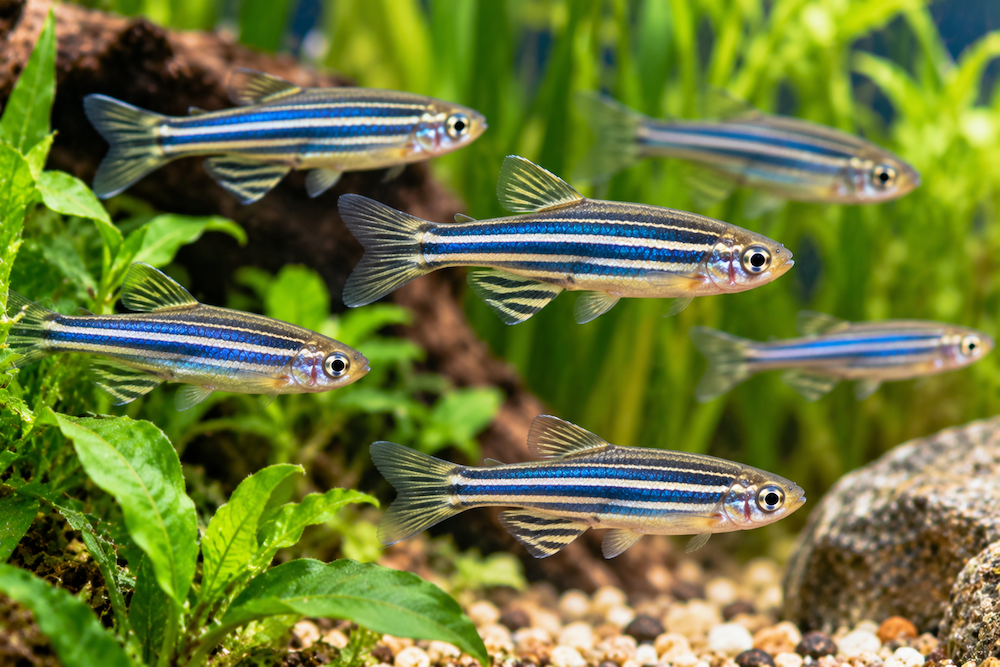
Zebra Danio — famous for its distinctive horizontal stripes
Leopard Danio — attractive spotted variety of the Zebra Danio
Giant Danio — larger, energetic fish with striking markings
Celestial Pearl Danio — tiny fish with beautiful pearl-like spots
Glowlight Danio — colourful species with orange and yellow markings
Pearl Danio — shimmering fish with delicate iridescent colours
Gold Zebra Danio — golden colour variety of the Zebra Danio
Each has different adult sizes, temperaments and environmental requirements.
Are Danio Fish Aggressive?
Most commonly kept Danios are generally peaceful.
However, their energetic swimming and social chasing can appear aggressive.
Some individuals may nip fins or harass slower fish when kept in unsuitable groups or overcrowded aquariums.
Do Danio Fish Nip Fins?
Some Danios occasionally nip the fins of other fish.
This behaviour may become more noticeable when they’re kept in insufficient numbers or with slow-moving, long-finned tankmates.
Providing appropriate group sizes and adequate swimming space helps reduce problems.
How Many Danio Fish Should Be Kept Together?
Most social Danios should be kept in groups of at least six individuals.
Larger groups of eight to ten or more are often preferable when aquarium space allows.
Group living supports natural behaviour and helps distribute social interactions.
Can Danio Fish Live Alone?
Generally, no.
Most commonly kept Danios are social fish that benefit from companionship with their own species.
Solitary individuals may become stressed or display abnormal behaviour.
Keeping an appropriate group is important for their wellbeing.
Can Different Danio Species Live Together?
Some Danio species can coexist successfully.
However, differences in adult size, swimming activity and environmental requirements must be considered.
Small, shy species such as Celestial Pearl Danios may struggle alongside larger, highly energetic varieties.
Can Danio Fish Live With Guppies?
Yes, some Danio species can coexist with Guppies.
However, Zebra Danios are fast swimmers and may occasionally bother long-finned males.
Water temperature, aquarium size and individual temperament should be considered.
Can Danio Fish Live With Bettas?
Generally, this combination requires caution.
Fast-moving Zebra Danios may stress Bettas, while some individuals may nip their long fins.
A peaceful aquarium with carefully selected companions is usually a better choice for Bettas.
Can Danio Fish Live With Tetras?
Yes.
Many Danios coexist successfully with peaceful Tetra species.
However, both groups must have compatible water requirements and sufficient swimming space.
Very small or shy Tetras may be overwhelmed by particularly active Danios.
Are Danio Fish Schooling Fish?
Yes.
Many Danios naturally form schools or loose shoals.
Their group behaviour provides social benefits and can help reduce vulnerability to predators.
Watching a healthy group swim together is one of their most appealing characteristics.
Are Danio Fish Intelligent?
Danios demonstrate learning, social recognition and responses to environmental cues.
They can learn feeding routines and navigate familiar surroundings.
Zebra Danios are also widely studied by scientists investigating behaviour, memory and nervous system development.
What Size Tank Do Danio Fish Need?
Tank requirements depend on species and group size.
A group of Zebra Danios generally benefits from an aquarium of approximately 75–100 litres or larger, preferably with a long horizontal swimming area.
Giant Danios require substantially larger aquariums, while smaller species may have different space requirements.
What Water Temperature Do Danio Fish Need?
Many Zebra Danios thrive around 20–26°C.
However, some Danio species prefer warmer or cooler conditions.
Stable temperatures within the appropriate species-specific range are important.
What pH Do Danio Fish Prefer?
Many commonly kept Danios do well in slightly acidic to slightly alkaline water.
A pH around 6.5–7.5 suits numerous popular species.
However, exact requirements vary, and stable water chemistry is particularly important.
Do Danio Fish Need Strong Filtration?
Danios require reliable biological filtration to maintain healthy water conditions.
Some species naturally inhabit flowing waterways and appreciate moderate water movement.
However, very small species may prefer gentler currents and sheltered areas.
Regular water changes remain essential.
What Do Danio Fish Eat?
Most Danios are omnivores.
They generally accept high-quality tropical flakes, micro-pellets and appropriately sized frozen or live foods.
Small aquatic invertebrates and insect larvae are important components of many wild Danio diets.
A varied diet supports healthy growth and colouring.
Do Danio Fish Need Plants?
Live plants are beneficial for many Danio species.
Plants provide shelter, visual barriers and natural-looking surroundings.
However, active species such as Zebra Danios also require plenty of open swimming space.
A combination of planted areas and clear swimming zones is ideal.
Why Are My Danio Fish Chasing Each Other?
Chasing is common among Danios.
It may occur during courtship, feeding competition or social interactions.
However, persistent harassment, damaged fins or exhausted individuals may indicate unsuitable group sizes or inadequate aquarium space.
Why Are My Danio Fish Jumping?
Danios are capable jumpers.
They may leap when startled, chasing one another or exploring the water surface.
A secure aquarium lid is strongly recommended to prevent accidental escapes.
How Do Danio Fish Breed?
Most Danios reproduce by scattering eggs.
During spawning, females release eggs that males fertilise externally.
The eggs may settle among plants, gravel or other aquarium surfaces.
Most species provide little or no parental care and may consume their own eggs.
What Health Problems Are Common in Danio Fish?
Potential concerns include parasitic infections, bacterial disease, fin damage and stress-related illness.
Zebra Danios can also be affected by certain chronic infections, including microsporidian diseases.
Good water quality, appropriate nutrition and quarantining new fish help reduce health risks.
Are Danio Fish Legal to Keep as Pets?
Many Danio species are legal aquarium pets in numerous countries.
However, importation, sale and possession regulations vary by species and jurisdiction.
In Australia, some species may be permitted while others are restricted, so current biosecurity and aquarium fish regulations should always be checked.
Never release aquarium fish into natural waterways.
What Makes the Danio Fish Unique?
Imagine a tiny fish with shimmering stripes, extraordinary swimming abilities and a scientific legacy that has helped researchers understand how living organisms develop.
That’s the remarkable Danio Fish.
These energetic freshwater fish may appear small and ordinary at first glance, but their biology and behaviour are truly fascinating.
Perhaps the most famous species is the Zebra Danio, scientifically known as Danio rerio.
Its beautiful horizontal stripes have made it a popular aquarium fish for generations.
But the Zebra Danio has another extraordinary distinction.
It’s one of the most important research animals in modern biological science.
Scientists use Zebra Danios, commonly called zebrafish in research, to study genetics, embryonic development, disease and tissue regeneration.
Their embryos develop outside the mother’s body and are initially transparent, allowing researchers to observe important developmental processes.
Even more remarkably, zebrafish can regenerate certain damaged tissues, including portions of their heart and fins.
This ability has made them valuable for research into regeneration and healing.
Danios are also fascinating social animals.
Many species form groups that move together, helping individuals respond to threats and navigate their environments.
Their rapid swimming and constant activity create a lively underwater display.
But not every Danio looks like a Zebra Danio.
The Celestial Pearl Danio, Danio margaritatus, is a tiny, spectacularly patterned species decorated with pale spots and bright orange-red fins.
The Giant Danio, Devario aequipinnatus, is considerably larger and displays impressive speed and agility.
Another surprising characteristic is their adaptability.
Different Danio species inhabit environments ranging from flowing streams to relatively calm freshwater habitats.
Their body shapes, swimming behaviour and temperature preferences reflect these varied conditions.
And despite their small size, Danios can display complex social interactions, courtship behaviours and learning abilities.
Danio Fish aren’t simply energetic aquarium companions — they’re beautiful, intelligent and scientifically extraordinary little fish that reveal some of nature’s most fascinating secrets about behaviour, development and regeneration.