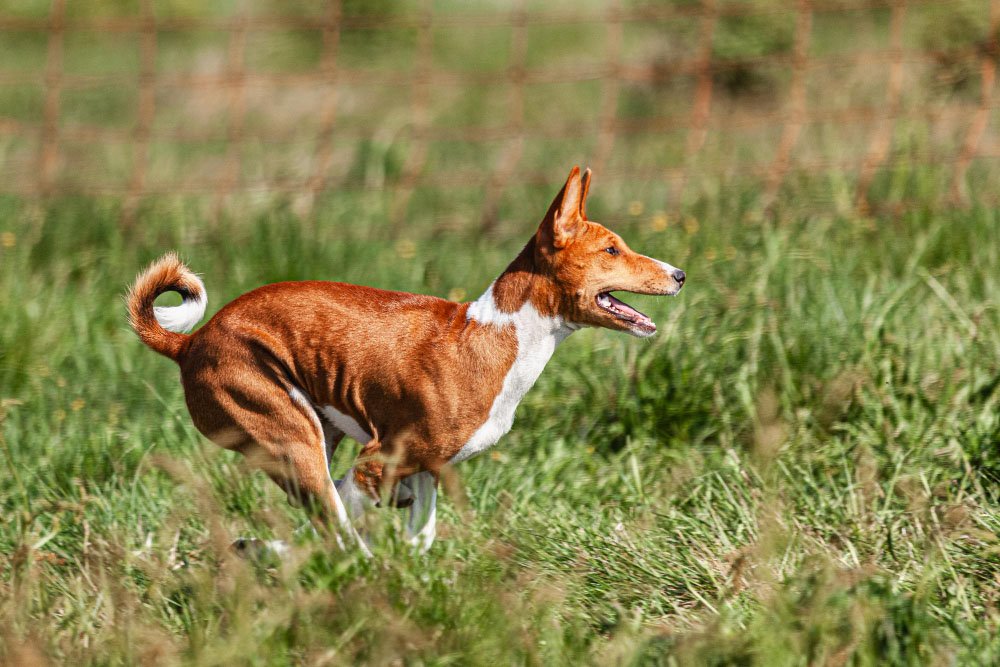







Quiet, independent, and uniquely expressive — a clever companion known as the “barkless dog.”
🧠 QUICK SNAPSHOT
- Temperament: Independent, alert, intelligent
- Energy Level: Moderate to high
- Size: Small to medium
- Good With Families: Yes
- Trainability: Moderate to low
- Grooming: Low
- Best For: Experienced owners, active homes
📚 OVERVIEW
The Basenji is an ancient African breed known for its unique vocalisation — instead of barking, it produces a yodel-like sound. It is a clean, cat-like dog with a strong independent streak.
They are intelligent and curious but prefer to do things on their own terms, making them a distinctive and sometimes challenging companion.
✅ PROS & CONS
Pros
- Very clean and low odour
- Minimal grooming needs
- Unique, quiet nature
- Intelligent and alert
Cons
- Strong-willed and independent
- Can be difficult to train
- High prey drive
- Needs stimulation and activity
Is a Basenji a Good Family Dog?
Yes, a Basenji can be a loving and entertaining family dog, but it is generally better suited to owners who understand its independent personality.
Basenjis often form very strong bonds with their families while remaining reserved around strangers. They can live successfully with respectful older children, although they may not appreciate rough handling.
This is an intelligent breed, but not necessarily an obedient one. Basenjis were developed to work with considerable independence rather than constantly waiting for human instructions.
For owners who appreciate a dog with its own opinions, the Basenji can be fascinating.
Think less “eager-to-please assistant” and more “highly intelligent independent contractor.”
How Much Exercise Does a Basenji Need?
An adult Basenji generally needs around 60–90 minutes of exercise each day, together with opportunities for mental stimulation.
They’re athletic, fast and surprisingly energetic dogs.
Daily walks, secure running areas, scent games, puzzle toys and activities such as lure coursing can all be excellent outlets.
Their strong prey drive means off-lead exercise should usually take place only in safely enclosed areas.
Basenjis can become destructive when bored, so physical exercise alone isn’t enough.
A tired Basenji may relax peacefully.
A bored Basenji may begin investigating which objects in your home can be dismantled without tools.
Is a Basenji Easy to Train?
Basenjis are highly intelligent but notoriously independent, so they aren’t usually considered one of the easiest breeds to train.
They can learn commands very quickly.
Whether they consider following those commands worthwhile is another question.
Positive reinforcement, food rewards and short, interesting sessions generally work better than repetitive drills or harsh corrections.
Recall can be particularly challenging because prey drive may override training when something runs past.
Training a Basenji is less about forcing obedience and more about making cooperation rewarding.
They’re certainly intelligent enough to understand what you’re asking.
Sometimes they’re also intelligent enough to consider your proposal and decline.
Does a Basenji Shed?
Yes, Basenjis shed, but generally quite lightly.
They have short, fine coats that require relatively little grooming.
A quick weekly brushing is usually sufficient to remove loose hair and maintain coat condition.
Basenjis are also famous for grooming themselves frequently, sometimes using their paws and tongue in a manner that owners compare with cats.
They usually have relatively little doggy odour.
However, Basenjis aren’t truly hypoallergenic. People with dog allergies can still react to their dander and saliva even if relatively little hair appears around the home.
What Health Problems Are Common in Basenjis?
Basenjis can be affected by several important inherited health conditions.
One of the best known is Fanconi syndrome, a kidney disorder that historically represented a significant health problem within the breed. Genetic testing now allows responsible breeders to greatly reduce the risk of producing affected puppies.
Progressive retinal atrophy (PRA) can cause progressive vision loss and is another condition for which genetic screening is important.
Hip dysplasia, hypothyroidism and certain other eye disorders can also occur.
Responsible Basenji breeders should perform breed-appropriate genetic and physical health testing and make the results available to prospective puppy owners.
How Long Do Basenjis Live?
Basenjis typically live around 13–16 years, making them a relatively long-lived dog breed.
Genetics, diet, body condition, exercise and preventive veterinary care all influence lifespan.
Genetic screening for conditions such as Fanconi syndrome and PRA has become particularly valuable in improving responsible breeding decisions.
Basenjis often remain active and curious well into their senior years.
Age may eventually slow their legs, but it doesn’t necessarily reduce their interest in finding out exactly what you’re doing and whether it concerns them.
Do Basenjis Really Not Bark?
Basenjis are often called “barkless dogs,” but they aren’t silent.
Their larynx is shaped differently from that of many other dogs, making a conventional repetitive bark unusual.
Instead, Basenjis can produce an extraordinary collection of sounds including whines, growls, howls and their famous yodel-like vocalisation, often called a baroo.
Some individuals can also produce isolated bark-like sounds.
So buying a Basenji because you want a completely silent dog could produce an unexpected surprise.
They may not bark like ordinary dogs, but nobody promised they wouldn’t have opinions.
Why Do Basenjis Yodel?
The Basenji’s famous yodel results partly from the unusual structure of its larynx.
Instead of producing the familiar repeated bark heard from most domestic dogs, Basenjis often create a rising and falling vocalisation commonly described as a yodel or baroo.
Dogs may make the sound when excited, greeting someone or expressing themselves socially.
The exact sound varies between individuals.
It’s one of the breed’s most distinctive characteristics and helps explain why the Basenji became famous as the “barkless dog.”
Barkless, however, should never be confused with voiceless.
Are Basenjis Good With Other Dogs?
Basenjis can live successfully with other dogs, particularly when properly socialised from puppyhood.
Many enjoy canine companionship and historically worked around other hunting dogs.
However, individuals can be assertive, and some may be selective about unfamiliar dogs.
Careful introductions are important when adding a Basenji to a multi-dog household.
Early socialisation helps puppies develop appropriate communication and play skills.
Compatibility ultimately depends on the individual dogs rather than breed labels alone.
Are Basenjis Good With Cats?
Basenjis can sometimes live peacefully with cats, particularly when raised alongside them from puppyhood, but their strong prey drive makes careful management essential.
The breed was developed for hunting, and rapidly moving small animals can trigger chasing behaviour.
A Basenji that accepts its own household cat may still chase unfamiliar cats outdoors.
Small pets such as rabbits, guinea pigs, rodents and birds require particularly careful separation.
With a Basenji, the distinction between family member and fast-moving potential quarry needs to be established very clearly.
Can a Basenji Live in an Apartment?
Yes, a Basenji can live successfully in an apartment if its exercise and enrichment needs are consistently met.
Its compact size and relatively low conventional barking can make apartment living practical.
However, Basenjis are active dogs and can become destructive when bored.
Their yodelling and other vocalisations can also travel surprisingly well through apartment walls.
Regular outdoor exercise and mental stimulation are essential.
Apartment living works best when the dog has an interesting life outside the apartment.
Can Basenjis Be Left Alone?
Basenjis can learn to tolerate reasonable periods alone, but they often dislike long periods of isolation.
Boredom can lead to chewing, escaping or other destructive behaviours.
Some Basenjis also develop separation-related distress.
Teaching puppies gradually that short absences are normal can help build independence.
Exercise and enrichment before longer absences are also useful.
Basenjis may behave independently, but independence shouldn’t be mistaken for wanting to spend the entire day without companionship.
Are Basenjis Escape Artists?
Yes, Basenjis have a well-earned reputation as talented escape artists.
They’re agile, intelligent, curious and highly motivated by moving animals and interesting scents.
Some can climb surprisingly well, squeeze through small openings or exploit weaknesses in fencing.
Secure fencing is therefore particularly important.
Their strong prey drive can also make recall unreliable once they’re pursuing something.
A Basenji examining a fence shouldn’t necessarily be assumed to be admiring the workmanship.
It may be conducting a structural assessment.
Why Do Basenjis Groom Themselves Like Cats?
Basenjis are famous for being exceptionally clean dogs and frequently groom their coats by licking themselves.
They may also use their paws during grooming in a way that reminds many owners of cats.
Their short coat requires relatively little maintenance and generally develops less noticeable doggy odour than many breeds.
This doesn’t literally make the Basenji part cat, of course.
But when you combine self-grooming, independence, climbing ability and a tendency to question instructions, it’s easy to understand why the comparison keeps appearing.
Do Female Basenjis Only Come Into Season Once a Year?
Female Basenjis commonly have only one reproductive cycle each year, unlike many domestic dog breeds that typically cycle approximately twice annually.
In the Northern Hemisphere, Basenji breeding seasons have traditionally tended to occur in autumn, with puppies consequently born during winter.
This seasonal reproductive pattern is particularly interesting because it resembles the breeding cycles seen in some more primitive or free-ranging canid populations.
There can be individual variation, so it shouldn’t be treated as an absolute rule for every female.
Nevertheless, it’s one of the Basenji’s most unusual biological characteristics.
Where Does the Basenji Come From?
The Basenji has deep roots in Central Africa, particularly the Congo region, where Basenji-type dogs were used by local hunters.
These dogs helped locate and drive game toward hunters and hunting nets.
Dogs resembling Basenjis also appear in ancient African art, although claims that today’s breed can be traced directly and continuously to specific ancient Egyptian dogs should be treated cautiously.
European attempts to establish the breed outside Africa initially encountered difficulties, particularly because imported dogs were vulnerable to diseases such as distemper.
Successful breeding populations were eventually established during the 20th century.
Is the Basenji One of the World’s Oldest Dog Breeds?
The Basenji is often described as an ancient or basal dog breed, and genetic studies have placed it among populations that diverged relatively early from many modern European breeds.
However, calling any modern dog breed “unchanged for thousands of years” is an oversimplification.
Dogs and human societies have continued evolving, moving and interbreeding throughout history.
What makes the Basenji particularly fascinating is that it retains a combination of unusual characteristics — seasonal breeding, distinctive vocalisations, hunting independence and physical features — associated with longstanding African dog populations.
The Basenji may be ancient in ancestry, but it’s still very much a living, evolving modern dog rather than a canine time capsule.