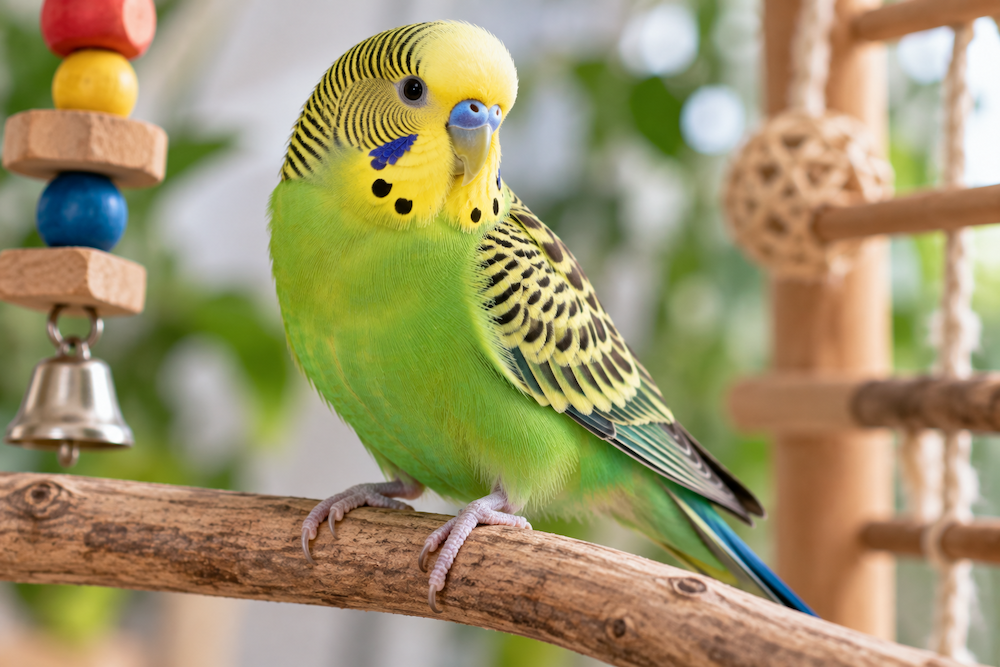







Tiny parrot, huge personality — the Budgerigar is an intelligent, social Australian bird capable of learning words, solving problems and forming remarkably close bonds with people.
🧠 QUICK SNAPSHOT
- Common Names: Budgerigar, Budgie, Parakeet
- Scientific Name: Melopsittacus undulatus
- Origin: Australia
- Size: Small parrot, approximately 18 cm long
- Weight: Usually around 30–40 g, depending on type and individual
- Temperament: Social, playful, curious, intelligent
- Noise Level: Moderate — frequent chirping and chatter
- Trainability: Excellent
- Talking Ability: Excellent for such a small bird
- Social Needs: High
- Best For: Families, adults and first-time bird owners prepared to provide daily interaction
- Typical Lifespan: Around 7–12 years, sometimes considerably longer with excellent care
📚 OVERVIEW
The Budgerigar may be one of the world’s most familiar pet birds, but calling it “just a budgie” seriously underestimates this remarkable little Australian parrot.
Wild Budgerigars live across large areas of inland Australia, where enormous flocks can travel in search of water, grass seeds and favourable breeding conditions. Their lives are intensely social, active and unpredictable — characteristics still clearly visible in pet Budgies.
Budgerigars are members of the parrot family and possess many of the qualities people associate with much larger parrots. They can learn words, recognise routines, solve simple problems, play with toys and develop strong relationships with both birds and humans.
Their relatively small size makes them easier to accommodate than many parrots, but small doesn’t mean low-maintenance. Budgies need space to fly, opportunities to forage, appropriate nutrition, toys, social interaction and specialised avian veterinary care.
With good husbandry, a Budgerigar can be an extraordinarily entertaining companion.
✅ PROS & CONS
Pros
- Extremely intelligent for such a small bird
- Can become affectionate and strongly bonded to people
- Some become exceptional talkers
- Smaller housing requirements than large parrots
- Generally less destructive than large parrot species
- Playful and entertaining
- Available in an enormous variety of colours
- Can live happily with other compatible Budgies
- Suitable for apartments when noise is acceptable
- Relatively affordable compared with many parrots
Cons
- Requires daily social interaction and enrichment
- Needs significantly more cage space than many pet-shop cages provide
- Can scatter feathers, seed husks and food
- May bite when frightened or poorly handled
- Needs regular opportunities for safe flight
- Can become lonely or bored when kept without sufficient companionship
- Birds often hide illness until seriously unwell
- Requires access to an avian veterinarian
- A seed-only diet can cause serious nutritional problems
- Commitment can potentially last well over a decade
Is a Budgerigar a Good Pet?
Yes. Budgerigars can be excellent pets for people prepared to meet their social, physical and behavioural needs.
They’re intelligent, interactive and capable of forming close relationships with humans.
Compared with larger parrots, they’re relatively easy to house and generally quieter.
However, Budgies shouldn’t be treated as decorative cage birds. They need daily enrichment, exercise, social interaction and appropriate nutrition.
Is a Budgie the Same as a Budgerigar?
Yes. Budgie is simply the common shortened name for Budgerigar.
In Australia, Britain and many other countries, “Budgie” is the usual everyday term.
In North America, Budgerigars are frequently called parakeets.
However, “parakeet” is a broad term covering numerous species of small-to-medium, long-tailed parrots.
Every Budgie is a parakeet, but not every parakeet is a Budgie.
Where Do Budgerigars Come From?
Budgerigars are native to Australia.
Wild populations occur across enormous areas of the continent, particularly arid and semi-arid inland regions.
They’re highly mobile birds capable of travelling substantial distances in response to rainfall, food and water availability.
Rather than defending permanent territories year-round, wild flocks can appear wherever environmental conditions suddenly become favourable.
What Do Wild Budgerigars Look Like?
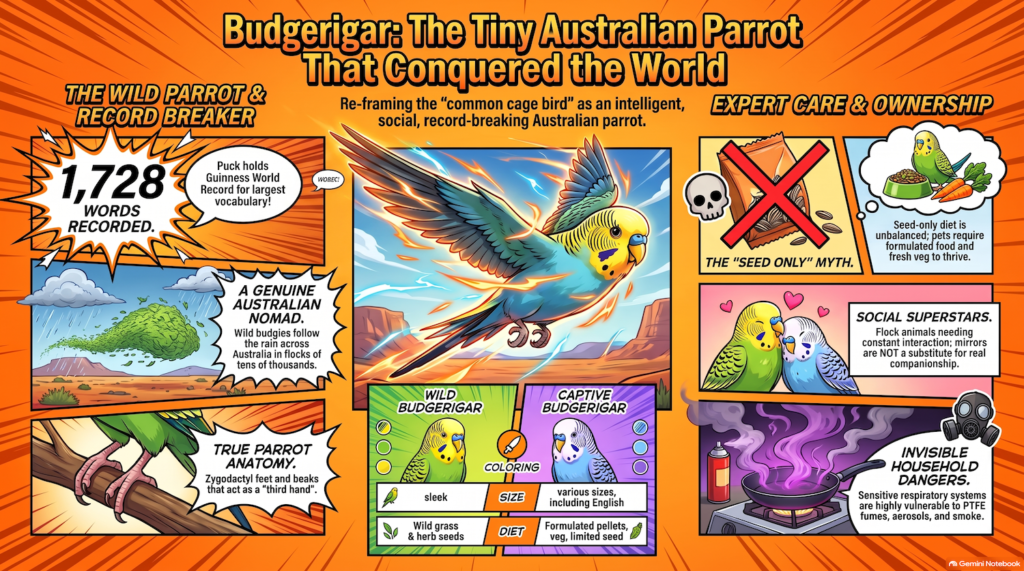
Wild Budgerigars are primarily bright green and yellow with black barring across parts of the head, wings and back.
This colouring provides excellent camouflage among Australian vegetation.
The blue, white, violet, grey and many other colours seen in domestic Budgies resulted from mutations selected by breeders.
The familiar green Budgie is therefore much closer to nature’s original design.
How Big Does a Budgerigar Get?
A typical Budgerigar is approximately 18 cm long from head to tail and usually weighs around 30–40 grams.
Domestic exhibition Budgies can be considerably larger and heavier than wild-type or pet-line birds.
Despite their tiny body weight, Budgies have the same basic intelligence, social complexity and behavioural needs expected from parrots.
What Is the Difference Between an English Budgie and an Australian Budgie?
So-called English Budgies aren’t a separate species.
They’re domestic exhibition lines selectively bred for larger bodies, broader heads and more abundant feathering.
Wild-type or pet-line Budgies generally have slimmer bodies and more closely resemble Australia’s wild birds.
“Australian Budgie” can therefore be confusing because every Budgerigar species is Australian in origin.
How Long Do Budgerigars Live?
Pet Budgerigars commonly live around 7–12 years, although well-cared-for individuals can live longer.
Genetics, nutrition, exercise, veterinary care and breeding history all influence lifespan.
Some Budgies unfortunately live much shorter lives because obesity, poor diets, tumours or other illnesses go undetected.
A Budgie shouldn’t be purchased as a short-term children’s pet — it can remain part of the family for many years.
What Size Cage Does a Budgerigar Need?
A Budgerigar needs a cage large enough to move, climb and stretch its wings comfortably, with width particularly important because Budgies fly horizontally.
For one or two Budgies, bigger is almost always better.
Long flight-style cages are preferable to narrow decorative cages.
Bar spacing must also be narrow enough to prevent the bird’s head becoming trapped.
Even with a good cage, Budgies benefit enormously from regular supervised flight in a bird-safe room.
Do Budgerigars Need to Fly Every Day?
Ideally, yes. Flight is fundamental Budgerigar behaviour.
Flying provides cardiovascular exercise, strengthens muscles, improves coordination and allows birds to express natural behaviour.
A sufficiently large flight enclosure can provide substantial exercise, while pet birds may also benefit from supervised free flight in a secure indoor environment.
Ceiling fans, open windows, hot cooking surfaces, mirrors, toxic plants and other pets must be controlled before allowing free flight.
Should You Clip a Budgie’s Wings?
Routine wing clipping is increasingly questioned from a welfare perspective because flight is one of a bird’s most fundamental natural behaviours.
Flight provides physical exercise, confidence and opportunities to escape situations that make the bird uncomfortable.
Rather than relying on clipping, owners can bird-proof indoor spaces and train recall and safe handling.
There may occasionally be individual veterinary circumstances requiring temporary flight restriction, but permanent removal of normal flight shouldn’t be treated as routine Budgie care.
What Should a Budgerigar Eat?
A healthy Budgie diet should be nutritionally balanced and varied.
A formulated high-quality pellet can provide an important nutritional foundation, supplemented with appropriate vegetables, leafy greens and smaller amounts of seeds and other suitable foods.
Dietary recommendations can vary between birds, so an avian veterinarian can provide individual advice.
Fresh clean water must always be available.
Is a Seed-Only Diet Healthy for Budgies?
No. A seed-only diet is generally nutritionally inadequate.
Budgies naturally eat seeds, but wild birds consume varied foods at different stages of development and expend enormous amounts of energy searching for them.
Captive birds offered unlimited high-fat seeds can selectively eat favourites while missing important nutrients.
Poor diets can contribute to obesity, fatty liver disease and vitamin and mineral deficiencies.
Seed can remain part of a balanced feeding programme without becoming the entire menu.
What Foods Are Toxic to Budgerigars?
Several common household foods can be dangerous to birds.
Important foods to avoid include avocado, chocolate, caffeine and alcohol.
Highly salty, fatty or sugary human foods are also inappropriate.
Owners should check the safety of unfamiliar foods before offering them because birds are extremely small and potentially toxic doses can therefore be tiny.
Can Budgerigars Eat Vegetables?
Yes. Budgies can eat a variety of bird-safe vegetables and leafy greens.
Options can include broccoli, carrot, capsicum, leafy greens and other appropriate fresh produce.
Introducing vegetables can require patience if a bird has spent years eating only seed.
Different presentation methods — chopped, clipped to the cage or incorporated into foraging activities — can encourage experimentation.
Do Budgerigars Need Grit?
Budgerigars generally don’t require insoluble grit to digest their food.
Unlike birds that swallow seeds whole, parrots remove the outer husk before eating the kernel.
Providing unlimited grit can potentially cause problems if a bird consumes excessive quantities.
Calcium and mineral requirements should instead be met through an appropriate balanced diet and veterinary guidance.
How Much Sleep Does a Budgerigar Need?
Budgies generally benefit from around 10–12 hours of quiet, uninterrupted darkness each night.
A predictable day-night routine supports normal behaviour and health.
Televisions, bright lights and household activity late into the night can interfere with rest.
A cage cover may help in some homes, but adequate ventilation and temperature must always be maintained.
Can a Budgerigar Live Alone?
A Budgie can live alone if it receives substantial daily social interaction, but Budgerigars are naturally flock-living birds.
Human companionship can be extremely valuable, but people generally can’t remain with a bird throughout the entire day.
Keeping compatible Budgies together can provide continuous social interaction.
Owners should still spend time with their birds even when they have avian companions.
Is It Better to Have One Budgie or Two?
For many households, two compatible Budgies can provide valuable companionship for each other.
Budgerigars evolved to live in social groups and communicate almost continuously.
A single bird can still thrive when its human family provides substantial interaction.
The idea that two Budgies will never bond with humans isn’t necessarily true. Patient handling and positive reinforcement can create tame, interactive birds even when they have avian friends.
Can Two Male Budgies Live Together?
Yes. Two male Budgies can often live together very successfully.
Male Budgies are frequently sociable with each other and may develop close bonds.
Individual compatibility still matters.
The enclosure should be sufficiently large, with multiple food locations, perches and resources to reduce competition.
Can Two Female Budgies Live Together?
Two females can live together, but female Budgies can sometimes be more territorial than males.
A large enclosure and duplicate resources can help reduce conflict.
Owners should monitor interactions rather than assuming every pair will automatically become friends.
Serious bullying requires intervention.
Can Male and Female Budgies Live Together?
Yes, but keeping a male and female together creates the possibility of breeding and reproductive behaviour.
Owners shouldn’t encourage breeding casually.
Egg laying carries genuine health risks for females, including calcium depletion and potentially life-threatening egg binding.
Environmental conditions that stimulate nesting should therefore be managed carefully unless breeding is being undertaken responsibly.
How Can You Tell if a Budgie Is Male or Female?
Sex can often be estimated by examining the cere, the fleshy area above the beak containing the nostrils.
Adult males commonly develop a bright blue cere in many colour varieties.
Adult females often have whitish, pale blue, tan or brown ceres depending on hormonal condition.
Some colour mutations alter these typical patterns, and young birds can be harder to sex visually.
DNA testing can provide certainty when necessary.
What Is a Budgie’s Cere?
The cere is the fleshy area directly above the beak where the nostrils are located.
Its colour can provide clues about sex, age and hormonal condition.
Changes in cere appearance can sometimes also indicate medical problems.
Owners who become familiar with their bird’s normal appearance are more likely to notice unusual changes early.
Can Budgerigars Talk?
Yes. Budgerigars can be remarkably talented mimics of human speech.
Some individuals learn dozens or even hundreds of words and phrases.
Their voices are tiny and rapid, so first-time listeners may initially struggle to recognise what they’re saying.
Talking ability varies enormously between individuals and should never be the sole reason for obtaining a bird.
Are Budgies Better Talkers Than Large Parrots?
Budgies can be astonishingly accomplished talkers, particularly considering their size.
Large parrots may produce clearer or more human-like voices, but individual Budgies have developed extraordinary vocabularies.
Some have held records for exceptionally large numbers of learned words.
The ability of a bird weighing only a few dozen grams to reproduce human speech remains one of the Budgerigar’s most impressive characteristics.
Which Budgie Had the Largest Vocabulary?
A Budgerigar named Puck became famous for an enormous recorded vocabulary and was credited by Guinness World Records with learning 1,728 words.
Puck lived in the United States and demonstrated just how extraordinary Budgerigar vocal learning can become.
Not every Budgie will become a champion talker, but the record destroys the idea that sophisticated vocal mimicry belongs only to large parrots.
Do Male or Female Budgies Talk More?
Male Budgies often develop reputations as more enthusiastic vocal mimics, although females can also learn words.
In the wild, male courtship behaviour involves extensive vocalisation, which may contribute to this tendency.
Individual personality, social environment and the amount of interaction a bird receives are extremely important.
A female shouldn’t be dismissed as incapable of learning speech.
How Do You Teach a Budgie to Talk?
Repetition, positive interaction and patience are the keys.
Short phrases spoken clearly and enthusiastically during regular social interaction can encourage vocal mimicry.
Budgies often learn words associated with exciting events, greetings or favourite people.
Recorded phrases may provide repetition, but direct social interaction is usually much more meaningful to a highly social parrot.
Never punish a bird for failing to talk.
Are Budgerigars Intelligent?
Yes. Budgerigars are highly intelligent little parrots.
They can learn associations, recognise routines, solve simple problems, distinguish sounds and learn complex vocalisations.
Research using Budgerigars has contributed to scientific understanding of vocal learning, hearing and social behaviour.
Their small brain shouldn’t be confused with a simple brain.
Can Budgies Recognise Their Owners?
Budgies can learn to recognise familiar people through appearance, voice, behaviour and routine.
A bonded bird may become excited when a particular person enters the room or calls to it.
Recognition is part of the complex social intelligence expected from a flock-living parrot.
They can also learn which family member is most likely to provide food, attention or freedom from the cage remarkably quickly.
Can Budgies Learn Their Names?
Budgies can learn to associate a particular sound or word with themselves, including the name humans repeatedly use for them.
Some talking Budgies even incorporate their own names into learned phrases.
Whether they conceptualise a name exactly as humans do is a much more complicated scientific question.
What is clear is that they can learn meaningful associations between particular sounds, individuals and events.
Can You Train a Budgerigar?
Absolutely. Budgies can learn step-up, recall, target training and numerous tricks.
Positive reinforcement is particularly effective.
Training isn’t simply entertainment. It can make routine handling, transport and veterinary care considerably less stressful.
A trained recall can also become an important safety behaviour for a flighted indoor bird.
Do Budgies Bite?
Budgies can bite, particularly when frightened, cornered, territorial or overstimulated.
A Budgie’s bite is much less powerful than that of a large parrot but can still hurt.
Punishment usually makes biting worse by increasing fear.
Learning the bird’s body language and allowing voluntary interaction is a much better approach.
Do Budgies Like Being Petted?
Some tame Budgies enjoy gentle head and cheek scratches, particularly from trusted people.
Others prefer interaction without physical touching.
Owners should respect individual preference.
Touching parrots repeatedly over the back, wings or lower body can also stimulate sexual behaviour, so affectionate touching is best concentrated around the head and neck.
Why Does My Budgie Grind Its Beak?
Gentle beak grinding is often a sign that a Budgie is relaxed and preparing to rest.
Many parrots quietly grind their beaks while settling down for sleep.
It can sound alarming to new owners but is usually normal.
As with any behaviour, sudden changes accompanied by other signs of illness deserve attention.
Why Does My Budgie Bob Its Head?
Head bobbing can have several meanings depending on context.
Young birds may bob while begging for food, while adults can bob during excitement, social interaction or courtship.
Some Budgies seem to incorporate head bobbing into play and attention-seeking.
Body language should always be interpreted as a complete picture rather than relying on one movement.
Why Does My Budgie Puff Up?
A Budgie may briefly fluff its feathers to relax, regulate temperature, groom or settle for sleep.
Occasional puffing is completely normal.
However, a bird that remains fluffed up for long periods, particularly while quiet, sleepy or sitting low on the perch, may be ill.
Because birds often conceal sickness, persistent behavioural changes should be taken seriously.
Why Does My Budgie Stand on One Leg?
A relaxed Budgie may tuck one foot into its feathers and stand on the other leg while resting.
This helps conserve body heat and is common in comfortable birds.
Birds frequently alternate feet.
Persistent inability to use one leg, swelling or unusual posture is different and requires veterinary assessment.
Why Does My Budgie Chirp All Day?
Budgerigars are naturally highly vocal flock birds.
Chirping helps maintain social contact and communicates excitement, location and emotional state.
A healthy Budgie may spend substantial portions of the day chattering, singing and responding to household sounds.
Sudden unusual silence in a normally vocal bird can sometimes be more concerning than noise.
Are Budgerigars Loud?
Budgies are generally much quieter than large parrots, but they aren’t silent.
Their regular chirping, chatter and contact calls can continue throughout the day.
They can therefore suit many apartments better than cockatoos or macaws.
However, someone requiring complete silence may still find a pair of enthusiastic Budgies surprisingly noticeable.
Why Does My Budgie Scream When I Leave the Room?
A Budgie calling when its owner disappears may be giving a contact call.
Wild Budgies use calls to maintain contact with flock members.
A bonded human can effectively become part of the bird’s social group.
Teaching independence and providing enrichment can reduce excessive calling without punishing a completely natural communication behaviour.
Do Budgies Need Toys?
Yes. Budgies need varied enrichment and opportunities to chew, climb, explore and forage.
Suitable toys can include shreddable materials, swings, climbing opportunities and food-based foraging activities.
Toys should be checked regularly for dangerous gaps, loose fibres, toxic materials or damaged components.
Rotating toys can maintain novelty without overcrowding the enclosure.
Do Budgies Need Mirrors?
Mirrors aren’t necessary and can create problems for some Budgies.
A bird may interpret its reflection as another Budgie and become obsessively attached to it.
This can contribute to regurgitation, territorial behaviour or frustration.
Interactive toys, foraging activities and genuine social interaction generally provide healthier enrichment than relying heavily on mirrors.
Why Does My Budgie Regurgitate Food?
Budgies sometimes regurgitate food as part of courtship and bonding behaviour.
A bird may attempt to feed a mate, favourite toy, mirror or even its owner.
Repeated regurgitation shouldn’t be confused with vomiting.
Vomiting, lethargy or other signs of illness require prompt veterinary attention.
Can Budgerigars See Colours?
Yes. Budgies have excellent colour vision and can perceive wavelengths beyond normal human vision, including ultraviolet.
Some plumage features that look relatively ordinary to humans can appear very different to another Budgerigar.
Ultraviolet visual information may play a role in social signalling and mate choice.
The Budgie’s world is literally more colourful than ours.
Can Budgies See Ultraviolet Light?
Yes. Budgerigars can perceive ultraviolet wavelengths invisible to humans.
This means their feathers and surroundings don’t necessarily look the same to them as they do to us.
Scientific research has investigated how ultraviolet-reflective plumage influences Budgerigar social and mating behaviour.
It’s a remarkable reminder that humans only see part of the visual information surrounding these tiny birds.
Why Do Budgies Have Black Spots on Their Cheeks and Throat?
Wild-type Budgerigars have distinctive dark throat spots and coloured cheek patches that contribute to their characteristic appearance.
These markings are part of their natural plumage pattern and can vary with age, mutation and breeding line.
Young Budgies often have different facial barring from mature adults, making plumage useful when estimating age.
How Can You Tell the Age of a Budgie?
Age can sometimes be roughly estimated from physical features, particularly in young normal-coloured Budgies.
Juveniles often have head barring extending towards the cere and completely dark eyes.
After the first moult, the forehead generally becomes clearer.
Many adults eventually develop a visible pale iris ring.
Colour mutations can alter these clues, so exact age usually can’t be determined visually in an unknown adult.
Why Do Baby Budgies Have Stripes on Their Foreheads?
Young Budgies often have dark barring extending down the forehead towards the cere.
After the first juvenile moult, typically at several months of age, the forehead becomes much clearer in many colour varieties.
This change can help distinguish young birds from adults.
Selective colour mutations can modify or remove the usual pattern.
How Many Colours of Budgerigar Are There?
Domestic Budgerigars occur in an enormous number of colour and pattern combinations.
Selective breeding has produced blue, white, grey, violet, yellow and many other appearances, along with mutations affecting wing markings, pigmentation and feather patterns.
Most of this extraordinary diversity ultimately developed from the wild Budgerigar’s green-and-yellow foundation.
Why Are Wild Budgies Green but Pet Budgies Can Be Blue?
The green colour of wild Budgies results from the interaction of yellow pigmentation and structural blue colour in their feathers.
Mutations affecting pigment production can remove yellow, revealing blue.
Selective breeding then combined mutations to produce the enormous colour range found in domestic Budgerigars.
Blue Budgies therefore aren’t a different species — they’re variations created from the same Australian bird.
Are There Wild Blue Budgies in Australia?
Wild Budgerigars are overwhelmingly the natural green-and-yellow form.
Colour mutations can theoretically occur naturally, but unusual individuals would generally be rare and may have reduced camouflage.
The spectacular blue, white and other colour varieties familiar in pet Budgies became common through selective breeding in captivity.
Do Budgerigars Live in Huge Flocks?
Yes. Wild Budgerigars can form enormous flocks, particularly when environmental conditions produce abundant food and water.
Australia’s rainfall is famously unpredictable, so Budgies can travel extensively following favourable conditions.
Large flocks moving together can create spectacular waves of green across the landscape.
Their extreme sociality helps explain why captive Budgies have such strong needs for interaction and communication.
Are Budgies Nomadic in the Wild?
Wild Budgerigars are often highly mobile and nomadic, especially across Australia’s dry interior.
Rather than following a simple fixed annual migration, they respond dynamically to rainfall, grass-seed availability and water.
When rain transforms an arid region, Budgies can arrive, feed and breed rapidly.
When conditions deteriorate, they move on.
How Do Budgies Survive Australia’s Heat?
Wild Budgerigars survive Australia’s challenging interior through a combination of mobility, behavioural adaptation and careful use of water and shade.
They can travel to locate water and food rather than remaining permanently in one location.
Extreme heat is still dangerous.
Pet Budgies should never be assumed to tolerate dangerous temperatures simply because their ancestors came from Australia.
When Do Wild Budgies Breed?
Wild Budgies are highly responsive to rainfall and food availability rather than relying solely on a rigid breeding season.
Rain can trigger grass growth and seed production, creating excellent conditions for raising chicks.
This flexibility allows Budgies to take advantage of Australia’s unpredictable inland environment.
When conditions suddenly become good, they can reproduce remarkably quickly.
Where Do Budgies Build Their Nests?
Budgerigars are cavity nesters.
Wild birds commonly use holes and hollows in trees rather than constructing elaborate open nests.
The female lays her eggs inside the cavity.
This nesting strategy helps protect eggs and chicks from weather and some predators.
How Many Eggs Does a Budgie Lay?
A Budgie clutch commonly contains around four to six eggs, although smaller and larger clutches occur.
Eggs are generally laid at intervals rather than simultaneously.
Owners shouldn’t encourage pet Budgies to breed simply because reproduction appears easy.
Egg production places substantial nutritional and physical demands on the female.
Can Female Budgies Lay Eggs Without a Male?
Yes. A female Budgie can lay unfertilised eggs without ever encountering a male.
This surprises many first-time owners.
Excessive egg laying can deplete calcium and increase the risk of serious reproductive problems.
Repeated laying should be discussed with an avian veterinarian, and environmental factors encouraging reproductive behaviour may need to be modified.
What Is Egg Binding in Budgies?
Egg binding occurs when a female bird is unable to pass an egg normally.
It can become a life-threatening emergency.
Signs may include straining, weakness, sitting low, abdominal swelling or difficulty perching.
A suspected egg-bound Budgie requires urgent veterinary attention.
Because Budgies are tiny, deterioration can occur rapidly.
Are Budgerigars Parrots?
Yes. Budgerigars are true parrots.
They’re members of the order Psittaciformes and possess classic parrot characteristics including a hooked bill, zygodactyl feet and sophisticated vocal-learning abilities.
Their small size sometimes causes people to underestimate them.
Biologically and behaviourally, the little Budgie sitting in a suburban living room belongs to the same extraordinary parrot order as cockatoos, lorikeets, African greys and macaws.
Why Do Budgies Have Two Toes Facing Forward and Two Backward?
Like other parrots, Budgerigars have zygodactyl feet — two toes face forward and two backward.
This arrangement provides an excellent grip for climbing and perching.
Budgies can also use their feet with considerable dexterity when navigating branches, cages and toys.
It’s one of the anatomical characteristics that immediately identifies them as parrots.
Who First Described the Budgerigar Scientifically?
European naturalists encountered Budgerigars as Australia’s wildlife became increasingly documented during the colonial period.
The species was scientifically described in the early 19th century, with the name eventually becoming Melopsittacus undulatus.
The scientific name has an appealing connection with the bird’s behaviour: Melopsittacus can be interpreted approximately as “melodious parrot”, while undulatus refers to the wave-like markings of its plumage.
When Did Budgies Become Popular Pets?
Budgerigars reached Europe during the 19th century and rapidly attracted attention as cage birds.
Their small size, sociability, attractive colours and ability to reproduce in captivity helped them become enormously popular.
Selective breeding subsequently produced numerous colour mutations.
By the 20th century, the Budgie had become one of the world’s most widely kept pet birds.
Is the Budgerigar the Most Popular Pet Bird in the World?
The Budgerigar is widely regarded as one of the world’s most popular companion birds, and is frequently described as the most commonly kept pet bird.
Exact worldwide ownership figures are difficult to establish.
Its popularity is easy to understand: Budgies combine parrot intelligence and social behaviour with a size and noise level manageable for far more households than most large parrots.
What Does the Word Budgerigar Mean?
The English word Budgerigar was derived from an Australian Aboriginal language, but its exact original meaning and linguistic pathway have been debated.
One famous popular claim translates it as something resembling “good to eat”, but this explanation is disputed and shouldn’t be treated as established fact.
Early European spellings varied considerably before “Budgerigar” became standard.
The nickname “Budgie” eventually became so familiar that many people don’t realise the bird has an Indigenous Australian name at the heart of its English identity.
🔘 Thinking About a Budgerigar?
Budgerigars may be inexpensive and small, but they’re intelligent Australian parrots with complex social and behavioural needs.
Give them space to fly, good nutrition, companionship, enrichment and appropriate veterinary care, and a Budgie can become one of the most entertaining little animals you’ll ever share your home with.
👉 Explore More Pet Guides at EatWagLove