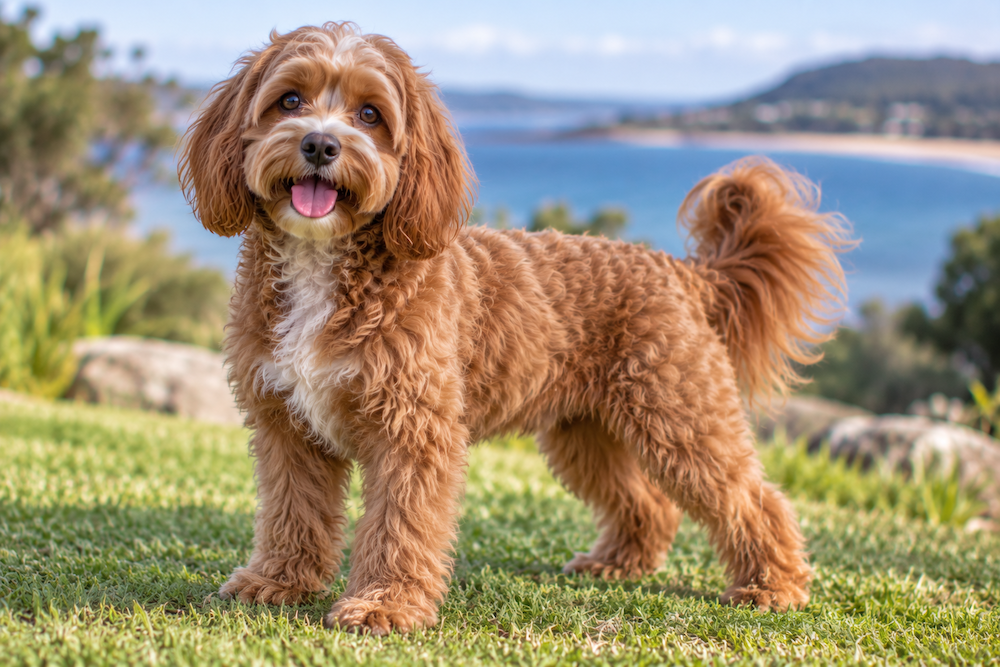




Affectionate, intelligent, and famous for its teddy-bear looks — the Cavapoo combines the gentle, people-loving personality of the Cavalier King Charles Spaniel with the intelligence and often lower-shedding coat of the Poodle, creating one of the world's most popular small companion dogs.
🧠 QUICK SNAPSHOT
- Temperament: Affectionate, friendly, intelligent
- Energy Level: Moderate
- Size: Small to Medium
- Good With Families: Excellent
- Apartment Living: Excellent with sufficient exercise
- Trainability: High
- Grooming: High
- Best For: Families, first-time owners, apartment living, interactive households, people wanting a highly affectionate companion
- Typical Lifespan: Around 12–15 years
📚 OVERVIEW
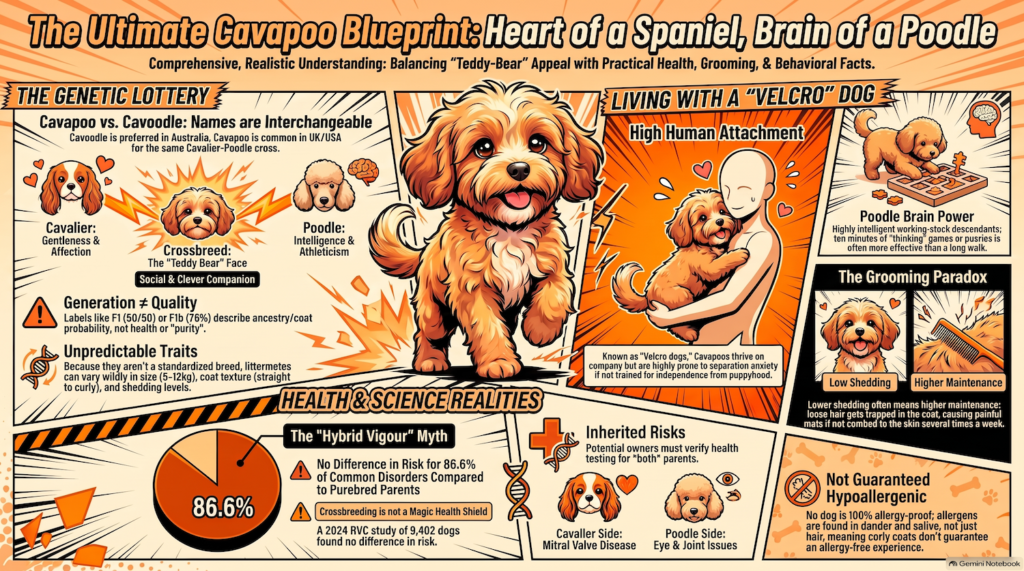
The Cavapoo — sometimes called a Cavoodle, particularly in Australia — is a cross between a Cavalier King Charles Spaniel and a Poodle, usually a Toy or Miniature Poodle.
The combination has become enormously popular.
Cavalier King Charles Spaniels are famous for their gentle, affectionate personalities, while Poodles bring intelligence, trainability and a coat that can shed considerably less than many other breeds.
Put them together and you can get an affectionate, clever little dog with expressive eyes and a soft wavy or curly coat.
But there’s an important word in that sentence:
can.
The Cavapoo is a crossbreed rather than a genetically uniform established breed. Coat, size, temperament, shedding and even appearance can vary substantially between individual dogs.
One Cavapoo may inherit a tightly curled Poodle-like coat.
Another may have much straighter Cavalier-like hair.
The same unpredictability applies to health.
Crossbreeding doesn’t automatically eliminate inherited disease. Cavapoos can potentially inherit health problems occurring in either parent breed, making health testing extremely important.
When responsibly bred and properly socialised, however, the Cavapoo can be a wonderful companion — affectionate, entertaining and often extraordinarily devoted to its humans.
✅ PROS & CONS
Pros
- Extremely affectionate
- Usually excellent with families
- Intelligent and highly trainable
- Generally friendly and sociable
- Adaptable to apartment living
- Moderate exercise requirements
- Often lower shedding than many breeds
- Usually enjoys other compatible dogs
- Excellent companion for interactive households
Cons
- Can struggle when left alone
- Coat requires considerable maintenance
- Professional grooming is often necessary
- Not guaranteed to be low shedding
- Not truly hypoallergenic
- Can inherit serious health conditions from either parent breed
- Appearance and temperament can vary significantly
- Popularity has encouraged irresponsible breeding
- Can become overly dependent on its owners
Is a Cavapoo a Good Family Dog?
Yes, the Cavapoo is generally an excellent family dog, particularly for households wanting an affectionate companion that enjoys being closely involved in family life.
Cavalier King Charles Spaniels were developed primarily as companion dogs, while Poodles are intelligent, people-oriented dogs. Those characteristics often combine particularly well in a Cavapoo.
Many are gentle, playful and sociable with children.
Because Cavapoos are relatively small, however, young children should be taught to handle them carefully. Supervision is especially important with smaller dogs that can be injured by rough play or accidental falls.
Early socialisation helps puppies become comfortable around different people, animals, sounds and environments.
Cavapoos generally aren’t dogs that want to live independently from their families.
For many, the ideal location is remarkably simple:
wherever their favourite human happens to be.
How Much Exercise Does a Cavapoo Need?
Most adult Cavapoos need around 45–60 minutes of physical activity each day, although requirements vary with size, age, health and how strongly an individual takes after its Poodle parent.
Daily walks combined with interactive play generally work well.
Cavapoos can also enjoy retrieving, swimming, scent games, obedience and beginner-level agility.
Mental stimulation shouldn’t be overlooked.
The Poodle is an exceptionally intelligent dog, and many Cavapoos inherit considerable problem-solving ability.
Puzzle toys, food searches and short training sessions provide useful mental exercise.
Puppies shouldn’t be subjected to excessive repetitive high-impact exercise while their bodies are developing, while senior dogs may require shorter, gentler sessions.
The Cavapoo usually doesn’t require the extraordinary workload of a Blue Heeler.
But “small and cute” still doesn’t mean decorative cushion with legs.
Is a Cavapoo Easy to Train?
Yes. Cavapoos are generally highly trainable, making them potentially suitable for first-time dog owners prepared to train consistently.
Both parent breeds are strongly people-oriented, and the Poodle contributes particularly high intelligence.
Positive reinforcement using treats, toys and praise generally works extremely well.
Early priorities should include toilet training, recall, loose-lead walking, calm greetings and learning to settle independently.
That last skill is especially important.
Because Cavapoos often bond intensely with their owners, puppies should gradually learn that short periods alone are normal and safe.
Without appropriate independence training, some individuals can develop significant separation-related problems.
Training should be short, varied and enjoyable.
A Cavapoo may look like a teddy bear.
There’s usually a surprisingly capable little brain underneath all that fluff.
Does a Cavapoo Shed?
A Cavapoo may shed very little, moderately, or occasionally considerably more than expected.
This is one of the biggest misconceptions surrounding Poodle crosses.
Poodles have tightly curled, low-shedding coats.
Cavalier King Charles Spaniels shed.
A Cavapoo can inherit characteristics anywhere between those two extremes.
Dogs with curlier Poodle-like coats often shed less, while straighter-coated individuals may shed more noticeably.
Even low-shedding Cavapoos require considerable grooming.
Loose hair can remain trapped inside a curly coat and contribute to painful matting rather than simply falling onto the floor.
Regular brushing — often several times each week or even daily for some coats — is important.
Most Cavapoos also require professional clipping approximately every 6–8 weeks, depending on coat length and style.
Low shedding does not mean low maintenance.
In the Cavapoo’s case, it can mean precisely the opposite.
What Health Problems Are Common in a Cavapoo?
Cavapoos can potentially inherit health problems found in both Cavalier King Charles Spaniels and Poodles, so responsible health testing is extremely important.
One major Cavalier concern is mitral valve disease (MVD), a heart condition particularly prevalent in the breed.
Cavaliers are also affected by syringomyelia and Chiari-like malformation, neurological conditions associated with abnormalities around the skull and spinal cord.
Other potential concerns include patellar luxation, hip problems and inherited eye disorders.
Poodle lines can contribute risks including progressive retinal atrophy and other inherited conditions depending on whether Toy or Miniature Poodles are used.
Dental disease is also important in small dogs because crowded teeth can encourage plaque and periodontal problems.
Prospective owners shouldn’t accept “hybrid vigour” as a substitute for health testing.
Crossbreeding can increase genetic diversity, but it doesn’t magically prevent two parent breeds from passing inherited problems to their puppies.
⭐ Is a Cavapoo the Same as a Cavoodle?
Yes. Cavapoo and Cavoodle generally describe the same Cavalier King Charles Spaniel–Poodle cross.
“Cavoodle” is particularly common in Australia.
“Cavapoo” is widely used in the United Kingdom, United States and elsewhere.
Neither name changes the underlying cross.
The terminology is largely regional branding rather than a biological difference.
Occasionally breeders use one name while describing particular generations or sizes, but there is no universal genetic distinction between a Cavapoo and Cavoodle.
So if you’ve been wondering whether Australia somehow developed a completely separate teddy-bear-looking dog:
No.
We largely just gave ours a different name.
⭐ Where Did the Cavapoo Come From?
The exact origin of the first Cavalier–Poodle crosses isn’t well documented, because mixed-breed dogs existed long before anyone started giving particular crosses dedicated names.
Australia is frequently associated with the deliberate development and popularisation of the Cavoodle during the late 20th century, particularly as interest grew in companion dogs combining Poodle coats with other breeds.
Similar crosses subsequently became enormously popular internationally under the Cavapoo name.
Unlike breeds developed through closed pedigrees over many generations, the Cavapoo remains primarily a deliberate crossbreed.
That means there isn’t one universally accepted breed standard defining precisely what every Cavapoo must look like.
Ironically, the dog now found in homes around the world may have become internationally famous partly because nobody could agree on what to call it.
⭐ How Big Does a Cavapoo Get?
Cavapoos are generally small dogs, but adult size can vary considerably.
One major reason is the Poodle parent.
A Toy Poodle produces a different potential size range from a Miniature Poodle.
The size of the Cavalier parent, genetics across previous generations, sex and nutrition can also influence final adult size.
Many adult Cavapoos fall somewhere around 5–12 kg, but individuals can fall outside that range.
Height can similarly vary.
This makes promises such as “your puppy will definitely remain under 5 kg” questionable unless the breeder has extensive information about the dog’s lineage — and even then genetics can surprise you.
For prospective owners with strict size restrictions, such as apartment or airline requirements, parental size and previous litters deserve careful examination.
⭐ What Do F1, F1B and F2 Cavapoo Mean?
These labels describe different generations of crossbreeding.
An F1 Cavapoo generally has one purebred Cavalier King Charles Spaniel parent and one purebred Poodle parent.
An F1B Cavapoo usually results from breeding an F1 Cavapoo back to one of the parent breeds — most commonly a Poodle.
An F2 Cavapoo generally results from breeding two F1 Cavapoos together.
There are additional multigenerational combinations beyond these.
Breeders sometimes suggest that a particular generation guarantees a specific coat, temperament or allergy outcome.
Genetics isn’t quite that cooperative.
Increasing Poodle ancestry may increase the likelihood of certain Poodle characteristics, including curlier coats, but individual puppies can still vary.
The generation label tells you how the dog was bred.
It doesn’t tell you everything about the dog you’ll actually get.
⭐ Is a Cavapoo Hypoallergenic?
No dog is reliably 100% hypoallergenic, and Cavapoos shouldn’t be sold with that guarantee.
Dog allergies can involve proteins found in dander, saliva and urine rather than simply loose hair.
A low-shedding coat may reduce how much allergen-containing material becomes distributed around a home, which can help some allergy sufferers.
But individual Cavapoos vary.
A puppy can also develop a different adult coat from the one it appeared to have at eight weeks old.
Someone with significant allergies should spend time around adult Cavapoos before committing and ideally discuss their individual allergy management with an appropriate medical professional.
The phrase “hypoallergenic Cavapoo” is enormously attractive marketing.
Biology, unfortunately, doesn’t read puppy advertisements.
⭐ Why Can Two Cavapoos Look Completely Different?
Because the Cavapoo combines two physically different parent breeds, puppies can inherit very different combinations of genes.
One may have tight Poodle curls.
Another may have loose waves.
Another can have a relatively straight Cavalier-style coat.
Face shape, muzzle length, leg length, ear appearance, body structure and adult size can all vary.
Colour variation is enormous as well.
Cavapoos may appear in cream, apricot, red, black, chocolate, white, parti-colour and various combinations depending on parental genetics.
Even puppies from the same litter can look surprisingly different.
This is part of the appeal for some owners.
But it also means anyone who needs a dog to mature into one extremely specific appearance may be better suited to a well-established breed with more predictable characteristics.
With a Cavapoo, genetics gets a vote in the final design.
⭐ Do Cavapoo Puppies Change Colour as They Grow?
Yes. Some Cavapoos can change colour quite noticeably as they mature.
Poodles carry genes capable of causing coat colours to fade or lighten over time.
A puppy that begins life as a rich dark red or apricot may become considerably lighter as an adult.
Other dogs maintain much more of their original colour.
Black coats can sometimes lighten or develop silvering depending on inherited genetics.
This doesn’t indicate that anything is wrong with the dog.
It’s simply part of coat genetics.
Prospective owners choosing a puppy primarily because of an exact colour should therefore understand that today’s photograph isn’t necessarily a perfect preview of the adult dog.
Your dark-red teddy bear puppy may eventually decide that cream is more its colour.
⭐ Why Do Cavapoos Have Such a Teddy-Bear Appearance?
The famous teddy-bear look comes from a combination of large expressive eyes, floppy ears, a relatively compact face and a soft wavy or curly coat.
The Cavalier contributes its famously gentle expression and large dark eyes.
The Poodle contributes coat texture and often additional fluff around the face.
When groomers leave the facial hair rounded, the resemblance becomes even stronger.
This appearance has contributed enormously to the Cavapoo’s popularity on social media.
But owners should be careful not to prioritise exaggerated “teddy-bear” features over healthy anatomy.
A functional muzzle, healthy eyes, appropriate body structure and good temperament are considerably more important than producing the roundest possible Instagram face.
Cute should never need to compete with comfortable breathing, movement and vision.
⭐ Do Cavapoos Suffer From Separation Anxiety?
Cavapoos can be particularly prone to separation-related difficulties, although not every individual develops clinical separation anxiety.
Both parent breeds are strongly people-oriented.
The Cavalier was developed specifically for companionship, while Poodles tend to form close relationships with their owners.
Combine those characteristics and you can get a dog that would happily accompany its human everywhere.
Problems can develop when puppies never learn to spend time independently.
Owners should introduce short, comfortable periods alone from an early age rather than waiting until the dog has become accustomed to constant company.
Food toys, predictable routines and a comfortable resting area can help.
True separation anxiety can require professional behavioural support.
A Cavapoo following you into the bathroom may seem adorable.
After the 4,000th supervised bathroom visit, independence training starts to make considerably more sense.
⭐ Does a Cavapoo Need Professional Grooming?
For most Cavapoos, yes.
Their coat can be deceptively demanding.
Curly and wavy coats readily trap loose hair, which can form mats close to the skin.
Areas behind the ears, beneath the collar, under the legs and around the chest can be particularly vulnerable.
Regular home brushing is essential, but many owners also schedule professional grooming roughly every six to eight weeks.
Grooming frequency depends on coat type and preferred length.
Dogs kept in shorter practical clips can often be easier to maintain than those with long teddy-bear coats.
Puppies should meet groomers early so clippers, dryers, brushing and handling become ordinary experiences.
One of the biggest Cavapoo surprises is that a dog advertised as “low shedding” can require far more grooming than a dog that sheds everywhere.
⭐ Is a Cavapoo Healthier Than a Cavalier King Charles Spaniel?
A Cavapoo may benefit from greater genetic diversity, but it’s inaccurate to assume that every Cavapoo will automatically be healthier than a Cavalier.
This is where the concept of “hybrid vigour” is often oversimplified.
Crossing genetically different populations can reduce the chance of some recessive disorders when the parents don’t carry the same harmful variants.
But it doesn’t erase dominant or complex inherited diseases.
A Cavalier carrying predisposition to mitral valve disease can still pass relevant genetics to offspring.
Likewise, a Poodle can contribute its own inherited risks.
The biggest advantage comes not simply from crossing two breeds, but from selecting genuinely healthy, appropriately tested parents from both sides.
A poorly bred Cavapoo isn’t automatically healthier than a responsibly bred pedigree dog just because its parents have different breed names.
⭐ Why Has the Cavapoo Become So Popular?
The Cavapoo combines several characteristics modern companion-dog owners find enormously attractive.
It’s relatively small.
It’s cute.
It’s intelligent.
It’s affectionate.
It can adapt to apartments.
And many individuals shed relatively little.
Add the teddy-bear appearance and the breed becomes almost purpose-built for modern family life and social media.
But popularity has consequences.
High demand creates opportunities for puppy farms, irresponsible breeders and sellers charging premium prices while performing little meaningful health testing.
Anyone buying a Cavapoo should therefore look beyond photographs and colour descriptions.
Ask about the Cavalier parent’s heart and neurological health, appropriate eye and joint screening, and relevant DNA testing in the Poodle line.
The Cavapoo’s popularity isn’t difficult to understand.
The challenge is making sure demand for an adorable puppy doesn’t become more important than producing a healthy dog.