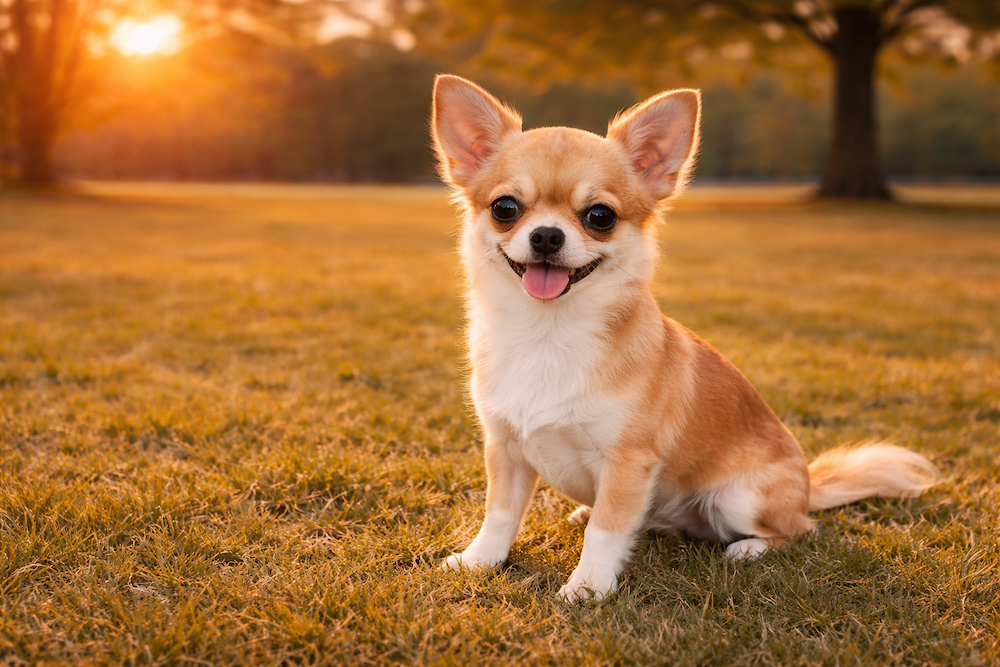







Tiny, bold, and full of personality — a small dog with a surprisingly big attitude.
🧠 QUICK SNAPSHOT
- Temperament: Bold, Loyal, Alert
- Energy Level: Low to Moderate
- Size: Small
- Good with Families: Yes (with care)
- Training Difficulty: Moderate
📚 OVERVIEW
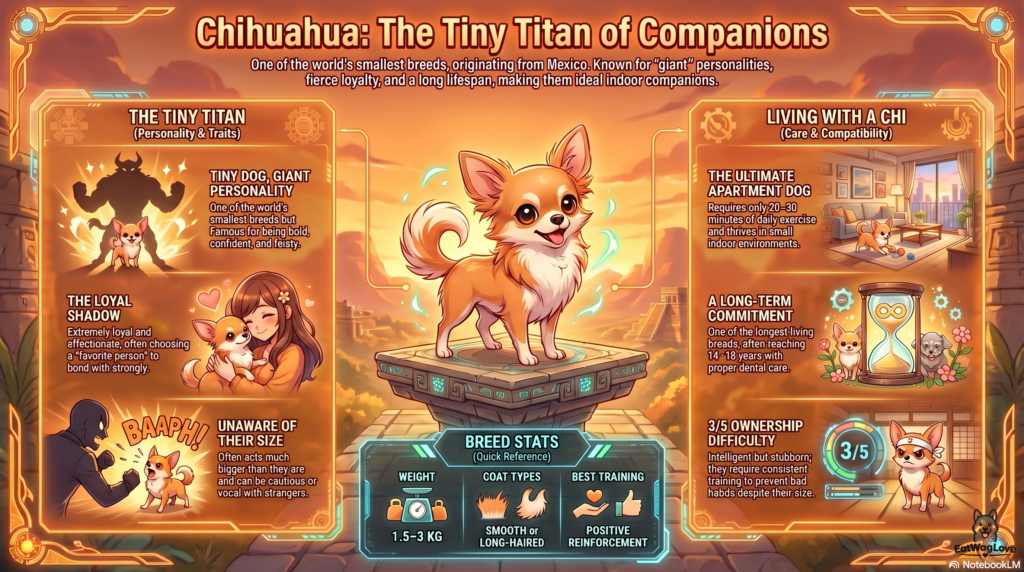
Chihuahuas are one of the smallest dog breeds in the world, known for their big personalities and strong attachment to their owners. Despite their size, they are confident, alert, and often act like much larger dogs. They are ideal companions for those looking for a small, devoted pet.
✅ PROS & CONS
Pros
- Great for apartments and small spaces
- Very loyal and devoted to their owner
- Low exercise requirements
Cons
- Can be vocal and alert to everything
- May be fragile and require careful handling
- Can develop behavioural issues without training
Is a Chihuahua a Good Family Dog?
Yes, a Chihuahua can be an excellent family companion, particularly in households that understand how to handle such a tiny dog.
Chihuahuas tend to form strong bonds with their people and can be affectionate, playful and surprisingly entertaining.
They can live with children, but very young children require careful supervision because accidental falls or rough handling can seriously injure a Chihuahua.
Small size doesn’t mean low personality — many Chihuahuas behave as though they’re the largest dog in the house.
How Much Exercise Does a Chihuahua Need?
Most Chihuahuas need around 30–45 minutes of daily activity, although this can be divided into several shorter walks and play sessions.
They’re more energetic than their tiny size suggests.
Indoor games, short walks, scent activities and training can provide plenty of stimulation.
Their small bodies mean owners should avoid excessive exercise in very hot or cold weather.
A Chihuahua doesn’t need kilometres of hiking every day, but it certainly shouldn’t spend its entire life being carried.
Is a Chihuahua Easy to Train?
Chihuahuas are intelligent and very capable of learning, although they can be independent and strong-willed.
Positive reinforcement and consistent rules work well.
One common mistake is allowing behaviours from a Chihuahua that would never be accepted from a larger dog.
Growling, lunging, guarding and excessive barking shouldn’t be dismissed simply because the dog weighs 2 kg.
Treating a Chihuahua like a dog rather than an accessory generally produces a much better companion.
Does a Chihuahua Shed?
Yes. Both Smooth Coat and Long Coat Chihuahuas shed.
Smooth-coated dogs can release more short hair than owners expect, while long-coated Chihuahuas may shed more noticeably during seasonal changes.
Regular brushing helps remove loose hair.
Long-coated dogs require additional attention around areas where tangles can develop.
Neither variety is genuinely non-shedding.
Is a Chihuahua Hypoallergenic?
No. Chihuahuas aren’t considered hypoallergenic.
They produce the same allergenic proteins in saliva, dander and skin secretions as other dogs.
Their tiny size may mean there’s less dog physically present in the home, but this doesn’t make them allergy-free.
People with significant allergies should spend time around Chihuahuas before deciding whether the breed is suitable.
What Health Problems Are Common in Chihuahuas?
Chihuahuas can be affected by several important health conditions.
Common concerns include patellar luxation, dental disease, heart disease, eye problems and tracheal collapse.
Hydrocephalus can occur, particularly in severely affected puppies, and very small puppies can be vulnerable to hypoglycaemia.
Their tiny jaws make dental care especially important.
Responsible breeding should prioritise sound structure and health rather than producing the smallest possible puppy.
How Long Do Chihuahuas Live?
Chihuahuas are generally a long-lived breed, commonly reaching around 14–17 years, with some living considerably longer.
Their small body size contributes to their impressive longevity.
Dental care, healthy body weight, heart monitoring and protection from preventable injuries become increasingly important as they age.
Choosing a sound, healthy Chihuahua is far more important than choosing the tiniest puppy available.
How Big Does a Chihuahua Get?
The Chihuahua is one of the smallest recognised dog breeds in the world.
Major breed standards generally emphasise weight rather than height, with adults typically expected to remain below approximately 2.7–3 kg, depending on the organisation.
Pet Chihuahuas can be larger and still be perfectly healthy companions.
Extremely tiny size shouldn’t be treated as automatically desirable.
Is There Such a Thing as a Teacup Chihuahua?
No. “Teacup Chihuahua” isn’t an officially recognised breed or size variety.
The term is usually a marketing description for an unusually small Chihuahua.
Breeding deliberately for extreme miniaturisation can increase the risk of fragile bones, dental abnormalities, hypoglycaemia, hydrocephalus and other health problems.
A healthy Chihuahua is already extraordinarily small.
There is no need to make one artificially smaller simply to create a more marketable label.
Can a Chihuahua Live in an Apartment?
Yes. Chihuahuas are excellent apartment dogs from a space perspective.
They require very little physical room and can receive much of their play exercise indoors.
The main potential problem is barking.
Chihuahuas can be highly alert and may react to hallway noises, neighbours or visitors.
Early training can make apartment living considerably more peaceful.
Can a Chihuahua Be Left Alone?
Adult Chihuahuas can learn to spend reasonable periods alone, but many become strongly attached to their owners.
Some individuals develop separation-related distress.
Gradual independence training during puppyhood is valuable.
Because Chihuahuas are small and sometimes sensitive to cold, they should have a warm, secure resting area.
They’re companion dogs and generally thrive when they’re genuinely included in household life.
Do Chihuahuas Bark a Lot?
Chihuahuas can be very vocal.
They’re naturally alert and quick to notice unfamiliar sounds, people or animals.
Barking can become excessive when owners accidentally reward it or fail to teach calm behaviour.
Their size may be tiny, but their watchdog instincts can be remarkably enthusiastic.
Early socialisation and training are the best ways to prevent alert barking from becoming constant barking.
Why Do Chihuahuas Shake So Much?
Chihuahuas can shake for several different reasons.
Their small bodies lose heat quickly, so cold temperatures are a common cause.
Excitement, fear, stress or anticipation can also produce trembling.
However, persistent shaking can sometimes indicate pain, low blood sugar, neurological problems or other illness.
A Chihuahua that suddenly begins trembling without an obvious explanation should be assessed rather than automatically dismissed as “just being a Chihuahua.”
Why Are Chihuahuas Always Cold?
Chihuahuas have very small bodies with relatively large surface areas, allowing them to lose body heat quickly.
Smooth-coated dogs have particularly little insulation.
This is why many Chihuahuas enthusiastically seek blankets, sunny windows and warm laps.
A well-fitted coat can be useful during cold weather.
Their preference for burrowing under blankets isn’t simply pampering — for a tiny dog, finding warmth makes biological sense.
Why Do Chihuahuas Burrow Under Blankets?
Many Chihuahuas love burrowing into blankets, beds and clothing.
Warmth is probably an important reason because their small bodies cool rapidly.
Burrowing also creates a secure, enclosed sleeping environment.
The behaviour can become a strong individual habit.
Owners should always check blankets before sitting down — a Chihuahua can disappear beneath one with astonishing efficiency.
Are Chihuahuas Aggressive?
Chihuahuas aren’t inherently destined to be aggressive, but fearfulness, poor socialisation and inappropriate handling can contribute to defensive behaviour.
Because they’re extremely small, the world can be physically intimidating.
Constantly picking up a nervous dog rather than teaching it confidence can sometimes reinforce reactive behaviour.
Genetics also matter.
A stable Chihuahua should be confident, alert and controllable rather than constantly snapping or lunging.
Are Chihuahuas Good With Other Dogs?
Chihuahuas can be very good with other dogs, especially when properly socialised.
Many particularly enjoy the company of other Chihuahuas.
Their greatest risk can actually be physical injury from much larger dogs.
Chihuahuas often seem remarkably unaware of their size and may challenge dogs many times heavier than themselves.
Interactions with unfamiliar large dogs should therefore be managed carefully.
Are Chihuahuas Good With Cats?
Yes, many Chihuahuas can live very successfully with cats.
Their tiny size means an adult cat may actually outweigh them.
Early introductions help both animals learn appropriate boundaries.
Some Chihuahuas may chase cats, while others become close companions.
A confident cat may quickly establish who controls the household.
Why Do Chihuahuas Sometimes Bond With One Person?
Chihuahuas are famous for forming particularly intense attachments to one favourite person.
They may still enjoy other family members while clearly preferring one individual.
This likely reflects their companion-dog temperament combined with individual personality and experience.
Early socialisation with multiple people can help prevent excessive dependence or guarding of a favourite owner.
Being chosen by a Chihuahua can feel flattering — until you’re no longer permitted to visit the bathroom alone.
Are There Two Types of Chihuahua?
There are two officially recognised coat varieties: the Smooth Coat Chihuahua and Long Coat Chihuahua.
They are varieties of the same breed rather than separate breeds.
Terms such as “Apple Head”, “Deer Head”, “Teacup” and “Pear Head” aren’t official breed varieties.
Some describe genuine differences in appearance, but they aren’t separate recognised types.
What Is an Apple Head Chihuahua?
“Apple Head” is an informal term describing a Chihuahua with the rounded skull, pronounced stop and relatively short muzzle associated with the breed standard.
Viewed from the side, the skull can resemble the dome of an apple.
It isn’t a separate breed.
The phrase is commonly used to distinguish these dogs from longer-headed Chihuahuas sometimes marketed as Deer Heads.
What Is a Deer Head Chihuahua?
A Deer Head Chihuahua is an informal description for a Chihuahua with a longer muzzle, less pronounced stop and often somewhat longer legs.
The head may appear more similar to that of a young deer.
Deer Head isn’t an officially recognised Chihuahua variety.
These dogs can make perfectly good companions, although their structure may differ from what conformation standards describe as ideal.
What Is a Molera in a Chihuahua?
A molera is a soft area or opening in the skull that can occur in Chihuahuas.
It is somewhat comparable to the fontanelle present in human infants.
Historically, the molera has been strongly associated with the breed.
A small molera isn’t automatically evidence of hydrocephalus, although unusually large skull openings or neurological symptoms require veterinary investigation.
Care should be taken to protect very small puppies from head injuries.
Is a Molera the Same as Hydrocephalus?
No. A molera and hydrocephalus are not the same condition.
A molera is an opening between skull bones.
Hydrocephalus involves an abnormal accumulation of cerebrospinal fluid within the brain’s ventricular system.
A Chihuahua can have a molera without having hydrocephalus.
Symptoms such as seizures, abnormal behaviour, balance problems or unusual skull enlargement require veterinary assessment rather than assumptions based solely on the presence of a molera.
Why Do Chihuahuas Have Such Big Ears?
The Chihuahua’s large upright ears are a defining feature of the breed.
They give the dog excellent awareness of surrounding sounds and contribute greatly to its alert expression.
Puppies aren’t necessarily born with fully upright ears.
The ears typically become more erect as the puppy develops, although they can temporarily change position during growth and teething.
Why Do Chihuahuas Have Such Big Eyes?
Chihuahuas have relatively large, expressive eyes in proportion to their tiny heads.
This contributes strongly to the breed’s distinctive appearance.
However, prominent eyes are more exposed to injury, irritation and drying than deeply set eyes.
Owners should seek veterinary advice for persistent redness, squinting, cloudiness or excessive tearing.
Eye health should always take priority over breeding for increasingly exaggerated facial features.
Do Long-Haired and Short-Haired Chihuahuas Have Different Personalities?
There is no reliable rule that Long Coat and Smooth Coat Chihuahuas have fundamentally different personalities.
Both belong to the same breed.
Temperament is influenced much more by genetics, socialisation, training and individual personality.
Long-coated dogs simply carry the genetics responsible for longer hair.
Choosing between them should mainly come down to coat preference and grooming requirements rather than expecting two different types of dog.
Can Two Short-Haired Chihuahuas Have a Long-Haired Puppy?
Potentially yes, if both Smooth Coat parents carry the recessive gene for long hair.
A puppy must inherit the relevant long-coat variant from both parents to develop the long coat.
This means two outwardly smooth-coated Chihuahuas can sometimes produce long-coated puppies.
Genetics can therefore produce a rather fluffy surprise.
What Colours Can Chihuahuas Be?
Chihuahuas occur in an extraordinary range of colours and patterns, including fawn, cream, black, chocolate, red and various combinations.
Markings can include white, tan and other patterns.
Accepted colours vary between kennel organisations.
One colour requiring particular caution is merle, because breeding merle-to-merle can produce puppies at increased risk of serious hearing and vision abnormalities.
Health should always take priority over unusual colouring.
Is the Chihuahua the Smallest Dog Breed in the World?
The Chihuahua is generally recognised as the smallest established dog breed by weight.
Individual record-holding dogs have been astonishingly tiny.
However, responsible breeding shouldn’t turn record-breaking miniature size into a goal.
Extremely small dogs can face increased risks from falls, hypoglycaemia, fragile bones and other problems.
The Chihuahua is already tiny enough without needing to win a competition for it.
What Were Chihuahuas Originally Bred For?
Unlike many working breeds, the Chihuahua’s ancient purpose isn’t completely documented.
Its ancestors were most likely kept primarily as companions and culturally significant dogs in pre-Columbian Mexico.
Dogs resembling the Chihuahua’s presumed ancestors appear in archaeological and artistic evidence from ancient Mexican cultures.
Claims that Chihuahuas had one single clearly defined ancient job should be treated cautiously because much of their earliest history remains uncertain.
What Is a Techichi?
The Techichi was a small companion dog associated particularly with the Toltec civilisation of ancient Mexico.
It is widely regarded as an important ancestor or relative of the modern Chihuahua.
Depictions of small dogs resembling Techichis appear in pre-Columbian art and archaeological sites.
Techichis were apparently culturally and sometimes religiously significant.
However, the exact genetic relationship between ancient Techichis and modern Chihuahuas is more complicated than simply saying today’s breed has remained unchanged for a thousand years.
Did the Aztecs Keep Chihuahuas?
The Aztecs kept small dogs related to earlier Techichi-type dogs, although these weren’t modern pedigree Chihuahuas in today’s sense.
Small dogs held cultural, religious and practical significance in several Mesoamerican societies.
Some were associated with beliefs surrounding death and the afterlife.
The modern Chihuahua therefore has genuine connections with ancient Mexican dog populations, although popular stories sometimes simplify several different cultures and centuries into one neat origin story.
Did Ancient Chihuahuas Guide People Through the Afterlife?
Ancient Mesoamerican cultures held beliefs in which dogs could help guide human souls through the world of the dead.
Dogs appear prominently in Aztec mythology, particularly in connection with the journey to Mictlan, the underworld.
However, describing these animals specifically as modern Chihuahuas would be inaccurate.
They were ancient Mexican dogs that may form part of the broader ancestry and cultural history associated with today’s breed.
Is the Chihuahua Really From Mexico?
Yes. The Chihuahua is strongly associated with Mexico, and both historical and genetic evidence supports ancestry involving indigenous American dogs.
The breed takes its modern name from the Mexican state of Chihuahua.
During the 19th century, travellers encountered small dogs in northern Mexico and brought examples into the United States.
These dogs contributed to development of the modern breed.
Why Is the Chihuahua Named After a Mexican State?
The breed is named after Chihuahua, Mexico’s largest state by area.
During the 19th century, American visitors reportedly encountered tiny dogs in the region and purchased them from local people.
The dogs became known by the location from which they were obtained — Chihuahua dogs.
Eventually the geographic description became the formal breed name.
Did Chihuahuas Descend From the Fennec Fox?
No. The Chihuahua isn’t descended from the Fennec Fox, despite an old theory inspired partly by similarities such as large ears and small body size.
Dogs and foxes belong to different branches of the canid family and cannot simply be crossed to produce Chihuahuas.
Modern genetic research places the Chihuahua firmly within domestic dog ancestry.
Its unusual appearance doesn’t require a fox ancestor to explain it.
Does the Chihuahua Still Carry DNA From Ancient American Dogs?
Yes. Genetic research has found that Chihuahuas retain ancestry connected with pre-European-contact American dogs.
This makes the breed particularly fascinating because European colonisation dramatically changed dog populations throughout the Americas.
Modern Chihuahuas aren’t genetically identical to ancient Mexican dogs, but evidence indicates that part of that indigenous ancestry survived.
So behind today’s tiny companion is a genetic connection reaching back into the Americas before European dog breeds arrived.
Where Does the Chihuahua Come From?
The Chihuahua comes from Mexico, with particularly strong associations with the state of Chihuahua.
Its deeper history appears connected with ancient Mexican dogs, including the Techichi associated with pre-Columbian civilisations.
During the 19th century, travellers encountered tiny dogs in northern Mexico and brought them into the United States, where the modern breed became increasingly standardised.
The Chihuahua may now spend much of its time under blankets and on laps, but its story reaches remarkably far back — from ancient Mesoamerican cultures to becoming the smallest recognised dog breed in the modern world.