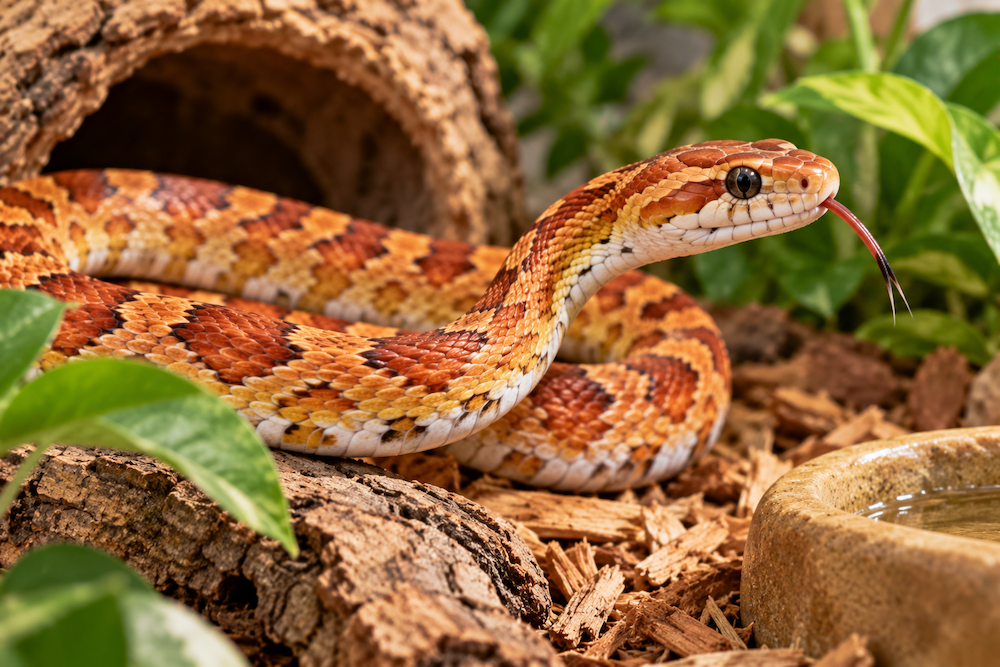







Calm, colourful and relatively straightforward to care for, the Corn Snake is one of the most popular pet snakes. Its manageable size and generally docile temperament make it an excellent first reptile, provided its housing, temperature and feeding needs are properly understood.
🧠 QUICK SNAPSHOT
| Trait | Corn Snake |
|---|---|
| Scientific Name | Pantherophis guttatus |
| Pet Type | Reptile / Snake |
| Natural Range | Southeastern and central United States |
| Typical Lifespan | Around 15–20+ years in captivity |
| Adult Length | Commonly around 90–150 cm |
| Diet | Carnivore |
| Activity | Often most active around dusk, dawn and nighttime |
| Temperament | Generally calm and docile |
| Venomous? | No |
| Housing | Secure, temperature-controlled enclosure |
| Social Needs | Solitary |
| Beginner Friendly? | Yes |
| Famous Feature | Huge variety of colours and patterns |
📚 OVERVIEW
The Corn Snake (Pantherophis guttatus) is a non-venomous North American snake known for its attractive pattern, manageable size and typically calm disposition.
Corn Snakes are constrictors. In the wild they prey primarily on small mammals and other appropriately sized animals, helping control rodent populations.
They’re particularly popular with reptile keepers because captive-bred Corn Snakes generally adapt well to appropriate husbandry and often become comfortable with gentle handling.
Selective breeding has also created an extraordinary variety of colour and pattern morphs, ranging from brilliant oranges and reds to whites, greys and almost patternless snakes.
They’re relatively beginner-friendly, but their potential 15–20+ year lifespan makes them a serious long-term commitment.
✅ PROS & CONS
Pros
- Generally calm and easy to handle
- Non-venomous
- Manageable adult size
- Relatively straightforward husbandry
- Usually feeds reliably in captivity
- Quiet and low odour
- Available in many striking colours and patterns
- Doesn’t require same-species companionship
- Excellent first snake for many reptile keepers
Cons
- Can live for 20 years or more
- Requires feeding whole prey items
- Needs carefully controlled temperatures
- Exceptional escape artist
- Requires a secure enclosure
- Not an interactive pet in the same way as a dog or rat
- Veterinary care may require a reptile specialist
- Ownership can be restricted in some countries or regions
Are Corn Snakes Good Pets?
Yes. Corn Snakes can make excellent pet reptiles.
They’re generally calm, manageable and relatively straightforward to care for once their enclosure is correctly established.
They’re particularly well suited to people who want a snake that can become comfortable with gentle handling.
Are Corn Snakes Good for Beginners?
Yes. Corn Snakes are frequently recommended as first snakes because of their docile temperament, manageable size and relatively straightforward care requirements.
Owners still need to research heating, feeding, enclosure security and shedding before bringing one home.
How Long Do Corn Snakes Live?
Corn Snakes commonly live around 15–20 years in captivity, and some can live beyond 20 years with excellent care.
This is considerably longer than many people expect when purchasing a young snake.
How Big Do Corn Snakes Get?
Adult Corn Snakes commonly reach around 90–150 cm in length, although individual size varies.
They’re relatively slender snakes, so even a long adult remains considerably lighter-bodied than many larger constrictors.
Are Corn Snakes Venomous?
No. Corn Snakes are non-venomous constrictors.
They subdue prey using constriction rather than venom and aren’t considered dangerous to humans under normal circumstances.
Do Corn Snakes Bite?
They can, but captive Corn Snakes generally aren’t aggressive.
A bite may occur if the snake is frightened, stressed or mistakes a hand for food.
Calm handling and learning to recognise the snake’s behaviour can greatly reduce the likelihood of biting.
Do Corn Snakes Like Being Handled?
Corn Snakes don’t seek physical affection in the way social mammals do, but many become comfortable tolerating gentle handling.
A relaxed Corn Snake will often calmly explore a person’s hands and arms.
New snakes should be given time to settle before regular handling begins.
What Size Enclosure Does a Corn Snake Need?
The enclosure should be large enough for the snake to stretch out, explore, climb and move between different temperature zones.
Because Corn Snakes are active explorers, providing additional usable space, branches, hides and environmental complexity can improve their living environment.
Most importantly, the enclosure must be escape-proof.
What Temperature Does a Corn Snake Need?
Corn Snakes require a thermal gradient, with a warm area and a cooler area that allows the snake to regulate its own body temperature.
Heat sources should be controlled by an appropriate thermostat and temperatures checked with reliable equipment.
Heating should never be based on guesswork.
Do Corn Snakes Need UVB Lighting?
Corn Snakes have traditionally been kept successfully without UVB when other husbandry needs are met, but appropriately provided low-level UVB can offer benefits and support a more naturalistic environment.
Any lighting should also provide a consistent day-night cycle.
What Do Corn Snakes Eat?
Corn Snakes are carnivores and are commonly fed appropriately sized mice in captivity.
Prey size and feeding frequency change as the snake grows.
Captive snakes are generally best offered properly sourced pre-killed or frozen-thawed prey rather than live prey.
How Often Do Corn Snakes Eat?
Young Corn Snakes generally eat more frequently than adults.
Healthy adults may only require feeding approximately every one to two weeks, depending on their age, size, body condition and prey size.
Overfeeding can lead to obesity.
Do Corn Snakes Need Water?
Yes.
Fresh, clean drinking water should always be available in a stable bowl large enough for the snake to access easily.
Water containers should be cleaned regularly.
Are Corn Snakes Nocturnal?
Corn Snakes can be active at different times but are often particularly active around dusk, dawn and during nighttime hours.
Captive snakes may also emerge during the day to explore or change temperature zones.
Can Corn Snakes Climb?
Yes — surprisingly well.
Although primarily terrestrial, Corn Snakes are capable climbers and may explore branches and elevated areas when these are safely provided.
A secure lid remains essential because climbing ability also helps make them talented escape artists.
Why Are Corn Snakes Called Corn Snakes?
There are two commonly cited explanations.
One connects the name to Corn Snakes being found around cornfields and grain stores, where rodents were plentiful.
Another points to the belly pattern, which can resemble kernels of colourful maize or Indian corn.
The exact origin of the common name isn’t completely certain.
Why Do Corn Snakes Shed Their Skin?
Like other snakes, Corn Snakes periodically shed their outer layer of skin as they grow and renew it.
Before shedding, their colours may become dull and their eyes can appear cloudy or bluish.
With appropriate humidity and health, the old skin should usually come away cleanly.
How Often Do Corn Snakes Shed?
Young, rapidly growing Corn Snakes shed more frequently than adults.
Frequency depends on age, growth, feeding and overall health, so there isn’t one fixed schedule for every snake.
Repeated incomplete sheds can indicate husbandry or health problems.
Can Corn Snakes Live Together?
Corn Snakes are generally best housed individually.
They don’t require another snake for companionship, and solitary housing makes feeding, health monitoring and husbandry much easier.
Keeping multiple snakes together can introduce unnecessary risks.
Why Is My Corn Snake Hiding?
Hiding is completely normal snake behaviour.
Corn Snakes should have secure hides in both warmer and cooler parts of their enclosure so they can feel protected without sacrificing thermoregulation.
A snake spending time hidden isn’t necessarily unhappy.
Are Corn Snakes Good Escape Artists?
Absolutely.
Corn Snakes can exploit surprisingly small openings and are excellent at pushing against loose lids or doors.
A properly secured enclosure is essential.
If you think a gap looks almost too small for the snake, that’s not a good enough reason to trust it.
What Health Problems Are Common in Corn Snakes?
Potential health problems include respiratory infections, parasites, retained shed, mouth infections, obesity and digestive problems.
Correct temperature, humidity, hygiene and nutrition can prevent many husbandry-related problems.
Persistent changes in breathing, appetite, weight or behaviour warrant veterinary assessment.
What Are Corn Snake Morphs?
Morphs are inherited variations in colour and pattern produced through selective breeding.
Corn Snakes have become famous for their enormous range of morphs, including albino-like amelanistic, anerythristic, snow, caramel, lavender and many complex combinations.
They’re still Corn Snakes — just wearing very different outfits.
Where Do Corn Snakes Come From?
Corn Snakes are native to parts of North America, particularly the southeastern and central United States.
They inhabit varied environments including forests, grasslands, rocky areas and agricultural landscapes.
Their ability to hunt rodents around farms helped bring them into regular contact with humans.
Are Corn Snakes Legal to Keep as Pets?
That depends on location.
Some countries or regions restrict or prohibit Corn Snake ownership, while they’re commonly kept as pets elsewhere.
Always check current local regulations before obtaining any exotic animal.
Is a Corn Snake a Good First Snake?
Yes. The Corn Snake is widely considered one of the best choices for someone entering snake keeping.
It’s generally docile, manageable in size and relatively straightforward to house and feed.
Just remember that your “first snake” could still be with you two decades from now.
What Makes the Corn Snake Unique?
The Corn Snake doesn’t need venom, enormous size or dramatic defensive weapons to be a successful predator.
Instead, it has become exceptionally good at one thing:
Finding rodents.
That historically brought Corn Snakes into barns, grain stores and agricultural areas where mice were abundant — making these snakes useful neighbours even when humans didn’t realise it.
They’re also impressive climbers and remarkably talented escape artists.
Then humans began selectively breeding them.
The naturally beautiful orange-and-red snake became the foundation for an extraordinary collection of reds, whites, greys, yellows, lavenders and intricate patterns.
So the modern pet Corn Snake combines a wild rodent hunter with decades of selective breeding.
And behind all those spectacular colours remains the same fundamental snake:
Quiet, curious and always worth double-checking that enclosure door.
Discover why Corn Snakes are such effective rodent hunters, how they got their unusual name, why they shed their skin and how breeders created their incredible range of colours.
Watch our Corn Snake video and discover what makes this remarkable snake such a popular reptile companion.