






Playful, loyal, and full of personality — a small dog with a big character.
🧠 QUICK SNAPSHOT
- Temperament: Playful, Brave, Loyal
- Energy Level: Moderate
- Size: Small
- Good with Families: Yes
- Training Difficulty: Moderate
📚 OVERVIEW
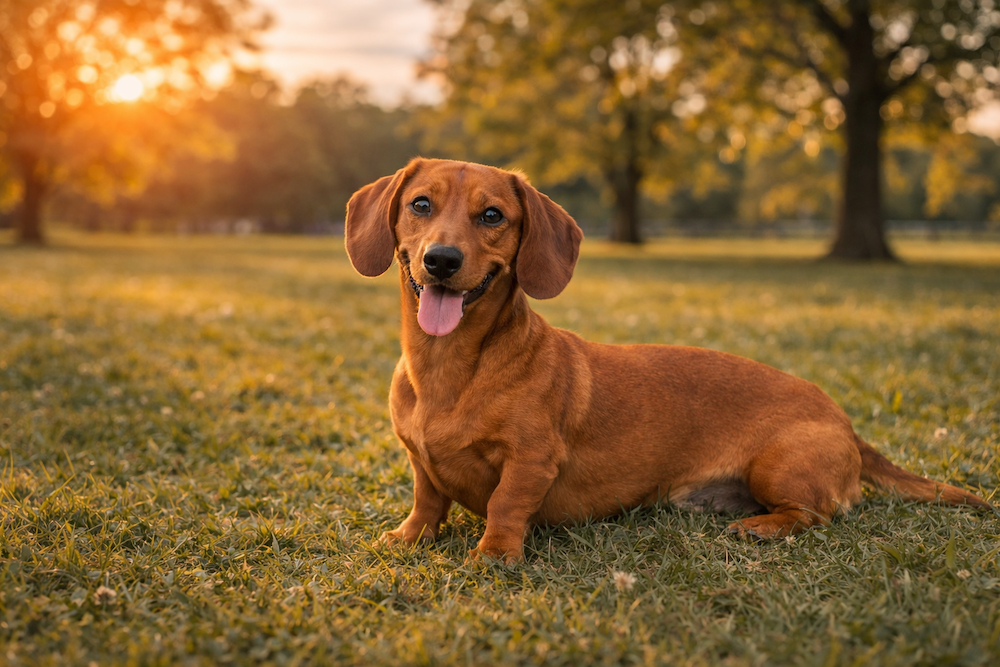
Dachshunds, often called “sausage dogs,” are known for their long bodies and bold personalities. Originally bred for hunting, they are curious, brave, and surprisingly energetic for their size. They make great companions and adapt well to a variety of living environments.
✅ PROS & CONS
Pros
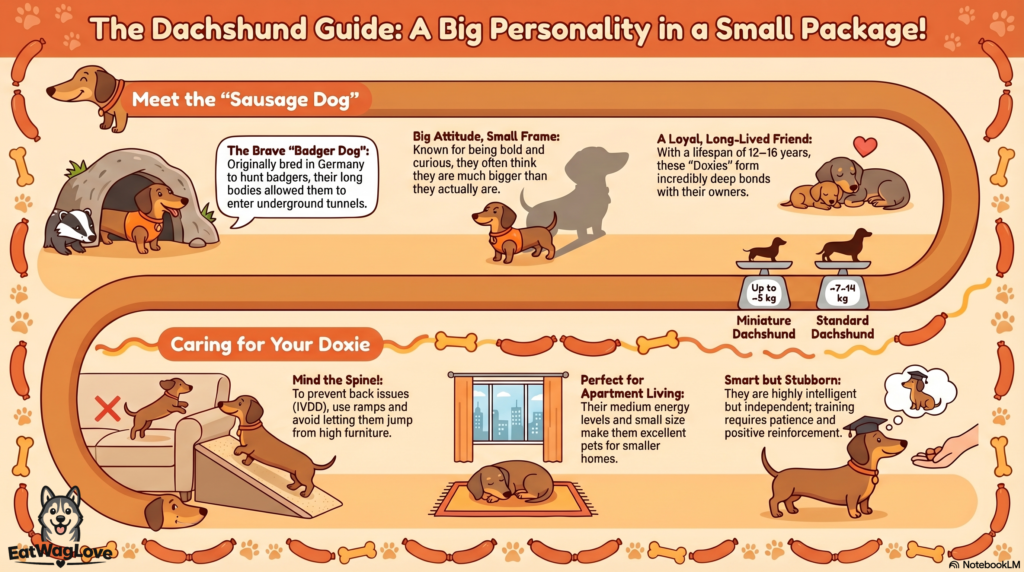
- Small size, great for apartments
- Loyal and affectionate
- Full of personality and fun
Cons
- Can be stubborn and difficult to train
- Prone to back issues due to body shape
- Can bark frequently
Is a Dachshund a Good Family Dog?
Yes. Dachshunds can be excellent family dogs for households that understand their bold personality and unusual body structure.
They’re affectionate, entertaining and often extremely devoted to their families. Many enjoy children, although interactions with young children should be supervised because rough handling can injure their long backs.
Despite their size, Dachshunds aren’t delicate lap dogs by temperament. They were developed as determined hunting dogs and can be surprisingly fearless, independent and stubborn.
How Much Exercise Does a Dachshund Need?
Most adult Dachshunds need around 45–60 minutes of daily exercise, depending on age, size and health.
Regular walking helps maintain muscle strength and, importantly, prevents obesity.
Dachshunds shouldn’t be encouraged to perform excessive repetitive jumping, particularly from furniture, because their long backs are vulnerable to spinal problems.
Exercise is important — wrapping a healthy Dachshund in cotton wool isn’t the answer either.
Is a Dachshund Easy to Train?
Dachshunds are intelligent but famously independent.
They were bred to pursue animals underground where they had to make decisions without constant instructions from a handler.
Positive reinforcement and consistency work best.
House training can sometimes require additional patience, particularly when the weather outside doesn’t meet the Dachshund’s personal standards.
Does a Dachshund Shed?
Yes. All three Dachshund coat varieties shed, although the amount and grooming requirements differ.
Smooth Dachshunds have short coats but still shed.
Longhaired Dachshunds require more brushing to prevent tangles.
Wirehaired Dachshunds have a harsher coat traditionally maintained through hand stripping.
None is genuinely non-shedding.
Is a Dachshund Hypoallergenic?
No. Dachshunds aren’t considered hypoallergenic dogs.
Even relatively low-shedding individuals produce allergens through saliva, dander and skin secretions.
Wirehaired Dachshunds may release less visible hair than some Smooth Dachshunds, but this doesn’t make them allergen-free.
What Health Problems Are Common in Dachshunds?
The most important health concern in Dachshunds is intervertebral disc disease (IVDD).
Their characteristic long body and short legs result from chondrodystrophic genetics that also affect the intervertebral discs.
Other potential problems include patellar luxation, eye disorders, dental disease, obesity and some coat- or variety-specific inherited conditions.
Maintaining a lean body weight is particularly important.
Why Are Dachshunds So Prone to Back Problems?
Dachshunds have a form of disproportionate dwarfism known as chondrodysplasia, producing shortened legs while retaining a relatively long body.
The same underlying biology is associated with early degeneration of the discs between the vertebrae.
Those discs can rupture or herniate, compressing the spinal cord.
This is why IVDD is taken so seriously in the breed.
What Is IVDD in Dachshunds?
Intervertebral disc disease (IVDD) occurs when one or more discs between the vertebrae degenerate and may bulge or rupture.
This can cause pain, weakness, difficulty walking or, in severe cases, paralysis.
Sudden back pain, reluctance to move, wobbliness, dragging limbs or loss of bladder control requires urgent veterinary attention.
Rapid treatment can make an enormous difference to the outcome.
Should Dachshunds Be Allowed to Jump on Furniture?
Repeated jumping from high furniture can place unnecessary stress on a Dachshund’s spine and joints.
Ramps or carefully designed steps can reduce repeated high-impact jumping.
However, owners shouldn’t conclude that Dachshunds should never exercise normally.
Good muscle condition and appropriate activity are important for supporting the spine.
The goal is sensible risk reduction, not creating a dog that never moves.
Can Dachshunds Climb Stairs?
Healthy Dachshunds can often manage stairs, but frequent steep stair climbing should be approached cautiously, particularly in dogs with existing spinal or mobility problems.
Preventing uncontrolled racing up and down stairs may be sensible.
Individual advice from a veterinarian is especially important following an IVDD episode.
How Long Do Dachshunds Live?
Dachshunds commonly live around 12–16 years.
Many remain lively well into their senior years.
Genetics, body weight, dental health, exercise and spinal health all influence longevity.
Their relatively long potential lifespan means a Dachshund puppy can easily become a companion for well over a decade.
How Big Does a Dachshund Get?
Size depends on the variety and kennel-club standard.
Standard Dachshunds commonly weigh around 7–14 kg, while Miniature Dachshunds are considerably smaller.
Some registries classify Dachshunds according to weight, while others use chest circumference.
Because terminology varies internationally, “Miniature” doesn’t always mean exactly the same measurement everywhere.
What Is a Miniature Dachshund?
A Miniature Dachshund is a smaller recognised size of Dachshund.
It isn’t simply the smallest puppy from a Standard Dachshund litter.
Depending on the kennel organisation, classification may be based on weight or chest circumference.
Miniatures retain the same characteristic elongated body, short legs and hunting-dog personality as their larger relatives.
Is There Such a Thing as a Teacup Dachshund?
“Teacup Dachshund” isn’t an officially recognised Dachshund size.
It’s primarily a marketing term for an unusually small dog.
Deliberately breeding for extreme miniaturisation can increase risks including fragile bones, dental crowding and other health problems.
A healthy, correctly structured Miniature Dachshund is a better goal than simply producing the smallest possible dog.
What Is a Kaninchen Dachshund?
Kaninchen is a recognised size classification in some international Dachshund standards.
The German word Kaninchen means rabbit.
These very small Dachshunds were associated with hunting rabbits and are typically classified using chest circumference rather than simply body weight.
The category isn’t formally recognised by every kennel club worldwide.
Can a Dachshund Live in an Apartment?
Yes. Dachshunds can be excellent apartment dogs if they receive enough exercise.
Their compact size is useful.
Their voice can be considerably less compact.
Dachshunds were bred to alert hunters and can be extremely enthusiastic barkers, so noise training is particularly important in apartments.
Can a Dachshund Be Left Alone?
Adult Dachshunds can learn to spend reasonable periods alone, but many form very strong attachments to their owners.
Some develop separation-related behaviour.
Gradual independence training from puppyhood can help.
A bored Dachshund may bark, dig, chew or begin its own investigation into the structural integrity of your furniture.
Do Dachshunds Bark a Lot?
Many Dachshunds are very vocal dogs.
Their surprisingly deep bark made practical sense for a hunting dog working underground or out of sight.
They also make enthusiastic watchdogs and may announce visitors, neighbours, dogs and suspicious leaves.
Training can reduce excessive barking, but expecting complete silence from a Dachshund may be unrealistic.
Why Does Such a Small Dachshund Have Such a Deep Bark?
Dachshunds were developed as working hunting dogs, and hunters needed to locate them when they disappeared into burrows.
A strong, carrying voice was therefore useful.
Their relatively deep chest also contributes to a bark that sounds surprisingly substantial for such a short dog.
Many first-time owners expect a tiny-dog yap and instead discover they’ve purchased a four-legged foghorn.
Are Dachshunds Good With Children?
Dachshunds can be good with respectful children, particularly when raised together.
Children need to understand how to handle them safely and shouldn’t pick them up carelessly or encourage rough jumping games.
Some Dachshunds can also be possessive or intolerant of rough handling.
Supervision protects both the child and the dog’s vulnerable back.
Are Dachshunds Good With Other Dogs?
Dachshunds can be very sociable with other dogs when properly socialised.
Many particularly enjoy other Dachshunds.
Their confidence can occasionally exceed their physical size, and some have absolutely no hesitation about challenging much larger dogs.
Early socialisation and sensible supervision are therefore valuable.
Are Dachshunds Good With Cats?
Dachshunds can live successfully with cats, especially when introduced while young.
However, they’re hunting dogs with potentially strong prey drive.
A familiar household cat may become part of the family while an unfamiliar cat running outdoors can trigger pursuit.
Individual temperament makes a substantial difference.
Do Dachshunds Have a Strong Prey Drive?
Yes. Dachshunds can have a very strong prey drive.
They were deliberately developed to hunt animals underground and follow scent trails.
Rabbits, rodents and other small animals can trigger intense interest.
This instinct is one reason reliable recall can be challenging.
Can Dachshunds Be Trusted Off Leash?
Some well-trained Dachshunds develop good recall, but their powerful scenting and hunting instincts can make off-leash reliability difficult.
Once an interesting scent appears, centuries of selective breeding may suddenly become more persuasive than their owner’s voice.
Secure fenced areas are generally safest for unrestricted running.
Why Do Dachshunds Dig So Much?
Digging is deeply connected to the Dachshund’s original hunting role.
They were bred to pursue animals into underground dens and burrows.
Powerful front feet and determined digging were useful working characteristics.
Providing an appropriate digging area can give enthusiastic individuals an acceptable outlet for behaviour they were specifically designed to perform.
Why Do Dachshunds Burrow Under Blankets?
Many Dachshunds love burrowing beneath blankets, cushions and bedding.
Part of the behaviour may reflect their history of entering underground animal dens.
Warmth and security also make enclosed spaces appealing.
Whatever the reason, many Dachshund owners eventually learn to check underneath every blanket before sitting down.
Why Does My Dachshund Follow Me Everywhere?
Dachshunds often form extremely strong bonds with their owners.
Although independent while hunting, they also worked closely with humans and became popular companion dogs.
Following an owner around the house can therefore be completely normal.
However, dogs should still learn to relax independently to reduce the risk of separation-related problems.
Are Dachshunds Cuddly?
Many Dachshunds are extremely affectionate and cuddly with their favourite people.
Some become dedicated lap dogs whenever they aren’t exploring, barking or investigating suspicious smells.
Others are more independent.
Their combination of fierce hunting-dog confidence and desire to sleep under a blanket beside their owner is one of the breed’s great contradictions.
Why Are Dachshunds So Stubborn?
What owners call stubbornness is partly a consequence of selective breeding for independent problem-solving.
A Dachshund underground confronting dangerous prey couldn’t constantly wait for instructions.
It needed confidence and persistence.
Those characteristics remain in the modern breed.
The Dachshund isn’t necessarily failing to understand what you’re asking. Sometimes it has understood perfectly and is reviewing whether your proposal deserves approval.
Are Dachshunds Aggressive?
Dachshunds aren’t inherently destined to be aggressive, but they can be bold, territorial, vocal and highly confident.
Fear, poor socialisation, pain and inappropriate handling can contribute to aggression in any dog.
Back pain is particularly important to consider if a normally tolerant Dachshund suddenly becomes defensive about being touched.
Small size shouldn’t be used as an excuse to ignore training or behavioural problems.
Were Dachshunds Really Bred to Hunt Badgers?
Yes. Dachshunds were famously developed in Germany to hunt badgers and other burrowing animals.
Their elongated bodies and short legs allowed them to enter underground tunnels.
They needed tremendous courage because a cornered badger is an extremely formidable opponent.
The modern Dachshund’s confidence makes considerably more sense once you understand the job its ancestors were expected to perform.
What Does the Word “Dachshund” Mean?
Dachshund is German for “badger dog.”
Dachs means badger and Hund means dog.
The name describes the breed’s original function with unusual precision.
Rather than being named after its appearance, the Dachshund is essentially named after the animal it was designed to pursue.
How Do You Pronounce Dachshund?
In German, Dachshund is pronounced much closer to “DAHKS-hoont” than the common English pronunciation “dash-hound.”
The German Dachs means badger and Hund means dog.
English-speaking countries have developed several everyday pronunciations, so hearing “dash-hund” or “dash-hound” is extremely common.
Why Are Dachshunds Called Sausage Dogs?
Their long bodies and short legs naturally invite comparisons with sausages.
“Sausage dog” is particularly common in Britain and Australia.
“Wiener dog” is more common in North America.
Neither is the official breed name, although both have arguably become almost as recognisable as Dachshund itself.
Why Are Dachshunds Called Wiener Dogs?
“Wiener dog” refers to the Dachshund’s resemblance to a long sausage.
The nickname became especially popular in the United States.
Interestingly, the relationship between Dachshunds and sausages runs both ways historically: long sausages have also been described using Dachshund-related terminology.
Few breeds have become quite so permanently associated with lunch.
Are There Three Types of Dachshund Coat?
Yes. Dachshunds occur in three recognised coat varieties:
Smooth
Longhaired
Wirehaired
Each has a distinct appearance and grooming requirement.
The different coats also reflect aspects of the breed’s historical development, with other breeds believed to have contributed to the Longhaired and Wirehaired varieties.
What Is a Smooth Dachshund?
The Smooth Dachshund has a short, sleek coat lying close to the body.
It’s the classic appearance many people associate with the breed.
Smooth coats require relatively little grooming but still shed.
The Smooth variety is generally considered closest to the earliest established Dachshund type.
What Is a Longhaired Dachshund?
Longhaired Dachshunds have soft, flowing coats with feathering around the ears, chest, underside, legs and tail.
Historical development probably involved crossing Dachshund-type dogs with long-coated sporting or spaniel-type dogs.
The exact ancestry isn’t completely documented.
Their coat requires more brushing than the Smooth variety.
What Is a Wirehaired Dachshund?
Wirehaired Dachshunds have a harsh outer coat, beard and distinctive eyebrows.
They were developed later than Smooth Dachshunds and probably received influence from wire-coated terrier and pinscher-type dogs.
The rough coat provided additional protection when working through difficult vegetation.
Traditional coat maintenance involves hand stripping.
Do the Three Dachshund Coat Types Have Different Personalities?
There can be general temperament tendencies, but coat type doesn’t determine an individual dog’s personality.
Wirehaired Dachshunds are sometimes described as more terrier-like and energetic.
Longhaired Dachshunds are often described as somewhat softer in temperament.
Smooths are frequently considered the classic bold Dachshund personality.
Breeding line, socialisation and individual genetics matter far more than stereotypes.
What Colours Can Dachshunds Be?
Dachshunds occur in numerous colours and patterns, depending on kennel-club standards.
Common colours include red, black and tan, chocolate and tan, and cream, with patterns such as dapple, brindle and piebald appearing in some populations.
Not every marketed colour is accepted by responsible breed organisations.
Some fashionable colour combinations can also be associated with health concerns or questionable breeding practices.
What Is a Dapple Dachshund?
A Dapple Dachshund carries the merle pattern, known as dapple within the breed.
This creates irregular lighter areas within the base coat.
Dapple can produce striking dogs, but responsible breeding is critical.
A single copy of the merle gene generally produces the pattern without the major risks associated with inheriting two copies.
What Is a Double Dapple Dachshund?
A Double Dapple Dachshund results when a puppy inherits merle/dapple genetics from both parents.
This dramatically increases the risk of serious developmental abnormalities, particularly involving the eyes and hearing.
Affected puppies may be deaf, visually impaired or born with malformed eyes.
Dapple-to-dapple matings should therefore be avoided.
What Is a Piebald Dachshund?
Piebald Dachshunds have white spotting produced by different genetics from dapple/merle.
They may have large areas of white combined with another coat colour.
Piebald and dapple shouldn’t be confused simply because both can create visually patterned coats.
Understanding the underlying genetics is particularly important when breeding.
What Is an Isabella Dachshund?
“Isabella” generally describes a diluted chocolate colour, producing a pale fawn or greyish-brown appearance.
The colour results from dilution genetics.
Dogs bred heavily for unusual dilute colours can be at increased risk of coat and skin problems such as colour dilution alopecia in susceptible lines.
Health should always take priority over producing fashionable colours.
What Is an English Cream Dachshund?
“English Cream” usually refers to certain cream-coloured Longhaired Dachshunds descended from British lines.
The term has become heavily used in marketing.
Not every pale cream Dachshund is necessarily an authentic English Cream from established lines.
Colour shouldn’t be treated as more important than health, temperament and responsible breeding.
Why Do Dachshunds Have Such Long Bodies?
Their elongated bodies were deliberately selected for working underground.
A long, narrow dog could follow quarry through tunnels that larger hunting dogs couldn’t enter.
The short legs kept the body close to the ground while powerful forequarters helped with digging.
The famous Dachshund silhouette therefore originated from function rather than appearance.
Why Do Dachshunds Have Such Big Feet?
Dachshunds have strong front feet adapted for digging.
Their paws can appear disproportionately large compared with their short legs.
This made sense for a dog expected to excavate earth while pursuing animals underground.
Even modern companion Dachshunds can demonstrate surprisingly enthusiastic digging ability when given the opportunity.
Why Do Dachshunds Have a Deep Chest?
The Dachshund’s prominent chest provides space for the heart and lungs needed for sustained hunting work.
Despite having extremely short legs, a properly built Dachshund should be athletic rather than weak or fragile.
The deep chest also contributes to the breed’s surprisingly powerful bark.
Why Do Dachshunds Have Long Ears?
Long, hanging ears are characteristic of many scent hounds.
They’re traditionally believed to help keep scent close to the dog’s nose while tracking, although claims about exactly how much they improve scenting are difficult to prove experimentally.
They also protect the ear opening to some degree while working through vegetation and underground spaces.
Whatever their original functional value, they became a defining feature of the Dachshund’s appearance.
Are Dachshunds Scent Hounds?
Yes. Dachshunds are classified as scent hounds in many kennel systems.
Their noses are extremely important to their hunting style.
They can track wounded game, follow animals to underground dens and pursue scent trails with remarkable determination.
Scent games can therefore provide excellent mental enrichment for modern pet Dachshunds.
Were Dachshunds Only Used for Badgers?
No. Although badger hunting gave the Dachshund its name, different sizes and types were used to hunt a variety of quarry.
These included rabbits and other burrowing animals.
Larger Dachshunds could also be used for tracking wounded deer and hunting larger game in packs.
The breed was considerably more versatile than its “badger dog” translation suggests.
Did Dachshunds Hunt Wild Boar?
Dachshunds and Dachshund-type dogs have been used in tracking and hunting larger game, including wild boar, particularly as part of organised hunting groups.
They weren’t expected to overpower a boar single-handedly.
Their scenting ability, courage and persistence made them useful for locating and pursuing game.
Again, their short legs shouldn’t be confused with a lack of working ability.
Is the Dachshund Related to the Basset Hound?
Both Dachshunds and Basset Hounds are short-legged scent hounds, but they’re distinct breeds with different histories.
Their similar proportions reflect partly similar functional requirements and related forms of chondrodysplasia.
The Dachshund developed primarily in Germany, while Basset breeds developed in France.
They aren’t simply large and small versions of the same dog.
Is the Dachshund Related to Terriers?
Dachshunds perform work that sounds very terrier-like — entering burrows and confronting quarry — but they’re generally classified as hounds rather than terriers.
Terrier-type dogs probably contributed to the development of the Wirehaired Dachshund.
The Dachshund’s combination of scent-hound tracking and underground hunting makes it somewhat unusual among recognised breeds.
How Old Is the Dachshund Breed?
Dogs resembling short-legged hunting hounds existed for centuries, but the modern Dachshund was developed and standardised primarily in Germany.
Written and illustrated references become increasingly recognisable from the early modern period onward.
Formal breed standards and organised breeding emerged much later in the 19th century.
Claims that modern Dachshunds existed unchanged in ancient Egypt are not supported by convincing evidence.
Did Dachshunds Come From Ancient Egypt?
Images of short-legged dogs appear in ancient Egyptian art, but there is no strong evidence that these animals were Dachshunds or direct ancestors of the modern breed.
Similar body shapes can develop independently in different dog populations.
The documented Dachshund breed developed much later in Europe, particularly Germany.
The Egyptian origin story is therefore more romantic than historically convincing.
Why Is the Dachshund Associated With Germany?
Germany is where the Dachshund was developed into the recognisable hunting breed we know today.
Its German name, hunting purpose and formal breed development all reflect this heritage.
Dachshunds became important dogs for hunters because they could work both above and below ground.
Their German identity eventually became so strong that it caused problems for the breed during wartime.
Were Dachshunds Unpopular During World War I?
Yes. Dachshunds became strongly associated with Germany during the First World War, particularly in Britain and the United States.
Anti-German sentiment affected the breed’s popularity.
Dachshunds were even used in wartime propaganda and political cartoons as symbols of Germany.
Some owners reportedly used alternative descriptions such as “badger dog” to distance their pets from German associations.
Did Dachshunds Become Unpopular Again During World War II?
The breed again faced some anti-German sentiment during the Second World War, although Dachshunds ultimately recovered strongly.
Their appeal as companion dogs eventually outweighed their political symbolism.
Today they’re among the world’s most recognisable breeds.
It is a remarkable example of how human politics can temporarily affect the reputation of an animal that obviously has no opinion whatsoever about international affairs.
Was the Dachshund the First Olympic Mascot?
Yes. A colourful Dachshund named Waldi became the official mascot of the 1972 Munich Olympic Games.
Waldi is widely recognised as the first official Olympic mascot.
The Dachshund was chosen because characteristics such as endurance, tenacity and agility were considered appropriate for athletes.
Waldi’s multicoloured design became one of the most memorable images of the Munich Games.
Why Was a Dachshund Chosen as the Munich Olympic Mascot?
The Dachshund represented qualities including persistence, agility and endurance, while also being unmistakably German.
The 1972 Munich Games were designed with a colourful visual identity, and Waldi was created in bright colours rather than realistic Dachshund shades.
Even the marathon route was reportedly designed with a resemblance to Waldi’s shape.
Few dogs have ever influenced urban sporting geography quite so directly.
Did Pablo Picasso Own a Dachshund?
Yes. Pablo Picasso had a famous Dachshund named Lump.
Lump originally belonged to photographer David Douglas Duncan but formed an immediate attachment to Picasso and effectively stayed with him.
Picasso incorporated Lump into several works.
The little Dachshund became one of the most famous canine companions in modern art history.
Did Andy Warhol Own Dachshunds?
Yes. Andy Warhol owned Dachshunds, including Archie and Amos.
Archie in particular accompanied Warhol frequently and became part of his public life.
Warhol also produced artwork featuring Dachshunds.
The breed’s distinctive shape has made it unusually popular with artists, designers and photographers.
Why Are Dachshunds So Popular in Art and Advertising?
Few dogs have a silhouette as instantly recognisable as the Dachshund.
Its extraordinarily long body, tiny legs, long ears and confident expression make it visually distinctive.
Artists have used Dachshunds in paintings, sculpture, cartoons, advertising and product design for generations.
The same body shape originally created for crawling underground eventually turned the breed into a design icon.
Where Does the Dachshund Come From?
The Dachshund comes from Germany, where it was developed as a determined hunting dog capable of tracking quarry and entering underground dens.
Its name literally describes its most famous job: Dachs — badger, Hund — dog.
Different sizes and coat types eventually developed for different hunting conditions and quarry.
Today the Dachshund is often pictured wrapped in a blanket or being carried around like a tiny companion dog, but underneath that famous sausage-shaped body remains the personality of a remarkably courageous hunter — a dog bred to disappear underground and argue with a badger on its own territory.