
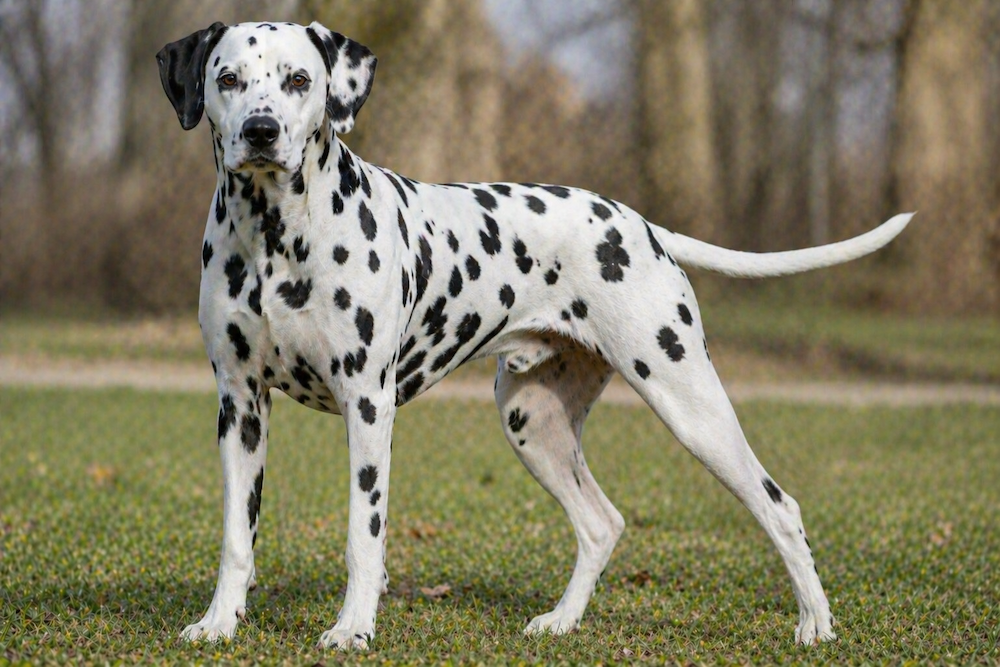







Energetic, distinctive, and full of personality — a striking companion built for movement and attention.
🧠 QUICK SNAPSHOT
- Temperament: Energetic, outgoing, intelligent
- Energy Level: Very high
- Size: Medium to large
- Good With Families: Yes
- Trainability: Moderate to high
- Grooming: Low (but sheds)
- Best For: Active owners and engaged households
📚 OVERVIEW
The Dalmatian is one of the most recognisable breeds in the world, known for its unique spotted coat and high energy levels. Originally bred as a carriage dog, they have strong endurance and love to run.
They are playful, intelligent, and thrive in active environments where they can stay mentally and physically engaged.
✅ PROS & CONS
Pros
- Unique and eye-catching appearance
- Energetic and playful
- Loyal and engaging
- Low grooming needs
Cons
- Very high exercise requirements
- Can be strong-willed
- Sheds more than expected
- Needs ongoing stimulation
Is a Dalmatian a Good Family Dog?
Yes. A well-bred and properly socialised Dalmatian can be an excellent family dog, particularly for an active household.
Dalmatians are affectionate, playful and often strongly attached to their families. They’re also energetic, intelligent and physically powerful, so they aren’t necessarily the easiest choice for every home.
Their enthusiasm can overwhelm very young children, while boredom can lead to destructive behaviour. A Dalmatian usually thrives with a family that wants the dog actively involved in everyday life.
How Much Exercise Does a Dalmatian Need?
Most adult Dalmatians need around 90 minutes to two hours of exercise each day, with some individuals happily doing considerably more.
This is an athletic breed historically expected to travel long distances alongside horses and carriages.
Running, hiking, scent work, training and structured dog sports can all provide useful outlets.
Mental exercise matters too. A physically fit Dalmatian with nothing interesting to do can become extraordinarily creative about finding its own entertainment.
Is a Dalmatian Easy to Train?
Dalmatians are highly intelligent and capable of learning quickly, but they can also be independent and sensitive.
Positive reinforcement and consistency usually produce the best results.
Harsh training can damage trust without improving performance.
Their intelligence means they learn undesirable behaviours just as efficiently as desirable ones, so training should begin early.
Does a Dalmatian Shed?
Yes — and often far more than people expect.
The Dalmatian’s coat is short, but it sheds throughout much of the year. The small, stiff hairs can become embedded in clothing, furniture and carpets.
Regular brushing helps remove loose hair.
Anyone choosing a Dalmatian because its short coat appears maintenance-free may receive a surprisingly spotty education in shedding.
Is a Dalmatian Hypoallergenic?
No. Dalmatians aren’t considered hypoallergenic.
They shed regularly and produce allergens through skin, saliva and dander.
Their short coat can actually make shed hairs particularly noticeable because the stiff hairs work their way into upholstery and fabrics.
What Health Problems Are Common in Dalmatians?
Important health concerns include deafness, urinary stone formation, hip dysplasia and certain eye and skin conditions.
The breed’s unusual uric-acid metabolism makes urinary health particularly important.
Responsible breeders should perform appropriate health screening, including hearing tests on puppies.
Diet and hydration may also require particular attention throughout the dog’s life.
Why Are Dalmatians Prone to Deafness?
Congenital deafness in Dalmatians is associated with the genetics underlying their extreme white spotting and pigmentation.
Pigment-producing cells have important functions within the inner ear. When those cells are absent from critical structures, hearing can be affected.
A Dalmatian can be deaf in one ear or both.
This is why visual assessment isn’t sufficient — a puppy hearing normally on one side may appear completely unaffected.
What Is a BAER Test for Dalmatians?
A BAER test — Brainstem Auditory Evoked Response — objectively measures a dog’s hearing.
Small electrodes detect electrical activity produced by the auditory pathway in response to sound.
Each ear can be tested independently.
BAER testing is particularly important in Dalmatians because it can identify puppies that are unilaterally deaf as well as those that are bilaterally deaf.
Can a Deaf Dalmatian Still Be a Good Pet?
Yes. A deaf Dalmatian can potentially live a happy and fulfilling life with an appropriately prepared owner.
Training can use hand signals, visual cues and other forms of communication.
However, deaf dogs require additional safety management because they can’t hear approaching traffic, people or animals.
The individual dog’s temperament and the owner’s experience are important considerations.
Why Do Dalmatians Get Urinary Stones?
Most Dalmatians have a genetic difference affecting the way their bodies process uric acid.
Instead of converting as much uric acid into the more soluble allantoin, they excrete relatively high levels of uric acid in their urine.
This increases the risk of urate bladder and urinary stones.
Good hydration, appropriate nutrition and veterinary monitoring can therefore be especially important.
Do Dalmatians Need a Special Diet?
Some Dalmatians benefit from dietary management designed to reduce the risk of urate stones, particularly dogs with a previous urinary problem.
This can involve controlling dietary purines and encouraging excellent water intake.
However, owners shouldn’t create an excessively restrictive homemade diet without veterinary guidance.
An individual dog’s nutritional requirements and medical history should determine the feeding plan.
What Is a LUA Dalmatian?
LUA means Low Uric Acid.
Most Dalmatians carry the genetic variant responsible for high urinary uric acid. LUA Dalmatians carry a normal version of the relevant gene introduced through a carefully managed historical outcross.
As a result, they process uric acid more like most other dogs and have a much lower risk of urate stone formation.
Why Were Dalmatians Crossed With Pointers?
In 1973, geneticist Dr Robert Schaible crossed a Dalmatian with a Pointer as part of a project designed to restore normal uric-acid metabolism.
The descendants were repeatedly bred back to Dalmatians while retaining the normal gene.
After many generations, the resulting LUA dogs were overwhelmingly Dalmatian genetically and physically while carrying the beneficial normal uric-acid allele.
The project became one of the most fascinating examples of a deliberate genetic outcross used to address an inherited breed-wide health problem.
Are LUA Dalmatians Still Dalmatians?
Yes. LUA Dalmatians descended from the historical Dalmatian-Pointer backcross project have been accepted within recognised Dalmatian populations under various kennel-club arrangements.
After generations of backcrossing, they are overwhelmingly Dalmatian while carrying the normal uric-acid gene originally introduced from the Pointer.
The project also sparked decades of debate about pedigree purity versus genetic health.
How Long Do Dalmatians Live?
Dalmatians commonly live around 11–13 years, although individuals can live longer.
Good breeding, appropriate exercise, healthy body weight, urinary management and preventive veterinary care all influence longevity.
Because Dalmatians are highly active dogs, maintaining good mobility and muscle condition throughout adulthood is particularly valuable.
How Big Does a Dalmatian Get?
Adult Dalmatians generally stand around 54–61 cm at the shoulder and commonly weigh roughly 20–32 kg, depending on sex, build and individual genetics.
They’re medium-to-large dogs but should appear athletic rather than heavy.
The breed was developed for endurance, and a correctly conditioned Dalmatian should look capable of travelling substantial distances.
Can a Dalmatian Live in an Apartment?
A Dalmatian can live in an apartment, but only if its considerable exercise and mental-stimulation needs are consistently met.
Size isn’t the biggest issue — energy is.
A well-exercised Dalmatian may settle comfortably indoors.
An under-exercised Dalmatian in a small apartment can become noisy, restless and destructive very quickly.
Can a Dalmatian Be Left Alone?
Adult Dalmatians can learn to spend reasonable periods alone, but many are strongly attached to their families.
They were historically expected to work closely alongside horses and people, and modern Dalmatians often want to be involved in everything.
Long periods of isolation can contribute to boredom, barking, destructive behaviour or separation distress.
Independence should be taught gradually.
Do Dalmatians Bark a Lot?
Dalmatians aren’t necessarily constant barkers, but they can be alert and vocal watchdogs.
Historically, carriage dogs had a role in guarding horses, vehicles and property.
Individual barking levels vary.
Adequate exercise and training can help prevent boredom-related barking.
Are Dalmatians Good With Children?
Dalmatians can be excellent with children when properly socialised and respectfully handled.
However, they’re energetic, muscular dogs and can accidentally knock over small children during enthusiastic play.
Supervision is important.
Children should also be taught not to disturb dogs while eating, sleeping or attempting to escape interaction.
Are Dalmatians Good With Other Dogs?
Many Dalmatians are sociable with other dogs, especially when well socialised from puppyhood.
Individual temperament matters.
Their energetic play style can sometimes be too intense for quieter dogs.
Positive early experiences with dogs of different sizes and personalities can help develop appropriate social skills.
Are Dalmatians Good With Cats?
Dalmatians can live successfully with cats, particularly when raised with them.
Some individuals have stronger chase instincts than others.
Careful introductions and supervision are therefore important.
A Dalmatian accepting the family cat doesn’t automatically mean it will ignore unfamiliar cats running outdoors.
Do Dalmatians Have a Strong Prey Drive?
Dalmatians can have a moderate prey or chase drive, but they weren’t primarily developed as specialised hunting dogs.
Historically, their work centred more heavily around horses, carriages, guarding and endurance.
Individual dogs may still enthusiastically chase wildlife.
Early recall training is worthwhile.
Are Dalmatians Good Running Dogs?
Yes. Healthy adult Dalmatians can be exceptional running companions.
Endurance is deeply embedded in their history as carriage dogs expected to trot beside horses over substantial distances.
Running should be introduced gradually after physical maturity.
Hot weather, hard surfaces and individual joint health also need consideration.
Why Do Dalmatians Have So Much Energy?
Their high energy makes perfect sense when you understand their original work.
Dalmatians were expected to travel alongside horse-drawn carriages for kilometres at a time, sometimes day after day.
They weren’t developed to spend most of their lives sleeping on a sofa.
Modern Dalmatians retain much of that endurance even though the carriage has disappeared.
Why Were Dalmatians Used as Carriage Dogs?
Dalmatians developed a remarkable association with horses and horse-drawn vehicles.
They could run alongside or beneath carriages, help keep other animals away from the horses and guard the carriage and its contents when stopped.
Their stamina, intelligence and natural affinity with horses made them particularly suited to the role.
This became so strongly associated with the breed that the Dalmatian was sometimes simply called a Coach Dog or Carriage Dog.
Why Did Dalmatians Run Under Carriages?
Dalmatians could run beside, behind or beneath carriage axles, depending on the dog, vehicle and training.
Running close to the carriage helped keep them positioned with the horses and vehicle.
Their endurance allowed them to maintain a steady pace for long journeys.
Carriage-dog competitions later even tested dogs on their ability to work correctly around horse-drawn vehicles.
Why Are Dalmatians So Good With Horses?
Dalmatians have a historic reputation for having a strong natural affinity with horses.
Generations of selection for carriage work likely reinforced dogs that remained comfortable and controllable around them.
They accompanied horses during travel and often shared stable environments.
Individual modern dogs still require careful introductions, but the breed’s equestrian connection is one of the strongest in canine history.
Why Are Dalmatians Associated With Firefighters?
Before motorised fire engines, fire brigades used horse-drawn fire apparatus.
Dalmatians were already established carriage dogs, so they were a natural fit.
They could run with the horses, help clear the route, guard the horses and equipment at the fire scene and live around the firehouse.
When horses disappeared from firefighting, the Dalmatian remained as an enduring mascot.
Did Dalmatians Really Run in Front of Fire Engines?
During the horse-drawn era, Dalmatians could run alongside or ahead of fire carriages, depending on their training and circumstances.
Popular culture sometimes exaggerates the idea that every Dalmatian always ran ahead specifically to clear traffic.
Their broader value came from being accomplished carriage dogs comfortable working around horses and guarding equipment.
The firefighter connection is nevertheless genuine.
Are Dalmatians Still Firehouse Dogs?
Some fire departments still keep or feature Dalmatians as mascots and ceremonial dogs, although they obviously no longer need to accompany horse-drawn engines.
The association remains particularly strong in the United States.
Dalmatian imagery continues to appear in fire-service memorabilia, education programmes and public events.
A working partnership created by horses survived long after the horses themselves left the firehouse.
Why Are Dalmatians White With Black Spots?
The Dalmatian’s dramatic appearance results from genetic interactions producing a predominantly white coat with pigmented spots.
Puppies are generally born largely white, with the characteristic spots developing afterwards.
The same pigmentation biology contributing to the white background is also connected with the breed’s increased risk of congenital deafness.
The famous coat is therefore both visually remarkable and genetically significant.
Are Dalmatian Puppies Born Without Spots?
Dalmatian puppies are generally born mostly white, although patches may already be visible at birth.
The familiar individual spots begin appearing during the first few weeks of life and continue becoming more obvious as the puppy grows.
A newborn litter therefore looks surprisingly different from a group of adult Dalmatians.
When Do Dalmatian Puppies Get Their Spots?
Dalmatian spots usually begin becoming clearly visible within the first few weeks after birth.
More spots can become apparent as the coat develops.
Pigmentation in the skin may already exist before it becomes obvious through the puppy coat.
Their transformation from mostly white newborns into unmistakably spotted dogs happens remarkably quickly.
Does Every Dalmatian Have a Unique Spot Pattern?
Yes. Each Dalmatian’s arrangement of spots is effectively unique, much like an individual pattern.
Spot size, distribution and density vary between dogs.
Even genetically related Dalmatians don’t develop identical patterns.
This individuality is one reason the breed is so visually distinctive.
Can Dalmatians Have Brown Spots?
Yes. Dalmatians can have liver-coloured spots, which appear rich brown rather than black.
Liver is an established recognised colour in the breed.
Liver-spotted Dalmatians also have corresponding brown pigmentation on areas such as the nose.
Black and liver are the two classic Dalmatian spot colours.
Can Dalmatians Have Other Coloured Spots?
Other colours and combinations can occur genetically, including lemon, orange, blue-grey or brindle-related markings, but these aren’t accepted as standard colours by many major kennel organisations.
Some unusual colours may indicate combinations of recessive genes or non-standard breeding.
A rare colour shouldn’t automatically be treated as more valuable.
Health and temperament matter far more than novelty pigmentation.
What Is a Dalmatian Patch?
A patch is a larger solid area of pigmentation present from birth, unlike ordinary spots that emerge after birth.
Patches commonly occur around the ears, eyes or other parts of the body.
Traditional conformation standards may regard patches as undesirable for showing.
They don’t make the dog any less capable of being a healthy and wonderful companion.
Do Dalmatians Have Spots on Their Skin Too?
Yes. Pigmentation can often be visible on the skin beneath the coat.
The exact appearance depends on the individual dog.
This becomes particularly noticeable on areas where the coat is thin or wet.
The Dalmatian isn’t simply a white dog with little pieces of black hair randomly sprinkled on top.
Why Do Dalmatians Sometimes Have Blue Eyes?
Blue eyes can occur in Dalmatians because of pigmentation genetics.
One or both eyes may be blue.
Blue eyes themselves don’t necessarily cause deafness, but both traits can be associated with reduced pigmentation, meaning statistical associations between blue eyes and congenital deafness have been observed in Dalmatian populations.
Hearing should be determined with BAER testing rather than eye colour.
Why Do Dalmatians Smile?
Some Dalmatians perform a distinctive submissive or appeasement grin, pulling their lips back and exposing their teeth.
To someone unfamiliar with canine body language, this can look alarmingly like a snarl.
Context is critical.
A relaxed body, wagging tail and friendly approach can indicate an appeasement grin, whereas stiff posture and threatening behaviour mean something very different.
Do Dalmatians Like Water?
Many Dalmatians enjoy swimming and playing in water, although it isn’t universal.
They’re athletic dogs and often enjoy energetic outdoor activities.
Unlike specialised water retrievers, swimming wasn’t the defining purpose of the breed.
Dogs should therefore be introduced gradually and supervised around deep water.
Are Dalmatians Protective?
Dalmatians can be alert and naturally watchful, reflecting their history guarding carriages, horses and property.
Many will readily announce unfamiliar visitors.
They shouldn’t be encouraged towards inappropriate aggression.
A stable Dalmatian should be confident and manageable rather than suspicious of everyone it encounters.
Were Dalmatians Guard Dogs?
Guarding was one component of their historical carriage-dog role.
When a carriage stopped, the dog could remain near the horses and vehicle and discourage theft or interference.
This helps explain why some modern Dalmatians retain strong watchdog instincts.
Their historical job required more than simply running beside a carriage looking decorative.
Where Does the Name Dalmatian Come From?
The breed’s name comes from Dalmatia, a historical coastal region along the eastern Adriatic, much of which lies within modern Croatia.
However, the exact early development of the breed remains surprisingly uncertain.
Dogs resembling spotted Dalmatians appear in historical art from several regions.
The Dalmatian name became firmly established even though its complete origin story remains debated.
Did Dalmatians Really Originate in Croatia?
The breed is officially associated with Croatia and the historical region of Dalmatia, but its deeper ancestry isn’t completely documented.
Spotted dogs resembling Dalmatians appear in artwork and historical descriptions from different parts of Europe and beyond.
The modern breed’s identity became strongly linked with Dalmatia, while Britain played a major role in developing and standardising the carriage dog.
So the answer is more complicated than simply identifying one birthplace.
Is the Dalmatian an Ancient Dog Breed?
Spotted dogs with a Dalmatian-like appearance have existed for many centuries, but proving an uninterrupted pedigree from ancient dogs to today’s Dalmatian is difficult.
Historical paintings and writings show similar dogs long before modern kennel clubs existed.
The modern breed was formalised much more recently.
Claims that every ancient spotted dog was definitely a Dalmatian should therefore be treated cautiously.
Were Dalmatians Ever Called Coach Dogs?
Yes. Coach Dog, Carriage Dog and English Coach Dog are among names historically associated with Dalmatians.
These names reflected their famous working relationship with horse-drawn vehicles.
They were also sometimes associated with stables and horses more broadly.
Few breed nicknames describe a dog’s historical occupation as clearly.
Were Dalmatians Ever Circus Dogs?
Yes. Dalmatians have historically been used as circus and performance dogs.
Their intelligence, athleticism, trainability and striking spotted coats made them naturally eye-catching performers.
Their ability to learn routines and tricks suited travelling shows.
The same qualities that made them useful carriage dogs also made them capable entertainers.
Did Dalmatians Ever Hunt?
Dalmatians have been used for various purposes historically, with references to hunting, guarding and vermin control as well as carriage work.
However, the breed’s defining historical speciality became its relationship with horses and coaches.
It shouldn’t be viewed primarily as a specialised hunting breed like a Pointer or scent hound.
Why Did Dalmatians Become So Popular After 101 Dalmatians?
Disney’s 1961 animated film One Hundred and One Dalmatians introduced the breed to an enormous worldwide audience.
The later live-action film in 1996 generated another surge of interest.
Unfortunately, sudden popularity can encourage impulsive purchases and irresponsible breeding.
Families attracted by the adorable spotted puppies sometimes discovered that the real Dalmatian is an athletic, demanding carriage dog requiring substantial exercise and training.
Are Pongo and Perdita Real Dalmatian Names?
Pongo and Perdita are the famous Dalmatian parents from Dodie Smith’s 1956 novel The Hundred and One Dalmatians and Disney’s adaptations.
They became so strongly associated with the breed that the names remain instantly recognisable decades later.
The fictional dogs helped transform an already distinctive breed into one of the world’s most recognisable canine images.
Was 101 Dalmatians Originally a Book?
Yes. The Hundred and One Dalmatians was originally a 1956 novel by British author Dodie Smith.
Disney adapted the story into its famous animated film in 1961.
Smith herself owned Dalmatians, and her experiences with the breed helped inspire the story.
The enormous cultural impact of the adaptation permanently changed public awareness of Dalmatians.
Did Dodie Smith Really Own Dalmatians?
Yes. Dodie Smith and her husband owned Dalmatians, and the breed played an important role in inspiring her novel.
One of their dogs was named Pongo.
This gives the fictional story a charming real-world connection: one of literature’s most famous Dalmatian characters inherited his name from the author’s actual dog.
Is Cruella de Vil Connected With the Dalmatian’s Real History?
No. Cruella de Vil is a fictional character created by Dodie Smith.
Her infamous plan to turn Dalmatian puppies into fur coats belongs entirely to the story.
However, the character became so culturally famous that Dalmatians and Cruella remain linked in popular culture generations later.
Fortunately, real Dalmatian ownership usually involves considerably less villainy and considerably more vacuuming.
What Is the Difference Between a Dalmatian and a Pointer?
Dalmatians and Pointers are both athletic, short-coated dogs, and the Pointer played a small but historically important role in the LUA Dalmatian project.
However, they’re distinct breeds.
Pointers were specialised as bird-hunting dogs that locate game and indicate its position.
Dalmatians became famous primarily as carriage dogs with strong associations with horses.
Their similar athletic appearance reflects function more than identical ancestry.
Why Is the Dalmatian Such an Unusual Dog Breed?
Few breeds combine such an unusual collection of characteristics.
The Dalmatian has a genetically distinctive spotted coat, a breed-wide tendency towards unusual uric-acid metabolism, an elevated risk of congenital deafness, exceptional endurance and one of the strongest historical relationships with horses of any dog breed.
Add firehouses, Olympic history and 101 Dalmatians, and its cultural history becomes almost as distinctive as its coat.
Where Does the Dalmatian Come From?
The Dalmatian is historically associated with Dalmatia on the Adriatic coast, now largely part of Croatia, although its deeper origins remain debated.
Britain later played an important role in developing the Dalmatian into the celebrated carriage dog that could run beside horses, guard coaches and travel enormous distances.
That working history eventually led directly to its famous relationship with horse-drawn fire engines.
Today most people recognise the Dalmatian because of its spots. But the breed’s real story is even more interesting: beneath those famous black or liver dots is an endurance athlete, horse companion, carriage guardian, firehouse icon and one of the most genetically unusual dogs in the world.